Every school district carries billions of dollars in building assets — HVAC systems, roofing, electrical infrastructure, plumbing networks, and structural components — that deteriorate quietly until they fail visibly. Most districts have no systematic way to measure that deterioration until a roof caves in, a boiler shuts down mid-winter, or a state inspector flags a critical deficiency. A Facility Condition Assessment (FCA) changes that entirely. It gives districts a defensible, scored picture of every asset across every building — and turns capital planning from a political argument into a data-driven decision. Districts using structured FCA frameworks alongside platforms like Oxmaint's asset condition scoring system report cutting emergency repair spending by up to 38% within two budget cycles — because they stop being surprised. Want to stop reacting and start planning? Start a free trial and see what a real FCA framework looks like in practice, or book a demo to walk through it with your team.
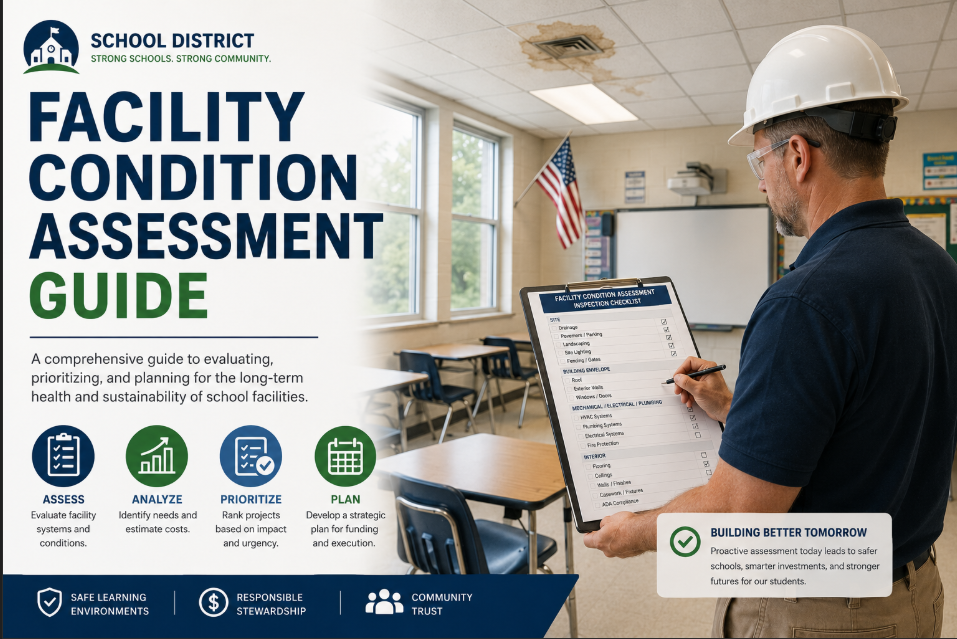
School District Facility Condition Assessment: The Complete Guide
Scoring methodology, asset inventory frameworks, condition benchmarks, and CapEx prioritization — everything a Director of Facilities needs to conduct a credible, board-ready FCA and protect the district's capital investments.
A Structured, Data-Driven Evaluation of Every District Asset
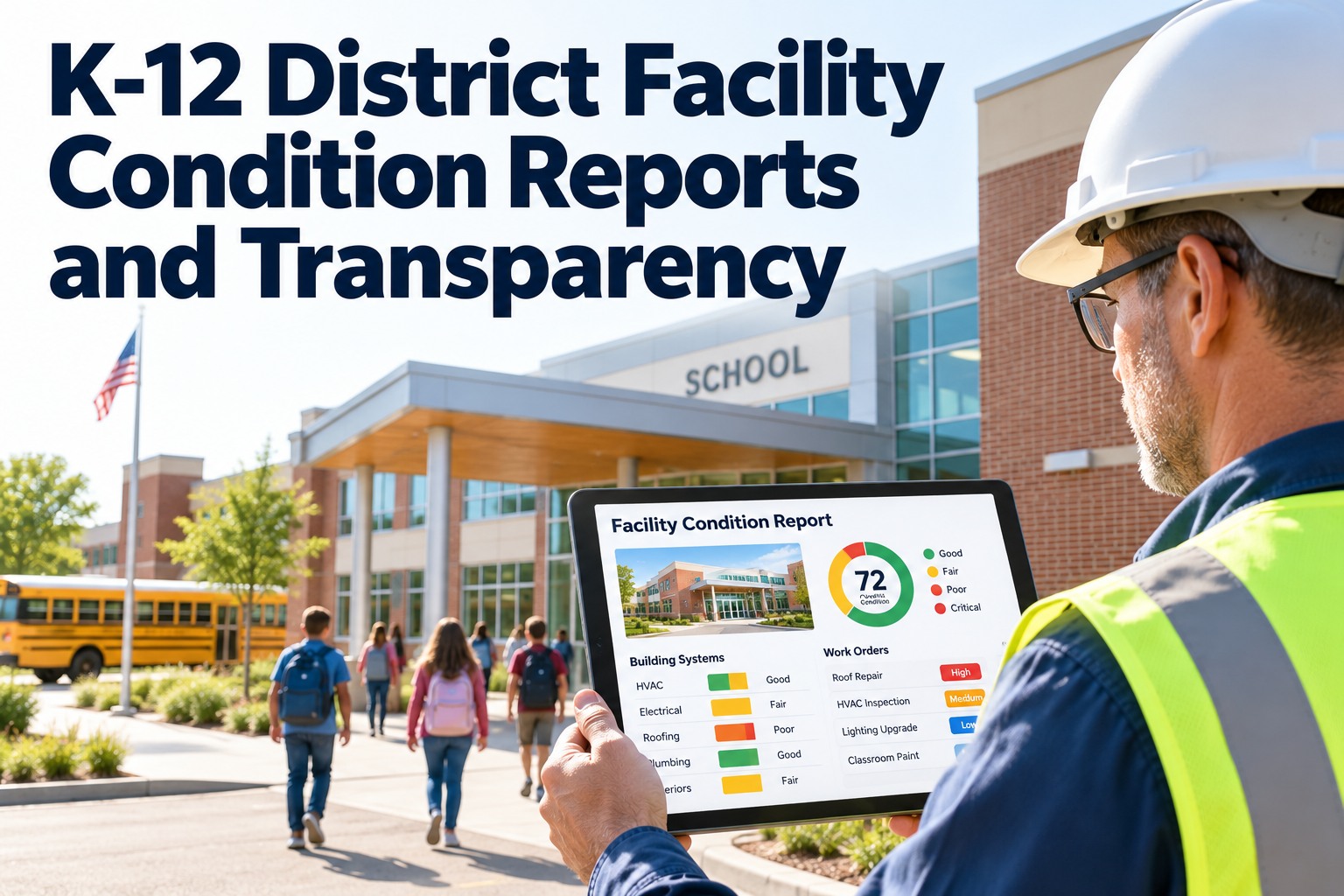
A Facility Condition Assessment (FCA) is a systematic, scored evaluation of every building system and asset across a school district's portfolio — roofing, HVAC, electrical, plumbing, structural, site infrastructure, and interior finishes. It produces a Facility Condition Index (FCI) for each building and each asset, which becomes the single source of truth for capital planning, bond proposals, and budget prioritization.
An FCA answers three questions that districts without one cannot answer: Which buildings are deteriorating fastest? Which systems are closest to failure? And where does every capital dollar have the greatest impact? The National Center for Education Statistics estimates that districts without formal FCA programs spend 22% more per square foot on unplanned repairs than those with structured assessment cycles. If your district is still making capital decisions based on principal complaints and superintendent intuition, a formal FCA is the first step toward credible, defensible planning. Start a free trial to see how digital condition scoring changes the conversation at the board level, or book a demo and walk through a live FCA workflow with our team.
Why Most Districts Are Flying Blind on Facility Condition
These are the systematic gaps that expose districts to budget shocks, safety failures, and failed bond votes — all preventable with a structured FCA program.
Asset records scattered across spreadsheets, binders, and individual building files. No single view of what the district owns, its age, or its condition. Capital decisions made on estimates, not data.
Without scored condition data, deferred maintenance accumulates silently. Districts discover the true backlog only when they commission an FCA — and the number is always larger than expected.
Board and community members reject capital requests that lack supporting data. Without FCI scores and cost documentation, facilities directors cannot defend prioritization decisions credibly.
Emergency repairs consume capital budgets meant for planned improvements. Districts without FCA data cannot forecast which assets will fail next — so every failure is a budget surprise.
Bond proposals without objective condition scoring and documented need fail at the ballot. Voters and oversight bodies demand credible, independent data — not superintendent estimates.
Larger districts manage 20, 50, or 100+ buildings. Without a standardized scoring system, condition data is inconsistent across buildings and impossible to compare at the portfolio level.
The FCA Scoring Framework: Step by Step
A credible FCA follows a structured methodology. Here is the complete framework — from asset inventory to FCI reporting — that districts can apply immediately. Platforms like Oxmaint digitize every step of this process, turning a traditionally paper-heavy exercise into a continuously updated digital record. Book a demo to see the full workflow, or start a free trial and begin building your district's asset registry today.
Catalog every building system and major component: roofing, HVAC, electrical panels, plumbing, flooring, windows, doors, site infrastructure, and technology systems. Record manufacturer, install date, OEM lifespan, and current replacement value.
Trained assessors inspect each asset using a standardized 1–5 condition scale. Score considers visible deterioration, maintenance history, remaining useful life, and performance against OEM specifications.
For each deficient asset, estimate the cost to restore it to acceptable condition. Include labor, materials, contractor fees, and disruption costs. This becomes the deferred maintenance backlog figure used in FCI calculation.
Divide total deferred maintenance cost by current replacement value for each building. Roll up individual FCI scores to produce a district-wide FCI. Buildings above 10% FCI require immediate capital attention.
Rank capital needs by FCI severity, safety risk, regulatory compliance, and enrollment impact. Build a rolling 5–10 year capital investment plan with annual spend targets aligned to budget cycles and bond timelines.
Every completed work order, renovation, and capital project updates the asset's condition score and deferred maintenance figure. The FCA is a living document — not a one-time report that goes stale in six months.
The 5-Point Condition Scoring Scale
Every asset in the district receives a condition score using this standardized scale. Scores are applied consistently across all buildings to enable portfolio-level comparison.
New or recently replaced. No deficiencies. Performing at or above OEM spec. Remaining useful life 90%+ of design life.
Minor wear. Performing adequately with routine PM. Remaining useful life 70–89%. No capital action required in next 3 years.
Visible deterioration. Increased maintenance frequency required. Remaining useful life 40–69%. Capital planning horizon: 3–7 years.
Significant deficiencies affecting performance or safety. Remaining useful life under 40%. Capital action required within 1–3 years.
Failure imminent or already occurring. Safety, code, or operational risk. Immediate capital action required. Potential shutdown risk.
Asset has exceeded design life. Continued operation requires documented risk acceptance. Replacement planning must be active.
Asset Systems Covered in a Complete District FCA
A thorough FCA covers eight major building system categories. Each system has its own replacement cost benchmarks, useful life standards, and condition indicators. Missing any one of these creates a gap in the capital plan.
Membrane, flashing, gutters, drains, insulation. Most common source of water infiltration damage. Replacement cost: $8–$22/sq ft depending on system type.
Air handling units, chillers, boilers, controls, ductwork. Largest energy consumer and IAQ determinant. Replacement cost: $15–$40/sq ft system-wide.
Panels, switchgear, wiring, lighting, emergency systems. Code compliance drives replacement more often than condition failure.
Supply piping, drain systems, fixtures, water heaters, backflow preventers. Lead pipe remediation drives significant unplanned capital need in older buildings.
Foundation, structural frame, load-bearing walls. Highest replacement cost and longest useful life. Condition deficiencies here carry the greatest safety risk.
Flooring, ceilings, partitions, doors, hardware. Lower replacement cost per item but high aggregate volume across a large district portfolio.
Parking, sidewalks, fencing, sports fields, playgrounds, site lighting, stormwater systems. Safety liability driver if condition scoring is absent.
Network infrastructure, cameras, access control, PA systems. Shortest useful life of any system — fastest-cycling capital need in a modern district portfolio.
FCA Done Right vs. FCA Done Wrong
The difference between a credible, board-ready FCA and a document that collects dust on a shelf comes down to methodology, data quality, and continuous updating.
| Assessment Factor | Traditional One-Time FCA | Oxmaint Digital FCA |
|---|---|---|
| Asset Inventory | Compiled manually at assessment time, not updated | Live digital registry updated with every work order |
| Condition Scoring | Point-in-time snapshot, outdated within 12 months | Continuously updated as maintenance history accumulates |
| Cost Documentation | Estimated during assessment, not linked to actual spend | Real labor and parts costs attached to every asset |
| Multi-Site Comparison | Building reports in separate documents, hard to compare | Portfolio-level FCI dashboard across all buildings |
| CapEx Planning | Separate spreadsheet, manually updated each year | Rolling 5–10 year CapEx model auto-updated by condition changes |
| Bond Proposal Support | Single report assembled for the proposal, no ongoing evidence | Exportable condition reports with full maintenance history |
| Update Frequency | Every 3–5 years, expensive to repeat | Continuous — every completed work order updates condition data |
| Stakeholder Reporting | Static PDF delivered post-assessment | Live dashboards for facilities directors, CFO, and board |
From Static Report to Living Capital Intelligence
Oxmaint replaces the traditional FCA report — which is outdated the moment it is delivered — with a continuously updated asset condition platform. Every maintenance activity updates the asset record. Every work order adds to the cost history. Every inspection adds to the condition evidence. The result is a capital planning tool that is always current, always defensible, and always ready for board review. Book a demo to see how district teams navigate the FCA dashboard, or start a free trial and load your first building's assets in under an hour.
Portfolio → Building → System → Asset → Component. Every asset carries its install date, OEM lifespan, replacement value, and full maintenance history. No more scattered spreadsheets.
Apply the same 1–5 condition scale across every building in the district. Scores update automatically as inspections and work orders are completed. Portfolio FCI always current.
Oxmaint's CapEx forecasting engine projects asset replacement needs based on condition scores and remaining useful life — giving directors a defensible 10-year spending roadmap.
Generate FCI reports by building, system, or district-wide in minutes. Export in formats ready for board presentations, bond proposals, and state facility reports — no manual assembly.
Field assessors complete standardized inspection checklists on mobile devices. Photos, notes, and deficiency flags attach directly to asset records — building an evidence trail with every assessment.
PM schedules attach directly to each asset. Completed PMs update condition scores and reset maintenance timers — so the FCA reflects actual maintenance activity, not just assessment snapshots.
What Districts Achieve With Digital FCA Programs
Measured results from districts that moved from traditional FCA reports to continuously updated digital asset condition platforms.
CapEx Prioritization: How to Rank Competing Capital Needs
Not every failing asset can be replaced in the same budget cycle. Districts need a transparent, consistent prioritization framework that board members and community stakeholders can understand and trust. The following four-factor model is used by leading districts to rank capital projects objectively.
Assets with active safety risk, code violation, or regulatory non-compliance. Non-negotiable — must be funded in the current budget cycle regardless of cost. Deferral creates liability exposure.
Assets where failure would close a building or significantly disrupt instruction. FCI score 11–30%. Failure likely within 12–24 months without intervention. Preventive replacement far cheaper than emergency response.
Assets with FCI 6–10%, visible deterioration but not yet causing operational disruption. Plan replacement within 2–4 years. Include in next bond cycle if not fundable from operating budget.
Assets in good or fair condition. FCI under 5%. Include in 5–10 year planning horizon. Monitor annually and adjust priority as condition scores change. No immediate capital action required.
Frequently Asked Questions
How often should a school district conduct a Facility Condition Assessment?
What is a good Facility Condition Index score for a school district?
Can Oxmaint be used to conduct the initial FCA, or is it only for ongoing tracking?
How does FCA data support a school bond referendum?
Turn Facility Condition Data Into Capital Decisions Your Board Can Trust
Oxmaint gives facility directors a continuously updated asset condition platform — not a report that goes stale in six months. Build your district's asset registry, score every building system, and generate board-ready FCI reports and 10-year CapEx forecasts without hiring a consultant every three years. Most districts have their first buildings loaded and scoring within a week of starting.
![school-district-cybersecurity-ot-building-controls[1]](./manage-post-2k26/uploads/school-district-cybersecurity-ot-building-controls[1].png)