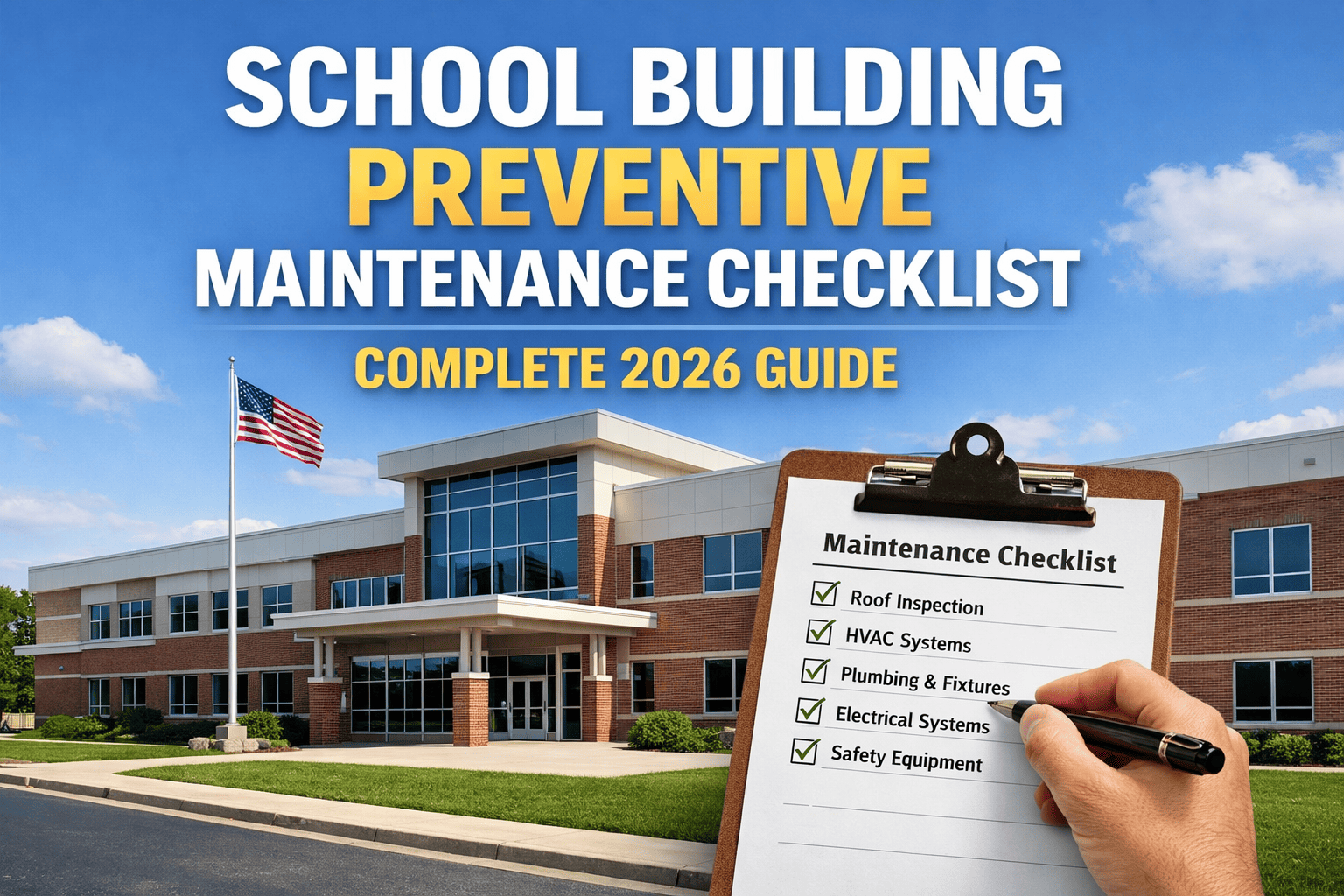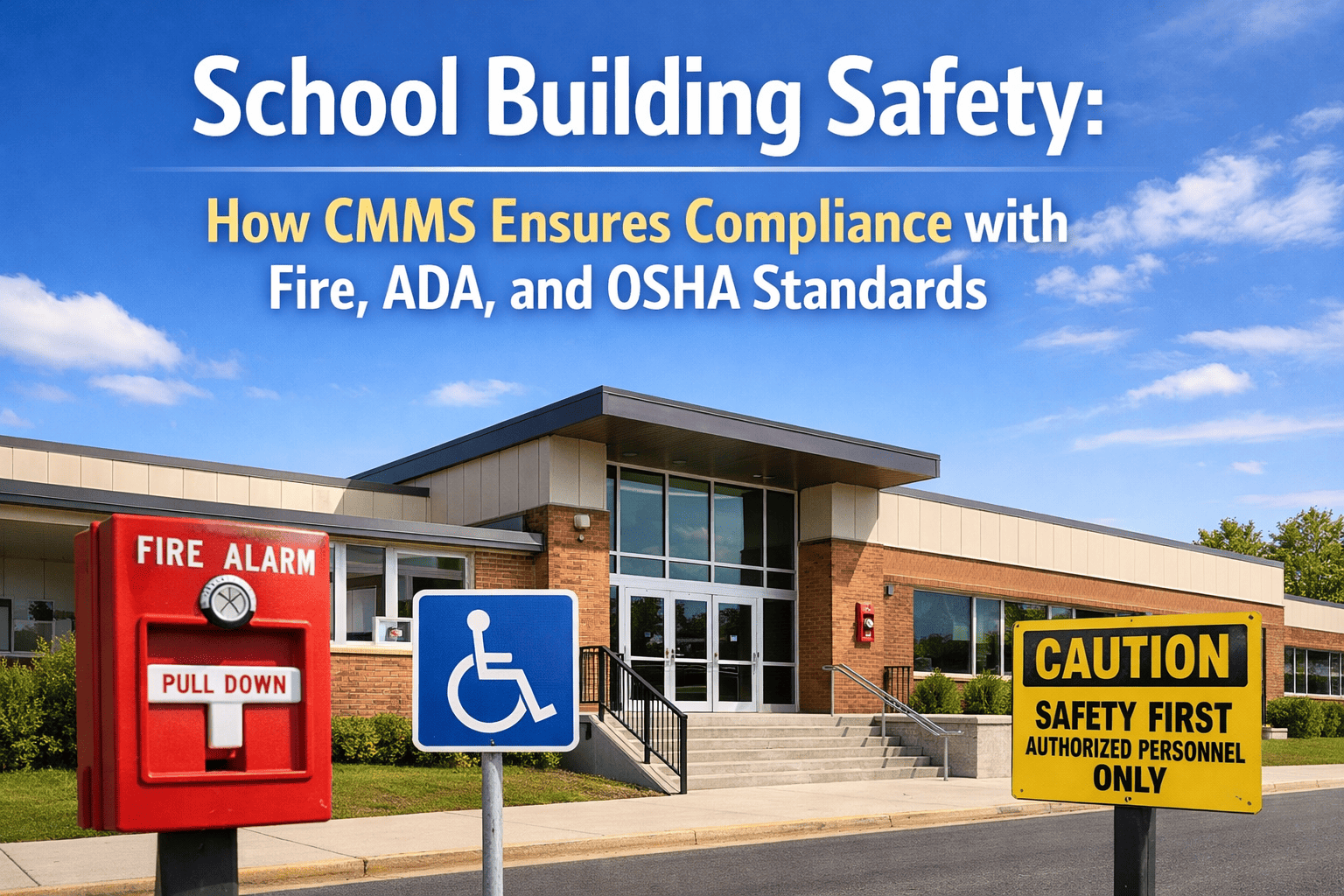
Every school year, approximately 130,000 schools across the United States are required to meet building safety compliance standards spanning fire codes, ADA accessibility, indoor air quality, structural integrity, and food service regulations. Yet fewer than 35% of districts maintain centralized, audit-ready documentation of their compliance activities. The consequence is predictable — districts discover compliance gaps during inspections rather than before them, facing fines averaging $15,000-$75,000 per violation and, more critically, exposing students and staff to preventable safety risks. A structured compliance checklist backed by digital documentation transforms safety from a reactive scramble into a systematic, defensible process. Districts using OxMaint's digital inspection and compliance platform reduce compliance gaps by 78%, cut audit preparation time from weeks to minutes, and maintain continuous documentation that is always inspection-ready. Ready to make your district audit-proof? Get a free trial for 30 days and book a demo to see digital compliance in action.
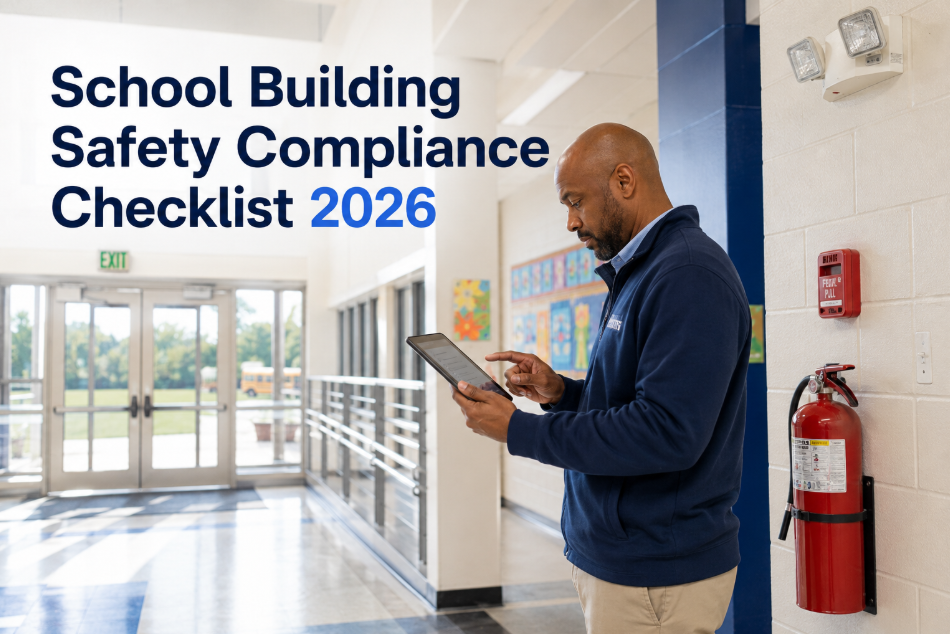
School Building Safety Compliance Checklist 2026
A comprehensive, category-by-category safety compliance checklist for facility managers and compliance officers managing K-12 school buildings — with documentation guidance and inspection frequency standards.
Why a Structured Compliance Checklist Matters in 2026
School building safety compliance is not a single inspection — it is an ongoing obligation across multiple regulatory domains that overlap and interact. Fire codes require one set of documentation. ADA accessibility requires another. HVAC and indoor air quality standards, playground safety, kitchen health codes, and structural inspections each carry their own requirements, frequencies, and documentation standards. In 2026, three regulatory shifts make structured compliance tracking more critical than ever: updated NFPA fire alarm testing intervals, new EPA indoor air quality guidance for K-12 buildings, and expanded ADA enforcement targeting public school facilities. Districts without centralized documentation systems will face increasing exposure. Facilities teams using OxMaint maintain continuous compliance records with timestamped inspections, digital signatures, and automated scheduling that ensures nothing falls through the cracks — even across 20, 30, or 60 buildings. See how this works in your district with a free trial or book a demo to map your compliance requirements.
Fire Safety Compliance Checklist
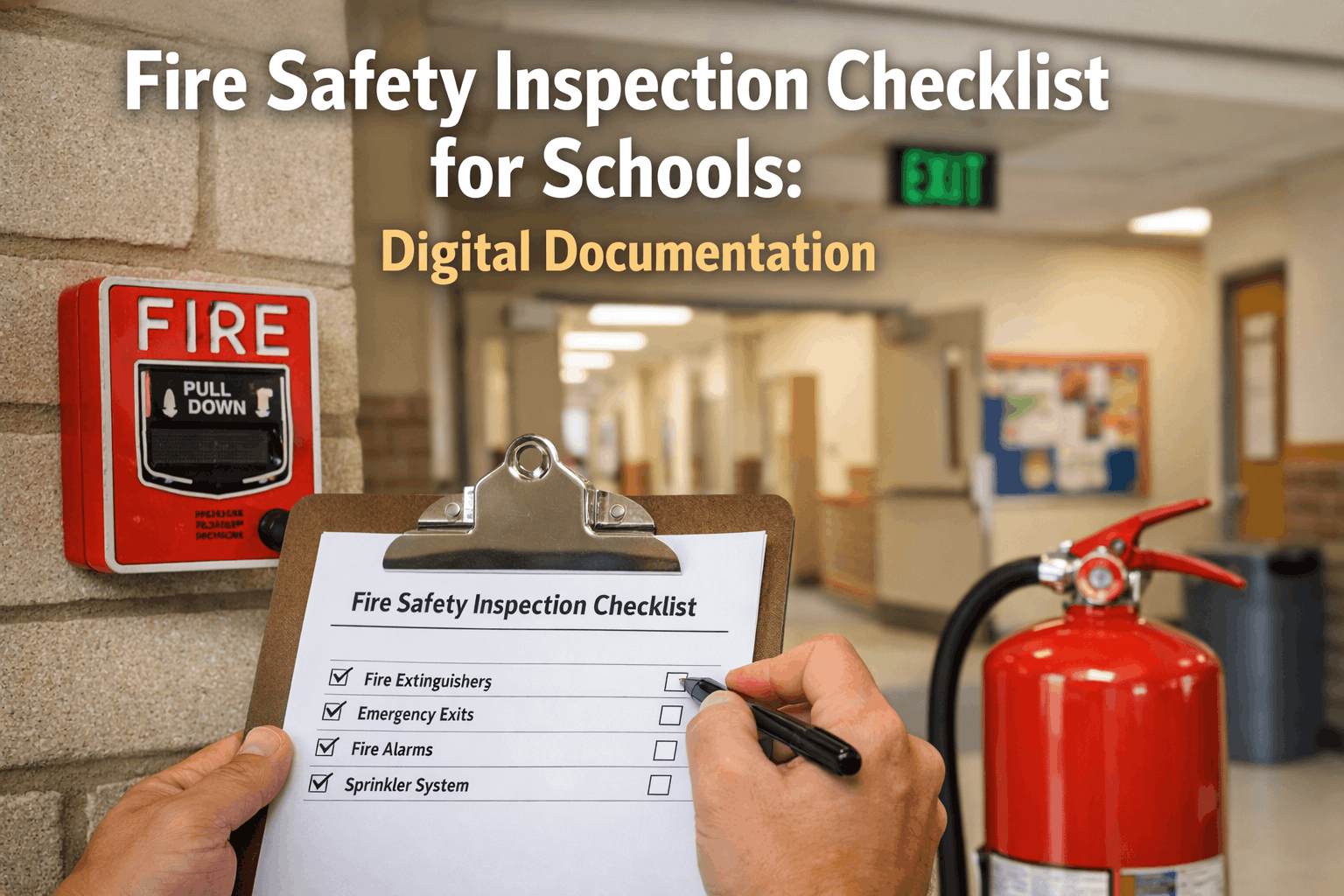
Fire safety violations are the most frequently cited compliance failure in school building inspections. NFPA 101 (Life Safety Code) and local fire marshal requirements establish minimum standards that apply to every occupied school building.
Verify pressure gauge, accessibility, signage, and tamper seal on every extinguisher. Document location and condition. NFPA 10 requires monthly checks with annual professional service.
Test notification appliances, pull stations, and supervisory devices. NFPA 72 requires quarterly testing of alarm-initiating devices with documented results and technician certification.
Conduct 90-minute battery discharge test on all emergency lighting. Verify exit sign illumination and directional accuracy. IBC requires semi-annual 90-minute functional tests.
Professional inspection of all sprinkler heads, piping, control valves, and flow switches. NFPA 25 requires annual inspection with 5-year internal pipe assessment. Document all findings.
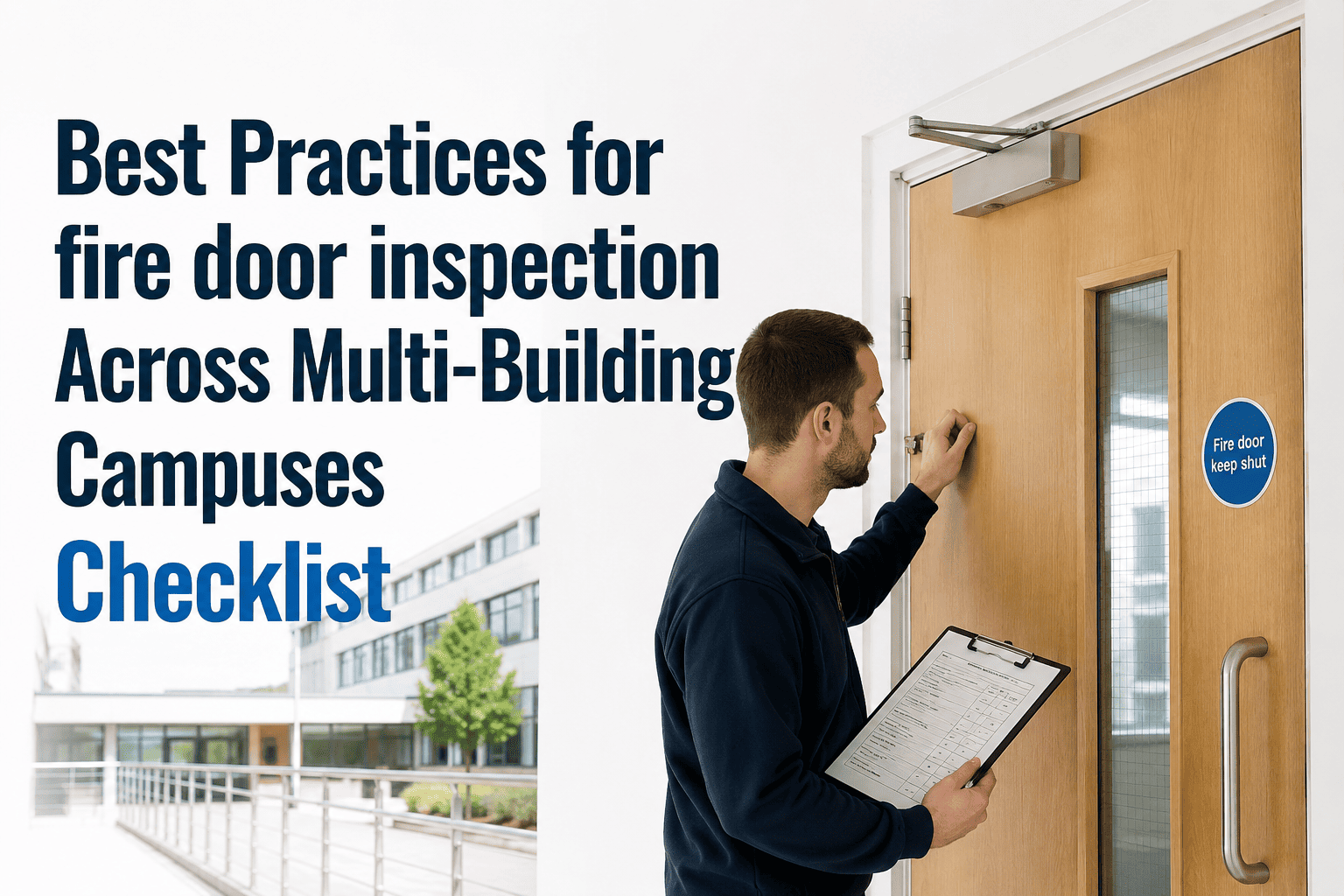
Inspect all fire-rated doors for proper closing, latching, and seal integrity. Check fire barriers and penetration seals. NFPA 80 requires annual inspection of all fire door assemblies.
Walk all evacuation routes to confirm clear egress paths, unblocked exits, and properly posted evacuation maps. 47% of school fire code violations involve obstructed egress paths.
ADA Accessibility Compliance Checklist
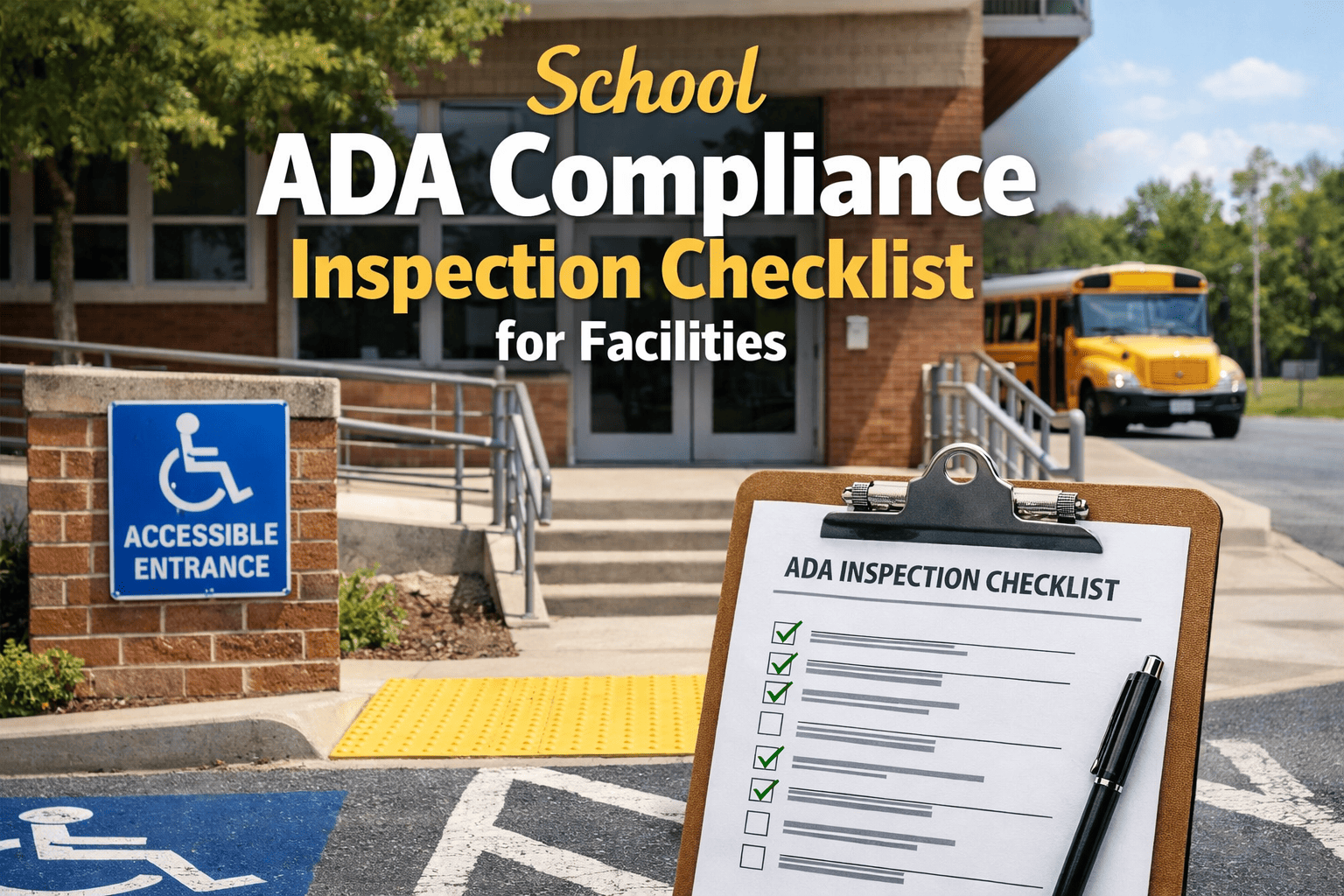
ADA enforcement in public schools has intensified significantly since 2023. The Department of Justice resolved 340+ accessibility complaints against school districts in 2024 alone. Maintenance-related ADA failures — broken automatic door openers, non-functional wheelchair lifts, deteriorated accessible pathways — are the most common findings.
Test every power-assisted door for proper opening force, hold-open time (minimum 5 seconds), and sensor activation. Broken automatic doors are the single most common ADA complaint in schools.
Verify grab bar mounting security, proper clearances, accessible sink height, and lever-handle faucet operation. Document any maintenance needs with corrective work orders.
Inspect ramp surfaces for cracking, heaving, or drainage issues. Verify handrail integrity and slip-resistant surfaces. ADA requires ramp slopes not exceeding 1:12 with level landings.
Schedule annual professional inspection and certification. Maintain service records, test results, and repair history. Non-functional elevators in multi-story schools create immediate ADA violations.
HVAC and Indoor Air Quality Compliance
The EPA's 2025 updated IAQ guidance for K-12 schools establishes minimum ventilation rates (per ASHRAE 62.1), CO2 monitoring recommendations, and filter maintenance documentation requirements. Poor indoor air quality affects student cognitive performance by up to 13%, according to Harvard T.H. Chan School of Public Health research.
Check filter condition and differential pressure readings. Replace per manufacturer schedule — typically every 30-90 days depending on MERV rating. Document filter type, date, and building location.
Measure outdoor air delivery rates in occupied classrooms. ASHRAE 62.1 requires 15 CFM per person in classrooms. Document readings and corrective actions for underperforming units.
Inspect supply and return ductwork for mold, debris, and biological growth. Clean evaporator and condenser coils. Document findings with photos. Mold in school HVAC systems triggers immediate remediation requirements.
Professional assessment of system capacity, efficiency, and remaining useful life. Identify units nearing end-of-life for CapEx planning. Average school HVAC system lifespan is 15-20 years — 43% of U.S. school HVAC systems exceed this age.
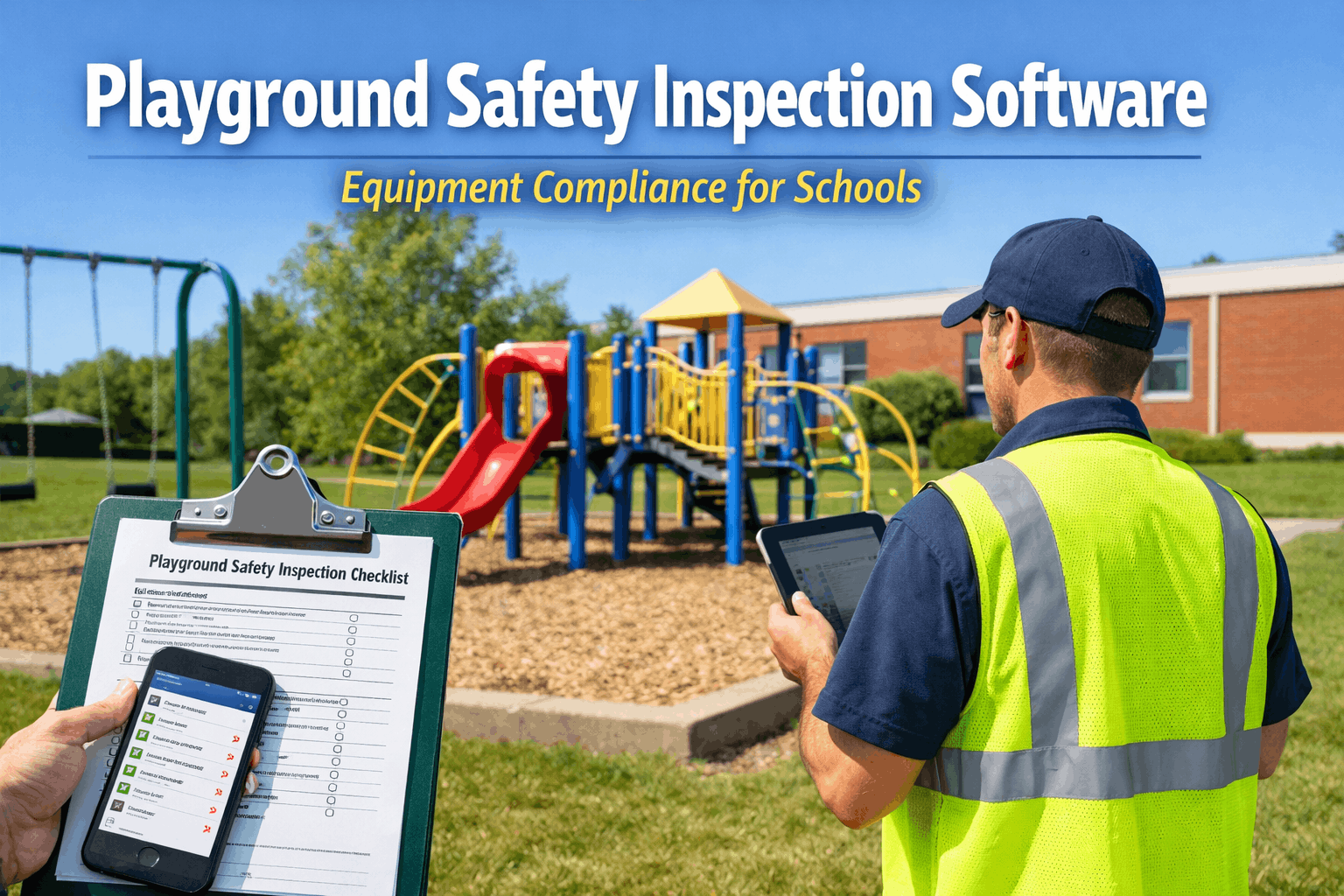
Playground and Outdoor Area Safety
The CPSC reports over 200,000 playground-related injuries requiring emergency department treatment annually among children under 15. Schools carry direct liability for playground equipment condition and surfacing compliance with ASTM F1487 and CPSC guidelines.
Check for vandalism, broken components, sharp edges, and foreign objects in fall zones. Quick visual scan by custodial staff before first recess. Document and report hazards immediately.
Inspect all fasteners, connectors, and structural members for wear, corrosion, and loosening. Check swing chain integrity, slide surfaces, and climbing structure joints. 62% of serious playground injuries involve equipment failure.
Measure loose-fill surfacing depth (minimum 12 inches for equipment under 7 feet). Inspect rubber surfacing for deterioration. CPSC requires adequate impact attenuation within critical fall zones.
Professional CPSI-certified inspection against current ASTM F1487 standards. Includes comprehensive report with remediation recommendations. Required for liability protection and insurance compliance.
Kitchen and Cafeteria Health Compliance
School cafeteria operations must comply with local health department codes, USDA food safety requirements, and equipment maintenance standards. A failed health inspection can close a cafeteria — affecting meal service for hundreds or thousands of students and creating immediate logistical crises.
Record temperatures for all walk-in coolers, freezers, and reach-in units. FDA Food Code requires cold holding at 41F or below, frozen at 0F or below. Digital logs eliminate handwritten recording errors.
Verify final rinse temperature (180F for hot water, 50 ppm for chemical) using test strips or thermometer. Document results. Sanitization failures are critical health code violations.
Check grease filter condition, exhaust fan operation, and fire suppression system status. NFPA 96 requires regular hood cleaning based on cooking volume. Document cleaning dates and contractor information.
Service all commercial cooking equipment, ice machines, and walk-in refrigeration units. Check door seals, compressor operation, and thermostat calibration. 28% of school kitchen health violations involve equipment malfunction.
Structural and Electrical Safety
The average age of a U.S. school building is 44 years. Structural deterioration and aging electrical systems create safety risks that are often invisible until a failure occurs. Systematic inspection and documentation protect both occupant safety and district liability.
Professional inspection of membrane condition, flashing integrity, drainage function, and penetration seals. Roof failures are the leading cause of emergency facility closure in schools. Average school roof lasts 20-25 years.
Inspect main panels, sub-panels, and branch circuit wiring for code compliance, thermal anomalies, and capacity issues. NEC requires proper labeling and accessible clearance. Infrared scanning identifies hot spots before failures.
Professional engineering assessment of foundation settlement, masonry condition, and load-bearing structure integrity. Document crack patterns, moisture intrusion, and any movement indicators. Critical for buildings over 30 years old.
Visual inspection of exterior walls, windows, doors, and sealants for water intrusion, damage, and deterioration. Catch moisture problems early — water damage remediation costs 6x more when discovered late.
Paper Compliance vs Digital Compliance Management
The difference between passing and failing a compliance inspection often comes down to documentation, not condition. Districts with digital records produce evidence instantly; paper-based districts scramble to reconstruct it.
| Compliance Activity | Paper-Based Approach | OxMaint Digital Approach |
|---|---|---|
| Fire extinguisher inspection | Paper tag on unit, often illegible or missing | Digital checklist with photo, timestamp, and technician ID |
| Audit preparation | 2-4 weeks of manual record assembly | One-click export, filterable by category and date range |
| Overdue inspection tracking | Relies on calendar reminders or memory | Automated alerts with escalation to supervisor |
| Multi-building compliance view | Call each building manager, compile reports | District-wide dashboard shows all buildings at a glance |
| Historical documentation | Filing cabinets, lost records, inconsistent formats | Complete searchable history per asset, per building |
| Inspector evidence | Verbal assurance with spotty paper trail | Digital signatures, photos, and timestamped completion proof |
Frequently Asked Questions
How does OxMaint help with fire safety compliance specifically?
OxMaint provides pre-built inspection templates for fire extinguishers, alarm systems, sprinklers, emergency lighting, and fire door assemblies. Each inspection is scheduled automatically at the required frequency (monthly, quarterly, annual). Completed inspections include timestamped digital signatures, condition notes, and photos — creating a compliance record that survives any audit. Overdue inspections trigger automatic escalation alerts to the facilities director.
Can we customize the checklist items for our specific district requirements?
Yes. OxMaint's inspection templates are fully customizable. You can add district-specific items, modify frequencies, attach reference documents (codes, OEM manuals), and create building-specific variations. Most districts start with the standard templates and add local requirements within the first two weeks of use.
How do we track compliance across 20+ buildings without a large team?
OxMaint's portfolio-level dashboard shows compliance status for every building on a single screen — green for current, yellow for upcoming, red for overdue. A single facilities director can monitor compliance across 50+ buildings without calling individual building managers. The system does the tracking; your team does the inspections.
What documentation does OxMaint produce for inspectors and auditors?
OxMaint generates exportable compliance reports filtered by inspection type, building, date range, and regulatory category. Each record includes the inspection checklist results, digital signature of the inspector, timestamped photos, and any corrective work orders generated from findings. Reports can be exported as PDF or shared via secure link. Most auditors accept OxMaint reports as primary compliance evidence.
Make Every School Building Audit-Ready, Every Day
OxMaint replaces paper checklists and filing cabinets with automated inspection scheduling, digital documentation, and district-wide compliance dashboards. Your first inspection templates are live within 48 hours of setup. See how it works for your buildings.
.png)