School districts across the United States face over 12,000 ADA-related complaints annually, and the average cost of defending a single accessibility lawsuit exceeds $75,000 before any settlement is reached. The core problem is rarely the absence of accessibility features — it is the absence of documented proof that those features are maintained, inspected, and functional. A ramp that exists but has a cracked surface, an automatic door opener that has not been serviced in 14 months, or an elevator with an expired inspection certificate all represent the same legal exposure: an ADA compliance gap that no paper logbook can defend. School districts that have moved to digital maintenance documentation platforms like OxMaint report 91% faster audit response times, 100% inspection traceability, and a 68% reduction in compliance-related legal exposure. The shift is not about technology adoption — it is about building a defensible, timestamped record that protects students, staff, and the district itself. Want to see how digital ADA documentation works for your district — book a demo or start a free trial and see it firsthand.
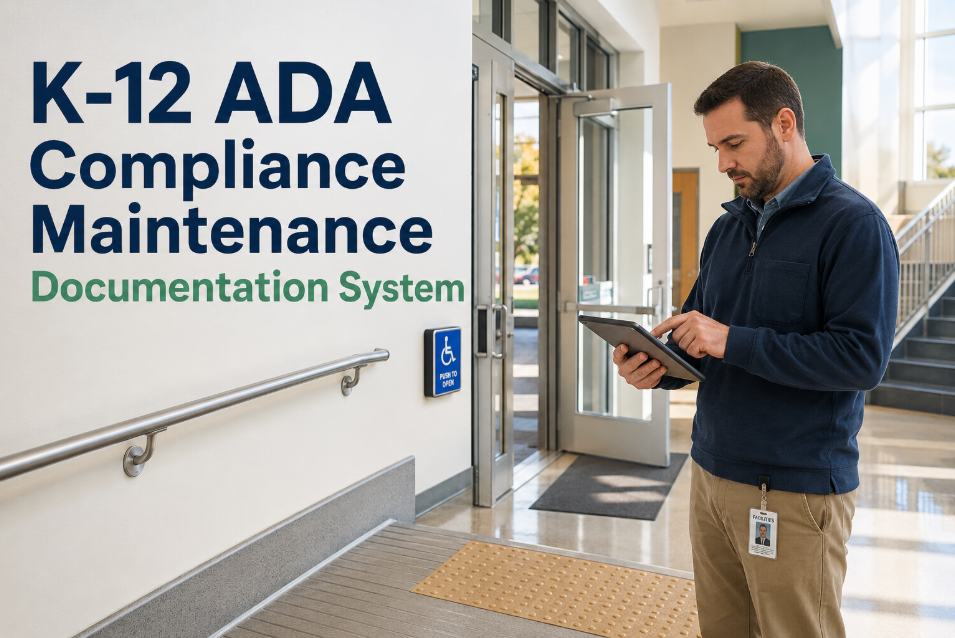
K-12 ADA Compliance Maintenance Documentation System
How school districts build audit-ready, legally defensible ADA compliance records using digital maintenance documentation — eliminating paper gaps, missed inspections, and litigation risk.
What Is ADA Compliance Maintenance Documentation?
ADA compliance maintenance documentation is the systematic recording of every inspection, repair, and service action performed on accessibility features within school buildings and campuses. This includes wheelchair ramps, automatic door systems, accessible restroom fixtures, elevator equipment, tactile signage, accessible parking surfaces, and assistive listening devices. The ADA does not simply require that accessibility features exist — it requires that they remain functional and available at all times. A broken automatic door opener is not a maintenance issue; it is a civil rights violation. Documentation proves the district actively maintains compliance, and more critically, it proves the district responded promptly when issues were identified.
Without digital documentation, districts rely on paper inspection sheets that are easily lost, inconsistently completed, and impossible to aggregate across multiple school sites. When the Office for Civil Rights requests maintenance records for an accessibility complaint, districts with paper systems spend weeks assembling partial records — and often cannot produce complete evidence. Digital CMMS platforms like OxMaint create automatic, timestamped, photo-verified records for every ADA-related maintenance action, building a compliance history that is exportable in minutes, not weeks. Districts managing 15 or more school buildings have found this capability essential to maintaining compliance at portfolio scale — explore how it works by booking a demo or starting a free trial today.
ADA Accessibility Assets That Require Documented Maintenance
Every school building contains dozens of ADA-regulated accessibility features. Each one requires scheduled inspection and documented maintenance to remain compliant. These are the six critical asset categories that generate the most compliance exposure for K-12 districts.
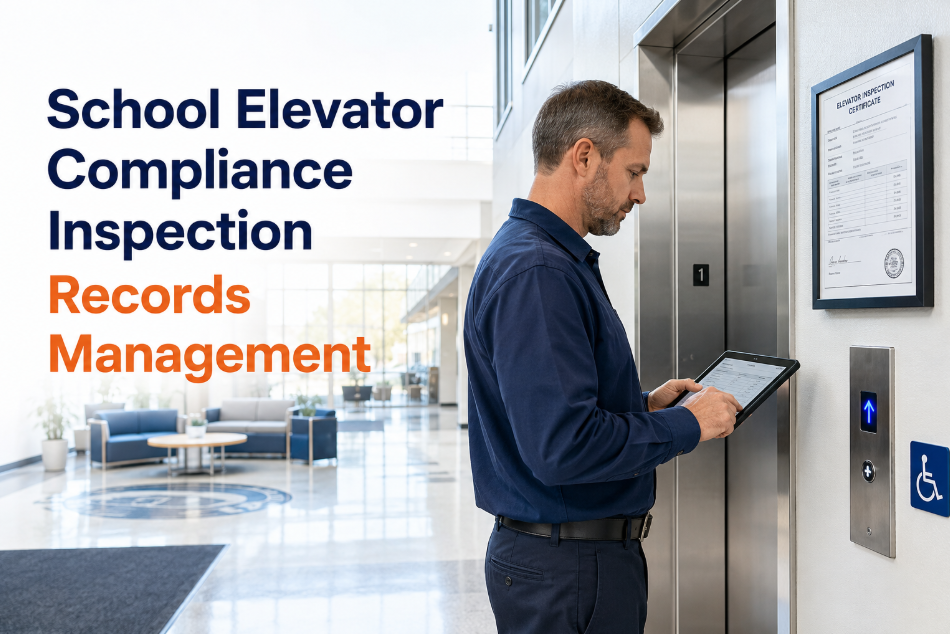
Passenger elevators, wheelchair lifts, and platform lifts require monthly inspections and annual state certifications. 38% of school ADA complaints involve non-functional or poorly maintained elevator equipment.
Power-assisted door operators on accessible entrances must maintain proper opening force (5 lbs max) and closing speed. Quarterly calibration checks are required to remain ADA compliant.
Grab bars, accessible toilet heights, sink clearances, and lever-style faucets must be inspected semi-annually. Loose grab bars alone account for 22% of school accessibility maintenance work orders.
Ramp surfaces, handrails, slope ratios, and pathway clearances require seasonal inspections. Cracked surfaces, ice accumulation, and vegetation encroachment create trip hazards and ADA violations simultaneously.
Braille signage, room identification plates, and wayfinding markers must remain securely mounted and legible. Damaged or missing ADA signage is among the most frequently cited violations during facility reviews.
Accessible parking spaces, van-accessible aisles, curb ramps, and detectable warning surfaces require bi-annual resurfacing inspections and immediate repair of any surface deterioration or fading markings.
Why Paper-Based ADA Documentation Fails School Districts
The gap between having accessibility features and proving they are maintained is where legal liability lives. Paper-based documentation creates four systemic risks that digital systems eliminate entirely.
Paper inspection sheets are completed inconsistently, stored in different locations across schools, and frequently lost during staff transitions. 53% of districts cannot produce complete ADA inspection records for the prior 12 months when requested by auditors or attorneys.
Paper logs can be backdated, altered, or completed in bulk before an audit. Courts and the Office for Civil Rights increasingly require timestamped digital evidence that cannot be retroactively created — paper records lack this evidentiary weight.
When a parent files an ADA complaint about a broken ramp handrail, the district needs to prove when the damage was reported, when the repair was scheduled, and when it was completed. Paper systems cannot attach before-and-after photos to work orders — digital CMMS does this automatically.
Districts with 20+ school buildings cannot aggregate paper inspection data to identify systemic compliance gaps. A district-wide pattern of failing automatic door openers will go undetected until it becomes a district-wide complaint — digital dashboards surface these patterns in real time.
How OxMaint Builds Audit-Ready ADA Compliance Records
OxMaint replaces fragmented paper documentation with a unified, automated compliance system designed for multi-site school district operations. Each step below represents a capability that directly addresses the documentation gaps that create legal exposure.
Every accessibility feature across every campus is cataloged in a single digital registry — elevators, ramps, door openers, restroom fixtures, signage, and parking. Each asset is linked to its location, condition score, and full maintenance history. Districts gain 100% visibility into their ADA asset inventory for the first time.
PM schedules are configured to ADA and state-specific inspection intervals — monthly elevator checks, quarterly door calibrations, semi-annual restroom fixture reviews. OxMaint auto-generates inspection work orders and escalates overdue tasks so no inspection window is silently missed.
Technicians complete ADA inspections on mobile devices using standardized checklists. Each item requires a pass/fail response and supports photo documentation. Completed inspections are timestamped, GPS-tagged, and signed digitally — creating evidence that holds up in legal proceedings.
When an inspection identifies a failed item — a loose grab bar, a non-functioning door opener, faded parking markings — OxMaint automatically creates a corrective work order linked to the inspection record. This creates a continuous documented chain from discovery to resolution.
Directors of Facilities can view ADA compliance status across all school buildings from a single dashboard — inspection completion rates, overdue tasks, open corrective actions, and asset condition trends. Red flags are visible immediately, not discovered during audits.
When the Office for Civil Rights, a state inspector, or legal counsel requests ADA maintenance documentation, OxMaint exports complete records — filterable by asset type, school site, date range, and compliance category — in minutes. Audit preparation that took weeks with paper is eliminated entirely.
Districts that have implemented this workflow report reducing their audit preparation time from 3-4 weeks to under 2 hours — see the full capability by booking a demo or starting a free trial with your actual school sites.
Paper Documentation vs. Digital ADA Compliance System
The difference between paper-based and digital ADA documentation is not incremental — it is the difference between legal defensibility and legal exposure.
| Compliance Capability | Paper-Based System | OxMaint Digital System |
|---|---|---|
| Inspection record completeness | 47% average across districts | 99.6% with auto-scheduling |
| Time to produce audit records | 3-4 weeks manual assembly | Under 2 hours, one-click export |
| Photo documentation attached | Rarely, not linked to work orders | Auto-attached to every inspection |
| Timestamp verification | None — can be backdated | Server-verified, tamper-proof |
| Multi-site compliance visibility | No aggregation possible | Real-time district dashboard |
| Corrective action traceability | Separate paper trail, often disconnected | Auto-linked from inspection to repair |
Frequently Asked Questions
What specific ADA elements should school districts track in a CMMS?
At minimum, districts should track elevators and lifts, automatic door openers, wheelchair ramps and accessible routes, accessible restroom fixtures (grab bars, sink clearances, toilet heights), tactile and braille signage, accessible parking spaces, curb ramps, detectable warning surfaces, and assistive listening systems in auditoriums. OxMaint allows each of these to be registered as individual assets with their own PM schedules, condition scores, and compliance inspection templates.
How does digital documentation help defend against ADA complaints?
The strongest legal defense in an ADA complaint is demonstrating that the district had a documented, proactive maintenance program — that inspections were conducted on schedule, issues were identified promptly, and corrective actions were completed within reasonable timeframes. OxMaint creates this evidence automatically through timestamped inspections, photo documentation, and linked corrective work orders. This documentation trail transforms a district's defense from "we think we maintained it" to "here is the complete, verified record."
Can OxMaint handle ADA documentation across 20+ school buildings?
Yes. OxMaint is built for multi-site portfolio management. Each school building is configured as a separate property within the district portfolio, with its own asset registry, PM schedules, and inspection templates. The district-level dashboard aggregates compliance data across all sites, allowing the Director of Facilities to identify which schools have overdue ADA inspections, which asset categories have the highest failure rates, and where corrective actions are lagging — all from a single view.
How quickly can a school district implement ADA compliance tracking?
Most districts complete initial ADA asset registration and PM template configuration within 2-3 weeks for the first school site, and then replicate the template across additional sites in 1-2 days each. OxMaint's implementation team provides guided onboarding specifically for K-12 districts, including pre-built ADA inspection checklist templates that align with federal accessibility standards. The first automated inspection work orders are typically generated within the first week.
Your ADA Compliance Record Should Defend Itself
Every undocumented inspection, every lost paper checklist, and every disconnected repair record is a gap in your district's legal defense. OxMaint builds the audit-ready ADA compliance documentation system that school districts need — automated scheduling, photo-verified inspections, and one-click audit exports across every school building in your portfolio. See it configured for your district in a 30-minute walkthrough.