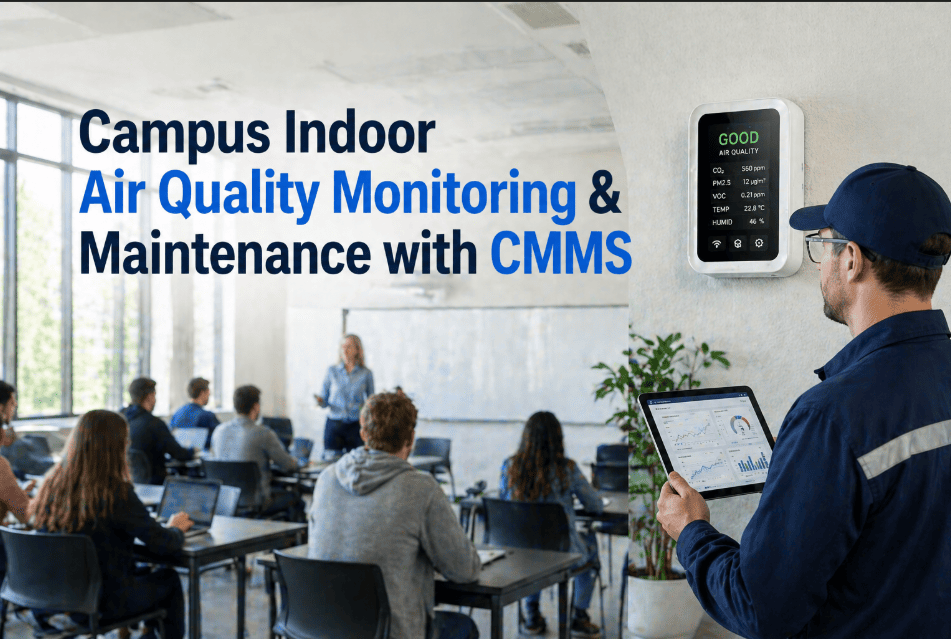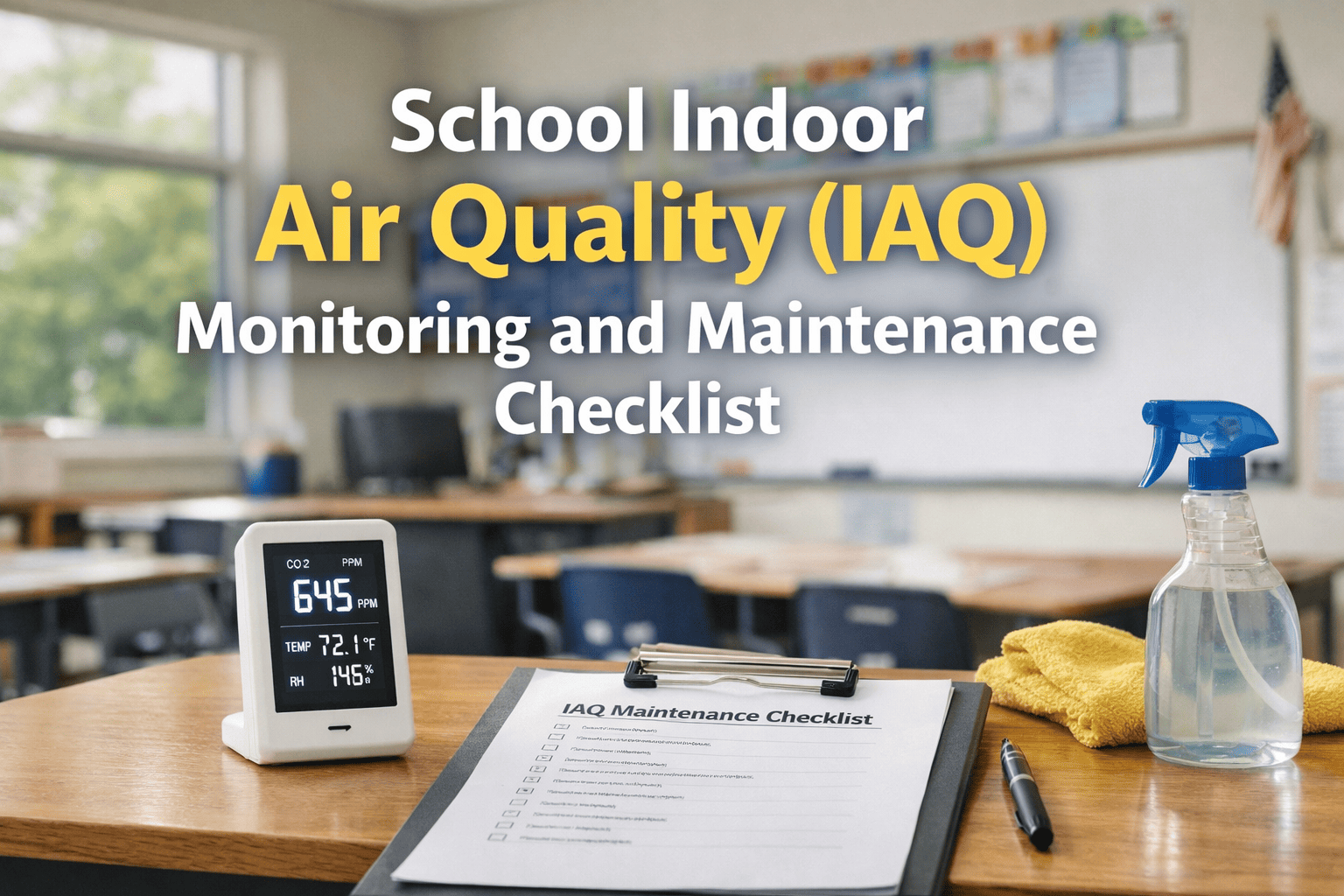
Indoor air quality in schools is not a comfort issue — it is a health and compliance issue that directly affects 55 million students and 3.7 million teachers across the United States every school day. The EPA estimates that half of all schools have IAQ problems linked to inadequate HVAC maintenance, and OSHA has increased enforcement actions against school districts where poor ventilation contributes to occupational health complaints from staff. The connection between IAQ failures and maintenance failures is direct: a filter that should have been changed 90 days ago, an outside air damper stuck in the closed position because it was never exercised, a rooftop unit running at 60% capacity because the coils were never cleaned. These are preventive maintenance tasks — simple, scheduled, and completely preventable — yet 43% of school districts cannot prove they were completed because maintenance records exist on paper or not at all. Districts using digital CMMS platforms like OxMaint to manage HVAC maintenance schedules and IAQ documentation report 96% PM compliance on ventilation systems, reduce IAQ-related complaints by 52%, and produce OSHA-ready records on demand. The cost of preventive HVAC maintenance is a fraction of the cost of a single OSHA investigation or a classroom closure due to mold remediation. Protect your buildings and your students — start a free trial or book a demo with our K-12 facilities team.
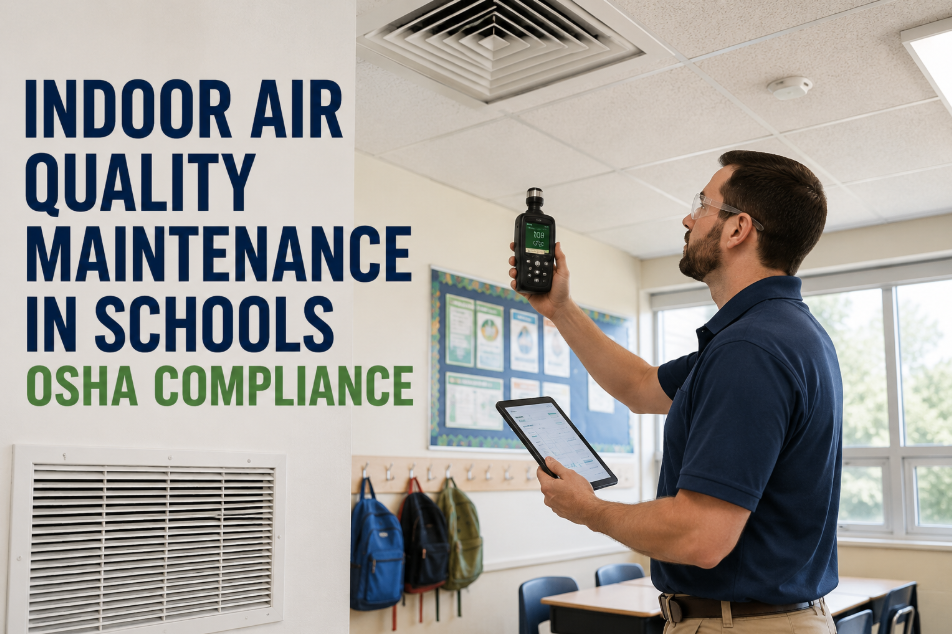
Indoor Air Quality Maintenance in Schools: OSHA Compliance
Poor indoor air quality affects student health and triggers OSHA scrutiny. Preventive HVAC maintenance and digital IAQ records protect districts from violations, closures, and liability — here is how to build the system.
What Is Indoor Air Quality Maintenance in Schools?
Indoor air quality maintenance is the systematic upkeep of HVAC systems, ventilation infrastructure, and environmental controls to ensure that the air students and staff breathe meets health and regulatory standards. In a school context, this means maintaining adequate outdoor air ventilation rates (ASHRAE 62.1 recommends 15 CFM per person for classrooms), controlling humidity between 30–60% RH to prevent mold growth, replacing filtration on schedule (MERV-13 filters recommended by CDC and ASHRAE for school environments), and ensuring exhaust systems in science labs, kitchens, and restrooms operate at design capacity. OSHA does not have a specific IAQ standard for schools, but enforces indoor air quality under the General Duty Clause (Section 5(a)(1)) when poor air quality creates recognized hazards for employees — meaning teachers and staff. When a teacher files an OSHA complaint about headaches, respiratory irritation, or visible mold in a classroom, the first thing an inspector reviews is HVAC maintenance records. Districts using OxMaint's PM scheduling and compliance documentation features maintain continuous records of every filter change, coil cleaning, damper check, and humidity reading — producing the documented proof that OSHA requires. Build your IAQ compliance system now — start a free trial or book a demo to see it in action.
HVAC Maintenance Tasks That Directly Impact IAQ
Every IAQ failure in a school traces back to a missed maintenance task. These six categories represent the preventive maintenance schedule that separates compliant districts from those facing OSHA investigations.
MERV-13 filters require replacement every 60–90 days in school environments. A clogged filter reduces airflow by 25–40%, increases energy costs, and allows particulates into classrooms. This is the single most impactful PM task for IAQ.
Dampers stuck in the closed position eliminate fresh air intake entirely. Quarterly exercise and calibration ensures classrooms receive the 15 CFM per person required by ASHRAE 62.1. 38% of IAQ complaints trace to damper failures.
Dirty coils breed mold and bacteria in the air handling unit itself — then distribute contaminants to every classroom served by that unit. Semi-annual coil cleaning prevents biological contamination at the source.
Standing water in drain pans creates Legionella and mold risk. Monthly drain pan inspection and clearing prevents the moisture accumulation that leads to biological contamination and visible mold growth in ductwork.
Restroom, kitchen, and lab exhaust fans must operate at design CFM to prevent contaminant buildup. Belt-driven fans lose 10–15% capacity annually from belt wear alone. Quarterly airflow verification catches degradation before complaints begin.
Miscalibrated controls cause over-cooling (condensation, mold), under-ventilation (CO2 buildup), or short-cycling (insufficient air exchange). Annual calibration ensures HVAC systems operate as designed — not as they have drifted.
The OSHA IAQ Compliance Risk for School Districts
OSHA enforces IAQ in schools through the General Duty Clause when employee health complaints are filed. Here is the enforcement path and why maintenance documentation is your primary defense.
A teacher reports persistent headaches, respiratory symptoms, or visible mold to OSHA. OSHA opens an investigation. In 2023, school-related IAQ complaints to OSHA increased 34% year-over-year as awareness of ventilation standards grew post-pandemic.
The first document request is always HVAC maintenance records — filter change schedules, coil cleaning logs, outdoor air damper inspections. Districts with paper records spend 20–40 hours compiling incomplete documentation. Districts with digital CMMS produce the report in minutes.
If you cannot prove the maintenance was done, OSHA treats it as not done. General Duty Clause violations carry penalties of $16,131 per violation — and each affected classroom can be treated as a separate violation. A single building with 30 classrooms and no filter change records represents potential six-figure exposure.
Beyond fines, the district pays for air quality testing ($3,000–$8,000 per building), mold remediation ($15,000+ per event), temporary classroom relocation, and increased insurance premiums. Preventive HVAC maintenance costs approximately $1.50 per square foot annually — remediation costs $12–$25 per square foot.
OxMaint gives school districts automated HVAC PM scheduling, digital filter change records, damper inspection logs, and OSHA-ready compliance documentation across every building. When an inspector asks for records, you produce them in two minutes — not two weeks.
Neglected HVAC vs. Digitally Maintained HVAC: IAQ Outcomes
| IAQ Factor | Deferred / Paper-Based Maintenance | OxMaint Digital PM Scheduling |
|---|---|---|
| Filter replacement compliance | 55–70% on schedule | 96% on schedule |
| IAQ-related staff complaints | 8.2 per building per year | 3.9 per building per year |
| Mold events per district | 2.4 per year average | 0.6 per year average |
| OSHA documentation readiness | 20–40 hours to compile | Under 5 minutes |
| Energy cost from HVAC inefficiency | 18–25% above optimal | Within 5% of design efficiency |
| Student absenteeism (IAQ-related) | 4.1 days per student per year | 2.3 days per student per year |
The correlation between HVAC maintenance compliance and IAQ outcomes is well-documented across school districts nationwide. Digital PM scheduling does not just prevent violations — it improves the physical environment where students learn. See the impact on your district — start a free trial or book a demo for a walkthrough.
Frequently Asked Questions
Does OSHA have a specific indoor air quality standard for schools?
No. OSHA does not have a standalone IAQ standard. However, OSHA enforces IAQ issues under the General Duty Clause (Section 5(a)(1)), which requires employers to provide a workplace free from recognized hazards. When teachers or staff file health complaints related to poor air quality, OSHA investigates and can cite the district for failing to maintain ventilation systems that prevent known IAQ hazards. The key defense is documented HVAC maintenance records proving the district took reasonable steps to maintain air quality.
How often should school HVAC filters be changed?
MERV-13 filters in school environments should be replaced every 60–90 days, depending on local conditions, occupancy density, and outdoor air quality. Schools in areas with high pollen counts, construction activity, or wildfire smoke may need 30–45 day replacement cycles during peak periods. OxMaint allows you to set filter replacement schedules per unit and automatically generates work orders at each interval — with escalation alerts if the task is not completed on time.
Can OxMaint track IAQ across buildings with different HVAC system types?
Yes. OxMaint's asset registry supports any equipment type — rooftop units, split systems, boiler-based heating, unit ventilators, energy recovery ventilators, or central air handling units. Each system gets its own PM schedule based on its specific maintenance requirements. The district-level dashboard shows IAQ-related PM compliance across all buildings regardless of system type, giving facility directors a single view of ventilation maintenance health.
What documentation should we produce if OSHA investigates an IAQ complaint?
OSHA expects to see: filter change records with dates and technician identification, outdoor air damper inspection logs, coil cleaning records, drain pan maintenance documentation, and any air quality testing results. With OxMaint, all of these records are generated automatically as work orders are completed — timestamped, signed off, and exportable in audit format. Districts using OxMaint produce OSHA-ready documentation in under five minutes.
Clean Air Starts With Maintained Equipment
Every IAQ complaint, every mold event, and every OSHA investigation traces back to a missed maintenance task. OxMaint gives your district automated HVAC PM scheduling, digital inspection records, and compliance documentation that protects students, staff, and your budget. Deploy across your first building in under a week — no implementation fees, no IT infrastructure required.