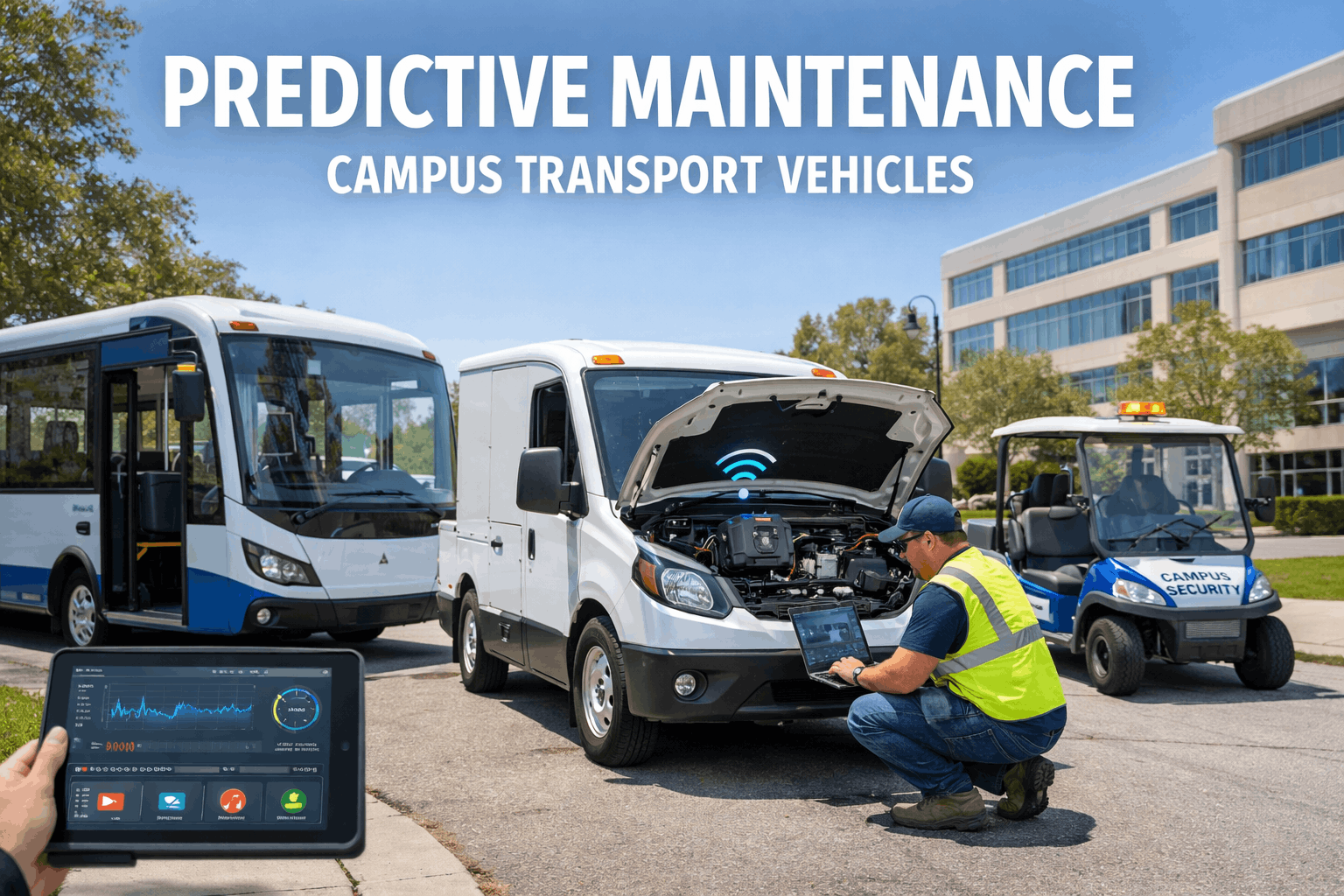
A large Midwestern research university lost $1.2 million in a single academic year to campus transport failures — not from catastrophic crashes, but from the slow bleed of unplanned breakdowns. Fourteen shuttle bus road calls during the first three weeks of fall semester. Nine paratransit van failures that left students with disabilities stranded between classes. Twenty-two facilities truck breakdowns that delayed emergency maintenance responses across 340 buildings. The fleet was not old — average age was 6.4 years — but maintenance was calendar-based, oil changes happened whether a bus had driven 800 miles or 8,000, and the only early warning system was a driver filling out a paper defect card that sat in a dispatcher's inbox until someone remembered to read it. After deploying connected vehicle monitoring with predictive maintenance algorithms tied to a CMMS, road calls dropped 73%, mean time between failures extended from 4,200 miles to 11,800 miles, and the ADA paratransit fleet achieved 100% scheduled service completion for the first time in the program's history. Schedule a consultation to see how predictive fleet maintenance works for campus operations.
73%
Reduction in unplanned road calls when campus fleets shift from calendar-based PM to condition-based predictive maintenance
2.8×
Improvement in mean time between failures — extending from 4,200 to 11,800 miles through sensor-driven intervention timing
$1.2M
Annual cost of reactive fleet maintenance at a mid-size university — emergency towing, rush parts, rental vehicles, and lost productivity
Why Calendar-Based Maintenance Fails Campus Fleets
Calendar-based PM treats every vehicle the same — oil changes every 90 days, brake inspections every 6 months, transmission service annually. But campus vehicles do not operate the same way. A shuttle bus running a continuous loop at 35 mph accumulates mileage and engine stress completely differently from a public safety cruiser idling 6 hours per shift or a grounds tractor running a PTO-driven mower at full load for 4 hours then sitting for a week. Calendar intervals either over-maintain low-use vehicles (wasting budget and taking them offline unnecessarily) or under-maintain high-stress vehicles (allowing failures to develop between scheduled checks). Predictive maintenance replaces arbitrary time intervals with data-driven intervention points — maintaining each vehicle based on its actual operating condition rather than when the calendar says it is due. Sign up to build condition-based PM schedules for every campus vehicle type.
Over-Maintenance Waste
Low-mileage vehicles serviced too frequently consume technician hours, parts, and fluids with zero reliability benefit. A grounds vehicle driven 1,200 miles between oil changes does not need the same 5,000-mile interval as a shuttle bus — but calendar schedules treat them identically.
Under-Maintenance Risk
High-stress vehicles degrade faster than calendar intervals predict. Patrol cars with 6 hours of daily idle time burn oil and wear brakes at rates their mileage does not reflect. By the time the calendar triggers service, damage is already accumulating in components the schedule was designed to protect.
Zero Early Warning
Calendar-based programs have no mechanism to detect developing failures between scheduled services. A transmission losing pressure, a battery cell degrading, or a brake rotor warping generates no alert until the component fails entirely — stranding passengers and creating emergency repair costs 3–5× higher than planned service.
Your shuttle bus and your grounds cart should not share the same PM schedule. Oxmaint builds condition-based maintenance programs that match intervention timing to each vehicle's actual operating profile — mileage, hours, idle time, and sensor data.
Predictive Maintenance Technologies for Campus Vehicles
Predictive maintenance is not a single technology — it is a layered system of sensors, data processing, and decision logic that converts raw vehicle operating data into actionable maintenance recommendations. Each technology layer addresses a different failure mode, and the most effective campus fleet programs combine multiple data sources to build a comprehensive health picture of every vehicle in the fleet.
OBD-II / J1939 Telematics
Monitors: Engine, transmission, emissions, electrical
Onboard diagnostic ports stream real-time engine data — coolant temperature, oil pressure, transmission fluid temperature, battery voltage, fuel system status, and diagnostic trouble codes. For diesel shuttle buses using J1939 protocol, data includes turbo boost pressure, DPF soot loading, DEF quality, and aftertreatment status. Trend analysis on these parameters detects degradation weeks before component failure.
GPS & Duty Cycle Analytics
Monitors: Route stress, speed profiles, idle time
GPS tracking combined with accelerometer data builds a duty cycle profile for each vehicle — average speed, stop frequency, idle percentage, harsh braking events, and grade exposure. A shuttle bus averaging 47 stops per hour on a campus loop experiences brake and transmission stress that mileage alone cannot quantify. Duty cycle data adjusts PM intervals to reflect actual component loading.
Battery & Electrical Monitoring
Monitors: Battery health, charging, HV systems (EV)
For conventional vehicles, battery state-of-health trending predicts no-start conditions before they strand a vehicle. For electric shuttle buses, cell-level monitoring tracks capacity degradation, thermal management performance, and charging efficiency — alerting fleet managers when battery health drops toward warranty thresholds or range begins affecting route completion reliability.
Monitors: Oil, coolant, transmission fluid, hydraulics
Scheduled oil and fluid sampling analyzed for metal particle counts, viscosity breakdown, coolant chemistry, and contamination indicators. A single oil analysis revealing elevated copper and lead particles predicts bearing failure 2–4 months before it occurs — converting a $12,000 roadside engine seizure into a $2,800 planned bearing replacement during scheduled downtime.
From Vehicle Data to Maintenance Action: The CMMS Connection
Vehicle sensors and telematics generate thousands of data points per vehicle per day. Without a system to process, prioritize, and convert that data into maintenance actions, it is just noise. The critical link is the connection between vehicle monitoring and your maintenance management platform — turning sensor alerts into prioritized work orders that technicians execute before failures strand passengers or create emergency repair costs. Book a demo to see how Oxmaint connects vehicle data to maintenance workflows.
Predictive Maintenance Workflow: From Sensor to Service
1
Continuous Data Collection
Telematics devices stream engine parameters, GPS duty cycle data, battery health, and diagnostic codes from every campus vehicle into a centralized platform — no manual data entry, no driver reporting dependency
2
Trend Analysis & Anomaly Detection
Algorithms compare current operating parameters against historical baselines for each vehicle. A shuttle bus coolant temperature trending 8°F above its 90-day average triggers investigation before it reaches the failure threshold
3
Risk Scoring & Prioritization
Each alert scored by severity, vehicle criticality, and time-to-failure estimate. An ADA paratransit van with a developing transmission issue scores higher than a grounds cart with a slow tire leak — ensuring technicians address the highest-impact risks first
4
Automated Work Order Generation
High-priority alerts auto-generate maintenance work orders in Oxmaint with diagnostic data, recommended actions, parts requirements, and scheduling constraints — technicians receive actionable tasks, not raw data they need to interpret
5
Feedback Loop & Model Refinement
Repair outcomes logged against predictions — confirming or correcting the predictive model. Over time, the system learns which data patterns reliably predict failures for each vehicle type, reducing false alerts and tightening intervention windows
Turn vehicle sensor data into work orders, not spreadsheets. Oxmaint processes telematics alerts, duty cycle data, and fluid analysis results into prioritized maintenance tasks — so your technicians fix developing problems before they become road calls.
Predictive vs. Calendar-Based: Measurable Differences
The performance gap between calendar-based and predictive fleet maintenance programs is not theoretical — it is measurable in road calls avoided, dollars saved, and service reliability delivered. These comparisons are drawn from campus fleet operations that have transitioned from time-based to condition-based maintenance programs.
Calendar-Based PM vs. Predictive Maintenance: Campus Fleet Outcomes
Validation: Proving Predictive Accuracy With Fleet Data
Predictive maintenance is only valuable if its predictions are accurate. False positives waste technician time on healthy vehicles. False negatives allow failures that the system should have caught. The validation framework below tracks prediction accuracy across the fleet, refining models until they reliably identify the right vehicles at the right time with the right maintenance actions. Sign up to start building your fleet's predictive maintenance baseline today.
87%
Prediction accuracy achievable within 6 months of deployment — rising to 93%+ as models learn each vehicle's operating patterns
14 days
Average advance warning before component failure — enough time to order parts, schedule service, and arrange replacement vehicles
$4.20
Return on every $1 invested in predictive fleet maintenance — from avoided towing, emergency parts, rental vehicles, and overtime labor
We used to find out a shuttle bus had a problem when a driver called in from the side of the road with 30 students on board. Now we get an alert 10 days before the failure would happen, schedule the repair for Saturday morning when the bus is not in service, and the students never know there was an issue. The shift from reactive to predictive did not just save money — it changed the entire relationship between our fleet team and campus operations from adversarial to collaborative.
Where Predictive Maintenance Creates the Most Value on Campus
Not every campus vehicle benefits equally from predictive monitoring. The highest return comes from vehicles where breakdowns create the largest disruption, where regulatory exposure is highest, and where the cost gap between planned and unplanned repairs is widest. Prioritizing these vehicle categories for predictive deployment first delivers the fastest ROI and builds institutional support for fleet-wide expansion. Book a demo to see how Oxmaint prioritizes predictive alerts by vehicle criticality.
Why predictive matters most: Highest passenger count, highest mileage, highest visibility. A road call strands 20–40 riders, triggers social media complaints, and disrupts the entire route schedule for hours
Key monitored parameters: Engine coolant and oil pressure trends, transmission shift patterns, brake pad wear estimation, DPF soot loading, battery voltage (electric), and turbo boost pressure
CMMS integration: Oxmaint generates work orders ranked by route criticality — a bus on the ADA-accessible route scores higher than a weekend express
Why predictive matters most: Service failures create immediate ADA compliance exposure. Unlike fixed-route buses, there is no next bus — a missed paratransit trip is a denied civil right
Key monitored parameters: Wheelchair lift hydraulic pressure trends, ramp mechanism cycle counts, securement anchor integrity, kneeling suspension performance, and drivetrain health
CMMS integration: Oxmaint flags ADA equipment degradation for priority repair and generates pre-certification inspection work orders before annual compliance deadlines
Why predictive matters most: Emergency response vehicles that fail to start or break down during incidents create safety gaps that calendar-based maintenance cannot prevent
Key monitored parameters: Idle-time-adjusted engine wear, battery health under high-draw electrical loads (lights, radio, MDT), pursuit-rated brake and tire condition, and alternator output trending
CMMS integration: Oxmaint applies idle-hour multipliers to PM intervals for patrol vehicles — a cruiser idling 6 hours daily needs oil service at 3,000 miles, not the standard 5,000
Why predictive matters most: Battery packs represent 40–50% of vehicle value. Undetected degradation leads to range anxiety, missed routes, and $80K–$200K replacement costs outside warranty windows
Key monitored parameters: Cell-level state of health, charging efficiency trends, thermal management system performance, regenerative braking degradation, and range-to-route completion margin
CMMS integration: Oxmaint tracks battery capacity against warranty thresholds and generates claims documentation before coverage expires
Stop Waiting for Breakdowns. Start Predicting Them.
Oxmaint connects vehicle telematics, fluid analysis results, and duty cycle data to automated maintenance workflows — turning sensor alerts into prioritized work orders that keep your campus fleet running reliably. Request a fleet assessment and we will identify which vehicles in your fleet will benefit most from predictive monitoring and map the implementation roadmap for your campus.
Frequently Asked Questions
What types of campus vehicles benefit most from predictive maintenance?
Shuttle buses and paratransit vehicles deliver the highest ROI because they combine high mileage, high passenger impact, and regulatory compliance obligations (ADA, DOT) that make breakdowns exceptionally costly. Public safety vehicles rank next due to their mission-critical role and unusual duty cycles (high idle, frequent stop-start) that calendar-based maintenance handles poorly. Facilities trucks and grounds equipment benefit from predictive monitoring when fleet size exceeds 15–20 units, where the aggregated savings from avoided breakdowns and optimized service timing exceed the monitoring system cost.
How much does predictive fleet maintenance cost to implement on a campus?
Telematics hardware costs $150–$400 per vehicle for OBD-II/J1939 connected devices, with monthly data service fees of $15–$35 per vehicle. CMMS platform costs vary by fleet size but typically run $3,000–$12,000 annually for a 50–150 vehicle campus fleet. Oil analysis programs cost $25–$40 per sample. Total first-year investment for a 100-vehicle campus fleet ranges from $35,000–$65,000 — typically paid back within 8–12 months through reduced road calls, lower emergency repair costs, and extended component life.
How accurate are predictive maintenance algorithms for fleet vehicles?
Prediction accuracy starts at 75–82% during the first 3 months of deployment as the system builds baseline operating profiles for each vehicle. By 6 months, accuracy typically reaches 87–90%, and mature systems operating for 12+ months achieve 93–96% accuracy for the failure modes they are trained to detect. The most reliably predicted failures are engine cooling system issues, transmission degradation, battery health decline, and brake system wear — all of which produce clear, gradual data signatures that algorithms detect well ahead of failure.
Does predictive maintenance replace scheduled preventive maintenance entirely?
No. Predictive maintenance augments scheduled PM — it does not replace it. Certain maintenance tasks remain time-based regardless of vehicle condition: safety inspections required by DOT and state regulations, ADA equipment certifications, emissions testing, and some fluid changes where degradation is chemistry-driven rather than wear-driven. What predictive maintenance replaces is the rigid calendar scheduling of wear-related services like brake jobs, transmission service, and engine component replacement — shifting these from arbitrary intervals to condition-based timing that matches each vehicle's actual operating profile.
How does Oxmaint integrate with existing telematics systems?
Oxmaint accepts data feeds from major fleet telematics providers through API integration — including Geotab, Samsara, CalAmp, GPS Trackit, and most J1939-compatible OBD devices. Vehicle operating data flows into the CMMS where it is matched against maintenance schedules, threshold alerts, and predictive models. When a parameter crosses a configured threshold or trend analysis detects anomalous behavior, Oxmaint generates a work order with the diagnostic data attached — giving technicians the specific information they need to diagnose and repair efficiently.