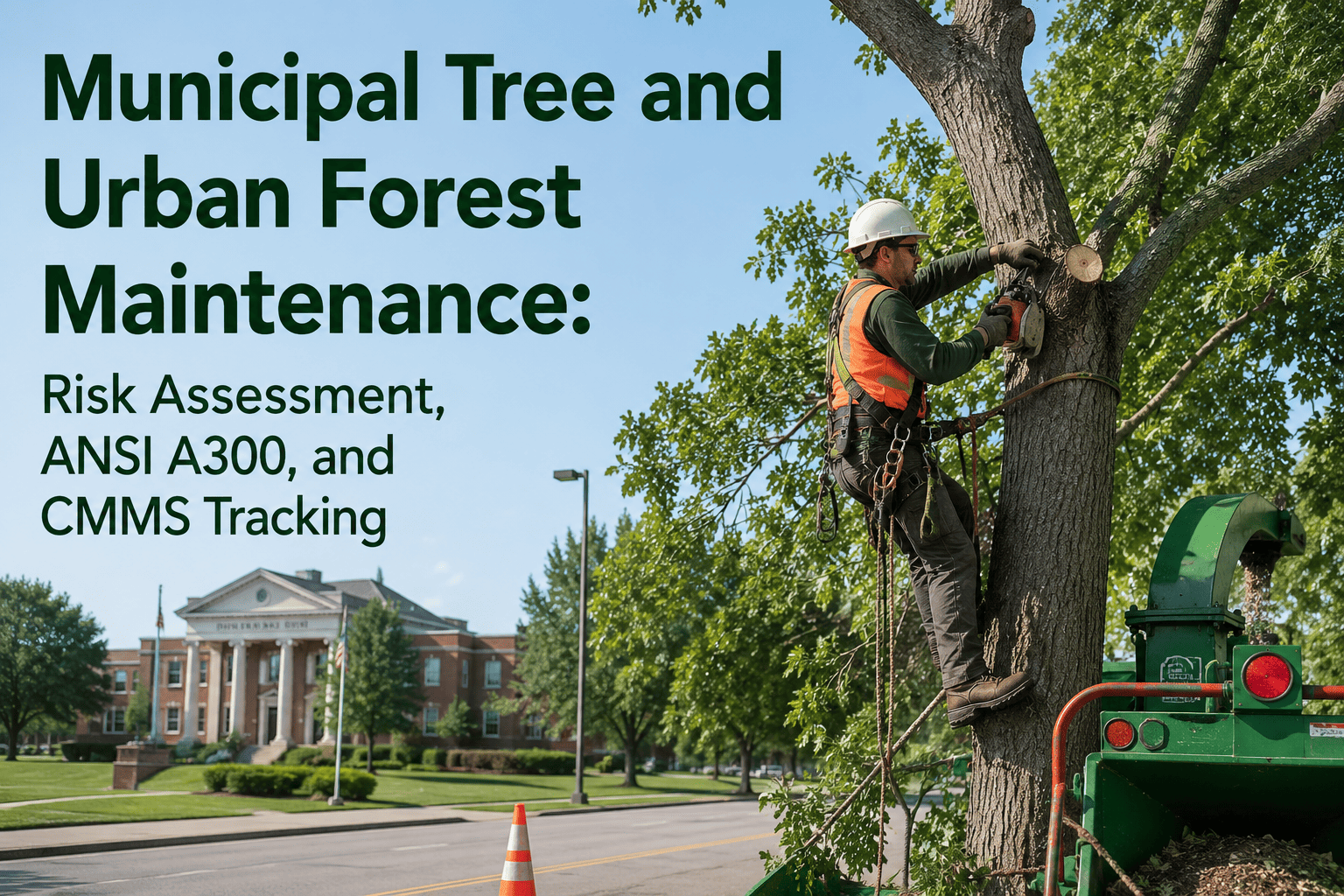
Municipal Tree and Urban Forest Maintenance: Risk Assessment, ANSI A300, and CMMS Tracking

By James Smith on May 18, 2026

municipal-tree-urban-forest-maintenance-ansi-a300-risk

Municipal trees are public assets — and like any asset, they carry liability. A single unpruned tree that fails during a storm can cost a city hundreds of thousands in legal exposure. OxMaint's CMMS for urban forestry gives city arborists a structured platform to track inspections, schedule ANSI A300-compliant pruning, log risk assessments, and maintain audit-ready records that protect municipalities when incidents occur. Book a 15-minute demo to see how cities manage their urban forest as a tracked asset portfolio.

Urban Forestry · ANSI A300 · Risk Assessment · CMMS

Municipal Tree & Urban Forest Maintenance: Risk Assessment, ANSI A300, and CMMS Tracking

How city arborists use structured maintenance programs — ANSI A300 pruning cycles, ISA risk ratings, removal triggers, and replanting schedules — tracked in CMMS to protect the public and limit municipal liability.

36M+
Street trees managed by U.S. municipalities
$2.4B
Annual urban tree maintenance spend nationally
73%
Of cities lack a formal tree inventory system
3–5yr
ANSI A300 pruning cycle for most street trees
Why It Matters

The Hidden Liability in Every City Block

Most city departments track potholes and street lights. Very few track trees with the same rigor — despite the fact that a failed tree limb creates the same tort exposure as a failed sidewalk. ISA research shows structured tree risk assessment programs reduce failure-related incidents by over 60% compared to reactive-only approaches.

HIGH RISK
Codominant Stems
Included bark between competing leaders — primary structural failure point. Requires ISA risk rating and priority pruning or removal trigger.
MODERATE
Crown Deadwood >2"
Dead branches above pedestrian or vehicle zones. ANSI A300 Part 1 specifies removal. Inspection cycle determines scheduling.
MODERATE
Root Zone Conflicts
Pavement heave, utility conflict, or construction proximity reducing structural stability. Risk escalates after storm events.
MONITOR
Canopy Asymmetry
One-sided growth creating wind load imbalance. Structural pruning recommended within next scheduled cycle — not immediate removal trigger.
ANSI A300 Standard

What ANSI A300 Requires — and What Gets Missed

ANSI A300 Part Scope Typical Cycle Common Gap
Part 1 — Pruning Crown cleaning, thinning, raising, reduction, structural 3–5 years No documented inspection triggering work order
Part 2 — Soil Management Aeration, amendment, compaction relief in root zone As needed Rarely performed; no tracking mechanism
Part 3 — Supplemental Support Cabling, bracing, guying for structural defects Annual inspection Cable inspections not scheduled; hardware ages past rated life
Part 6 — Planting Species selection, planting specs, establishment care 3-year establishment period Post-planting care not tracked; mortality rate unknown
Part 9 — Integrated Pest Mgmt Monitoring, threshold-based intervention, record keeping Seasonal Chemical application not logged; no outbreak pattern data
ISA Risk Framework

How ISA Tree Risk Assessment Works in Practice

01
Identify Defects
Structural defects, root problems, canopy condition, pest or disease signs — each mapped to a likelihood of failure rating: Low, Medium, High, or Very High.
02
Assess Failure Consequence
What is the target? Pedestrian path, roadway, parked vehicles, playground. Consequence of failure ranges from Negligible to Catastrophic based on occupancy and exposure.
03
Calculate Risk Rating
Likelihood × Consequence = Risk. Low/Moderate risk enters the routine pruning queue. High/Extreme risk triggers priority work order and may trigger removal evaluation.
04
Assign Mitigation and Timeline
Each risk rating produces a recommended action (prune, cable, monitor, remove) and response timeframe (immediate, within 30 days, next scheduled cycle). CMMS creates and tracks the work order.

Track Every Tree. Prove Every Inspection. Limit Every Liability.

OxMaint gives city arborists a CMMS built for urban forestry — tree inventory, ISA risk ratings, ANSI A300 pruning schedules, and removal records in one audit-ready platform.

CMMS for Urban Forestry

What a Tree Inventory CMMS Record Contains

ID
Tree Identifier & Location
GIS coordinates, street address, block face, GPS pin — every tree uniquely identified and locatable on a map.
SP
Species & Age Data
Species, DBH (diameter at breast height), estimated age, canopy spread — inputs for lifecycle planning and replanting species selection.
RK
Current Risk Rating
ISA risk rating from last assessment, date assessed, assessing arborist, and recommended action with target completion date.
PM
Maintenance History
Every pruning event, cable inspection, pest treatment, and soil intervention — date, crew, method, and cost — searchable against the tree record.
WO
Open Work Orders
Scheduled and reactive work orders linked to the tree — assigned crew, status, and target date visible to supervisors in real time.
LB
Liability Record
Inspection log with timestamps and named inspectors — the audit trail that demonstrates due diligence when a failure occurs near a city tree.
Expert Perspective

What Urban Forestry Professionals Say

"
Cities that cannot produce inspection records and risk assessments when a tree failure results in injury are in an extremely difficult legal position. Courts do not accept verbal testimony that inspections occurred — they want dated, signed documentation. A CMMS that creates a timestamped inspection record for every tree in the inventory is not just an operational tool; it is the municipality's primary defense against negligence liability. The standard has shifted: documented, systematic inspection is now the expected duty of care for any city managing trees over public space.
Dr. E. Thomas Smiley, PhD
Board Certified Master Arborist · Senior Research Scientist, Bartlett Tree Research Laboratories · Co-author, ISA Tree Risk Assessment Manual · 35 years urban tree failure investigation
60%+
Reduction in tree failure incidents with structured ISA risk assessment programs vs reactive-only management
$500K+
Average municipal liability exposure per serious injury from documented tree failure on public property
73%
Of U.S. cities lack a formal, documented tree inventory — the baseline requirement for defensible risk management
Removal & Replanting

When Removal Is the Right Decision — and What Comes Next

Removal Triggers
ISA Extreme risk rating with no cost-effective mitigation
Greater than 50% crown dieback with structural compromise
Root rot confirmed at greater than 30% basal area
Confirmed emerald ash borer or Dutch elm disease — eradication protocol
Utility conflict requiring greater than 25% crown removal to clear
Replanting Standards
1-for-1 canopy replacement minimum — many cities require 2-for-1
Species diversity target: no more than 10% of inventory in one species
Site suitability assessment before species selection
3-year establishment care plan: watering, mulching, structural pruning
CMMS tracking from planting date through establishment sign-off

See OxMaint Running a Municipal Tree Inventory.

Tree asset records · ISA risk rating tracking · ANSI A300 pruning schedules · Removal and replanting documentation · Liability-ready audit trail. Every tree. Every inspection. Every work order.
FAQ

Municipal Tree Maintenance — Common Questions

Does OxMaint support GIS mapping for municipal tree inventories?
Yes. OxMaint links each tree asset record to GPS coordinates, allowing city arborists to view tree locations on a map, filter by risk rating, and dispatch crews to specific block faces. The location data also integrates with 311 citizen request systems so tree service requests are automatically linked to the correct asset record. Sign in to configure GIS-linked tree inventory in OxMaint. For implementation questions, book a demo with the OxMaint team.
How does a CMMS help with ANSI A300 compliance documentation?
ANSI A300 standards require that work is performed according to current standards of practice — but they do not mandate a specific documentation format. What matters for audit and liability purposes is that work is documented: what was done, when, by whom, and on which tree. OxMaint creates a timestamped work order record for every pruning, cabling, and inspection event, linked to the tree's asset record and retrievable by inspectors on demand. Start building your ANSI A300 documentation record in OxMaint.
Can OxMaint track both city-maintained and contractor-maintained trees in the same system?
Yes. OxMaint supports work orders assigned to internal crews and external contractors within the same asset record. When a contractor completes a pruning cycle, the work order is closed with completion notes, photos, and crew details — all linked to the tree record. City staff can see contractor work history alongside in-house maintenance without managing two separate systems. Book a demo to see contractor work order management in OxMaint.
What is the best way to prioritize which trees to inspect first when building a new inventory?
Most city arborists start with trees in high-target zones — pedestrian paths, playgrounds, school zones, and high-traffic corridors — because the consequence of failure in these locations is highest. Within those zones, large-diameter trees (DBH over 18 inches) and known high-risk species in your region get priority. OxMaint lets you tag trees by zone and risk tier so inspection crews work through the highest-consequence areas first, and the system generates a prioritized work queue automatically. Sign in to configure zone-based inspection prioritization in OxMaint.

Share This Story, Choose Your Platform!