Federal NEVI funding requires a 97% uptime guarantee — but most government agencies have no systematic process to track EVSE failures, dispatch technicians, or document compliance. OxMaint's CMMS for public sector EV infrastructure connects outage detection to work order dispatch, tracks SLA compliance for ChargePoint, EVgo, and Blink networks, and generates the uptime documentation NEVI auditors require. Book a 15-minute demo to see how government agencies protect their NEVI funding through structured EVSE maintenance.
NEVI · EVSE · ChargePoint · Government CMMS
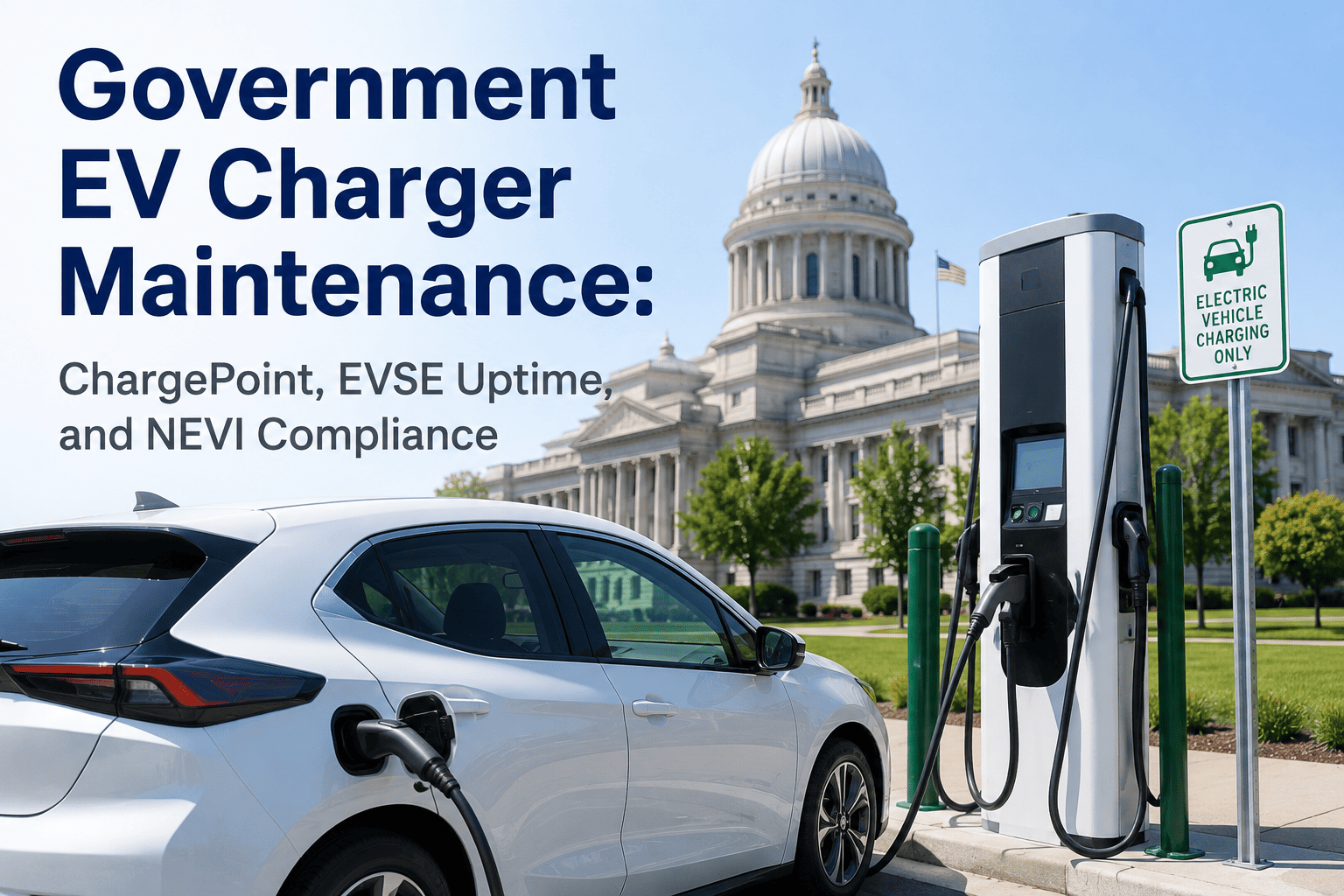
Government EV Charger Maintenance: ChargePoint, EVSE Uptime, and NEVI Compliance
NEVI mandates 97% uptime. Most government agencies have no way to prove it. Here is how structured EVSE maintenance — with CMMS-driven dispatch and documented SLA tracking — closes that gap.
NEVI Uptime Requirement
97%
per station per year
≈ 263 hours of allowed downtime annually per charger. One unmanaged failure lasting 11 days can put a station out of compliance.
The Compliance Problem
Why Government Agencies Are Failing NEVI Audits
01
No Outage-to-Dispatch Connection
Network alerts from ChargePoint or Blink arrive in email. No one assigns a work order. Hours pass before anyone responds — hours that count against the 97% uptime clock.
02
No Uptime Documentation
When a FHWA auditor asks for uptime records, agencies produce network screenshots — not structured uptime logs with incident timestamps, response times, and restoration evidence.
03
SLA Not Enforced on Vendors
ChargePoint and EVgo contracts specify response and repair SLAs. Without a CMMS tracking actual response times against contracted SLAs, agencies cannot enforce penalties or demonstrate compliance.
04
No Preventive Maintenance Cycle
EVSE requires scheduled PM: connector inspection, firmware updates, cable integrity checks, pedestal cleaning, and electrical connection torque checks. Without scheduling, failures are always reactive.
NEVI Requirements
What NEVI Actually Requires — Translated for Maintenance Teams
| NEVI Requirement |
Specific Standard |
Maintenance Implication |
CMMS Role |
| Uptime Standard |
97% per EVSE port, measured annually |
Outages must be detected and resolved within hours, not days |
Auto-create WO on outage alert; timestamp restoration |
| Response Time |
Initial response within agreed SLA (typically 4–24 hrs) |
Vendor SLA clock starts at outage detection, not report |
Track response time per incident against SLA threshold |
| Data Reporting |
Uptime and session data reported to FHWA via OCPI/OCPP |
Network and maintenance data must be reconcilable |
CMMS records link to network outage timestamps for audit |
| Pricing Transparency |
Per-kWh pricing, credit card acceptance required |
Payment system PM included in charger maintenance scope |
Payment hardware inspection included in PM checklist |
| ADA Compliance |
ADAAG requirements for accessible charging spaces |
Site condition inspections must include ADA elements |
ADA checklist items in EVSE site inspection WO template |
Maintenance Program
Government EVSE Preventive Maintenance Schedule
Monthly
Visual inspection — connector condition, cable jacket, display screen
Pedestal and housing integrity check
Firmware version verification
Payment terminal test transaction
Lighting and signage condition
Quarterly
Connector torque check and contact cleaning
Electrical connection retorque at panel
GFCI and ground fault protection test
Thermal scan of electrical connections
ADA accessibility site inspection
Annual
Full electrical inspection by licensed electrician
Cable replacement assessment (DCFC: 5-year typical life)
Network connectivity and OCPP compliance test
SLA vendor performance review against CMMS data
Uptime calculation and NEVI documentation package
Protect Your NEVI Funding. Document Every Hour of Uptime.
OxMaint connects EVSE outage detection to maintenance dispatch, tracks SLA compliance per vendor and charger, and generates the uptime documentation FHWA auditors require. Book a demo to see it live.
Expert Perspective
What EV Infrastructure Experts Say About Government EVSE Maintenance
"
The 97% NEVI uptime requirement is a maintenance engineering challenge, not just a network management challenge. Government agencies that treat EVSE uptime as a software metric — something the charger network monitors automatically — will fail audits. Uptime is a function of preventive maintenance quality, response time discipline, and documented restoration. Agencies need CMMS integration with their network management systems so that every outage generates a traceable work order and every restoration generates a timestamped record. Without that link, proving 97% uptime to a federal auditor is essentially impossible.
Dr. Gil Tal, PhD
Director, Plug-in Hybrid & Electric Vehicle Research Center · University of California Davis · Member, NEVI Formula Program Technical Advisory Group · Leading U.S. EV infrastructure reliability researcher
$5B
NEVI Formula Program funding — agencies must maintain 97% uptime to retain grants and avoid clawback risk
28%
Of public DCFC chargers found non-operational in J.D. Power 2023 study — a direct maintenance failure
4–24 hr
Typical vendor SLA response window — untracked, these SLAs are never enforced and downtime compounds
Vendor SLA Tracking
How to Hold ChargePoint, EVgo, and Blink to Their SLAs
1
Outage Detected
Network alert received from ChargePoint/EVgo portal. OxMaint auto-creates a work order with outage start timestamp — SLA clock begins.
2
Vendor Notified
WO assigned to vendor with SLA category tagged. Contracted response window (e.g. 4 hours for DCFC, 24 hours for L2) tracked against actual first response.
3
Resolution Documented
Technician closes WO with repair notes, parts replaced, and restoration timestamp. Total downtime calculated and logged against the charger's annual uptime record.
4
SLA Report Generated
Monthly and quarterly SLA performance reports show response time compliance per vendor, per charger, per site — ready for contract reviews and NEVI audits.
See OxMaint Managing Government EVSE Uptime in Real Time.
Outage-to-WO dispatch · SLA tracking per vendor · PM scheduling · Uptime documentation · NEVI audit package. Every charger. Every incident. Every hour counted.
FAQ
Government EV Charger Maintenance — Common Questions
Does OxMaint integrate directly with ChargePoint or EVgo network management portals?
OxMaint supports API integration with major EVSE network management systems including ChargePoint, EVgo, and Blink, allowing outage alerts to automatically trigger work orders in OxMaint. Where direct API integration is not available, OxMaint supports manual or email-triggered work order creation with timestamped logging. The key requirement for NEVI compliance is that every outage generates a traceable record with start time, response time, and restoration time — OxMaint provides this regardless of the integration method.
Book a demo to discuss your specific network configuration.
How does OxMaint calculate EVSE uptime for NEVI reporting purposes?
OxMaint calculates uptime per EVSE port by tracking the cumulative downtime from all work orders linked to that asset during the reporting period. The formula is: uptime % = (total hours in period − total downtime hours) / total hours in period × 100. This calculation is exportable as a structured report per station, per port, and per site — formatted to match FHWA NEVI reporting requirements. Planned maintenance windows can be flagged separately from unplanned outages.
Sign in to configure NEVI uptime reporting in OxMaint.
Can OxMaint track EVSE maintenance across multiple sites and multiple network providers?
Yes. OxMaint's asset hierarchy supports multi-site, multi-vendor EVSE portfolios — each charging station is a tracked asset with its own location, network provider, SLA tier, and maintenance history. A government fleet manager can view the uptime status of every charger across every site on a single dashboard, filter by vendor or location, and generate site-level or portfolio-level uptime reports. Multi-vendor SLA tracking is handled within a single CMMS instance.
Start building your EVSE asset inventory in OxMaint.
What EVSE preventive maintenance tasks should be included in a government PM schedule?
A government EVSE PM program should include monthly visual inspections, quarterly electrical connection retorque and GFCI testing, and annual full electrical inspections by a licensed electrician. For DCFC stations, cable and connector condition assessment is critical — DCFC cables typically have a 5-year service life under normal use. ADA accessibility checks, payment terminal testing, and firmware verification rounds out the PM scope. OxMaint provides configurable PM checklists for L1, L2, and DCFC stations that can be assigned to internal staff or contracted vendors.
Book a demo to see the EVSE PM checklist templates in OxMaint.