A municipal roof failing prematurely does not just cost the city a replacement — it triggers insurance claims, disrupts public services, and in many cases represents a capital expenditure that could have been deferred 10 to 15 years with proper preventive maintenance. OxMaint's CMMS for government facilities tracks TPO, EPDM, and built-up roof systems through their full lifecycle — warranty milestones, infrared scan results, membrane condition assessments, and CapEx prioritization — so facilities directors can defend roof budgets with data. Book a 15-minute demo to see how cities manage roof assets as a tracked capital portfolio.
TPO · EPDM · Built-Up Roof · Municipal CapEx · CMMS
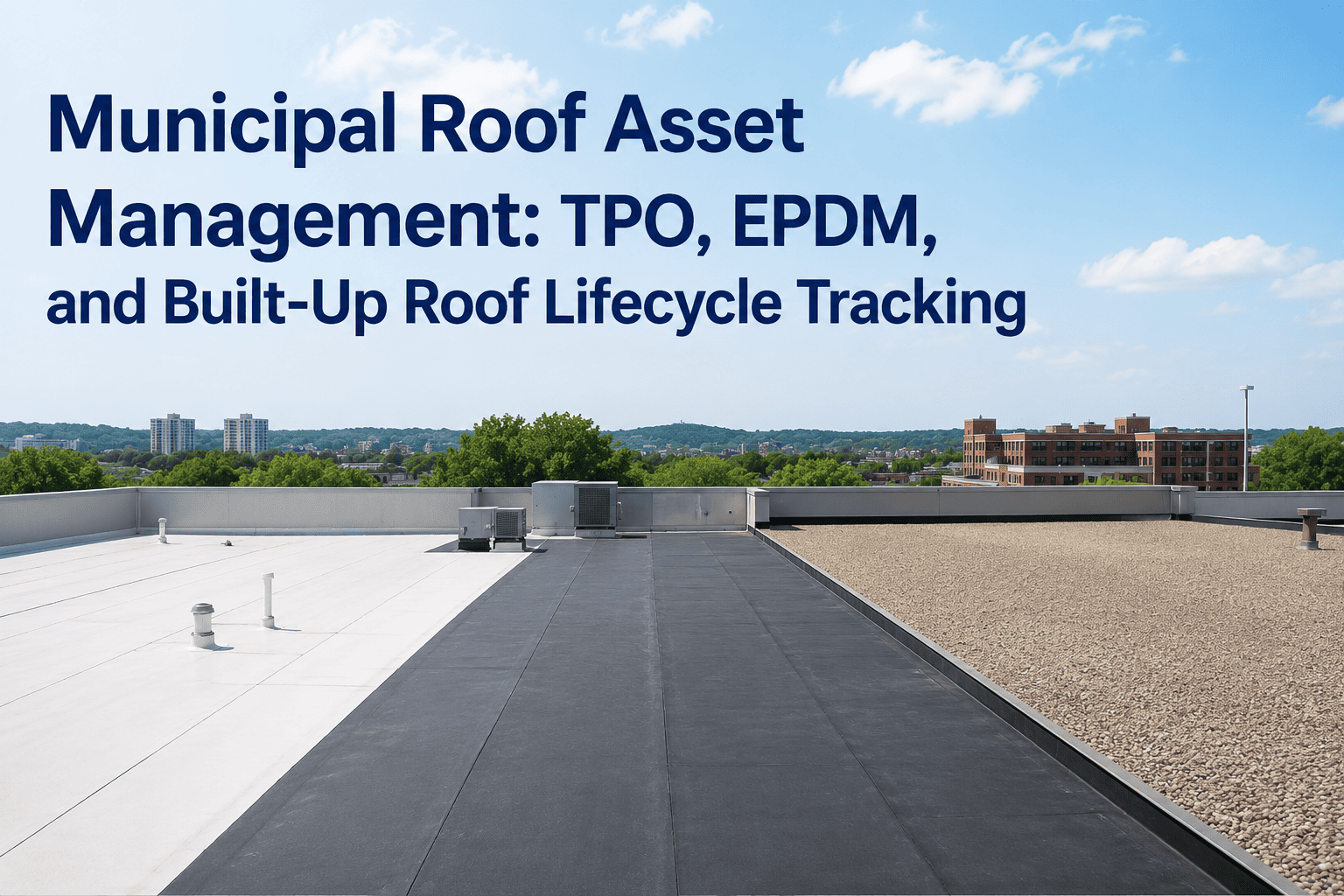
Municipal Roof Asset Management: TPO, EPDM, and Built-Up Roof Lifecycle Tracking
Most cities replace roofs reactively — after leaks damage interiors and records show the roof was last inspected six years ago. Structured roof lifecycle tracking changes that calculus entirely.
Roof System Expected Lifespans
Modified Bitumen
15–20 yr
Actual life varies significantly based on maintenance program quality and inspection frequency
The Real Problem
Why Municipal Roofs Fail Prematurely
IR
No Infrared Scan Program
Infrared thermography detects wet insulation — the primary driver of premature failure — years before visible leaks appear. Cities without scan programs replace roofs that could be repaired.
WR
Warranty Not Tracked
A 20-year manufacturer warranty on a TPO membrane provides material coverage — but only if the city submits inspections per the warranty schedule. Missed inspections void warranty coverage.
PM
Drain and Flashing PM Skipped
Ponding water from clogged drains degrades membrane chemistry regardless of membrane type. Flashing failures at penetrations and parapets account for over 80% of commercial roof leaks.
RX
No CapEx Prioritization Data
Without condition scores and lifecycle age data across the roof portfolio, facilities directors cannot prioritize which buildings need budget in year 1 vs year 5. Decisions become political, not data-driven.
Membrane Comparison
TPO vs EPDM vs Built-Up: What Maintenance Programs Look Like
| Roof System |
Primary Failure Modes |
Annual PM Tasks |
Infrared Scan Trigger |
Replacement Indicator |
| TPO Single-Ply |
Seam separation, UV brittleness, punctures at HVAC penetrations |
Seam inspection, drain cleaning, penetration flashing check |
Every 3–5 years or after major storm |
Seam failure rate greater than 5% of roof area |
| EPDM Rubber |
Shrinkage at perimeter, lap seam adhesive failure, puncture damage |
Perimeter inspection, lap seam resealing, drain PM |
Every 5 years after year 10 |
Membrane shrinkage pulling off parapets |
| Built-Up Roof (BUR) |
Blister formation, surfacing erosion, flashing base failure |
Blister mapping, surface coat inspection, flashing PM |
Every 5–7 years |
Greater than 25% wet insulation by IR scan |
| Modified Bitumen |
Granule loss, lap seam cracking, thermal cycling fatigue |
Granule level check, seam inspection, drain cleaning |
Every 3–5 years after year 8 |
Brittle membrane, extensive lap cracks |
Expert Perspective
What Roofing Engineers Say About Municipal Roof Programs
"
Every dollar spent on preventive roof maintenance and annual inspection saves between four and eight dollars in avoided premature replacement costs. Municipal roof programs that treat the roof as a capital asset — tracked from installation with condition assessments, infrared scans, and warranty milestone inspections — routinely achieve the full design life of the membrane. Programs that treat roofing as reactive maintenance are on a 12 to 15 year replacement cycle for systems designed to last 25 years. The difference is not luck or climate. It is whether someone is looking at the roof on a schedule or waiting for the ceiling tile to collapse.
Thomas W. Smith, RRC, FRCI
Fellow, Roofing Consultants Institute · Registered Roof Consultant · Past President, RCI International · 30+ years government and institutional roof consulting
4–8x
Return on preventive roof maintenance investment vs reactive replacement cost per dollar spent
80%
Of commercial roof leaks originate at flashings and penetrations — the highest-value PM targets
12–15yr
Actual replacement cycle for reactively-managed roofs designed for 20–30 year life
Track Every Roof. Prove Every Inspection. Defend Every CapEx Request.
OxMaint gives municipal facilities directors a CMMS that tracks roof condition, warranty milestones, infrared scan results, and lifecycle age — so CapEx decisions are made with data, not guesswork.
CMMS Tracking
What a Municipal Roof Asset Record in OxMaint Contains
Asset ID
Building name, roof section identifier, area in square feet, system type, installation date, and installer/contractor name.
Warranty
Manufacturer warranty terms, expiry date, required inspection schedule to maintain coverage, and warranty claim history.
Condition
Last condition rating (1–5 scale), inspection date, inspector name, defects noted, and recommended action with priority level.
IR Scan
Infrared scan date, provider, wet insulation percentage found, scan report attached, and next scheduled scan date.
PM History
Every drain cleaning, flashing repair, seam reseal, and surface coat event — date, crew, cost, and materials used — against the roof asset record.
CapEx Flag
Replacement year estimate, projected replacement cost, priority tier (immediate / 1–3 yr / 3–5 yr), and budget cycle year tagged for capital planning.
See OxMaint Running a Municipal Roof Portfolio.
Roof asset register · Warranty tracking · Condition scoring · Infrared scan records · CapEx prioritization. Every roof. Every inspection. Every dollar justified.
FAQ
Municipal Roof Asset Management — Common Questions
How does OxMaint help municipalities prioritize which roofs need CapEx budget first?
OxMaint assigns a condition score and lifecycle age to each roof asset, allowing facilities directors to rank the entire roof portfolio by urgency. A roof with a condition score of 2 out of 5, a lifecycle age of 90%, and active warranty concerns ranks ahead of a newer roof with minor defects. This data is exportable as a prioritized CapEx list that can be presented directly to budget committees — replacing subjective facility manager judgment with objective asset data.
Sign in to configure roof condition scoring in OxMaint.
How often should municipal roofs be professionally inspected?
Industry standard is a minimum of two professional inspections per year — spring and fall — plus an inspection within 48 hours of any significant storm event. Warranty-backed inspections may have additional requirements specified by the manufacturer. Internal monthly walkthroughs by facilities staff should check drains, visible membrane condition, and HVAC penetrations. OxMaint schedules all inspection types as recurring work orders so nothing is missed.
Book a demo to see the municipal roof inspection scheduling workflow in OxMaint.
Can OxMaint track roofing warranties and alert the facilities team before coverage lapses?
Yes. Each roof asset record in OxMaint includes warranty type (manufacturer membrane warranty, contractor workmanship warranty), expiry date, and required inspection schedule for warranty maintenance. OxMaint generates alerts before warranty milestone inspection deadlines and flags roofs approaching warranty expiry so the facilities team can arrange final warranty inspections and negotiate extended coverage before the original warranty closes.
Start tracking roof warranties in OxMaint.
What is the right infrared scan frequency for a municipal roof portfolio?
The National Roofing Contractors Association recommends infrared scanning every 3 to 5 years as part of a proactive roof management program, with scans triggered sooner after significant storm events or when visual inspections identify suspected moisture intrusion. For a municipal portfolio, the most cost-effective approach is scanning the oldest and lowest-condition roofs annually while scanning newer, well-maintained roofs on the 5-year cycle. OxMaint tracks scan dates and results per roof section and schedules the next scan automatically.
Book a demo to see how infrared scan scheduling works in OxMaint.