A government data center's HVAC failure is simultaneously an IT incident and a facilities maintenance event — but in most municipalities, the CMMS and the CMDB are completely separate systems with no shared data. The IT team opens a P1 incident while the facilities team generates a work order, and neither system knows the other exists until the postmortem. OxMaint's CMMS integrates with IT CMDB platforms to create a single asset record for shared OT/IT infrastructure — cooling, power, physical security, and network — so government CIOs get the operational visibility that audit frameworks and zero-trust architectures demand. Book a 15-minute demo to see how municipal CIOs tie operational maintenance data to their IT asset strategy.
Government CIO · CMDB · CMMS · OT/IT Convergence
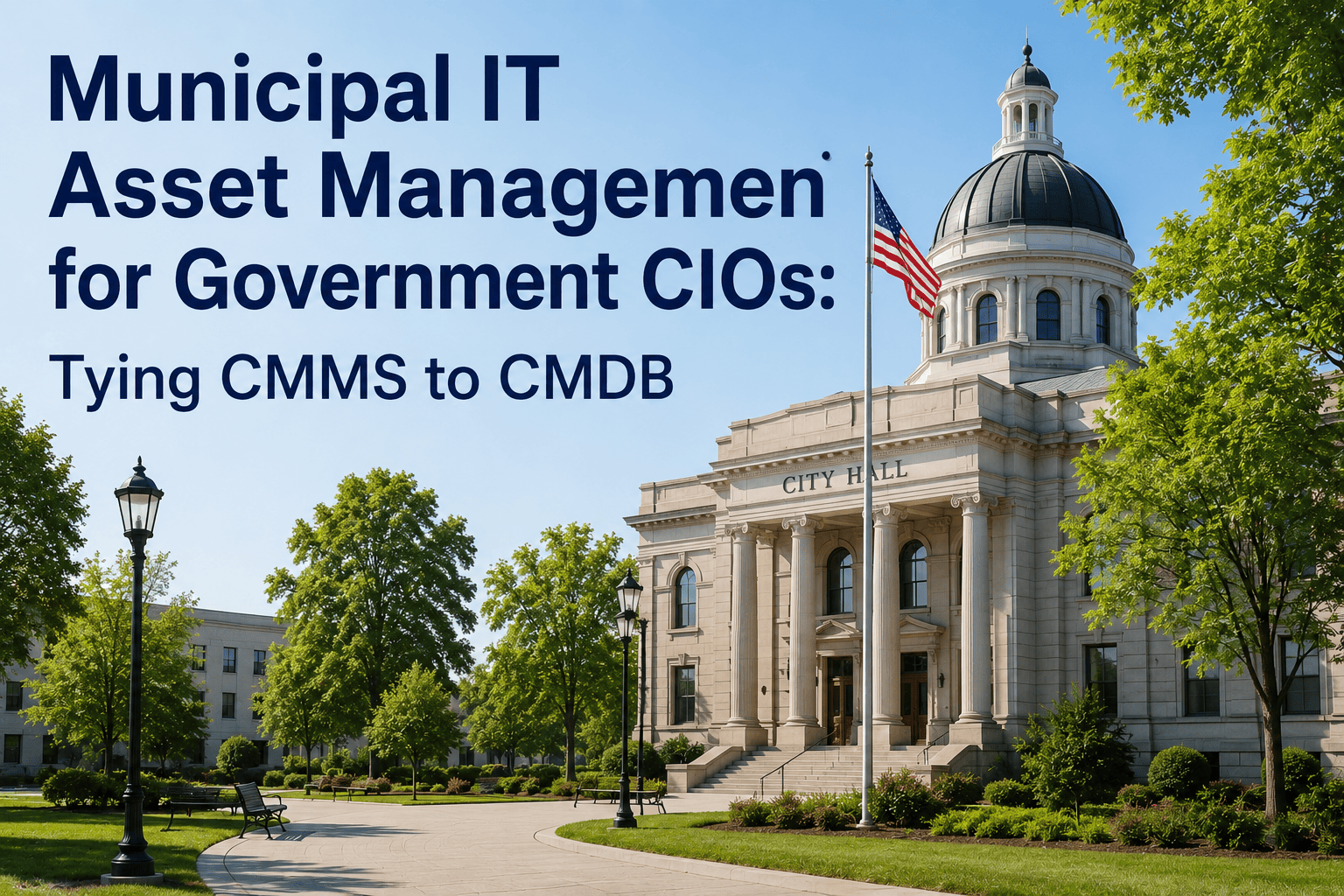
Municipal IT Asset Management for Government CIOs: Tying CMMS to CMDB
The assets that keep government IT running — UPS systems, computer room air conditioning, physical access controls, fiber runs — live in facilities CMMS. The services they support live in IT CMDB. The gap between them is where municipal CIOs have their worst audit findings.
The Core Problem
Where the CMMS-CMDB Gap Creates Real Risk
Audit Risk
FedRAMP / StateRAMP / SOC 2
Physical asset controls — power, cooling, access — must be documented in the IT risk framework. A CMDB with no connection to physical maintenance records fails continuous monitoring requirements in every major government cloud framework.
Incident Risk
Infrastructure Failure = IT Outage
When a CRAC unit fails in the server room, it is a P1 IT incident. When the UPS battery reaches end of life, it is a PM event in the facilities system. Neither team sees the other's data — until the failure happens simultaneously to both.
Planning Risk
Capital Budget Blindspot
IT CapEx for a server refresh is planned without visibility into the age and condition of the physical infrastructure supporting those servers. A $2M server procurement installed into a cooling system three years from replacement is a poor capital decision.
Security Risk
Physical Access Not in CMDB
Zero-trust architecture requires all access paths — physical and logical — to be in scope. Physical access control systems maintained in facilities CMMS but absent from the IT CMDB create gaps in the access control configuration record.
Asset Classification
Which Assets Live in CMMS, CMDB, or Both
| Asset Type |
Primary System |
Why CMMS Needs It |
Why CMDB Needs It |
Integration Value |
| UPS Systems |
Both |
Battery PM, load test scheduling, runtime logging |
IT service dependency, power chain for CI mapping |
Battery end-of-life visible to IT before failure |
| CRAC / CRAH Units |
Both |
Filter PM, refrigerant checks, coil cleaning schedules |
Cooling capacity for server rack CI in CMDB |
PM overdue status alerts IT of uptime risk |
| Physical Access Control |
CMMS primary |
Reader PM, lock hardware inspection, card system PM |
Access path in zero-trust scope |
Access system PM status in security configuration record |
| Fiber / Structured Cabling |
CMDB primary |
Pathway inspection, conduit PM where facilities-owned |
Network topology CI and connectivity mapping |
Physical pathway PM linked to logical circuit CI |
| Generators (IT-supporting) |
Both |
NFPA 110 PM, load bank tests, fuel polishing |
Power redundancy path in IT service continuity model |
Generator test status feeds IT BCP documentation |
Integration Architecture
How CMMS and CMDB Connect Without Replacing Either
01
Shared Asset Identifier
Each shared OT/IT asset has a single identifier present in both OxMaint and the IT CMDB (ServiceNow, Lansweeper, or equivalent). The CMMS record is the physical and maintenance source of truth. The CMDB record is the IT service and configuration source of truth. Both reference the same physical asset.
02
PM Status Sync
When a UPS battery PM is overdue in OxMaint, that status is synced to the UPS CI record in the CMDB — visible to IT operations teams as a risk flag on the CI. IT does not need to check the CMMS; the relevant operational status is surfaced where they work.
03
Incident Linkage
When an IT incident is opened for a CRAC failure, the CMDB CI links to the OxMaint asset record — giving the incident manager immediate visibility into the maintenance history, last PM date, and open work orders on the failed unit. Root cause analysis has physical context from day one.
04
Audit-Defensible Hierarchy
FedRAMP and StateRAMP continuous monitoring requires an asset inventory that accounts for all components in scope — including physical infrastructure. The CMMS-CMDB integration produces a combined asset register that satisfies both the IT audit (CMDB record) and the physical maintenance audit (CMMS record) from a single source.
Close the Gap Between Your Facilities CMMS and IT CMDB.
OxMaint gives government CIOs a CMMS that integrates with IT CMDB platforms — shared asset identifiers, PM status sync, and audit-defensible records for all OT/IT shared infrastructure. Book a demo to see the integration in action.
Expert Perspective
What Government Technology Leaders Say About OT/IT Asset Integration
"
Government CIOs increasingly face audit frameworks — FedRAMP, StateRAMP, CISA CSAF — that require a complete and accurate configuration management database covering all assets that support IT services. The problem is that the assets physically supporting those services — generators, UPS systems, cooling infrastructure, physical access controls — are managed in facilities CMMS systems that IT has no visibility into. The result is a CMDB that is accurate for logical assets and completely blind for physical supporting infrastructure. That gap is not just a compliance problem. It is a genuine risk management failure — you cannot assess the risk to a service if you do not know the condition of the infrastructure it depends on.
Dr. Alan Shark, DPA
Executive Director, Public Technology Institute · Affiliate Professor, Schar School of Policy and Government · Author, Technology and Public Management · 25 years advising municipal CIOs on IT governance and asset management
68%
Of state and local government CIOs report incomplete physical asset coverage in their CMDB per PTI 2024 survey
$4.2M
Average cost of a municipal data center outage — majority traceable to physical infrastructure maintenance failures
Top 3
FedRAMP audit finding: incomplete physical asset inventory — directly addressable by CMMS-CMDB integration
See OxMaint Bridging Government Facilities and IT Asset Management.
Shared OT/IT asset records · PM status visible to IT operations · Incident root cause with physical maintenance history · Audit-defensible asset hierarchy for FedRAMP and StateRAMP. One system. Both teams.
FAQ
Government CIO CMMS-CMDB Integration — Common Questions
Does OxMaint integrate with ServiceNow CMDB for government agencies?
Yes. OxMaint supports API-based integration with ServiceNow and other major ITSM/CMDB platforms used in government — including Remedy, Cherwell, and Jira Service Management. The integration creates shared asset records using a common identifier, allowing PM status, maintenance history, and open work orders from OxMaint to surface in the CMDB CI record. The integration is bidirectional — IT-raised incidents can automatically create facilities work orders in OxMaint.
Book a demo to discuss your specific CMDB integration requirements.
How does a government CIO make the business case for CMMS-CMDB integration to budget committees?
The most compelling business cases combine three arguments: audit compliance (FedRAMP, StateRAMP, and ISO 27001 all require physical asset coverage in the configuration record), risk reduction (the cost of a data center outage from unmanaged physical infrastructure typically exceeds $4M), and operational efficiency (eliminating duplicate work order management across IT and facilities reduces resolution time for shared-infrastructure incidents by an average of 40%). OxMaint can provide implementation cost and ROI data from comparable government deployments to support the budget case.
Sign in to access OxMaint government ROI case studies.
What is the OT/IT boundary — and how do you decide which assets belong in CMMS vs CMDB?
The practical boundary is operational control responsibility. Assets where the primary management question is physical condition, maintenance scheduling, and lifecycle replacement (UPS batteries, CRAC units, generators, physical access hardware) belong primarily in CMMS. Assets where the primary management question is logical configuration, software version, and service dependency (servers, switches, applications) belong primarily in CMDB. Shared assets — anything that is both physically maintained and logically configured — should have records in both systems with a shared identifier linking them. OxMaint helps government agencies map their OT/IT boundary as part of implementation.
Book a demo to walk through the OT/IT asset boundary mapping process.
Can OxMaint support a zero-trust architecture implementation in a government agency?
OxMaint contributes to zero-trust implementation specifically for physical asset control plane components — physical access control systems, network infrastructure, and building technology systems that are in scope for zero-trust security models. By maintaining accurate physical asset records with PM status, configuration history, and access control data, OxMaint provides the physical layer of the asset inventory that zero-trust frameworks require. This data integrates with the logical asset inventory in the CMDB to produce a complete asset register for zero-trust policy enforcement.
Start building your physical asset inventory for zero-trust compliance in OxMaint.