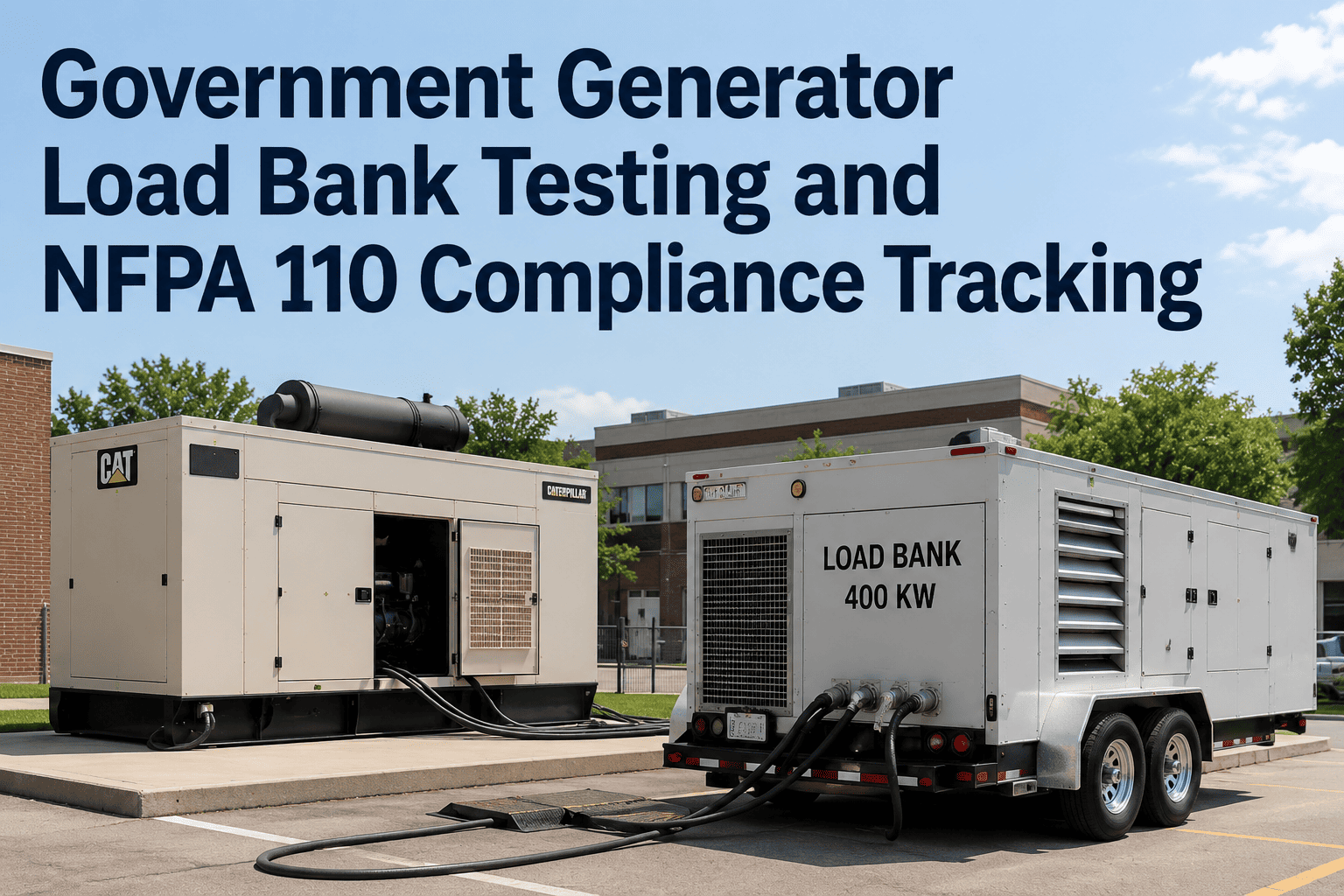
Government Generator Load Bank Testing and NFPA 110 Compliance Tracking

By James Smith on May 18, 2026

government-generator-load-bank-nfpa-110-compliance

A government emergency generator that has not been load bank tested in two years is not a backup power system — it is a liability that will fail when the grid goes down and lives depend on it. NFPA 110 mandates monthly exercise runs and annual full-load tests, but most public agencies run their generators on lightly loaded or no-load conditions and call it compliant. OxMaint's CMMS for government emergency power schedules and documents every NFPA 110 compliance event — monthly runtime logs, annual load bank tests, fuel polishing records, and ATS PM — so agencies can prove compliance before an audit and before a failure. Book a 15-minute demo to see how government facilities manage generator compliance in OxMaint.

NFPA 110 · Load Bank · Emergency Power · Government CMMS

Government Generator Load Bank Testing and NFPA 110 Compliance Tracking

Monthly run tests, annual load bank tests, fuel polishing, ATS preventive maintenance — and the documentation to prove every one of them when a regulatory inspector arrives.

NFPA 110 Compliance Calendar
Monthly
30-minute exercise run at rated load or per NFPA 110 Table 8.4.2
Quarterly
ATS operational test, battery load test, fuel level verification
Annual
Full load bank test at 100% rated kW for minimum 2 hours
As Needed
Fuel polishing, coolant flush, oil analysis, exhaust back-pressure check
What Gets Missed

The Four NFPA 110 Compliance Gaps That Cause Generator Failures

01
Wet Stacking from Under-Loading
Generators run at less than 30% load build up unburned fuel in the exhaust — wet stacking — that deposits on cylinder walls and turbochargers, causing premature failure and reducing output capacity. Load bank testing burns off deposits and verifies the engine can actually deliver rated power.
02
ATS Not Tested — Fails at Transfer
The Automatic Transfer Switch transfers load from utility to generator when power fails. An ATS that has not been operationally tested quarterly may fail to transfer — or transfer to a generator that won't start — exactly when the backup power chain is needed.
03
Degraded Fuel — Generator Won't Start
Diesel degrades over 6 to 12 months — microbial growth, water contamination, and oxidation cause filter plugging and injector damage. A government facility with a tank last polished three years ago has a generator that may not start reliably under extended outage conditions.
04
No Documentation — Failed Audit
The Joint Commission, CMS, NFPA, and state agencies require documented evidence of testing — not verbal confirmation. Agencies that perform tests but do not log them in an auditable system fail inspections even when the physical maintenance was performed correctly.
Load Bank Testing

What Happens During a Government Generator Load Bank Test

1
Pre-Test Inspection
Fluid levels, battery condition, coolant concentration, exhaust system, fuel filter status, and alternator connections checked and documented before load application.
2
Step Load Application
Load bank applied in steps: 25%, 50%, 75%, and 100% of rated kW — each step held for 30 minutes. Voltage, frequency, and temperature recorded at each stage.
3
Full Load Hold
Generator held at 100% rated load for minimum 2 hours per NFPA 110. Oil pressure, coolant temperature, exhaust temperature, and output voltage logged continuously.
4
Post-Test Documentation
Load bank test report completed with all recorded parameters, deficiencies noted, and pass/fail determination. Report uploaded to CMMS asset record — compliance documented and retrievable.
Compliance Reference

NFPA 110 Requirements by System Classification

NFPA 110 Class Max Outage Time Typical Application Monthly Test Annual Load Bank
Class X (10 sec) 10 seconds Critical care areas, ICU, OR 30 min at rated load 2 hr at 100% rated kW
Class 10 (10 sec) 10 seconds Emergency lighting, fire alarm 30 min at rated load 2 hr at 100% rated kW
Class 60 (60 sec) 60 seconds Data centers, municipal EOC 30 min at rated load 2 hr at 100% rated kW
Class 120 (2 min) 120 seconds Water treatment, corrections 30 min at rated load 2 hr at 100% rated kW

Never Fail an NFPA 110 Audit. Document Every Test, Every Time.

OxMaint schedules monthly runs, annual load bank tests, ATS PM, and fuel polishing — and creates the timestamped, audit-ready documentation that proves compliance to any inspector. Book a demo to see it working.

Expert Perspective

What Emergency Power Engineers Say About Government Generator Programs

"
The most common reason government generators fail during actual power outages is not mechanical deficiency — it is maintenance neglect that was never documented and therefore never corrected. Wet stacking from under-loaded monthly tests, degraded fuel from tanks that have not been polished in years, and ATS contactors that have never been operationally tested account for the majority of emergency generator failures I investigate. NFPA 110 is not a bureaucratic exercise. Every requirement in that standard exists because a generator failed in exactly that way, with consequences. Agencies that treat documentation as the compliance goal have it backwards — documentation is the evidence that real maintenance happened.
Mark Migliaro, PE, LEED AP
Principal Engineer, Electrical Systems Group · Past Chair, NFPA 110 Technical Committee · Fellow, IEEE Industry Applications Society · 28 years emergency power system design and failure investigation
72%
Of generator failures during actual outages are attributable to fuel system or maintenance issues — not mechanical defects
2 hr
Minimum NFPA 110 annual load bank duration at 100% rated kW — a test most facilities have never performed
$0
Cost of a monthly runtime log that prevents an audit failure — versus the cost of a failed compliance inspection

See OxMaint Managing Government Generator Compliance.

Monthly runtime scheduling · Annual load bank test records · ATS PM tracking · Fuel polishing schedule · NFPA 110 audit package. Every generator. Every test. Every document.
FAQ

Government Generator Compliance — Common Questions

What exactly does NFPA 110 require for monthly generator testing?
NFPA 110 Section 8.4.2 requires generators to be exercised at least monthly for a minimum of 30 minutes. The test must be conducted at a load that is at least 30% of the nameplate rating, or at a load that maintains exhaust gas temperatures at the manufacturer's recommended minimum level. A generator run at no load or minimal load does not satisfy NFPA 110 monthly test requirements. OxMaint logs each monthly run with start time, duration, load percentage, and operator signature — creating the documentation record auditors require. Sign in to configure monthly generator run scheduling in OxMaint.
How often should government facilities fuel polish their diesel generator tanks?
Diesel fuel stability depends on storage conditions, but the general industry standard for government facilities is fuel polishing and testing every 12 months for active backup generators, and every 6 months for generators in hot, humid climates where microbial growth is accelerated. A fuel sample should be tested for water content, microbial contamination, and fuel quality before each annual load bank test — and any fuel out of specification should be polished or replaced before the test. OxMaint schedules fuel polishing as a recurring work order and links the fuel test report to the generator's asset record. Book a demo to see fuel polishing scheduling in OxMaint.
Does OxMaint generate the compliance report documentation needed for Joint Commission or CMS inspections?
Yes. OxMaint's work order completion records include all fields required for NFPA 110 and Joint Commission Environment of Care documentation: test date, duration, load level, operator name, equipment identifier, deficiencies found, and corrective actions taken. These records are permanently stored and exportable as a structured compliance report — organized by equipment, date range, or inspection period — ready for Joint Commission, CMS, state health department, or FHWA inspectors. Start building your generator compliance documentation record in OxMaint.
What is the correct ATS preventive maintenance frequency for NFPA 110 compliance?
NFPA 110 requires ATS operational testing at least quarterly — the ATS must be tested for transfer from normal to emergency source and back. Annual PM should include contact inspection, electrical connection retorque, contact resistance measurement, and testing of all supervisory functions. For critical facilities (hospitals, EOC, corrections), many facilities engineers recommend semi-annual full operational tests. OxMaint schedules quarterly ATS operational tests and annual full PM as separate recurring work orders so neither task falls through the cracks. Book a demo to see ATS maintenance scheduling in OxMaint.

Share This Story, Choose Your Platform!