Government and municipal maintenance directors face a procurement landscape crowded with CMMS vendors making similar claims — yet the features that matter for public sector operations are fundamentally different from those built for private industry. Citizen accountability, audit trail requirements, GIS integration, offline mobile access for field crews, and role-based access across elected and appointed officials are non-negotiable in public sector deployments. This guide defines the features every government CMMS shortlist must include in 2026 — and explains why each one matters for your operations, compliance, and budget defence. OxMaint is built for public sector maintenance teams and delivers every feature on this list out of the box.
Top/Best · Government CMMS · Public Sector · 2026
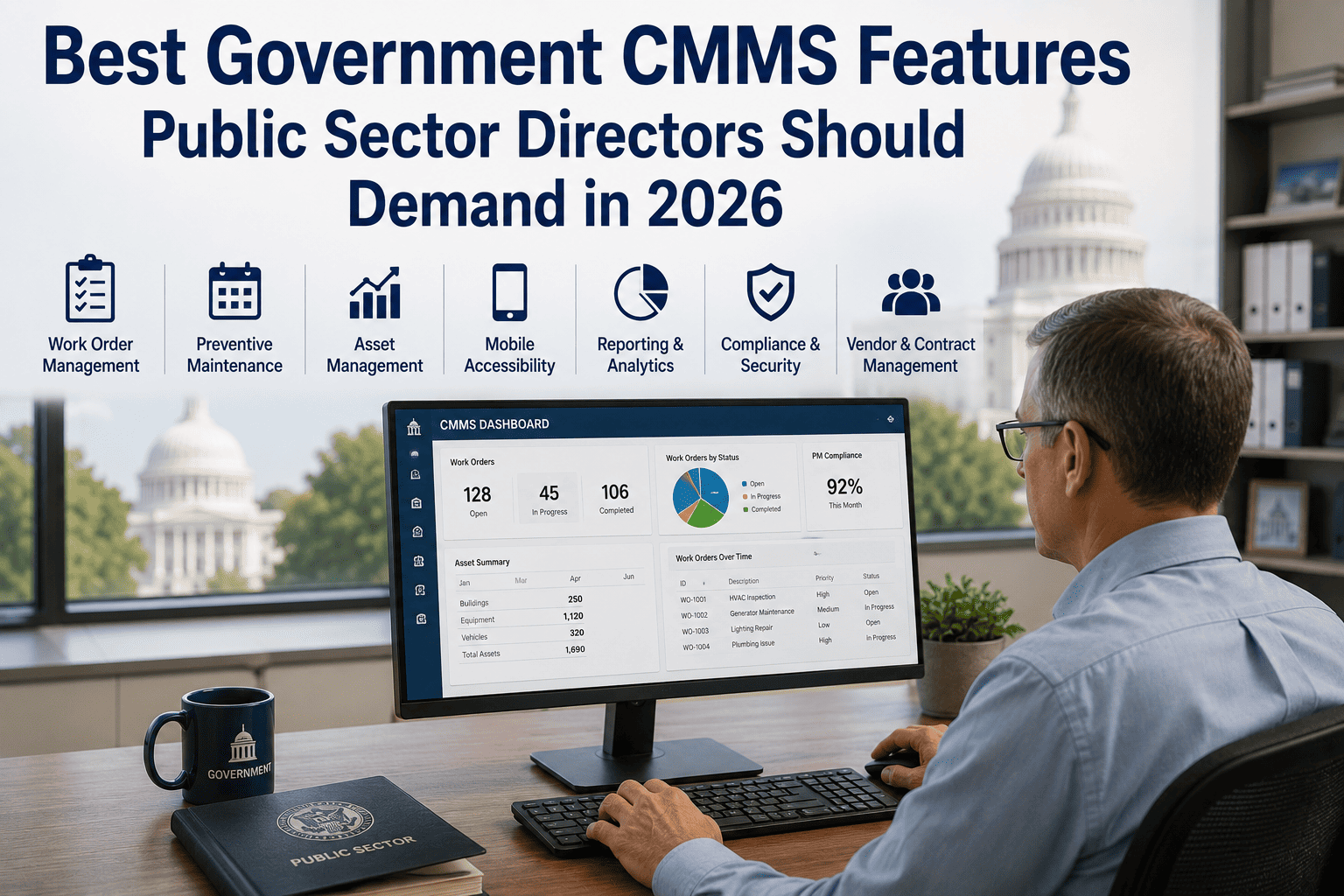
Best Government CMMS Features Public Sector Directors Should Demand in 2026
The definitive feature checklist for municipal and government CMMS procurement — citizen portal, GIS mapping, mobile offline, audit log, role-based access, and SSO explained with evaluation criteria
Why Government CMMS Needs Are Different
Private-sector CMMS is built around production uptime and cost efficiency. Government CMMS must also serve citizen accountability, public records requirements, multi-department coordination, union labour rules, elected official reporting, and federal grant compliance documentation. A CMMS that scores well on Gartner or G2 for manufacturing may fail completely in a public works or facilities context. The 12 features below are the ones that separate a government-grade CMMS from a system that creates more problems than it solves.
The 12 Must-Have Government CMMS Features — Ranked by Priority
Audit Trail & Immutable Work Order History
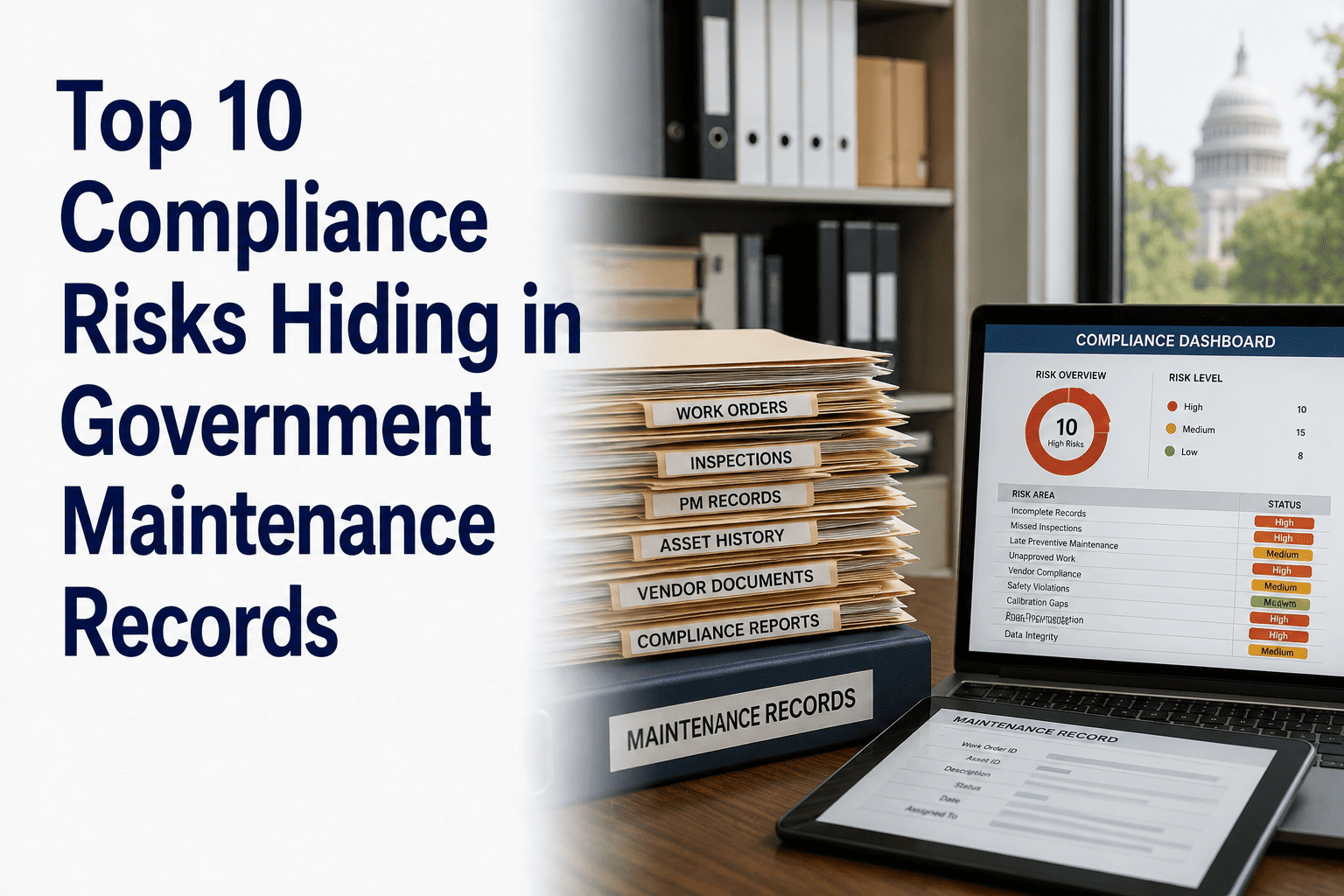
Every work order, PM completion, and asset update must be timestamped, technician-attributed, and tamper-proof. Government agencies are subject to public records requests, FOIA, and state audit requirements. A CMMS without a complete, uneditable audit log is a compliance liability — not an asset.
Evaluation test: Ask the vendor to show you the audit log for a deleted or modified work order. If they can't show the original record and who changed it, disqualify.
Role-Based Access Control (RBAC) with Elected Official View
Government CMMS users include field technicians, supervisors, department heads, city managers, elected officials, and external auditors — each needing different data access. RBAC must be granular enough to allow a council member read-only access to capital asset condition data without exposing personnel records or union grievance-linked work orders.
Evaluation test: Configure a custom role for an elected official with read-only access to asset condition and PM completion rate dashboards. If it takes more than 10 minutes, the system is too rigid.
Citizen Service Request Portal
Residents should be able to submit facility maintenance requests, pothole reports, or park equipment issues directly into the CMMS work order queue — without calling a department. The portal must be mobile-accessible, ADA-compliant, and generate automatic status notifications back to the citizen when the work order is updated or closed.
Evaluation test: Submit a test request through the citizen portal on a mobile phone. Verify it appears in the work order queue within 60 seconds and that a confirmation notification is sent to the submitter.
GIS / Map Integration
Public works assets — roads, stormwater infrastructure, parks, water mains — exist in geographic space. A CMMS that cannot display assets on a map forces field crews to navigate by address lists. GIS integration (ArcGIS, Google Maps API, or municipal GIS) enables map-based work order dispatch, asset proximity analysis, and infrastructure condition mapping for capital planning.
Evaluation test: Ask the vendor to show a live map view of all open work orders for a specific service zone, with the ability to click an asset on the map and view its PM history.
Mobile Offline Access
Government field crews work in basements, tunnels, remote parks, and underground infrastructure where cellular coverage is absent. A CMMS mobile app that requires connectivity to function is unusable for half the work a government maintenance team performs. Offline mode must allow full work order completion, photo capture, and checklist sign-off — syncing when connectivity returns.
Evaluation test: Put the mobile app in airplane mode. Complete a work order, attach a photo, and sign off. Restore connectivity and verify the record synced with all data intact.
Single Sign-On (SSO) — Active Directory / SAML 2.0
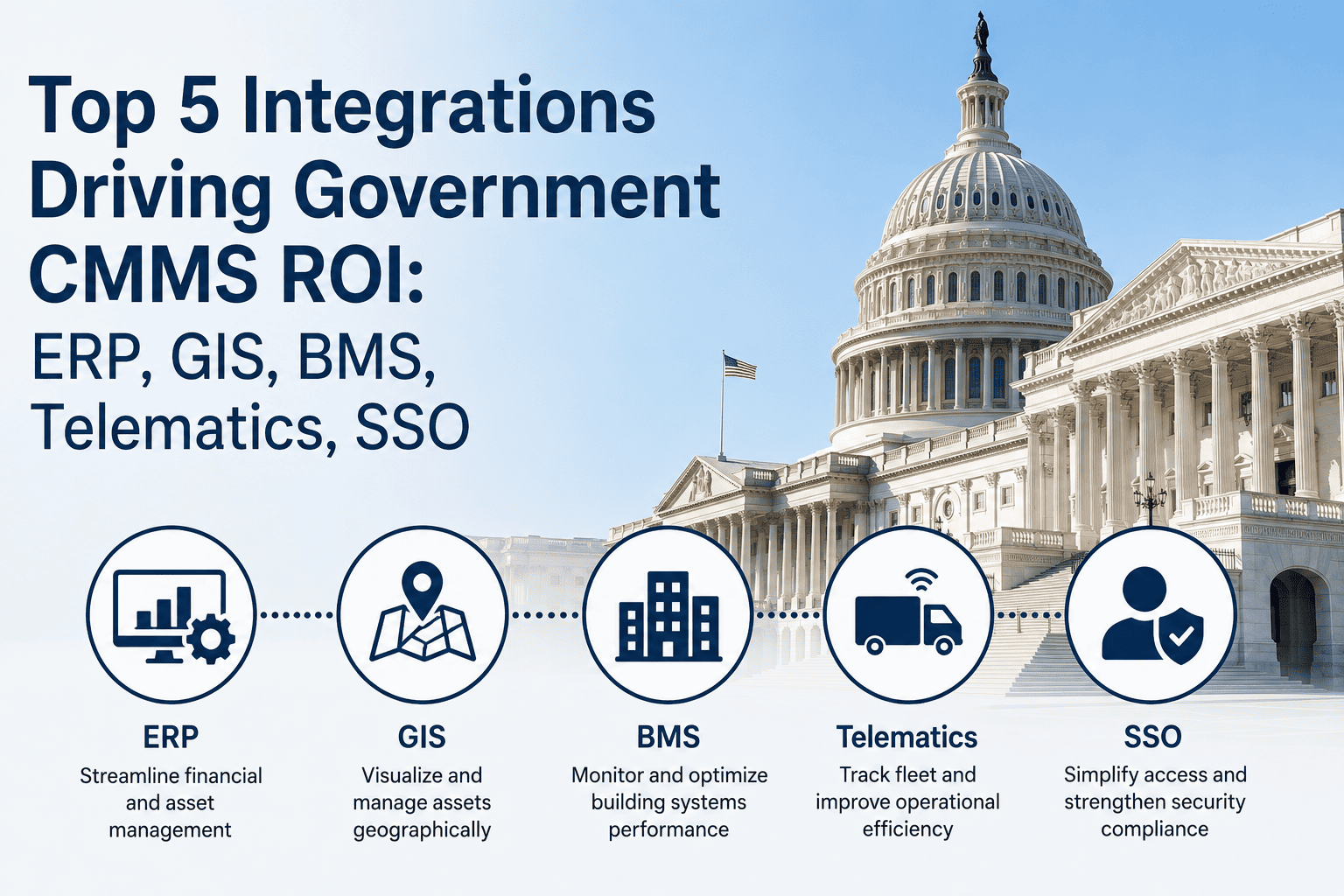
Government IT departments operate under strict identity and access management policies. A CMMS that requires separate credentials is a security risk and an IT support burden. SSO integration with Microsoft Active Directory, Azure AD, or SAML 2.0 identity providers ensures that user access is governed by the government's existing identity system — with automatic deprovisioning when employees leave.
Evaluation test: Request the vendor's SAML 2.0 integration documentation and confirm deprovisioning is automatic when a user is disabled in Active Directory.
Federal Grant & Capital Project Documentation
FEMA BRIC, BIL, EPA SRF, and other federal infrastructure grants require maintenance programme evidence as part of compliance reporting. A government CMMS must be able to tag assets and work orders to specific grant projects, generate grant-formatted maintenance reports, and document the maintenance investment that justifies grant drawdowns or renewal applications.
Evaluation test: Create a test grant project, tag five assets to it, and generate a maintenance activity report filtered to those assets for a 6-month period — in under 5 minutes.
Multi-Department & Multi-Site Management
A municipal government operates public works, parks, facilities, water/wastewater, and fleet — often as separate departments with their own budgets, crews, and reporting chains. The CMMS must allow each department to operate independently while providing city management with a consolidated cross-department view. Shared asset visibility (e.g., a vehicle pool) with department-level cost allocation is essential.
Evaluation test: Set up two departments with separate technician pools and budgets. Assign a shared asset to both. Verify that each department sees only its own cost data while the admin sees the consolidated view.
Compliance Certificate & Inspection Expiry Tracking
Government facilities have a dense compliance calendar — elevator certifications, fire alarm inspections, HVAC permits, backflow preventer tests, playground safety inspections, and vehicle emissions compliance. A CMMS must track every certificate expiry date and auto-generate renewal work orders before deadlines pass. Missed statutory deadlines create regulatory penalties and legal liability for elected officials.
Evaluation test: Enter 10 assets with compliance due dates at varying intervals. Verify that the system auto-generates PM work orders 30 days before each due date and escalates if uncompleted.
Asset Condition & Capital Planning Reports
Government budget cycles require multi-year capital planning supported by current asset condition data. A CMMS must generate condition assessment reports by asset type, age, and maintenance history — enabling public works directors to justify capital replacement requests to councils and budget committees with data, not opinion.
Evaluation test: Generate an asset condition summary report for all HVAC units over 15 years old, showing maintenance cost trend, PM completion rate, and estimated remaining service life — in one export.
Union Labour Rule Configuration
Government maintenance departments governed by collective bargaining agreements have specific rules on overtime authorisation, task assignment by trade classification, and callback protocols. A CMMS that cannot enforce these rules in the work order assignment workflow forces supervisors to manually check compliance — and creates grievance risk when assignments are made incorrectly.
Evaluation test: Ask the vendor to demonstrate how the system handles trade-classified task assignment and overtime approval workflows. If it's manual, budget for compliance risk.
Public-Facing Dashboard for Elected Officials
Councils and boards increasingly demand real-time maintenance performance data — PM completion rates, response times to citizen requests, infrastructure condition scores, and maintenance budget utilisation. A CMMS with a configurable public-facing or board-facing dashboard eliminates the monthly manual report and gives elected officials the transparency they (and the public) expect.
Evaluation test: Configure a read-only dashboard showing PM completion rate, citizen request response time, and top 10 assets by maintenance cost this year. Share it via a link without requiring a login.
OxMaint Delivers Every Feature on This List — Out of the Box
From citizen portals to GIS mapping, audit trails, and federal grant documentation — OxMaint is purpose-built for government and municipal maintenance teams. See a live demo configured for your department type.
Feature Priority Summary — RFP Scorecard
| Feature |
Priority |
Primary Driver |
OxMaint |
| Audit Trail & Immutable History | P1 Critical | FOIA, state audit, public records compliance | Included |
| Role-Based Access Control | P1 Critical | IT security, elected official access management | Included |
| Citizen Service Request Portal | P1 Critical | Constituent accountability, SLA tracking | Included |
| GIS / Map Integration | P1 Critical | Field crew dispatch, infrastructure mapping | Included |
| Mobile Offline Access | P2 High | Underground / remote crew operations | Included |
| SSO / Active Directory | P2 High | IT security policy, auto-deprovisioning | Included |
| Grant Documentation | P2 High | BIL, FEMA, EPA SRF compliance reporting | Included |
| Multi-Department Management | P2 High | Cross-department consolidation, budget allocation | Included |
| Compliance Certificate Tracking | P3 Standard | Elevator, fire, playground statutory compliance | Included |
| Capital Planning Reports | P3 Standard | Budget cycle, council capital justification | Included |
| Union Labour Configuration | P3 Standard | CBA compliance, grievance risk reduction | Included |
| Public Dashboard | P3 Standard | Transparency, council reporting | Included |
Expert Review
JH
Janet Holloway
Director of Public Works — Mid-Size Municipality (pop. 180,000), 22 years in government operations · APWA Certified Public Works Professional
"We went through a CMMS selection process in 2023 that took 14 months and ended with a system our field crews refused to use because the mobile app required internet connectivity in areas where we have none. The lesson was expensive. In 2026, the features that matter for government aren't the AI dashboards or predictive analytics — they're the fundamentals: offline mobile, a citizen portal that actually works, and an audit log that can survive a state auditor. Any vendor that can't demonstrate those three things in a 30-minute demo shouldn't be on your shortlist. OxMaint was the first platform that passed all three tests in our second evaluation cycle."
Frequently Asked Questions
What is the most important CMMS feature for government compliance in 2026?
The single most critical feature for government compliance is an immutable audit trail — a tamper-proof record of every work order, PM completion, and asset modification with timestamps and technician attribution. Government agencies face FOIA requests, state audits, and insurance investigations where the ability to produce a complete, unaltered maintenance history is non-negotiable. Without it, a single adverse event can expose the municipality to significant legal and financial liability.
OxMaint's audit trail is designed to meet government public records standards out of the box.
Do government CMMS platforms need to support federal grant documentation?
Yes — and this is a feature many commercial CMMS vendors overlook. Federal infrastructure grants (BIL, FEMA BRIC, EPA SRF, USDA rural development) increasingly require evidence of ongoing maintenance programme quality as a condition of award and renewal. A CMMS that can tag assets to specific grant projects, track maintenance investment by grant code, and generate formatted compliance reports gives public works directors a significant advantage in both initial award and continuation grant applications.
Book a demo to see OxMaint's grant documentation module.
How should government agencies evaluate CMMS mobile offline capability?
The only reliable evaluation method is a live test in the field conditions where your crews actually work. Put the vendor's mobile app in airplane mode at the start of the demo and keep it there for the entire field workflow test — work order completion, photo attachment, checklist sign-off, and parts usage logging. Restore connectivity at the end and verify that all data synced accurately with zero loss. Any CMMS that cannot pass this test should not be considered for government field operations involving underground infrastructure, remote parks, or building mechanical rooms.
OxMaint's mobile app is fully functional offline with automatic sync on reconnection.
What is the typical implementation timeline for a government CMMS deployment?
Government CMMS deployments typically take 8–16 weeks from contract execution to full departmental go-live, depending on asset registry size, the number of departments, integration requirements (ERP, GIS, SSO), and data migration scope. Phased implementations — starting with one department or a single asset class — can achieve operational use within 3–4 weeks while the broader configuration continues in parallel. OxMaint government deployments average 6 weeks to full go-live for departments under 50 technicians, with dedicated implementation support included in the platform cost.
Use This Feature List as Your 2026 Government CMMS RFP Criteria
OxMaint meets every requirement on this list and is actively deployed across municipal public works, parks, facilities, and water/wastewater departments. See a live demo configured for government operations — or start a free account and evaluate the platform against your own criteria.