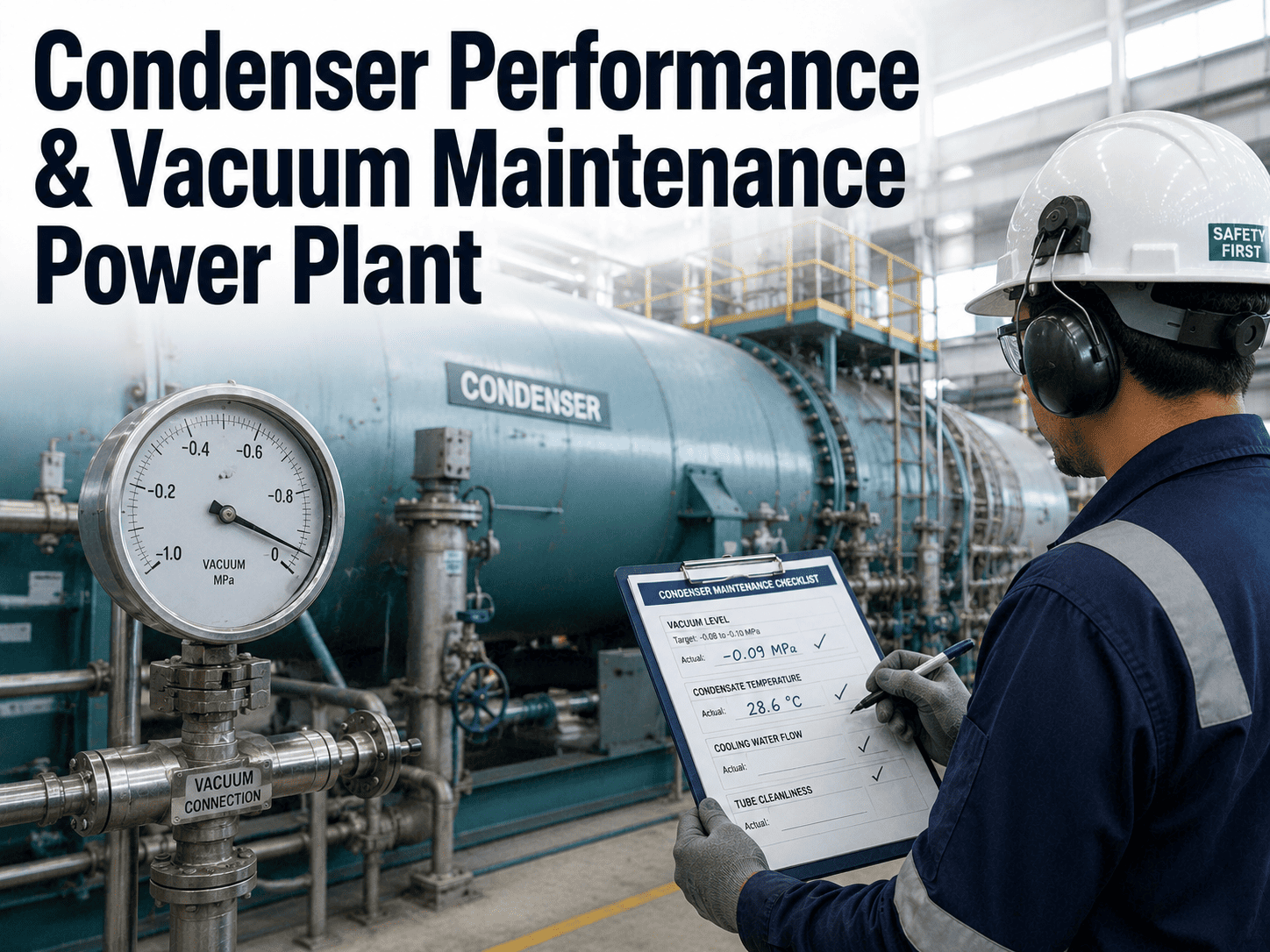
Condenser performance and vacuum maintenance directly determine a power plant's heat rate, fuel cost and megawatt output — a 25 mmHg drop in condenser vacuum can raise net heat rate by 100–300 kJ/kWh and cut generation by 2–5 percent. This condenser maintenance guide covers tube fouling monitoring, air inleakage control and cooling water optimization so reliability teams can stop efficiency losses before they escalate into derates. Each section maps a root cause to an actionable maintenance strategy, then shows how a condenser CMMS like OxMaint automates the inspections, work orders and analytics that keep vacuum tight. Ready to move off spreadsheets? Start Free Trial and digitize your condenser monitoring in under a day.
Condenser Performance & Vacuum Maintenance
Is your condenser leaking 1–3 percent of gross generation every single cycle?
Every 1 percent of air inleakage or tube fouling you tolerate silently inflates heat rate, burns extra fuel and erodes dispatch margins. OxMaint turns condenser performance maintenance into a data-driven, predictive workflow — so vacuum deviation triggers a work order before it becomes a derate.
Why Vacuum Matters
How condenser vacuum losses kill power plant efficiency
The condenser is the thermodynamic sink of the Rankine cycle — every millimetre of mercury lost to fouling, air inleakage or high cooling-water temperature raises back-pressure on the LP turbine and directly steals gross generation.
Root Cause Playbook
Condenser tube fouling, air inleakage and cooling water: a maintenance guide
Condenser Tube Fouling
Biofilm, scaling and silt reduce overall heat-transfer coefficient by 15–40 percent. Monitor terminal temperature difference (TTD) daily — a TTD above 5°C is an early fouling flag. Trigger on-line sponge ball cleaning or plan off-line high-pressure water jetting before cleanliness factor drops below 85 percent.
Air Inleakage Control
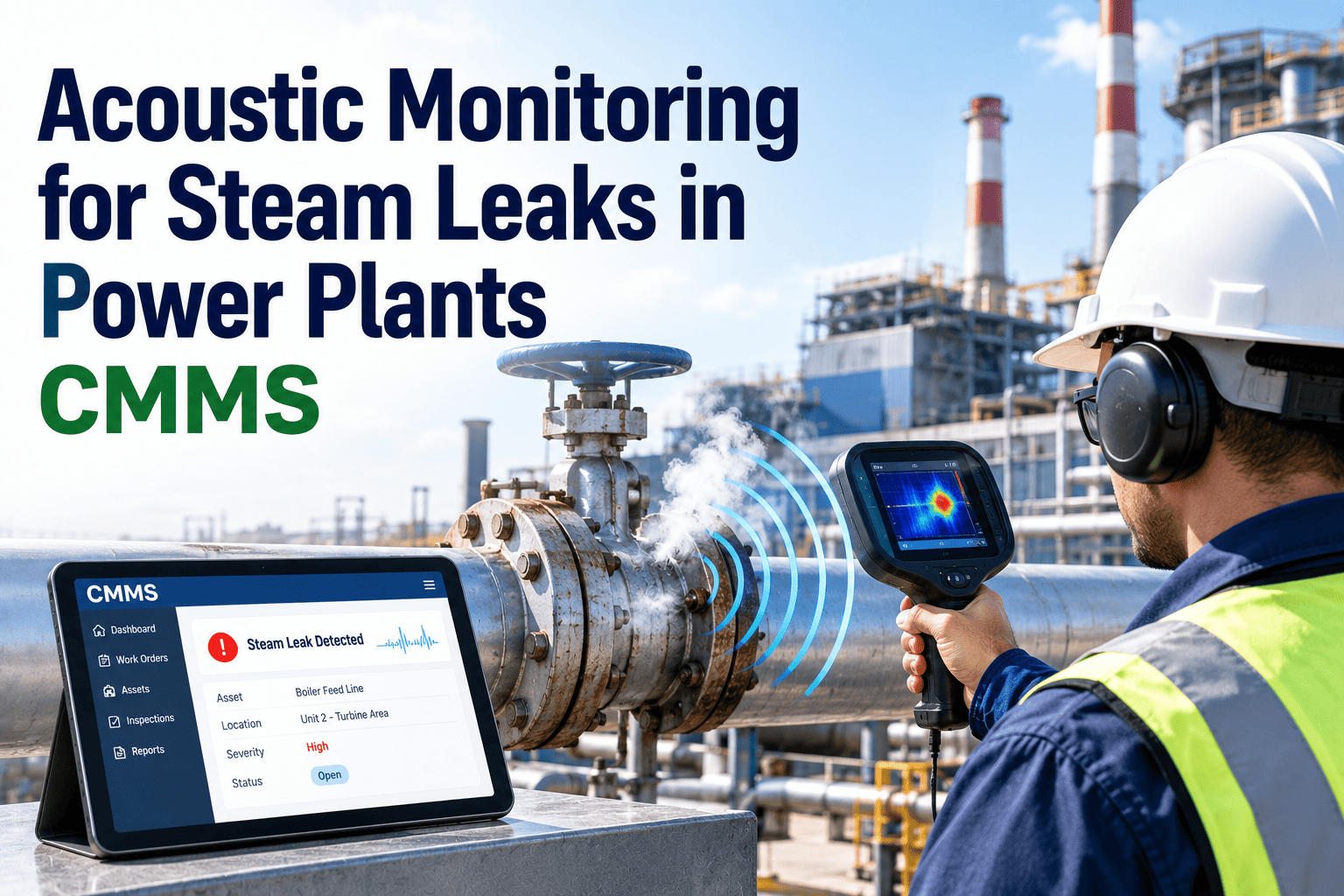
Air enters through turbine seals, expansion joints, valve packing and low-pressure heater flanges. Target dissolved oxygen below 10 ppb and monitor vacuum rise during unit hold. A helium-tracer or ultrasonic leak survey every 12 months catches 90 percent of ingress points before they degrade vacuum by more than 5 mmHg.
Cooling Water Flow & Temperature
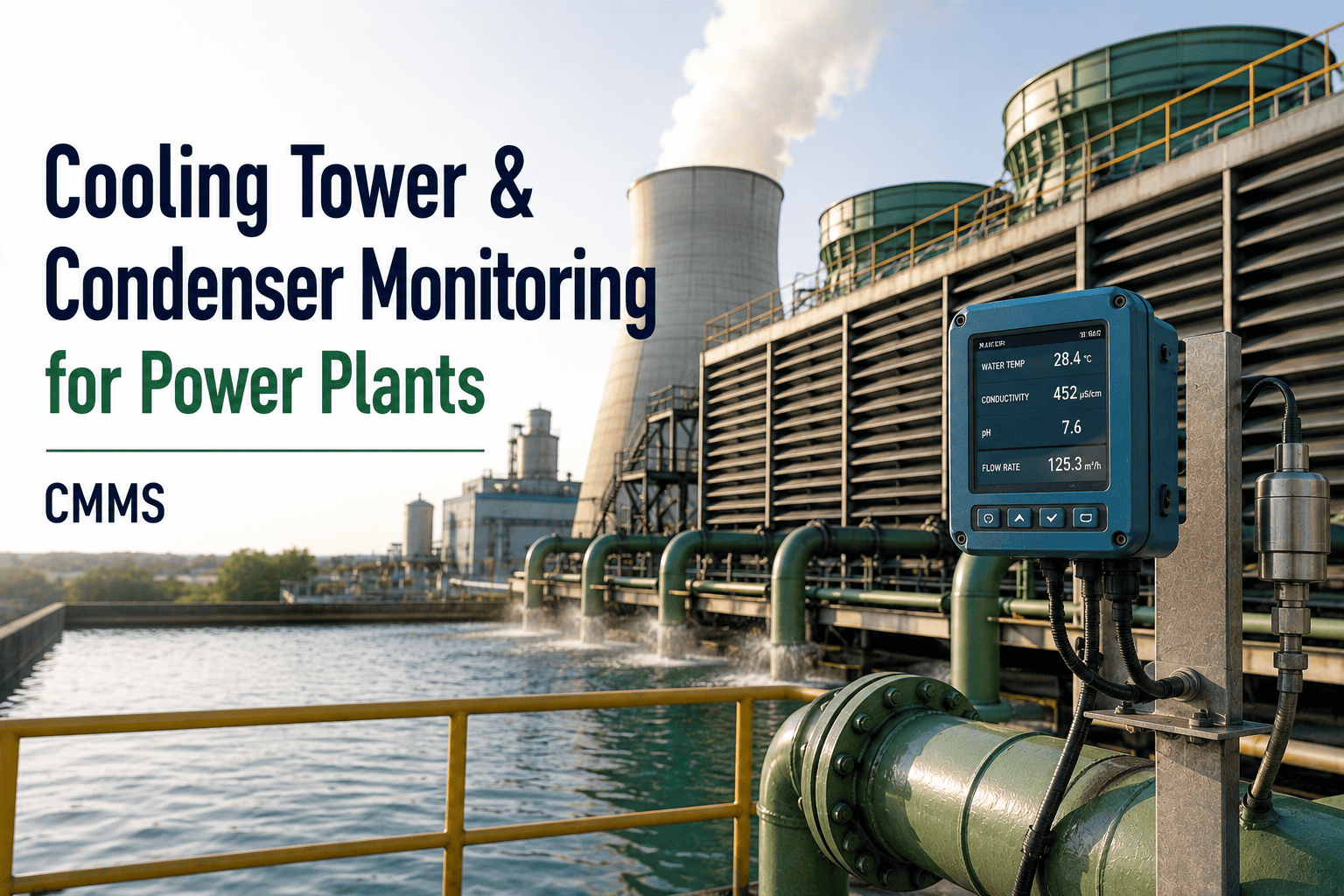
Verify circulating-water flow against design (typically 40–50 times steam load). A 10 percent flow shortfall from pump wear or clogged intake screens raises condenser inlet temperature and cuts vacuum. Deploy cooling-water condenser monitoring on inlet, outlet and hotwell temperatures — log approach and TTD trends weekly.
Tube Plugging & Wall Thinning
Microbiologically influenced corrosion (MIC) and ammonia stress-corrosion cracking thin Admiralty brass, cupro-nickel and SS tubes. Eddy-current test 20 percent of tubes per outage and cap plugging below 10 percent per waterbox — above that, retubing economics flip in favour of replacement.
ROI & Heat Rate
Calculating the cost of poor condenser performance
Quantify the gap between your current vacuum and design back-pressure, then translate it into fuel and lost-margin dollars. The formula below is the baseline every reliability engineer should run each month.
Annual condenser performance loss
Annual Loss ($) = ΔHR (kJ/kWh) × MW × CF × 8,760 h × Fuel Cost ($/kJ)
Where ΔHR is the heat-rate penalty from vacuum deviation (≈ 1 percent per 10 mmHg), MW is net rating, CF is capacity factor. A 500 MW unit at 70 percent CF with 5 mmHg chronic loss and $8/MMBtu fuel loses roughly $420,000 per year in extra coal alone.
| Vacuum Deviation | Heat Rate Penalty | Annual Fuel Cost (500 MW, 70% CF) | Annual Generation Loss |
|---|---|---|---|
| 5 mmHg | 0.5 percent | $210K | 2,150 MWh |
| 10 mmHg | 1.0 percent | $420K | 4,300 MWh |
| 20 mmHg | 2.0 percent | $840K | 8,600 MWh |
| 30 mmHg | 3.0 percent | $1.26M | 12,900 MWh |
Worked example: a 180-asset coastal plant spending $42K per month on excess fuel traced 70 percent of the penalty to biofilm fouling and 30 percent to flange inleakage. After deploying a condenser CMMS with monthly TTD-based work orders and an annual helium survey, they recovered 12 mmHg in 90 days — a payback under five months on the software investment alone.
Stop guessing at condenser vacuum losses
See how OxMaint turns fouling thresholds and inleakage alarms into automatic work orders — book a 30-minute demo on your assets today.
OxMaint Solution
How OxMaint CMMS improves condenser performance monitoring
OxMaint digitises the entire condenser maintenance guide above — from condition triggers to spare-parts kitting — so your team executes the right fix at the right time without paper, spreadsheets or tribal knowledge.
AI-driven condenser monitoring
Ingests DCS vacuum, TTD, D.O. and CW temperatures; flags deviation trends 2–4 weeks before a derate. Cut unplanned condenser downtime by 30–50 percent with early-warning work orders.
Trigger-based PM scheduling
Auto-generates fouling clean, leak survey and eddy-current inspection tasks when thresholds breach. Eliminates 90 percent of manual scheduling effort and ensures no inspection slips past its interval.
Tube register + spare-parts inventory
Maintains a per-tube history (material, install date, plug count, wall thickness). Links to plug kits, gaskets and seal-water spares so outage kitting is one click — reducing outage duration by up to 20 percent.
Full traceability for ISO 55000
Every inspection, reading and repair is timestamped and audit-ready. Pass internal and regulatory audits in hours, not weeks, with one-click evidence exports for every condenser asset.
Reactive vs Predictive
Condenser maintenance without a CMMS vs with OxMaint
| Maintenance Dimension | Spreadsheets / Reactive | OxMaint Condenser CMMS |
|---|---|---|
| Vacuum monitoring | Manual log sheets, daily rounding | Live DCS ingestion + AI trend alerts |
| Fouling response | Scheduled cleaning regardless of need | TTD-triggered clean only when warranted |
| Air inleakage surveys | Ad-hoc, memory-based scheduling | Auto-scheduled annual helium + ultrasonic WOs |
| Tube history | Binder in the shop, partial data | Per-tube digital register with ECT results |
| Outage kitting | Manual BOM, last-minute scrambling | Auto-linked spares, pre-kitting alerts |
| Audit readiness | Days of report compilation | One-click ISO 55000 evidence export |
| Heat rate impact | 5–30 mmHg chronic loss typical | Target < 3 mmHg deviation sustained |
Frequently Asked Questions
Condenser vacuum maintenance: questions power plant teams ask
How often should condenser tubes be cleaned to maintain performance?
Frequency depends on cooling-water quality and fouling tendency. Plants with on-line tap-ball or sponge-ball systems clean continuously; others schedule off-line mechanical or chemical cleaning when the cleanliness factor drops below 85 percent or TTD exceeds 5°C — typically every 6–12 months. A condenser CMMS like OxMaint monitors TTD in real time and auto-triggers cleaning work orders only when thresholds breach, avoiding both under-cleaning and unnecessary outages.
What are the most common sources of air inleakage in a condenser?
The top culprits are LP turbine shaft seals, expansion joints, low-pressure heater flanges, valve stem packing and cracked extraction piping welds. A helium-tracer or ultrasonic leak-detection survey performed annually — or after any major casing opening — identifies 85–95 percent of ingress points. Schedule your next survey through Book a Demo to see how OxMaint automates the work-order chain from survey finding to repair verification.
How much does condenser vacuum loss cost a power plant?
Roughly 1 percent of heat rate — equivalent to $40K–$120K per month in extra fuel at a 500 MW coal unit — for every 10 mmHg of chronic vacuum degradation. Severe fouling combined with air inleakage can push losses to $1M+ annually. Use the formula Annual Loss = ΔHR × MW × CF × 8,760 × Fuel Cost to quantify your own gap, then close it with structured condenser performance maintenance in OxMaint.
What is the target dissolved oxygen level for condenser vacuum maintenance?
Dissolved oxygen in the hotwell should remain below 10 ppb (ideally below 7 ppb) for corrosion control and vacuum integrity. Rising D.O. is an early indicator of air inleakage, often preceding a measurable vacuum drop by days. OxMaint can ingest D.O. data and create an inleakage-response work order automatically when the 10 ppb threshold is crossed.
Can a CMMS improve condenser performance and reduce derates?
Yes — a condenser CMMS centralises vacuum, TTD, D.O. and tube-condition data, then converts threshold breaches into prioritised work orders with linked spare parts and checklists. Plants using OxMaint report 30–50 percent less unplanned condenser downtime and 2–5 percent heat-rate recovery within the first year. Start Free Trial to digitise your condenser program in a single afternoon.
Your Next Step
Recover lost megawatts with a condenser CMMS built for power plants
Join reliability teams using OxMaint to monitor vacuum, automate fouling and inleakage work orders, and keep every condenser asset audit-ready — all in one AI-powered platform.
Free 14-day trial · No credit card