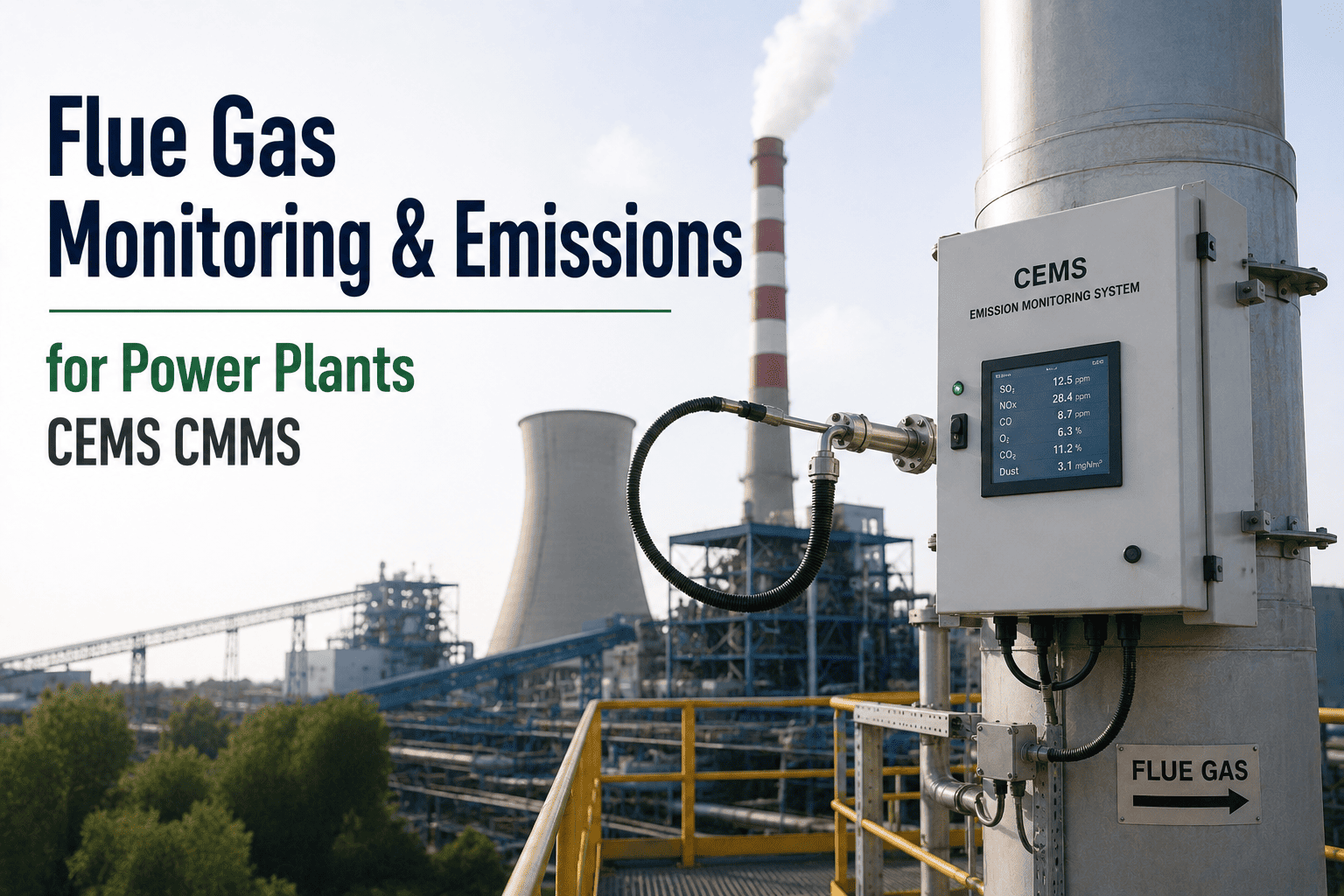
Flue gas monitoring in a power plant is the continuous measurement of combustion-exhaust pollutants — NOx, SO2, CO, CO2, and opacity — to satisfy EPA emissions compliance and air-quality permits. A Continuous Emissions Monitoring System (CEMS) performs this measurement, but the instrument itself demands rigorous, recurring maintenance: daily drift checks, calibration gas certification, sample-line heat tracing, and quarterly CGA audits. This guide walks through the complete CEMS maintenance calendar, calibration intervals, and how a flue gas CMMS centralizes every compliance task so your team avoids EPA violations and monitor downtime. Ready to automate your emissions maintenance program? Start Free Trial and configure your plant's monitoring assets in under an hour.
Is a single CEMS downtime event costing your plant $25K+ in EPA penalties?
Most power plants lose 40–60 hours per year to reactive emissions-monitor repairs, missed calibrations, and audit scrambles. OxMaint schedules every CGA, calibration, and probe-clean automatically — so your stack stays compliant without the firefighting.
What EPA emissions compliance requires from your CEMS
Under 40 CFR Part 75 and Part 60, a power plant must demonstrate that its CEMS operates with ≥90% data availability during operating hours — meaning a single failed quarterly audit can trigger monitoring plan deviations and tens of thousands in penalties.
CEMS calibration intervals and drift-check protocols
A defensible flue gas analysis program hinges on consistent calibration — daily drift checks, quarterly CGAs (Calibration Gas Audits), and annual RATA (Relative Accuracy Test Audit) — each of which must be logged, certified, and retrievable for EPA inspectors for up to 3 years.
- Zero and span gas injection — NOx, SO2, CO2
- Drift alarm if response exceeds 2.5% of span
- Auto-record results to the CMMS work order
- Flag for recalibration after 2 consecutive drifts
- Certified reference gas at 50% and 80% of span
- Response accuracy must be within ±5%
- Document gas-lot certifications in OxMaint
- Generate EPA-compliant audit report on close
- Reference method stack testing at 3 load levels
- Relative accuracy ≤10% (or 20% for low-emitters)
- Schedule 30 days ahead via OxMaint PM engine
- Attach third-party testing report to asset record
- Weekly blowback / soot-blow cycle verification
- Heat-trace line temp maintained at 180°C ±10°
- Quarterly probe extraction and physical cleaning
- Moisture trap and filter replacement every 6 months
How to maintain NOx, SO2, and opacity monitoring power systems
Each pollutant channel in your CEMS has unique failure modes — from NOx converter degradation to SO2 sample-line condensation — and a disciplined maintenance schedule targeting each analyzer type is what separates 97%-uptime plants from those scrambling before every audit.
| Pollutant / Parameter | Maintenance Task | Frequency | Compliance Driver |
|---|---|---|---|
| NOx (chemiluminescence) | Converter efficiency test; ozone generator check | Quarterly | 40 CFR 75 Appendix A |
| SO2 (UV fluorescent) | Sample-line heat-trace inspection; hydrocarbon cutter replacement | Monthly | Part 60 PS-2 |
| Opacity (transmissometer) | Lens cleaning; alignment check; simulated zero/span | Weekly | Part 60 PS-1 |
| CO / CO2 (NDIR) | Optical bench clean; water-trap inspection | Quarterly | Part 75 §75.10 |
| Flow rate | Ultrasonic transducer sweep check; temp probe calibration | Semi-annual | Part 75 Appendix A §6 |
| Sample conditioning | Chiller thermoelectric check; peristaltic pump tubing swap | Monthly / 6 months | Manufacturer spec + Part 75 |
The real cost of reactive CEMS maintenance (worked example)
A 500-MW coal-gas plant running 4 CEMS racks on spreadsheets typically absorbs $42K–$68K per year in avoidable costs — emergency calibrations, expedited reference gas, audit retorts, and EPA deviation penalties — before any forced deratement is counted.
- Calibration dates tracked in Excel — missed by days
- Reference gas cylinders expire unmonitored
- Audit prep takes 40+ hours per quarter
- Penalty exposure: $25K–$50K per deviation event
- Auto-PM triggers calibrations 7 days before due
- Gas-lot expiry tracked on the asset record
- Audit reports generated in one click — 2 hours max
- Penalty risk cut by 80–95% through proactive alerts
How OxMaint CMMS streamlines CEMS power plant operations
OxMaint is purpose-built for maintenance and reliability teams in regulated plants — turning every CEMS calibration, probe clean, and audit prep into a scheduled, documented, AI-optimized work order that keeps your stacks running above 97% uptime.
Automated CEMS PM Scheduling
Auto-generate daily drift checks, quarterly CGAs, and annual RATAs 7–14 days ahead. Result: 60% fewer missed calibrations and audit readiness year-round.
EPA-Ready Audit Trail
Every calibration result, gas-lot certificate, and technician note is timestamped and attached to the asset record. Result: audit prep drops from 40 hrs to under 4 hrs per quarter.
AI-Driven Predictive Alerts
OxMaint's AI analyzes drift trends and probe-cleaning intervals to predict analyzer failure 2–4 weeks out. Result: unplanned CEMS downtime cut 30–50% across monitoring assets.
Spare-Parts & Gas Inventory
Track calibration gas-lot expiry, filter stocks, and converter cartridges with auto-reorder points. Result: zero expired-gas incidents and 70% less emergency-part shipping spend.
See OxMaint manage your CEMS assets live — book a 30-minute demo
Walk through a real CEMS maintenance workflow: auto-scheduled calibrations, EPA audit reporting, AI drift predictions, and gas-inventory tracking — configured for your plant.
Frequently asked questions about flue gas monitoring and CEMS maintenance
What is CEMS calibration and how often should it be done?
CEMS calibration verifies analyzer accuracy using certified reference gases. Daily calibration drift checks (zero and span) are required under 40 CFR Part 75, quarterly CGAs test accuracy at multiple span levels, and an annual RATA compares the CEMS to a reference method. A flue gas CMMS like OxMaint auto-schedules all three tiers and stores gas-lot certifications for every event, ensuring zero missed calibrations. Start Free Trial to automate your calibration calendar today.
How does a CMMS improve EPA emissions compliance?
A CMMS centralizes every CEMS work order — daily drift checks, probe cleanings, gas-cylinder swaps, and audit prep — into a timestamped, inspector-ready audit trail. Rather than searching spreadsheets for proof of calibration, OxMaint generates an EPA-compliant report in one click, cutting audit preparation from 40+ hours to under 4 hours and reducing deviation penalty risk by 80–95%.
What pollutants must a power plant CEMS monitor?
Most coal, gas, and oil-fired power plants must continuously monitor NOx, SO2, CO2, and opacity under 40 CFR Parts 60 and 75. Some permits also require CO, NH3 (for SCR plants), and flow rate. Each pollutant channel has its own analyzer type — chemiluminescence for NOx, UV fluorescence for SO2, NDIR for CO/CO2 — and each demands pollutant-specific maintenance tasks scheduled in your CMMS.
What happens if CEMS data availability drops below 90%?
If your CEMS fails to collect ≥90% of required operating-hours data in a quarter, the plant must report a monitoring deviation and may face EPA penalties of $25K–$50K per event. You'll also need to submit substitute data (Emissions Monitoring Plan Appendix D) and may trigger additional scrutiny. OxMaint prevents this by flagging drift trends and scheduling probe/analyzer maintenance before downtime occurs.
How long does it take to implement OxMaint for CEMS maintenance?
Most plants import their CEMS asset register, calibration schedules, and spare-parts inventory into OxMaint within 1–2 weeks. Our team pre-configures PM triggers for daily drift checks, quarterly CGAs, and annual RATAs based on your monitoring plan. Book a Demo to see the CEMS setup workflow and go-live timeline mapped to your plant.
Stop managing CEMS compliance on spreadsheets
Join the power plants using OxMaint to keep emissions monitors running above 97% uptime, pass EPA audits on the first try, and cut maintenance rework by half.
Free 14-day trial · No credit card