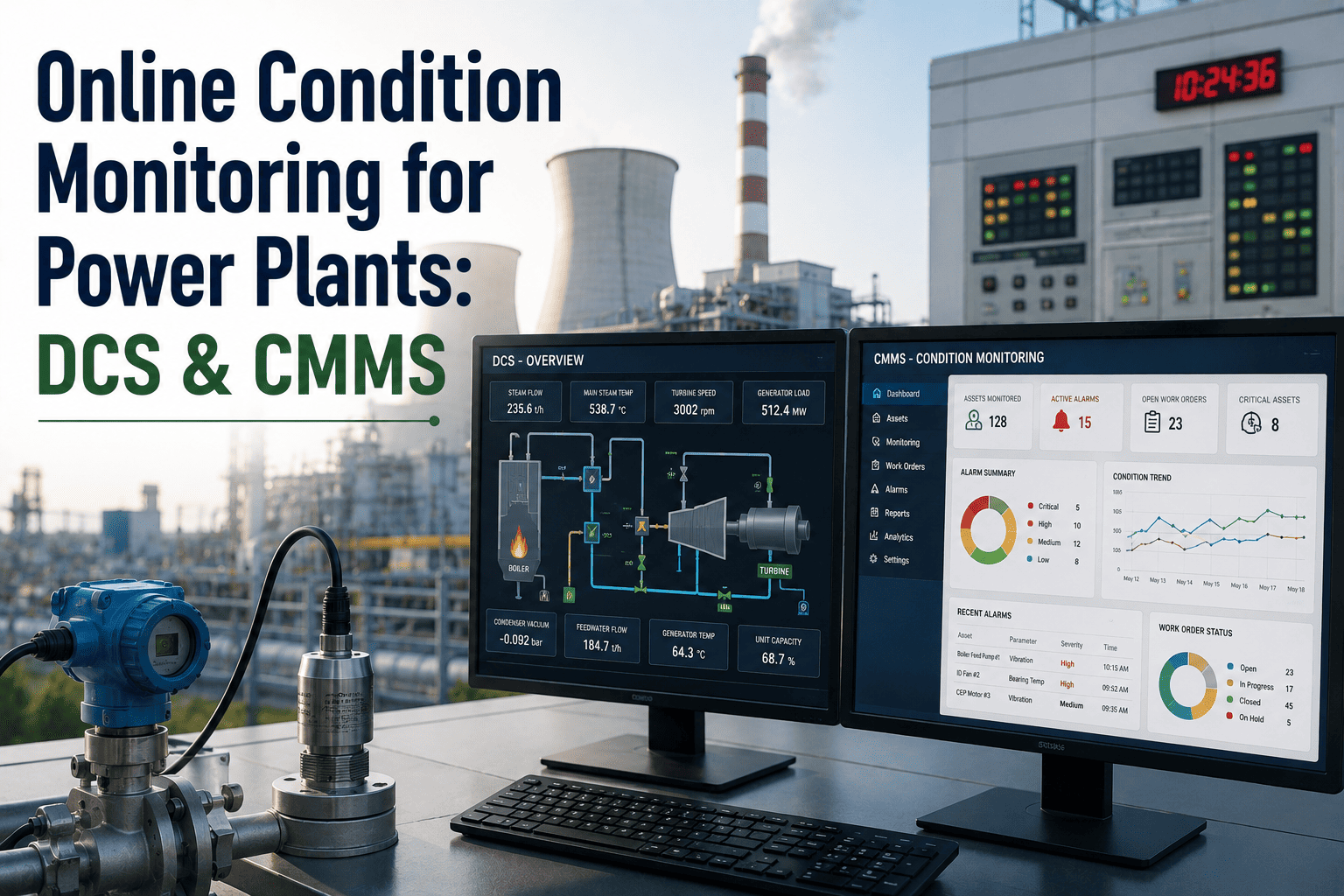
Online condition monitoring for power plants connects your distributed control system (DCS) to a modern CMMS, turning real-time sensor data into automated work orders that prevent unplanned outages. By unifying DCS integration with CMMS-based continuous monitoring, reliability teams can detect early warning signs in rotating equipment, reduce downtime by 30 to 50 percent, and move from reactive firefighting to predictive maintenance. This guide explains how to bridge the gap between your DCS alarms and your maintenance workflow, the KPIs you need to track, and how OxMaint automates the entire alarm-to-work-order pipeline so nothing slips through the cracks. Ready to modernize your plant monitoring? You can Start Free Trial today or keep reading to see the integration blueprint.
Turn DCS Alarms Into Automated Work Orders Before Equipment Fails
Stop treating your DCS as a siloed data screen. OxMaint ingests live vibration, temperature and pressure signals, evaluates them against asset-specific thresholds, and dispatches prioritized work orders to the right technician automatically.
How DCS and CMMS Integration Works for Power Plants
A 500 MW combined-cycle plant generates over 50,000 DCS tags daily. Without CMMS integration, critical alarms get buried in operator logs. Here is the five-step data pipeline that bridges DCS monitoring to maintenance execution.
DCS Data Acquisition
Vibration, bearing temperature, oil pressure and motor current signals stream from PLCs and sensors through the DCS via OPC-UA or MQTT protocols. OxMaint connects directly to your existing historian or OPC server, pulling data at configurable intervals from 1 second to 15 minutes.
Threshold Evaluation
Each asset has ISO 10816 vibration limits, OEM temperature curves and custom statistical thresholds. OxMaint evaluates every incoming data point against these baselines, distinguishing between transient startup noise and genuine degradation trends using AI pattern recognition.
Alarm-to-Work-Order Automation
When a signal breaches a critical threshold, OxMaint generates a work order in under 15 seconds. The system auto-populates the asset ID, fault description, priority level, required spare parts and assigned technician based on your pre-configured escalation rules.
Maintenance Dispatch & Execution
Technicians receive push notifications on mobile devices with the fault context, diagnostic data and step-by-step corrective procedures. Parts are automatically reserved from the spare-parts inventory module, eliminating warehouse delays.
Closed-Loop Feedback
After work order completion, OxMaint records the corrective action, updates the asset health score and feeds the outcome back into the predictive model, continuously improving alarm accuracy and reducing false positives over time.
Power Plant Online Monitoring KPIs You Should Track
A coal-fired plant in the Midwest reduced forced outages by 38 percent after implementing these five KPIs in a unified DCS-CMMS dashboard. Track them continuously to catch degradation weeks before failure.
Overall Equipment Effectiveness gain achievable when online monitoring replaces time-based preventive maintenance for critical rotating assets.
Average savings for a 400 MW plant avoiding three major bearing failures per year through early vibration detection.
Typical advance warning OxMaint predictive analytics provides before a critical pump or fan failure occurs.
Reduction in false-positive alarms after 90 days of machine learning calibration on your asset baseline data.
Manual Rounds vs Online Condition Monitoring: Cost Comparison
A 180-asset steam plant spending $42,000 annually on manual vibration rounds and oil sampling can recover the cost of an integrated DCS-CMMS platform within 8 months. Here is how the two approaches compare.
| Monitoring Dimension | Manual Rounds + Spreadsheet | OxMaint DCS-CMMS Integration |
|---|---|---|
| Data Collection Frequency | Weekly or monthly spot readings | Continuous, 1-second to 15-min intervals |
| Alarm-to-Work-Order Time | 4 to 48 hours, often logged on paper | Under 15 seconds, fully automated |
| Early Fault Detection Window | 2 to 5 days before failure | 14 to 30 days before failure |
| False Alarm Rate | 25 to 35 percent | Under 8 percent after ML calibration |
| Audit & Compliance Readiness | Manual report compilation, days of effort | Instant NERC and ISO 55000 reporting |
| Annual Cost for 180 Assets | $42,000 in labor and lost production | $18,000 subscription, $24K net savings |
See OxMaint on Your Assets — Book a 30-Min Demo
Walk through a live DCS-CMMS integration on equipment profiles matching your plant. See alarm-to-work-order automation, predictive analytics and real-time dashboards in action.
How OxMaint Powers Continuous Monitoring for Power Plants
OxMaint combines AI-driven predictive analytics with full CMMS and EAM capabilities, giving reliability teams a single platform for condition monitoring, work order management and spare-parts inventory. Here is what that means in measurable outcomes.
Predictive Failure Alerts
Machine learning models analyze vibration spectra, temperature trends and oil quality data to flag bearing degradation, misalignment and imbalance 14 to 30 days before failure. Plants using OxMaint cut unplanned downtime by 30 to 50 percent.
Automated Work Order Generation
DCS alarm thresholds trigger work orders automatically with asset context, priority, parts and technician assignment. Eliminate paper routes and reduce mean time to repair by 40 to 60 percent through instant mobile dispatch.
Real-Time KPI Dashboards
Customizable plant-level dashboards display OEE, MTBF, MTTR and asset health scores updated live from DCS feeds. Share compliance-ready reports for NERC, ISO 55000 and internal audits in one click instead of days.
Spare-Parts Inventory Sync
When a predictive alert fires, OxMaint checks spare-parts availability, reserves components and flags low stock automatically. Reduce emergency parts spend by 25 percent and eliminate warehouse bottlenecks during critical repairs.
A 600 MW Combined-Cycle Plant: From Reactive to Predictive in 90 Days
Consider a gas-fired plant running two GE 7FA turbines and four BFW pumps. Maintenance was entirely calendar-based, with vibration routes conducted monthly. Over 12 months, the plant experienced three forced outages costing $4.8 million in lost generation revenue and emergency repairs.
- Monthly vibration routes, paper work orders
- 3 forced outages per year, $4.8M lost revenue
- MTTR of 18 hours for critical pump failures
- $42K annual spend on manual monitoring labor
- Continuous DCS monitoring, automated dispatch
- 1 outage prevented in first 6 months, $1.6M saved
- MTTR dropped to 7 hours with pre-staged parts
- $18K annual platform cost, $24K net monitoring savings
Common Questions About DCS-CMMS Integration for Power Plants
What is online condition monitoring in a power plant?
Online condition monitoring is the continuous, real-time collection and analysis of equipment health data — vibration, temperature, pressure, oil quality — from plant assets via sensors connected to a DCS or SCADA system. Unlike periodic manual routes, it evaluates every data point against thresholds instantly and triggers automated responses when anomalies are detected, enabling predictive maintenance.
How does DCS integration with a CMMS work?
DCS-CMMS integration uses protocols like OPC-UA, MQTT or REST APIs to stream sensor data from the control system directly into the CMMS. OxMaint evaluates incoming data against asset-specific thresholds, and when a breach occurs, it automatically generates a work order with asset ID, fault type, priority and assigned technician — typically in under 15 seconds. You can Book a Demo to see a live integration walkthrough.
How much does power plant online monitoring software cost?
For a mid-sized plant with 150 to 250 critical assets, an integrated DCS-CMMS platform like OxMaint typically costs $15,000 to $25,000 per year. Most plants achieve full payback within 5 to 8 months by avoiding a single major bearing or gearbox failure, which can cost $500,000 to $2 million in downtime and emergency repairs.
Can OxMaint connect to our existing DCS or SCADA system?
Yes. OxMaint supports OPC-UA, OPC-DA, MQTT, Modbus TCP and REST API connections, making it compatible with all major DCS platforms including Emerson Ovation, Honeywell Experion, Siemens PCS 7, ABB Bailey and GE Mark VIe. Integration typically takes 2 to 4 weeks depending on the number of tags and data historian configuration.
What standards govern power plant condition monitoring?
The key standards are ISO 10816 for vibration severity on rotating machinery, ISO 55000 for asset management systems, NERC PRC-005 for protection system maintenance and IEEE 841 for motor reliability. OxMaint aligns reporting with these frameworks out of the box, so audit preparation takes minutes instead of days. You can Start Free Trial to test compliance reporting on your assets.
Stop Reacting to Failures. Start Predicting Them.
Join the power plants using OxMaint to turn DCS data into automated work orders, cut unplanned downtime by up to 50 percent, and build a fully auditable predictive maintenance program.
Free 14-day trial · No credit card