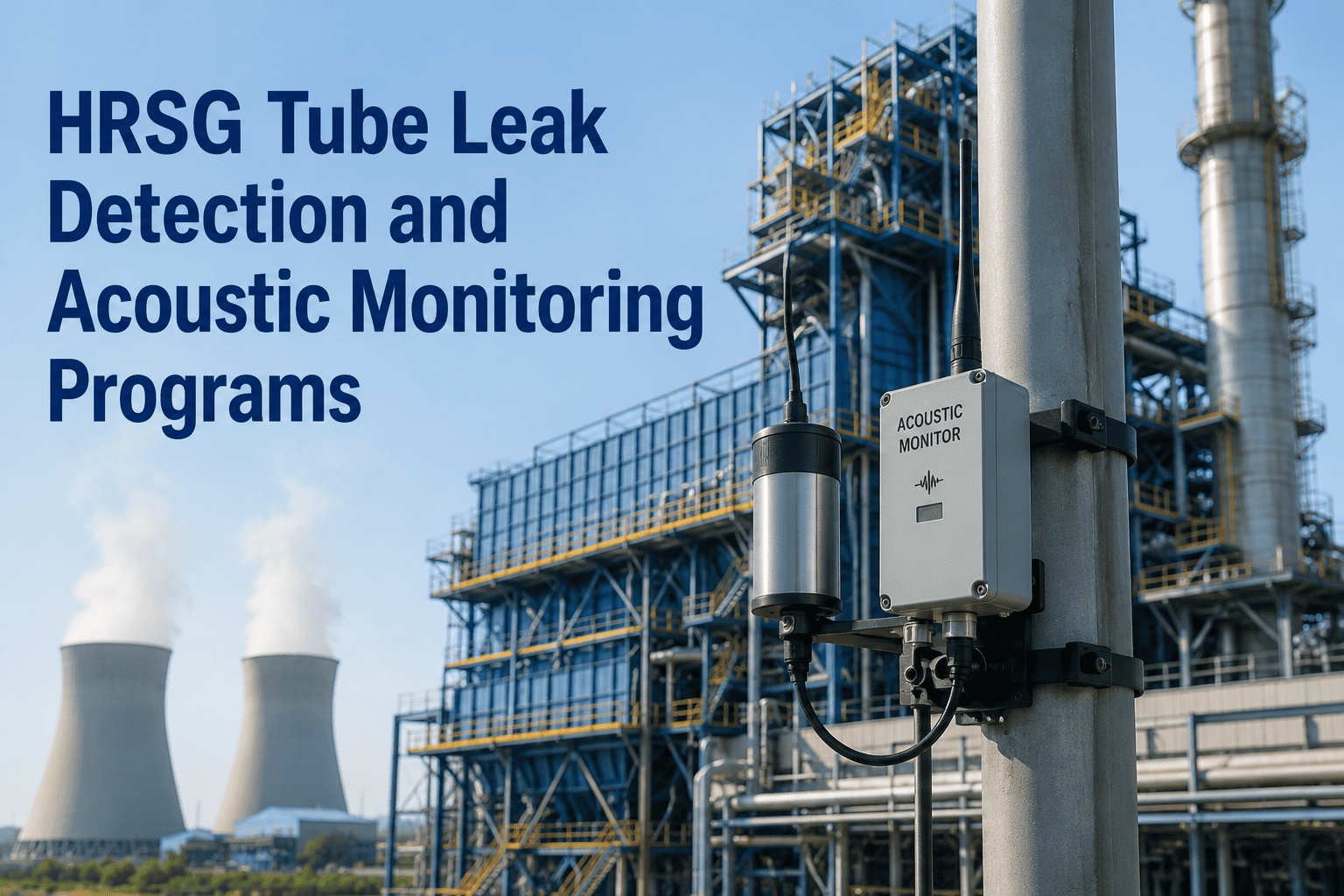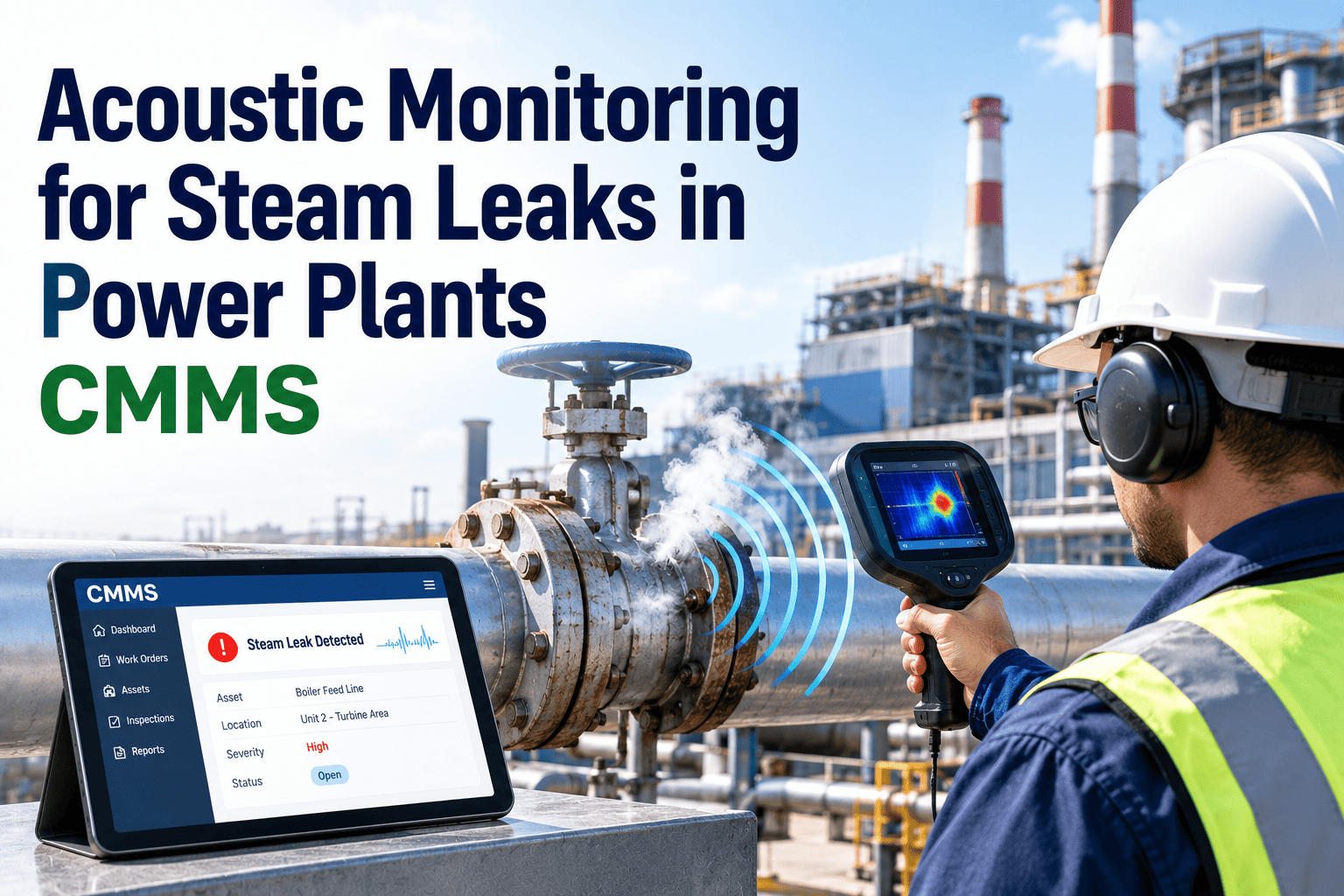
Acoustic monitoring for steam leaks in power plants uses ultrasonic and acoustic emission sensors to detect high-pressure steam escaping from valves, pipe insulation, and boiler tubes long before failures escalate — and feeding those signals into a CMMS like OxMaint turns raw detection data into prioritized, traceable work orders. Studies show that a single undetected steam leak in a 500 MW unit can cost upward of $40,000 per month in lost energy and collateral damage, making steam leak detection one of the highest-ROI predictive maintenance strategies available to reliability teams today. From valve seat leakage to pipe insulation power loss, an integrated acoustic inspection power workflow catches issues that thermography and visual rounds miss, then routes them automatically into your maintenance backlog. Ready to stop losing steam and start closing work orders faster? You can Start Free Trial or read on for the full playbook.
STEAM LEAK DETECTION · ACOUSTIC MONITORING
A single 3 mm steam leak can waste $40K+ per year in lost energy — are your valves whispering before they fail?
Ultrasonic acoustic emission monitoring catches valve seat leakage and pipe insulation breaches weeks before thermography or visual rounds can. OxMaint turns every acoustic anomaly into a tracked, prioritized work order — so no leak goes unheard or unassigned.
COST OF INACTION
Why steam leaks drain power plant profitability silently
In a typical 500 MW fossil-fuel or combined-cycle plant, high-pressure steam carries over 60% of the thermal energy in the cycle. Even a hairline crack at a valve seat or a failed gasket under pipe insulation can bleed 5–15 tonnes of steam per hour — energy that was already paid for in fuel, water treatment, and boiler firing. Across a fleet, the Department of Energy estimates that steam-system losses account for 3–7% of total generation cost, and the majority of those losses stem from leaks that go undetected between scheduled outages.
The compounding cost is not only energy. Escaping steam accelerates erosion on adjacent piping, degrades thermal insulation, and in extreme cases creates safety hazards for operators conducting walkdowns. A plant that waits for the next planned outage to find leaks is effectively choosing to pay the full fuel penalty — plus the collateral repair cost — for months. Acoustic emission monitoring collapses that window from months to hours.
INSPECTION CHECKLIST
Acoustic inspection checklist for steam leak detection in power plants
A structured acoustic route across a power plant should cover every high-energy boundary where steam can escape. Use this tiered checklist — mapped directly to OxMaint inspection templates — to ensure no asset class is skipped during routine rounds.
Valve Seat Leakage
- Scan all isolation & control valves on HP/IP/LP steam lines at 40 kHz
- Compare dB readings against baseline at full-load & part-load conditions
- Flag any valve reading >8 dB above background for work-order generation
- Verify seat tightness on bypass & drain valves after each cycling event
Pipe Insulation Power Lines
- Survey insulated main-steam & hot-reheat piping for ultrasonic breakthrough
- Mark GPS-tagged anomalies for infrared confirmation within 48 hours
- Check lagging integrity at hangers, supports, and weld-seam covers
- Log dB trend per location to detect gradual insulation degradation
Boiler Tube & Header Sweeps
- Deploy fixed acoustic emission sensors on waterwall & SH headers
- Set adaptive alarms for high-frequency burst patterns (80–200 kHz)
- Cross-reference tube-leak signals with feedwater make-up rate
- Escalate confirmed signals to planned-outage scope within 24 hours
Steam Trap & Drain Lines
- Route ultrasonic pistol along all trap discharge lines quarterly
- Distinguish live-steam blow-through from normal condensate flow
- Calculate per-trap steam loss in kg/hr and feed into OxMaint cost field
- Auto-generate replacement WO for traps exceeding 10 kg/hr loss
| Asset / Location | Sensor Type | Frequency Band | Alarm Threshold | Inspection Cadence |
|---|---|---|---|---|
| HP Main-Stop & Control Valves | Portable ultrasonic pistol | 40 kHz | >8 dB over baseline | Monthly |
| Boiler Waterwall Headers | Fixed AE sensor array | 80–200 kHz | Adaptive burst alarm | Continuous |
| Insulated HRH Piping | Contact ultrasonic + IR | 40 kHz + thermal | >6 dB + ΔT >15 °C | Bi-monthly |
| Steam Traps & Drains | Portable ultrasonic | 40 kHz | >10 kg/hr steam loss | Quarterly |
| Turbine Gland Seals | Airborne ultrasonic | 40 kHz | Audible hiss pattern | Monthly |
ROI & PAYBACK
How much does acoustic steam leak monitoring save? The real payback math
Reliability leaders often ask for the business case before deploying acoustic sensors. The calculation below shows a worked example for a 500 MW combined-cycle unit with 180 instrumented steam-path assets. Every input is editable inside OxMaint's analytics module so you can model your own fleet.
Annual Steam Loss Cost (per leak)
L = Q × H × F × 8,760 × η
L = annual loss ($) · Q = leak flow rate (kg/hr) · H = enthalpy of steam (kJ/kg) · F = fuel cost ($/GJ) · η = boiler efficiency factor
Detection Payback Period
P = (C_sensors + C_CMMS) ÷ (N × L_avg × D_factor)
P = payback (months) · C = total deployment cost · N = expected leaks/yr · L_avg = avg loss per leak · D_factor = % caught early by acoustic vs. outage-only
180-asset combined-cycle unit · $42K baseline loss
When acoustic findings are routed instantly into a CMMS like OxMaint — with auto-prioritised work orders, spare-parts reservation, and trend dashboards — the payback compresses further because technician dispatch time drops and no finding is lost in a spreadsheet. Plants that integrate detection with maintenance execution typically see 30–50% fewer unplanned downtime events related to steam-path failures within the first year.
HOW OXMAINT HELPS
From acoustic signal to closed work order — the OxMaint advantage
Detecting a leak is only half the battle; the other half is acting on it before it grows. OxMaint closes the loop between acoustic monitoring sensors and maintenance execution, ensuring every anomaly becomes a tracked, costed, and completed work order.
Auto-Generated Leak Work Orders
When an acoustic emission sensor or ultrasonic round flags a threshold breach, OxMaint instantly creates a prioritised work order pre-filled with asset ID, dB reading, location, and recommended repair procedure — cutting manual data entry to zero.
Outcome: 70% faster dispatch from detection to technician assignment.
Predictive Trend Dashboards
OxMaint's AI engine trends every acoustic reading over time, applying machine-learning baselines per valve and pipe segment. Dashboards show which assets are deteriorating fastest so planners can sequence repairs before the next outage window closes.
Outcome: 30–50% fewer unplanned steam-path downtime events.
Digital Acoustic Route Templates
Replace clipboard inspection sheets with OxMaint mobile route templates. Technicians follow GPS-guided acoustic routes, log readings on tablets, and every data point syncs instantly to the asset history — fully audit-ready for NERC and ISO 55000 compliance.
Outcome: Eliminate paper inspection sheets and 100% audit traceability.
Spare-Parts Auto-Reservation
When a steam-leak work order fires, OxMaint checks inventory for gaskets, valve seats, and packing kits — then reserves them automatically. No more arriving at a repair only to find the parts cage empty.
Outcome: 40% reduction in repair-cycle time and zero stockout delays.
DETECTION METHOD COMPARISON
Acoustic vs. thermography vs. visual inspection: which catches steam leaks first?
No single method finds every leak, but acoustic monitoring consistently detects high-pressure steam leaks earliest — especially through pipe insulation where infrared cameras cannot see. Here is how the three primary inspection methods compare across the metrics that matter to reliability teams.
| Capability | Acoustic / Ultrasonic | Thermography (IR) | Visual Inspection |
|---|---|---|---|
| Detects leaks through pipe insulation | Yes — penetrates lagging | Limited — needs surface temp change | No — hidden under insulation |
| Earliest detection window | Weeks before visible symptoms | Days to weeks | Only after plume or staining |
| Valve seat leakage sensitivity | Excellent (40 kHz tuned) | Poor — no external heat signature | Cannot detect internal leak |
| Continuous / online monitoring | Fixed AE sensors = 24/7 | Periodic camera surveys only | Manual rounds only |
| CMMS integration maturity | Native in OxMaint (API + mobile) | Manual upload of IR images | Paper notes or spreadsheets |
| Typical cost per detected leak | $180–$400 | $500–$1,200 | $800–$2,500 (late-stage) |
REAL-WORLD IMPACT
What changes when acoustic monitoring meets a CMMS
The gap between "we found a leak" and "we fixed the leak" is where most plants lose money. These testimonials reflect what happens when detection and execution live in the same system.
"Before OxMaint, our acoustic route findings lived in a spreadsheet that nobody opened between outages. Now every flagged valve auto-generates a work order with the dB reading and repair history attached. We cut our steam-loss energy penalty by an estimated 18% in the first quarter."
"The fixed acoustic emission sensors on our boiler headers caught a waterwall tube leak three weeks before it would have forced a trip. OxMaint routed it straight into the planned-outage scope with parts reserved. That single event paid for the entire monitoring deployment."
See OxMaint on your assets — book a 30-minute demo
We will map your steam-path assets, show you how acoustic readings auto-generate work orders, and model the payback for your specific unit. Bring your top 5 leak-prone valves to the call.
FAQ
Steam leak acoustic monitoring — frequently asked questions
How does acoustic monitoring detect steam leaks in power plants?
Acoustic monitoring uses ultrasonic sensors (typically at 40 kHz) and acoustic emission sensors (80–200 kHz) to detect the high-frequency turbulence produced when high-pressure steam escapes through a crack, valve seat, or failed gasket. The signal intensity in decibels is compared against a per-asset baseline; a sustained rise of 6–10 dB above background flags a probable leak. Fixed sensors provide 24/7 online monitoring on critical headers, while portable ultrasonic pistols are used for routine route-based inspection of valves, traps, and insulated piping. When integrated with a CMMS like OxMaint, each flagged reading automatically generates a prioritised, traceable work order.
Can acoustic emission monitoring find leaks under pipe insulation?
Yes — and this is where acoustic inspection outperforms thermography. Ultrasonic waves generated by escaping steam travel through the pipe wall and lagging, so a contact sensor on the outside of insulated piping can detect a leak that an infrared camera cannot see because the insulation masks the surface temperature change. For the best results, reliability teams pair acoustic detection with infrared confirmation once the insulation is removed for repair. OxMaint stores both readings on the same asset record so the full inspection history is audit-ready.
How much does a steam leak cost a power plant per month?
A single moderate steam leak (5–15 tonnes per hour) on a 500 MW unit typically costs $2,000–$4,500 per month in wasted fuel and water-treatment chemistry, plus accelerated erosion on adjacent piping. Across a fleet with 10–20 undetected leaks, the annual energy penalty easily exceeds $200K. You can model your own figures by Start Free Trial of OxMaint and entering your leak flow rate, enthalpy, and fuel cost into the ROI calculator.
What is the difference between ultrasonic and acoustic emission monitoring for steam leaks?
Ultrasonic monitoring usually refers to portable, route-based inspection at a fixed 40 kHz frequency — ideal for valves, steam traps, and accessible piping where a technician scans points during rounds. Acoustic emission (AE) monitoring uses fixed sensors mounted on structures like boiler headers and pressure vessels, listening across a broad 80–200 kHz band for the burst patterns characteristic of crack growth or tube leaks. Both methods feed data into OxMaint, but AE provides continuous online surveillance while ultrasonic excels at targeted, high-resolution route inspection.
How does a CMMS improve steam leak inspection workflows?
A CMMS like OxMaint eliminates the gap between detection and repair. Instead of logging acoustic readings on paper or in a standalone spreadsheet, every measurement is tied to an asset record, trended automatically, and — when a threshold is breached — converted into a prioritised work order with repair procedures, spare parts, and labor estimates attached. This reduces dispatch time by up to 70%, ensures no finding is lost, and provides a full audit trail for NERC, OSHA, and ISO 55000 compliance. You can see the full workflow in a 30-minute personalised demo — Book a Demo today.
STOP LOSING STEAM
Turn every acoustic signal into a closed work order
Join the reliability teams using OxMaint to detect steam leaks weeks earlier, auto-generate repair work orders, and cut unplanned downtime by 30–50%. Start free or let us walk you through it.
Free 14-day trial · No credit card