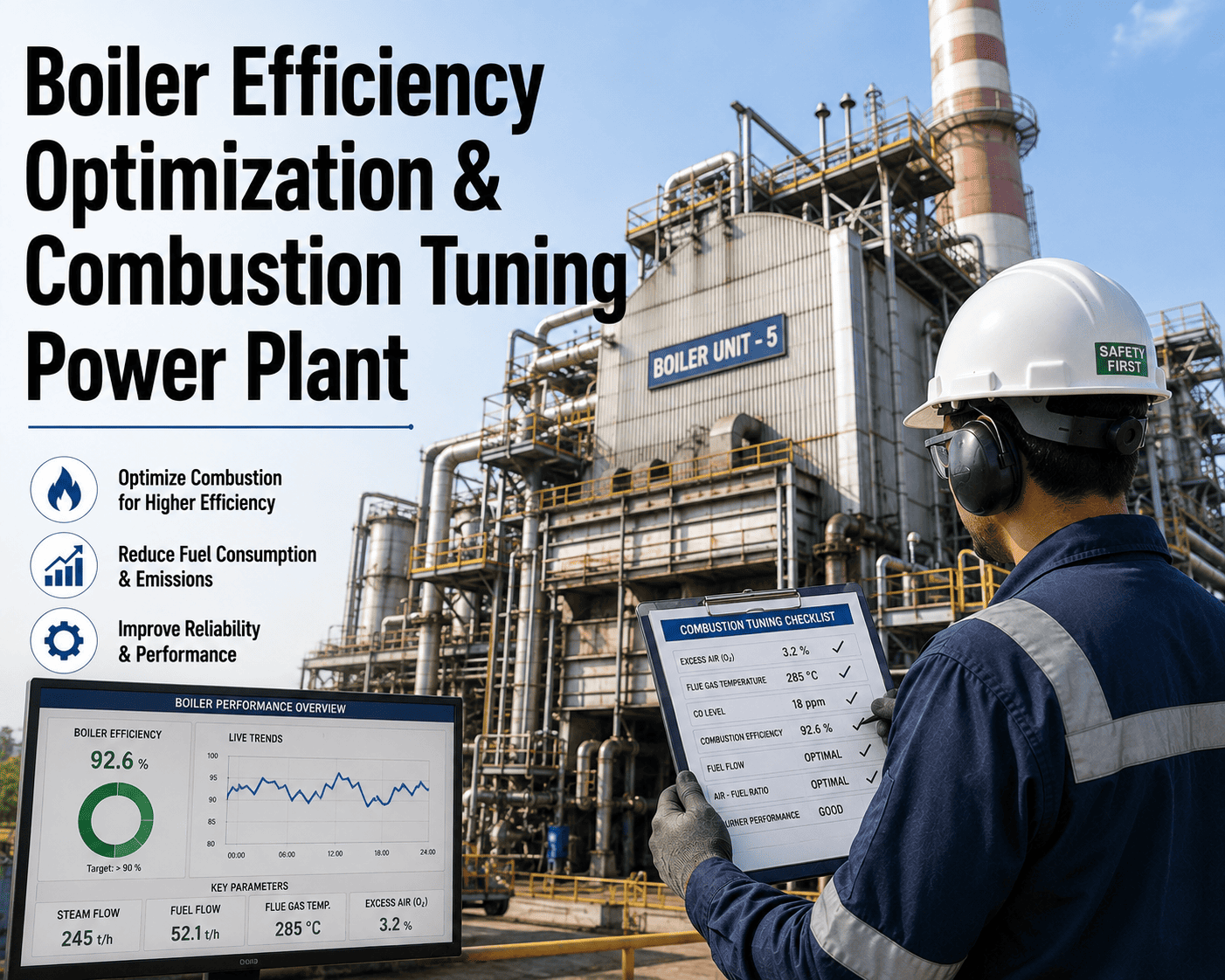
Boiler efficiency optimization and combustion tuning in a power plant can improve net plant heat rate by 200–500 kJ/kWh, translating to six-figure annual fuel savings for a mid-sized facility. By tightly managing excess air, sootblower performance, and radiation losses, maintenance and reliability teams typically recover 2–6% in boiler efficiency that erodes silently through fouling, drift, and delayed repairs. This guide breaks down the practical levers—combustion management, boiler tuning, and sootblower maintenance—and shows how a CMMS built for power generation keeps those gains locked in. Ready to stop losing efficiency between outages? Start Free Trial with OxMaint and digitize your combustion-tuning workflow today.
Boiler Efficiency & Combustion Tuning
A 1% drop in boiler efficiency can cost a 500 MW plant over $1M per year in excess fuel.
Combustion tuning, excess-air control, and sootblower optimization are the fastest levers to recover lost heat rate — but only if maintenance teams execute them on schedule, every time.
The Efficiency Equation
What drives boiler efficiency loss in power plants?
Boiler efficiency typically runs 84–88% on bituminous coal and 90–94% on natural gas, but real-world performance drifts 2–6% below design within months of an outage.
Dry Flue Gas Loss (Lfg) — the largest single loss
Lfg = (Mfg × Cp × ΔT) ÷ GCV × 100
Every 22°C rise in stack temperature above design adds ~1% efficiency loss. Excess air multiplies Mfg — more air heated and sent up the stack means more wasted fuel.
Combustion Efficiency vs. Overall Efficiency
ηoverall = ηcombustion − Lradiation − Lunburned − Lblowdown
Combustion tuning targets ηcombustion by optimizing the air-fuel ratio. Overall efficiency also demands maintenance on refractory, blowdown recovery, and sootblowing to minimize the other three losses.
| Loss Source | Typical % of Fuel Input | Primary Maintenance Lever | Recovery Potential |
|---|---|---|---|
| Dry flue gas (excess air + stack temp) | 5.0 – 8.0% | Combustion tuning, O2 trim calibration | 1.0 – 2.5% |
| Fouling / soot buildup on heat-transfer surfaces | 1.5 – 4.0% | Sootblower optimization, cleaning schedule | 1.0 – 3.0% |
| Moisture in fuel + hydrogen combustion | 4.0 – 6.0% | Fuel quality management, pre-drying | 0.2 – 0.5% |
| Radiation and convection (casing) | 0.5 – 1.5% | Refractory repair, insulation audit | 0.3 – 0.8% |
| Unburned carbon / CO | 0.3 – 1.5% | Burner tuning, pulverizer maintenance | 0.2 – 0.7% |
| Blowdown losses | 0.5 – 1.0% | Blowdown control, flash-tank recovery | 0.3 – 0.6% |
Excess Air & Burner Tuning
How to optimize excess air for boiler combustion efficiency
Excess air is the single most adjustable combustion variable — every 10% above the stoichiometric minimum raises stack loss by roughly 0.5–0.7 percentage points.
Establish O2 and CO baseline across load range
Log flue-gas O2, CO, and NOx at 25%, 50%, 75%, and 100% MCR. Identify the O2 level where CO drops below 200 ppm — that is your combustion floor. Most boilers operate 2–4% excess O2 (roughly 15–25% excess air).
Calibrate in-situ O2 analyzers and trim controls
A drifted zirconia O2 sensor can bias combustion air by 5–8%. Calibrate quarterly, verify with portable flue-gas analyzer, and tune the PID loop on the O2 trim damper so it responds within 30 seconds to load changes.
Tune burner registers, pulverizer fineness, and air-fuel distribution
Uneven air-fuel distribution forces operators to run higher excess air to protect the richest burner. Balance pulverizer fineness to 70% passing 200 mesh, adjust burner diffusers, and use flame-scanner patterns to confirm symmetrical combustion.
Schedule recurring combustion-tuning PMs every 6 months
Combustion drift is gradual — without a calendar-based PM, teams lose 0.5–1.0% efficiency between annual outages. Trigger a combustion-audit work order every 6 months or whenever fuel quality changes by more than 10% in heating value.
Fouling & Heat Transfer
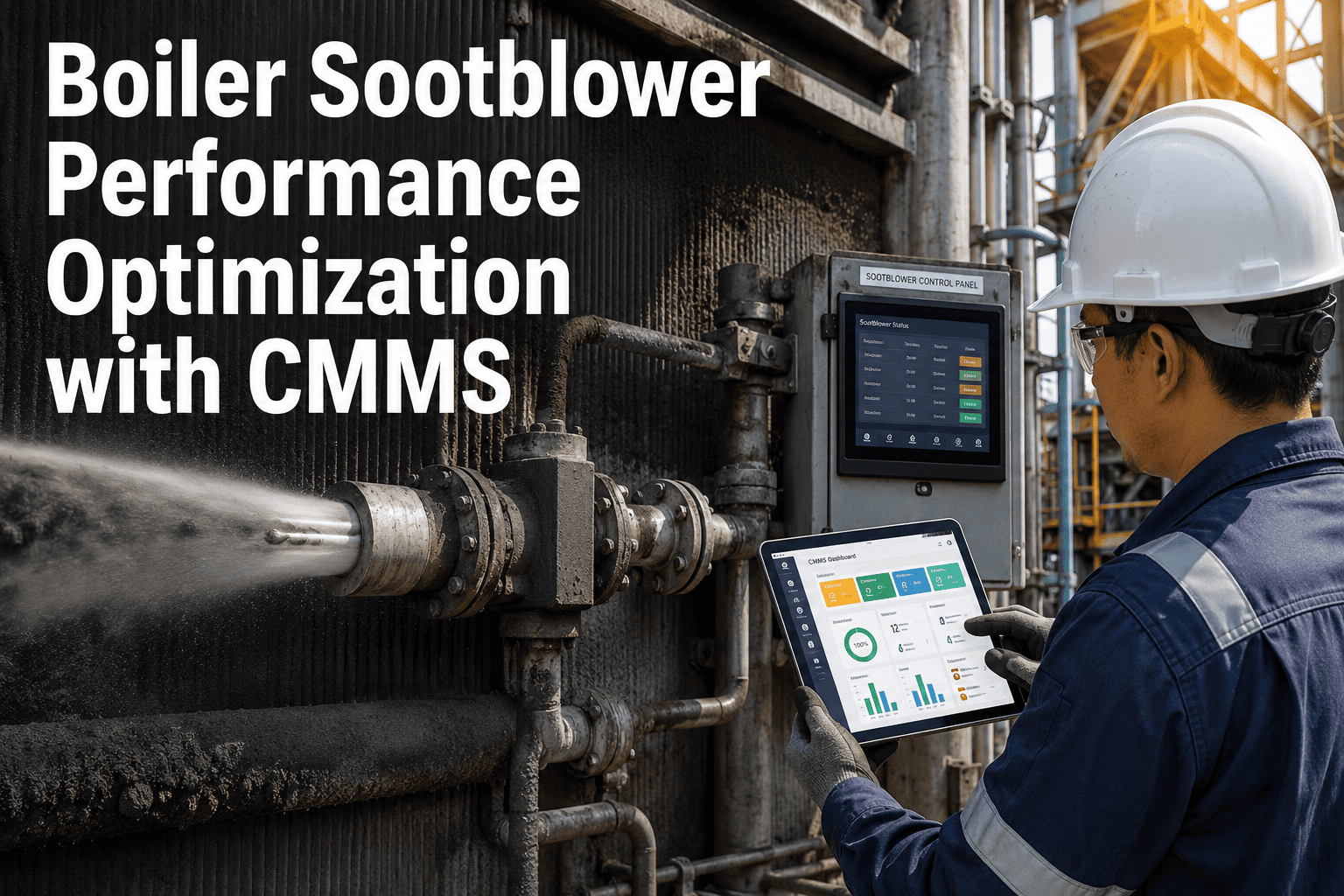
Sootblower optimization and cleaning-schedule maintenance
A 1 mm soot layer on economizer tubes can reduce heat absorption by 5–8%; a 3 mm ash buildup on waterwalls can cut overall boiler efficiency by 2–4%.
Blow frequency optimization
Switch from fixed-interval to load- and temperature-triggered sootblowing. Monitor furnace exit gas temperature (FEGT) and economizer outlet — a 15°C rise above baseline triggers a cleaning cycle. This cuts steam consumption by sootblowers 20–35%.
Lance and nozzle condition
Worn sootblower nozzles reduce cleaning radius by up to 40%. Inspect nozzle orifice and lance tube alignment quarterly; replace nozzles when wear exceeds 0.8 mm. Track each sootblower as a tracked asset with maintenance history in your CMMS.
Targeted zone cleaning
Not all zones foul equally. Use heat-flux sensors and gas-temperature probes to identify the 3–5 most fouled zones and prioritize blowing there. Over-blowing clean zones wastes steam and accelerates tube erosion — a hidden cost of 0.2–0.4% efficiency.
Water-lance and explosive cleaning
For slagged waterwall sections that sootblowers cannot clean, schedule water-lance cleaning during planned outages. Track slag-buildup indicators (FEGT trend, steam-flow deviation) to predict when water-lancing is needed before efficiency drops below 85%.
See how OxMaint tracks every sootblower, sensor, and tuning PM in one platform
Book a 30-minute demo and we'll map your boiler-tuning workflow inside OxMaint — including automated PM triggers, asset history, and real-time efficiency KPIs.
Radiation, Blowdown & Unburned Carbon
Boiler efficiency maintenance: reducing radiation, blowdown, and unburned losses
Beyond combustion tuning, three secondary losses quietly consume 1.5–4% of fuel input — and each has a straightforward maintenance fix.
Refractory and casing insulation audit
Radiation loss is 0.5–1.5% at full load and proportionally higher at partial load. Use thermal imaging quarterly to scan boiler casing, drum covers, and ductwork for hot spots above 80°C ambient. Repair cracked refractory within 30 days; every 10°C reduction in average casing temperature saves ~0.05% efficiency. Log all thermography findings as work orders in your CMMS with photo attachments.
Blowdown control and heat recovery
Continuous surface blowdown at 3–5% of feedwater flow wastes 0.5–1.0% of fuel input. Install or repair automatic blowdown controllers to maintain TDS at 3,000–3,500 ppm instead of over-blowing. Route blowdown through a flash tank to recover low-pressure steam — payback is typically under 12 months for a 150 t/hr boiler.
Pulverizer and burner maintenance to cut unburned carbon
Flyash unburned carbon above 5% signals poor fineness or burner imbalance. Maintain pulverizer grinding elements, classifier settings, and primary air temperature. For oil/gas boilers, service burner guns, atomizer nozzles, and register vanes every 4,000 operating hours. Target CO below 100 ppm and unburned carbon below 3%.
CMMS for Boiler Efficiency
How OxMaint CMMS sustains boiler efficiency gains year-round
Boiler efficiency isn't a one-time tuning event — it's a continuous maintenance discipline. OxMaint's AI-powered CMMS and EAM platform digitizes the entire workflow so efficiency gains from your last outage don't evaporate before the next one.
Predictive PM scheduling for combustion tuning
OxMaint auto-generates combustion-audit and O2-calibration work orders on calendar or runtime triggers. AI predicts when sootblower nozzles will wear past tolerance based on operating hours and steam flow — cutting over-blowing and tube erosion by 25%.
Outcome: 1.0–2.5% efficiency recovery sustained between outages
Asset tracking for every boiler component
Track each sootblower, burner, pulverizer, O2 sensor, and refractory section as a hierarchical asset. Full maintenance history, thermography scans, and repair costs are one click away — eliminating the "tribal knowledge" problem when senior techs retire.
Outcome: 40% faster troubleshooting and audit readiness
Spare-parts inventory for critical tuning components
Maintain min/max stock for zirconia sensors, sootblower nozzles, burner tips, and refractory repair kits. OxMaint auto-generates purchase requisitions when stock hits reorder point, so you never delay a combustion-tuning PM because a $200 sensor is on backorder.
Outcome: 60% reduction in PM deferrals caused by missing parts
Real-time efficiency KPIs and analytics dashboards
OxMaint pulls boiler efficiency, stack temperature, excess O2, and FEGT into live dashboards. Set threshold alerts — if stack temp rises 15°C above baseline, a sootblowing work order triggers automatically. Reliability managers see trend lines and can prove ROI to plant leadership.
Outcome: 30–50% faster response to efficiency drift
Real-World Impact
Case snapshot: 500 MW coal plant recovers 3.2% efficiency in 90 days
A 500 MW bituminous-coal plant in the Midwest was running 84.1% boiler efficiency against a design target of 87.5%. After implementing structured combustion tuning and sootblower optimization through OxMaint, the team recovered 3.2 percentage points within one quarter.
Before OxMaint
- Boiler efficiency: 84.1% (design 87.5%)
- Excess O2: 5.8% (target 3.0–3.5%)
- Stack temperature: 165°C (design 148°C)
- Sootblowing: fixed interval, 22 blows/day
- PM compliance: 61% on-time
- Annual excess fuel cost: ~$1.4M
After 90 Days with OxMaint
- Boiler efficiency: 87.3% (+3.2 points)
- Excess O2: 3.4% (tuned and auto-trimmed)
- Stack temperature: 151°C (−14°C)
- Sootblowing: load-triggered, 14 blows/day (−36%)
- PM compliance: 94% on-time
- Annual fuel savings: ~$960K
The plant's total investment in OxMaint licenses, sensor calibration, and nozzle replacement was recovered in less than 7 weeks. PM compliance jumped from 61% to 94% because automated work-order triggers eliminated the spreadsheet-and-sticky-note workflow that had caused 40% of tuning PMs to be deferred.
Frequently Asked Questions
Boiler efficiency optimization: questions maintenance teams ask
What is the ideal excess air level for boiler combustion optimization?
For most pulverized-coal boilers, the target is 15–25% excess air (3.0–4.0% O2 in flue gas). Natural-gas boilers can run leaner at 5–10% excess air (1.0–2.0% O2). The exact optimum is the O2 level at which CO drops below 100–200 ppm — going lower risks unburned fuel and CO spikes, going higher wastes heat up the stack. Calibrate your O2 analyzers quarterly and log results in your CMMS to detect drift.
How often should combustion tuning be performed in a power plant boiler?
Combustion tuning should be performed every 6 months at minimum, plus after any major fuel-quality change, burner modification, or pulverizer overhaul. Between formal tunings, O2-trim calibration should be checked quarterly. A CMMS like OxMaint automates these recurring PMs so they are never deferred — see how by booking a demo at calendly.com/oxmaintapp/30min.
How much does a 1% boiler efficiency improvement save?
For a 500 MW coal-fired plant at 75% capacity factor with coal at $60/ton, a 1% efficiency improvement saves roughly $300K–$400K per year in fuel. For a comparable gas-fired plant at $4/MMBtu, the same 1% gain saves $500K–$700K annually. These numbers are why even small combustion-tuning and sootblower-optimization gains have payback periods measured in weeks, not years.
What are the most common causes of boiler efficiency drop?
The top three causes are (1) excess-air drift from miscalibrated O2 sensors or damper linkage wear, (2) heat-transfer-surface fouling from inadequate or mis-targeted sootblowing, and (3) burner deterioration — worn pulverizer grinding elements, clogged burner nozzles, or register misalignment. Less common but significant: refractory degradation increasing radiation loss, and blowdown-control valve leakage. A CMMS boiler efficiency program catches all five before they compound.
Can a CMMS improve boiler efficiency?
Yes — a CMMS directly sustains boiler efficiency by ensuring combustion-tuning PMs, sensor calibrations, sootblower inspections, and refractory audits are executed on schedule and documented. OxMaint goes further with AI-driven predictive maintenance that forecasts component wear, live KPI dashboards that flag efficiency drift in real time, and automated work-order triggers tied to temperature and O2 thresholds. Start a free trial at app.oxmaint.ai to see it on your assets.
Stop losing boiler efficiency between outages
OxMaint digitizes your combustion-tuning PMs, sootblower inspections, and efficiency KPIs in one AI-powered platform — so every 1% you recover stays recovered. Book a 30-minute demo and we'll build your boiler-maintenance workflow live.
Free 14-day trial · No credit card