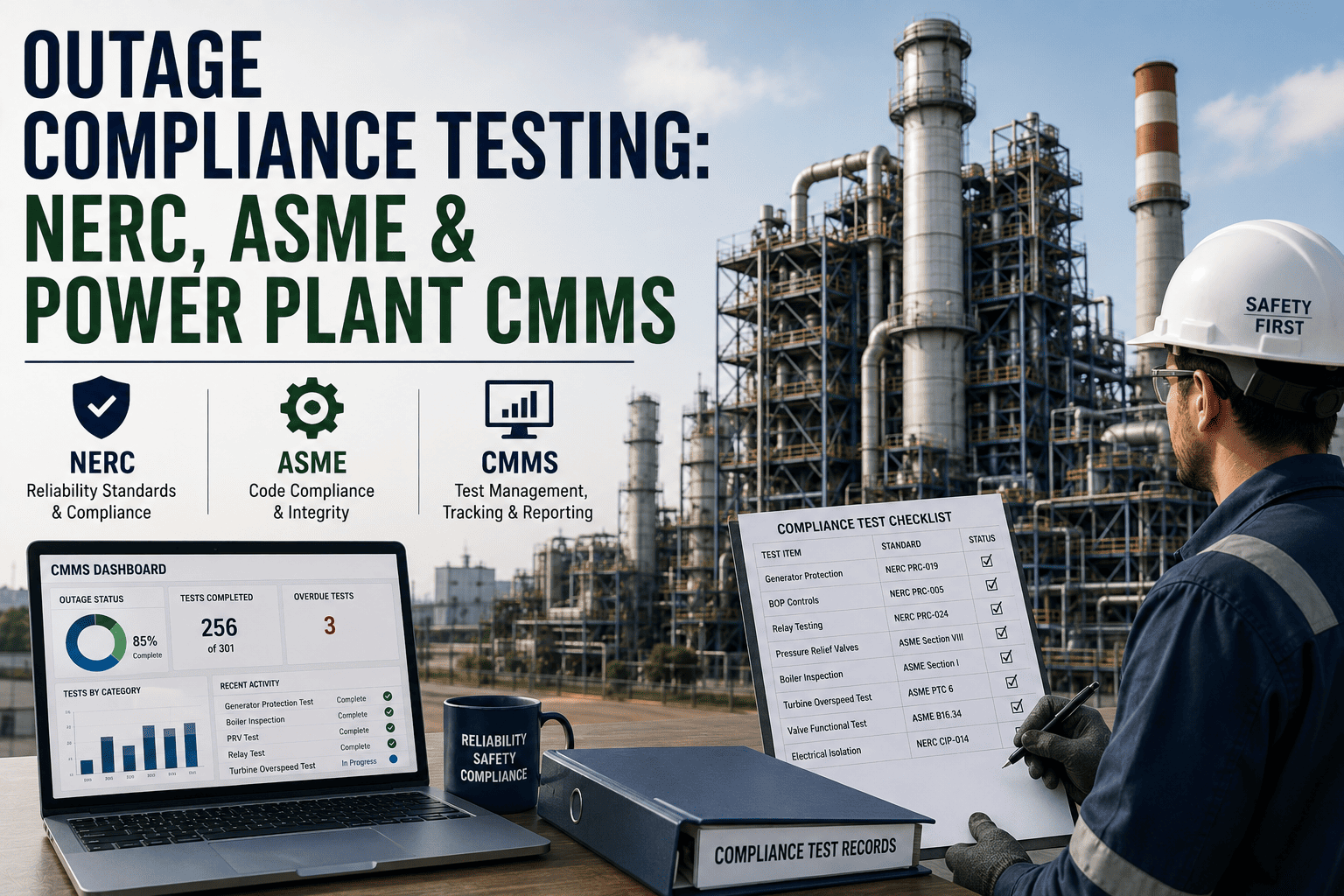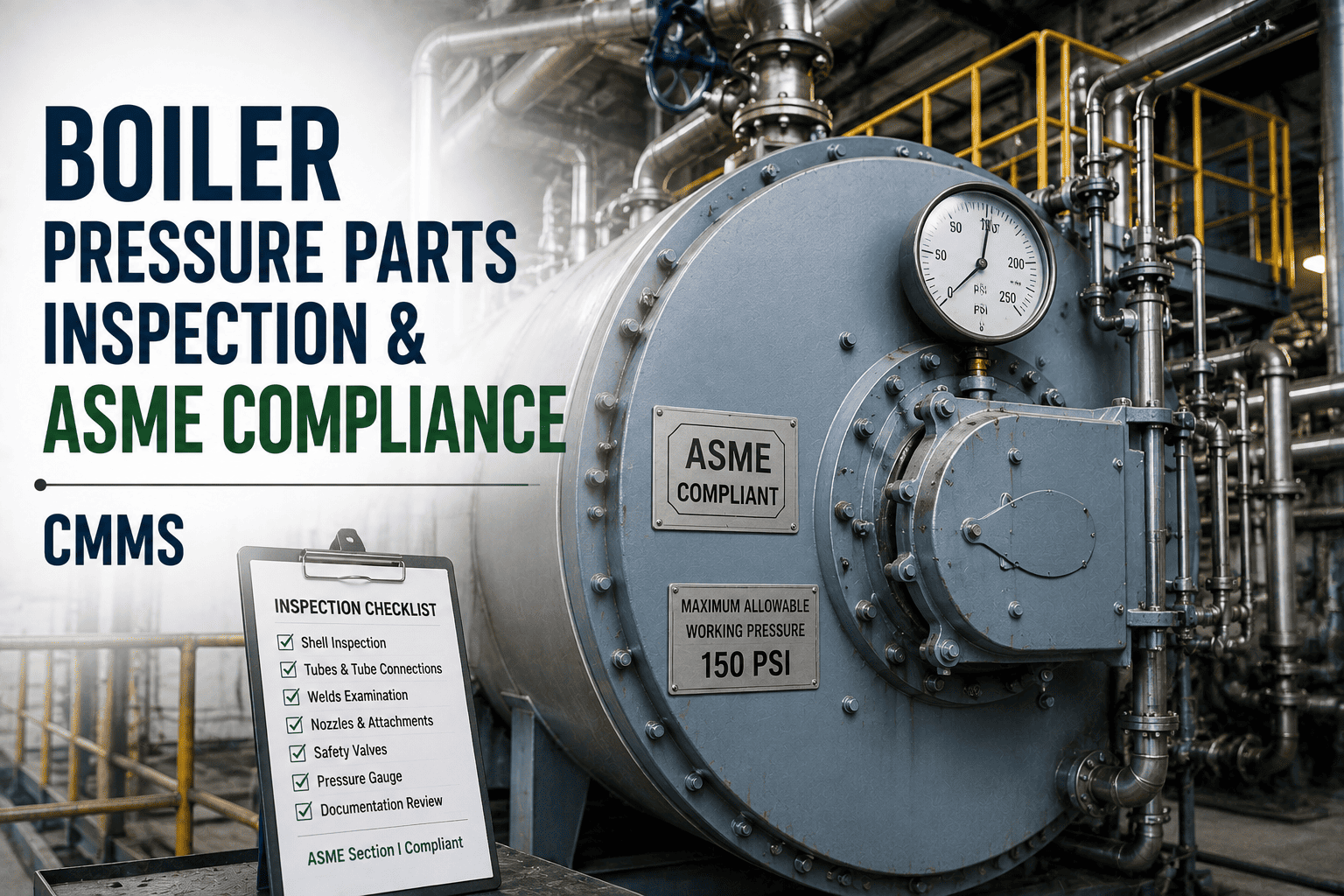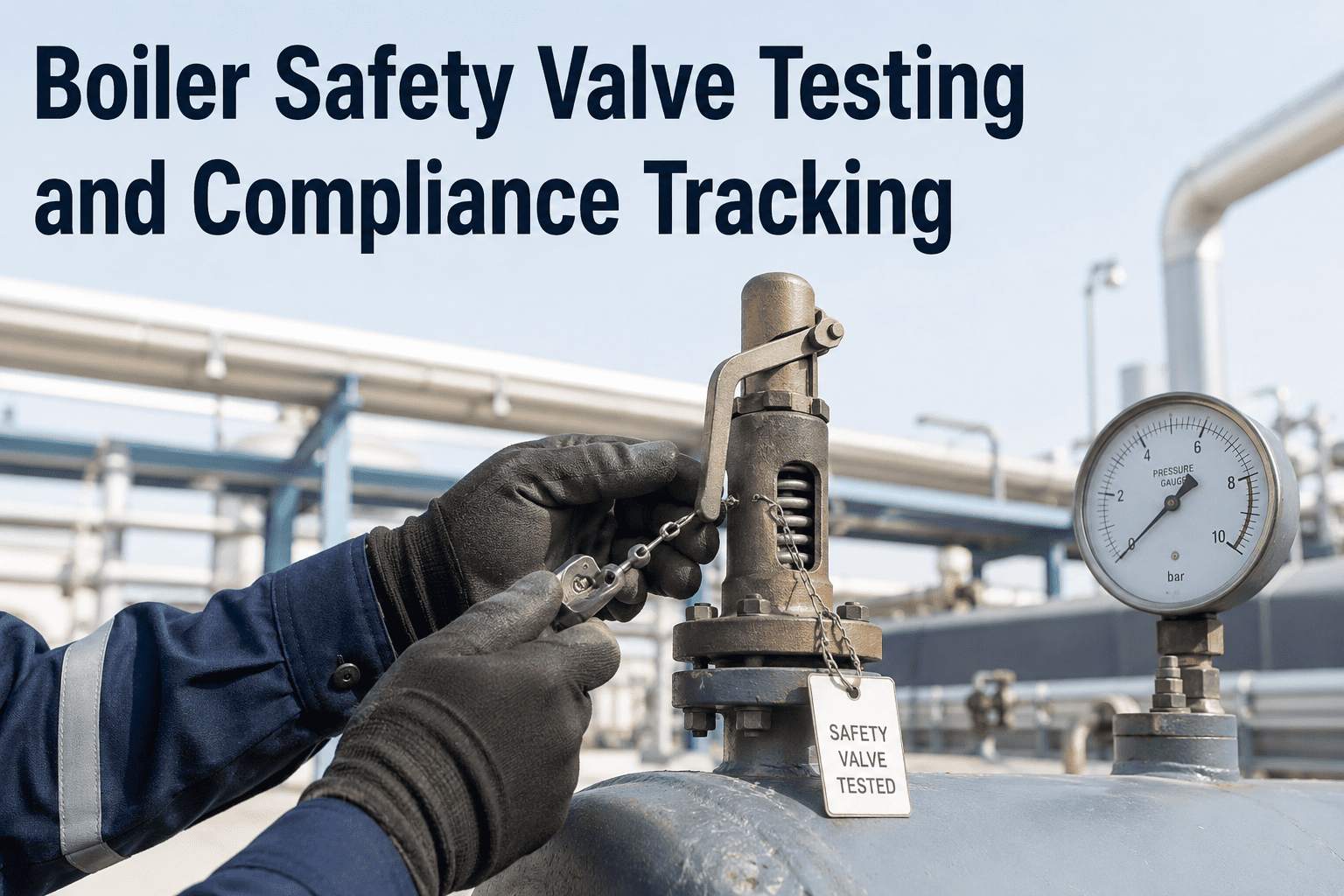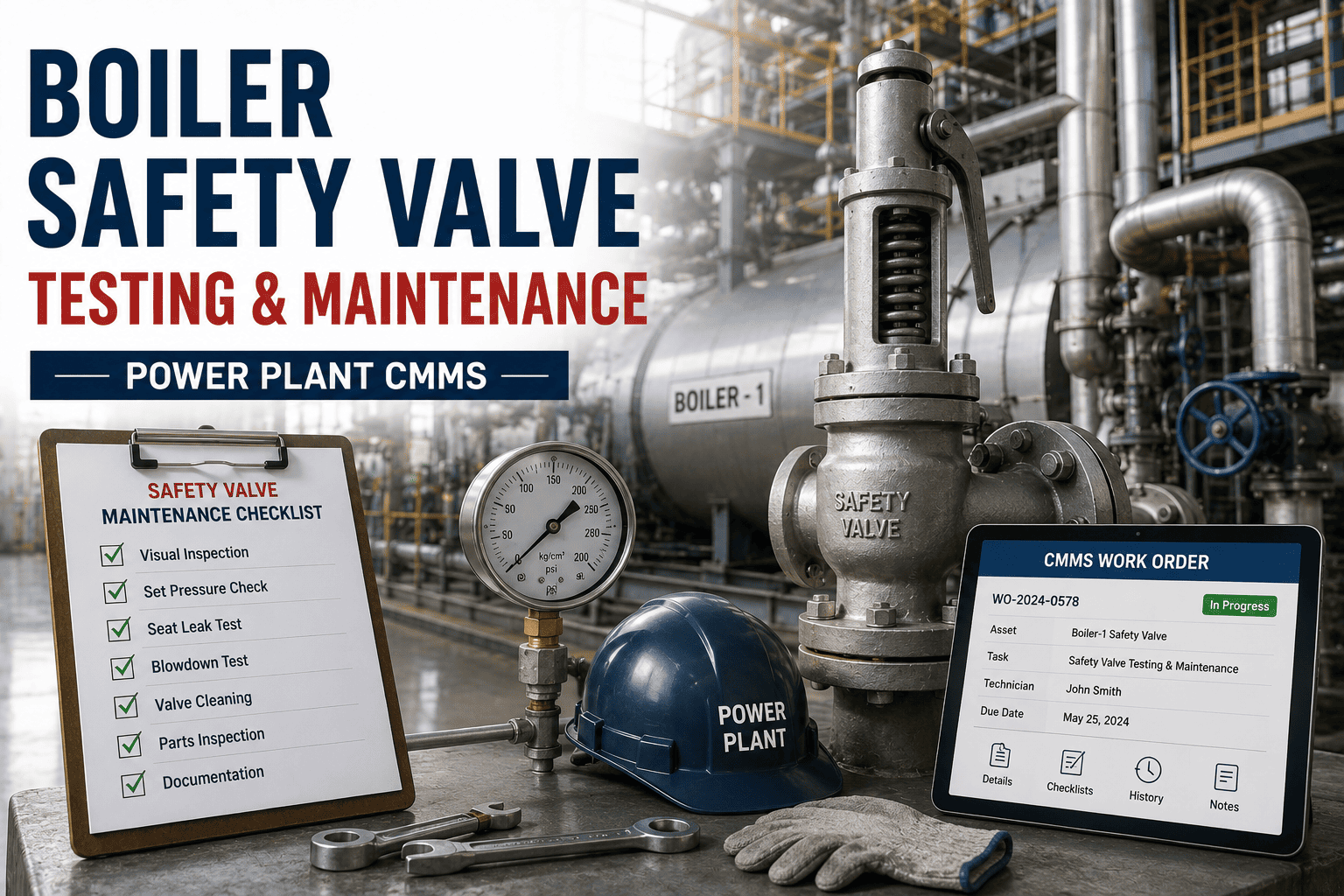
Boiler safety valve testing is the single most critical preventive maintenance task in any power plant, because these valves are the last line of defense against catastrophic overpressure events that can cause explosions, prolonged outages, and regulatory penalties. ASME Section I and Section VIII codes mandate rigorous safety valve inspection intervals, seat leak detection, and pop testing procedures to ensure boilers operate within safe pressure limits. This boiler safety valve guide covers testing intervals, compliance requirements, and how a safety valve CMMS like OxMaint automates the entire workflow — from scheduling inspections to generating audit-ready compliance reports. You can Start Free Trial today or keep reading to build a bulletproof valve maintenance program.
Is your next boiler safety valve failure hiding in a spreadsheet?
Over 40% of power plant boiler incidents trace back to overdue or improperly documented safety valve testing. Manual tracking misses pop-test due dates, ignores seat leak trends, and fails ASME audits — costing plants millions in downtime and fines every year.
Boiler safety valve testing intervals and ASME compliance explained
ASME PTC 25 and NBIC Part 3 require boiler safety valves to be tested, repaired, or recalibrated at intervals ranging from 1 to 5 years depending on valve type, service conditions, and operating pressure — yet many power plants still rely on whiteboards and clipboards to track hundreds of critical valves across multiple units.
Power Boilers — Annual Testing
Safety relief valves on Section I power boilers must be pop-tested at least annually under operating pressure or bench-tested during planned outages. OxMaint auto-generates work orders 30, 60, and 90 days before each valve's due date and attaches the latest ASME PTC 25 test procedure, set-pressure charts, and repair-vendor certifications directly to the asset record.
Repair & Recalibration Intervals
The National Board Inspection Code requires VR-stamped repair every 3–5 years for valves in continuous high-pressure service. A safety valve CMMS like OxMaint tracks each valve's NB certificate number, VR stamp expiry, and repair history — flagging valves approaching their recalibration window so procurement can schedule authorized repair shops before the compliance deadline lapses.
Pressure Vessel Code Inspections
For safety valves on Section VIII pressure vessels and auxiliary systems, API 510 inspection intervals typically run 5 years for non-severe and 2 years for severe service. OxMaint's predictive engine analyzes seat leak rates, cycle counts, and temperature excursions to recommend risk-based intervals that can extend or shorten the default schedule — reducing unnecessary testing on healthy valves while catching degradation early.
Complete boiler safety valve inspection checklist for maintenance teams
A single missed seat-leak test can allow a boiler to drift past its maximum allowable working pressure (MAWP). Use this checklist — derived from ASME PTC 25 and common power plant PM procedures — to standardize every safety valve inspection across your fleet.
Pop Test & Set Pressure Verification
5 items- Verify valve pops within ±3% of nameplate set pressure
- Confirm reseating pressure is ≥96% of set pressure
- Record lift height and blowdown duration during pop
- Check for simmering or chattering during activation
- Compare current pop value against previous 3 test cycles
Seat Leak Detection
4 items- Perform bubble-test or flow-meter seat tightness check at 90% set pressure
- Measure leak rate in bubbles/minute or cc/min per ASME PTC 25
- Inspect valve seat and disc for erosion, pitting, or wire-drawing
- Log trend data into CMMS for predictive seat-replacement alerts
Mechanical & Visual Inspection
5 items- Inspect spring housing for corrosion, cracks, or scale buildup
- Verify lifting lever (try-lever) moves freely and returns to rest
- Check discharge piping for back-pressure, obstruction, or condensate trap
- Confirm valve nameplate and NB stamp are legible
- Verify bonnet vent is clear and directed to safe location
Documentation & Compliance
4 items- Attach calibrated pressure-gauge certificate to work order
- Record technician name, test date, and equipment ID in CMMS
- Generate ASME-compliant test report with digital signature
- Schedule next pop-test due date based on code interval
Safety valve test intervals by valve type and service condition
Different valves carry different regulatory intervals. Use this reference table to benchmark your current PM schedule and identify gaps where a safety valve CMMS can automate compliance tracking.
| Valve Type / Service | Code Reference | Pop Test Interval | Seat Leak Test | VR-Stamp Repair |
|---|---|---|---|---|
| Power Boiler SRV (Section I) | ASME Sec I / NBIC | 12 months | Annual | 3–5 years |
| High-Pressure Steam Header | ASME B31.1 / PTC 25 | 12 months | Annual | 3 years |
| Pressure Vessel Relief (Sec VIII) | API 510 | 5 years (non-severe) | Every inspection | 5 years |
| Severe Service / Corrosive | API 510 / RBI | 2 years | Semi-annual | 2 years |
| Hot Water Heating Boiler | ASME Sec IV | 12 months | Annual | 5 years |
| Auxiliary / Low-Pressure | Plant PM Standard | 24 months | Annual | 5 years |
Intervals shown are code minimums. Insurance carriers and plant reliability programs often specify shorter intervals based on operating history and risk classification.
What delayed safety valve maintenance really costs a power plant
A mid-sized 500 MW coal plant typically operates 180–240 safety relief valves across its boiler, reheater, and auxiliary systems. When valve testing lapses, the financial and operational consequences compound rapidly — often invisible until an audit or incident forces an emergency outage.
A 180-asset power plant spending $42K annually on manual valve tracking and spreadsheet compliance switched to OxMaint's safety valve CMMS. Within 6 months they eliminated 14 overdue valve tests, reduced seat-leak-related steam losses by an estimated $28K, and passed their annual insurance audit without a single finding — achieving full payback in under 4 months.
See OxMaint manage your entire safety valve program in 30 minutes
Import your valve inventory, auto-schedule ASME-compliant test intervals, and generate audit-ready reports — all in one platform built for power plant maintenance teams.
How OxMaint CMMS automates boiler safety valve testing and compliance
OxMaint replaces spreadsheets, paper work orders, and tribal knowledge with an AI-powered maintenance platform purpose-built for power plant reliability teams. Here is how four core capabilities map directly to your safety valve program:
Automated PM Scheduling by Code Interval
OxMaint auto-generates pop-test, seat-leak, and VR-stamp work orders based on each valve's code classification (ASME Sec I, IV, VIII, API 510). Triggered 30–90 days ahead, these work orders arrive with pre-attached PTC 25 procedures — cutting planning time by up to 70% and eliminating missed deadlines.
Predictive Failure Analytics
The AI engine analyzes seat leak trends, pop pressure drift, cycle counts, and operating temperature logs to predict which valves are degrading — recommending condition-based testing instead of rigid calendar intervals. Catch valve degradation 2–3 cycles before failure and avoid unplanned boiler trips.
Audit-Ready Compliance Reports
Every test result, technician signature, gauge calibration certificate, and repair record is stored against the valve's asset history. Generate a complete ASME/NBIC compliance dossier in one click — no more scrambling through filing cabinets when an auditor or insurance inspector arrives.
Spare Parts & Vendor Management
Track each valve's make, model, orifice size, and required spare kits in the OxMaint inventory module. When a seat-leak test fails, the work order auto-creates a purchase request for the correct replacement kit and notifies your VR-stamped repair vendor — cutting valve repair cycle time by 40%.
Power plant teams trust OxMaint for safety valve compliance
Maintenance and reliability leaders at power generation facilities across North America use OxMaint to manage their boiler safety valve programs — here is what they report after switching from spreadsheets and legacy CMMS platforms.
"We had 23 overdue safety valve tests scattered across three boilers and nobody knew until the insurance audit. OxMaint flagged every one within the first week and auto-scheduled the catch-up work orders. We passed re-inspection with zero findings."
"The predictive seat-leak analytics caught a valve degrading two cycles before it would have failed. That alone saved us an estimated $340K in avoided unplanned downtime. The ASME compliance reporting feature alone justifies the subscription."
Boiler safety valve testing and CMMS — your top questions answered
How often should boiler safety valves be tested?
ASME Section I power boiler safety relief valves must be pop-tested at least once every 12 months, either under operating pressure or during a planned outage using bench testing. Severe-service and high-pressure steam header valves may require semi-annual seat leak tests. VR-stamp repair and full recalibration is typically required every 3–5 years depending on the valve's service conditions and operating history. A safety valve CMMS like OxMaint automates these intervals so no test date is ever missed.
What is the difference between a pop test and a seat leak test?
A pop test verifies that the safety valve opens at its nameplate set pressure (within ±3%) and reseats properly — it confirms the valve will activate during an overpressure event. A seat leak test checks whether the valve's seating surfaces are tight when the valve is closed, typically performed at 90% of set pressure using a bubble test or flow meter. Both are required for full ASME PTC 25 compliance, and OxMaint tracks both results in each valve's asset history.
Can a CMMS help with ASME boiler valve compliance?
Yes — a safety valve CMMS is the most effective way to maintain ASME compliance because it automatically schedules tests by code interval, attaches the correct PTC 25 procedures to each work order, stores test results and calibration certificates against each asset, and generates audit-ready compliance reports on demand. You can Book a Demo to see how OxMaint maps your entire valve inventory to ASME, NBIC, and API 510 requirements.
What happens if a boiler safety valve fails a test?
If a valve fails its pop test or exceeds acceptable seat leak rates, it must be immediately removed from service and repaired or replaced by a VR-stamped repair organization. The boiler cannot operate until a compliant valve is reinstalled and retested. OxMaint auto-creates a purchase request for the correct replacement parts and routes a repair work order to your authorized vendor — reducing the typical repair cycle from 2–3 weeks to under 10 days.
How long does it take to implement a safety valve CMMS?
Most power plants are fully operational on OxMaint within 2–4 weeks. The onboarding team imports your existing valve inventory from spreadsheets or your legacy CMMS, configures code-based test intervals for each valve classification, and trains your technicians on mobile work order completion. You can also Start Free Trial to explore the platform immediately with your own data before committing.
Stop tracking boiler safety valves on spreadsheets
Join the power plant maintenance teams using OxMaint to automate ASME-compliant safety valve testing, predict failures before they happen, and pass every audit without stress.
Free 14-day trial · No credit card required