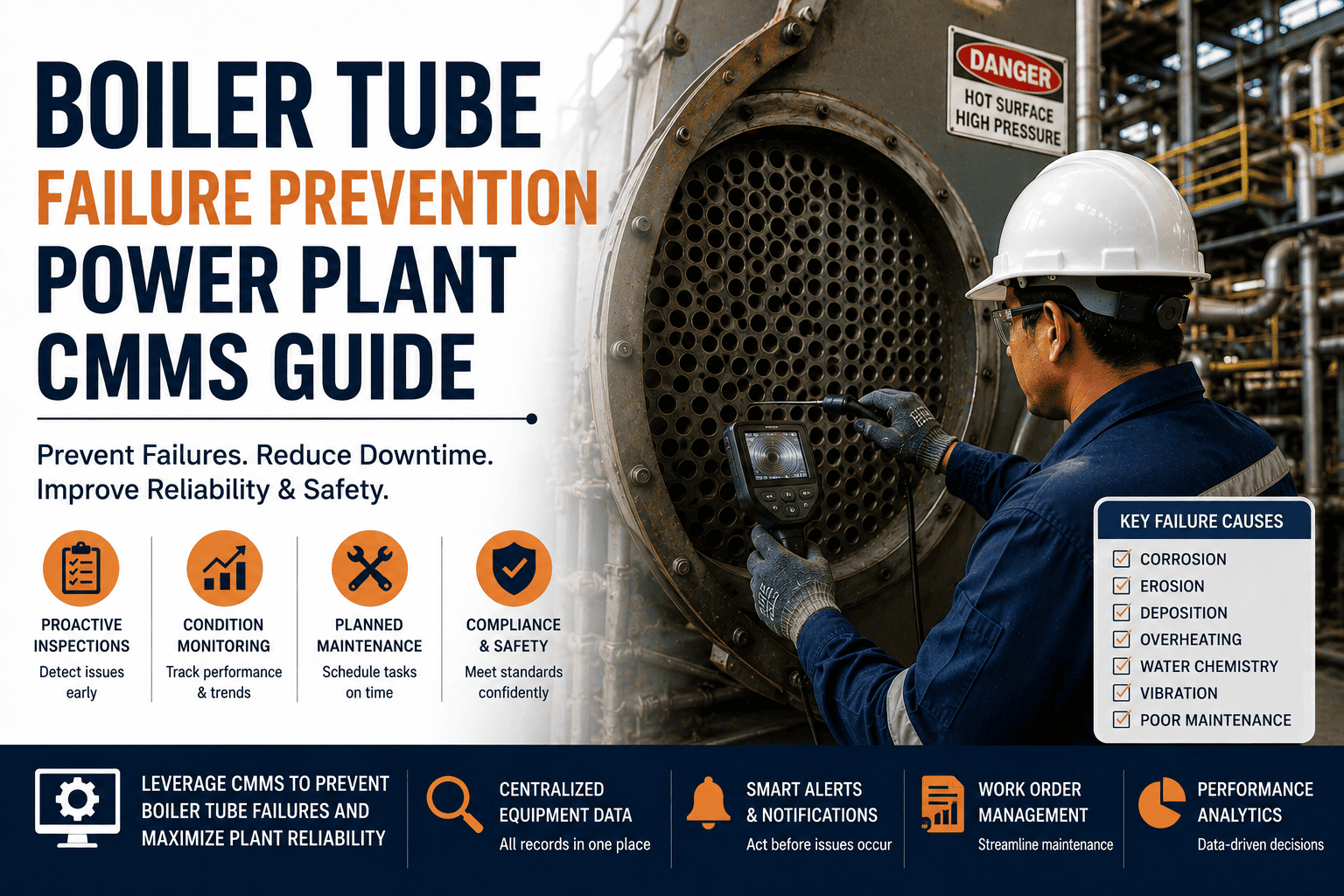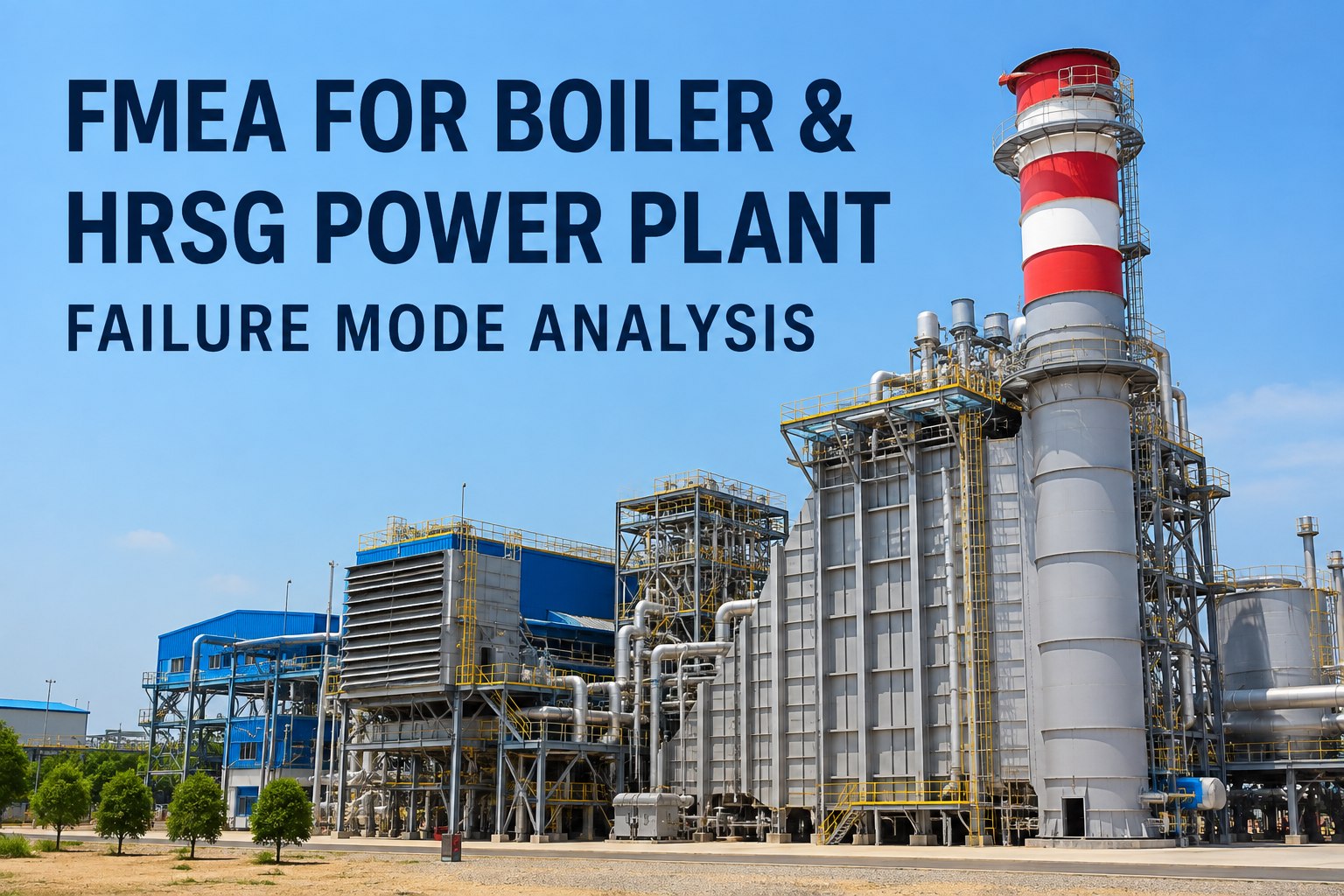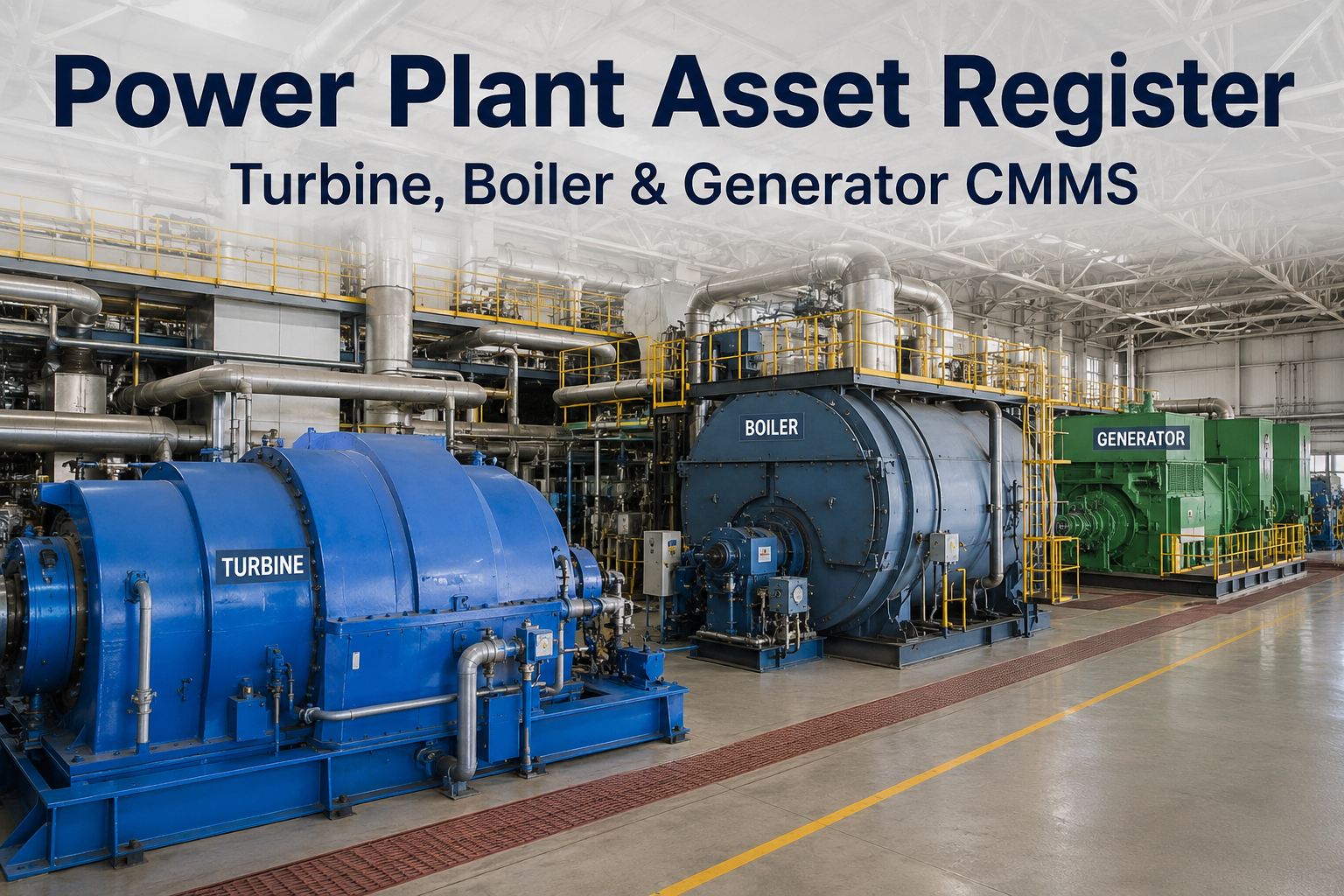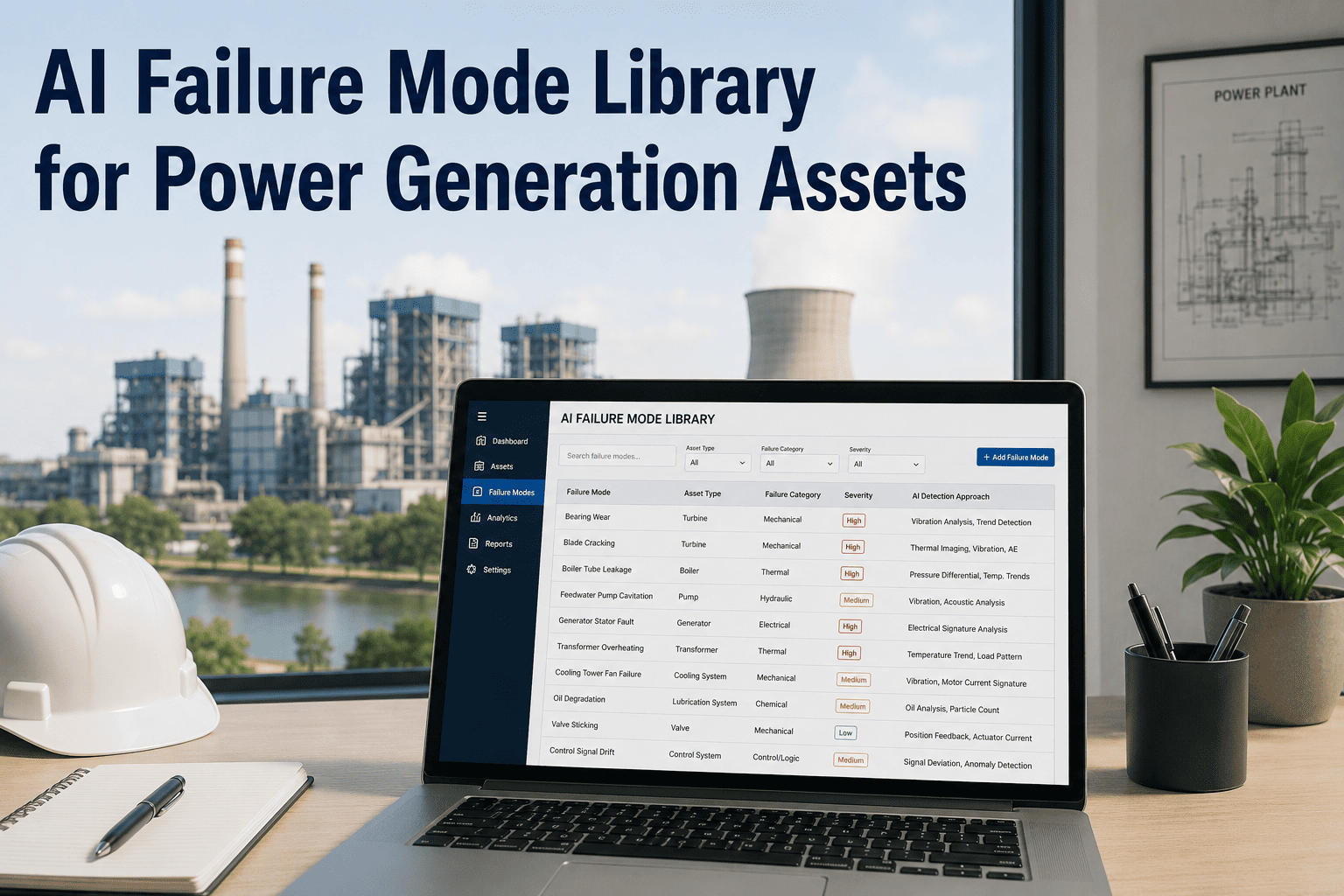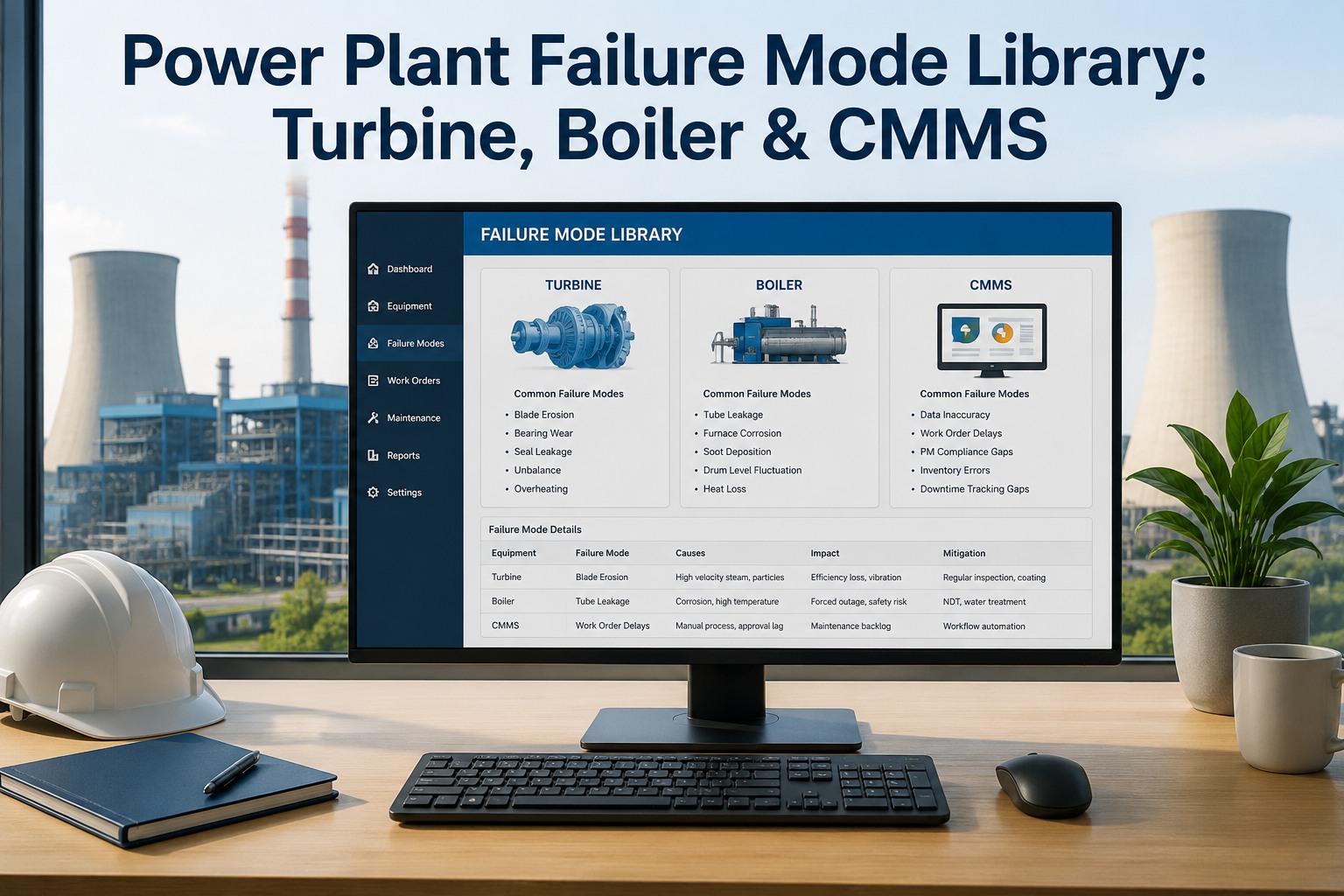
A power plant failure mode library is a structured, searchable catalog of equipment fault modes—turbine failure modes, boiler failure modes, generator failure codes—mapped to symptoms, root causes, and corrective work-order actions inside a CMMS. Without one, reliability teams lose hours hunting through spreadsheets and tribal knowledge every time an asset trips. Building this failure taxonomy in a CMMS like OxMaint gives technicians instant symptom-to-cause mappings, standardizes repair codes across shifts, and feeds predictive analytics the clean failure data needed to cut unplanned downtime by 30–50%. Ready to replace reactive chaos with a structured power plant fault library? Start Free Trial and configure your first failure taxonomy today.
CMMS FAILURE TAXONOMY FOR POWER GENERATION
Every turbine trip, boiler tube leak and generator fault — mapped, coded and searchable in one CMMS failure library.
A power plant logs 8,000–15,000 work orders per year. Without a standardized failure mode library, 40% of those records carry ambiguous "general repair" descriptions — eroding the data quality your RCA and predictive programs depend on. OxMaint turns that noise into a structured, queryable asset.
FAILURE TAXONOMY STRUCTURE
What belongs in a power plant failure mode library?
A robust power plant fault taxonomy follows a four-level hierarchy: asset class → failure mode → failure cause → remediation code. This structure aligns with ISO 14224 and gives reliability engineers the granularity needed for Weibull analysis, MTBF trending and FMEA updates.
Asset Class & Criticality
Top-level grouping: steam turbine, HRSG, boiler, generator, condenser, BOP pumps. Each carries a criticality rating (A/B/C) that drives PM frequency and spare-part safety stock.
Failure Mode
The observable effect: "vibration above trip," "tube leak," "bearing temperature high," "stator winding ground fault." This is what the technician sees, not the root cause.
Failure Cause
The physical or operational root: misalignment, erosion, fatigue, lubrication breakdown, electrical overload. Links directly to RCA findings and predictive sensor thresholds.
Remediation Code
Standardized repair action: "replace bearing," "re-tube section," "realign coupling," "rewind stator." Feeds job-plan templates and spare-part kitting automatically.
TURBINE · BOILER · GENERATOR
Core failure modes by equipment class — mapped to CMMS codes
Below is a condensed extract from a production-grade power plant fault library. Each row shows the failure mode a technician selects in the CMMS dropdown, the likely cause, and the standard remediation code that auto-triggers the correct job plan and parts kit.
| Asset Class | Failure Mode | Likely Cause | CMMS Remediation Code | Detection Method |
|---|---|---|---|---|
| Steam Turbine | Vibration above 7.1 mm/s trip | Bearing wear / misalignment | TBR-014 Bearing Replace | Accelerometer / CMS |
| Steam Turbine | Blade-tip clearance alarm | Differential expansion | TAL-003 Alignment Check | Eddy-current probe |
| Boiler / HRSG | Tube leak (waterwall) | Short-term overheating | BRT-021 Retube Section | Acoustic leak detection |
| Boiler / HRSG | Refractory spalling | Thermal cycling fatigue | BRF-008 Refractory Repair | Thermography survey |
| Generator | Stator winding ground fault | Insulation degradation | GRW-011 Stator Rewind | Partial-discharge monitor |
| Generator | Hydrogen seal oil leak | Seal-ring wear | GSO-006 Seal Replace | Pressure / flow deviation |
| BOP Pump | Seal flush flow low | Restriction / degradation | PSF-002 Flush Service | Flow transmitter |
| Condenser | Tube fouling / vacuum loss | Biological scaling | CFT-009 Tube Clean | Heat-rate deviation |
A 500 MW combined-cycle plant using this coding structure reported a 22% reduction in time-to-diagnose and a 15% lift in PM compliance within the first six months of deployment.
STEP-BY-STEP IMPLEMENTATION
How to build a CMMS failure library in 90 days
Migrating from free-text work orders to a coded failure taxonomy is a 90-day project for a mid-size plant. Here is the timeline reliability managers use to roll out a power plant fault library without disrupting operations.
Days 1–30 · Audit & Extract
Pull 24 months of work-order history. Mine free-text descriptions for recurring phrases. Group into asset classes and rank by downtime hours to prioritize the top 20 failure modes that drive 80% of lost availability.
Days 31–60 · Code & Validate
Draft the four-level hierarchy in OxMaint. Validate with senior technicians and operations engineers — they must recognize their equipment in the dropdowns. Load remediation codes and link each to a job-plan template.
Days 61–90 · Pilot & Train
Pilot on one unit or shift. Enforce mandatory failure-code selection on work-order closure in the CMMS mobile app. Run weekly data-quality audits. Expand plant-wide once 95% of closed WOs carry a valid code.
THE COST OF UNCODED DATA
Why free-text work orders are costing your plant millions
When technicians type "fixed pump" instead of selecting a coded failure mode, the data collapses. You cannot trend, you cannot predict, and your RCA meetings start from scratch every time. The financial impact is measurable.
Annual Cost of Poor Failure Data
Lost availability (MW × hours × $/MWh) + Excess labor hours spent on RCA + Over-stocked spares from no demand signal
Example: a 180-asset plant losing 120 hours/year to repeat failures at $60/MWh and 400 MW capacity loses $2.88M in availability alone — before labor and parts inflation.
HOW OXMAINT HELPS
Turn your failure mode library into predictive action with OxMaint
OxMaint is an AI-powered CMMS and EAM platform that operationalizes your failure taxonomy — not just storing codes, but using them to trigger work, predict failures and optimize inventory. Here is what changes when your fault library lives inside OxMaint.
Symptom-to-Code Smart Search
Technicians type "high vibration on turbine bearing 2" and OxMaint AI maps it to the correct failure mode and remediation code instantly — eliminating guesswork and boosting code-compliance to 98%.
Predictive Failure Alerts
OxMaint's AI correlates SCADA, vibration and oil-analysis trends against your coded failure modes — alerting reliability engineers 7–21 days before a fault escalates, cutting unplanned downtime 30–50%.
Auto-Generated Job Plans
Each remediation code auto-triggers a standardized job plan, safety permit checklist and spare-parts kit — reducing mean-time-to-repair by 25% and ensuring audit-ready documentation every time.
Failure Analytics Dashboard
Live MTBF, MTTR and bad-actor reports sliced by failure mode, cause and asset class — giving plant managers the evidence needed to justify capital replacements and PM optimization in real time.
"We coded 1,200 failure modes in OxMaint across our turbine and boiler fleets. Within four months our PM compliance hit 96% and we cut unplanned downtime events by a third. The AI symptom search alone saved our technicians 20 hours a week."
— Reliability Manager, 1,200 MW Combined-Cycle Plant
See your turbine, boiler and generator failure modes coded and live in 30 minutes.
Book a personalized demo and we will map your top 20 failure modes into OxMaint on the call — using your own asset list and work-order history.
FREQUENTLY ASKED QUESTIONS
Power plant failure mode library — common questions
What is a power plant failure mode library?
A power plant failure mode library is a structured, standardized catalog of equipment fault modes — covering turbines, boilers, generators and BOP systems — organized by asset class, failure mode, root cause and remediation code. It lives inside a CMMS so technicians select from validated dropdowns at work-order closure instead of typing free-text descriptions, giving reliability engineers clean, trendable data.
How do I build a CMMS failure taxonomy from scratch?
Start by mining 24 months of historical work orders for recurring failure phrases, then group them by asset class and rank by downtime impact. Draft a four-level hierarchy (asset → mode → cause → remediation), validate it with senior technicians, and load it into your CMMS. OxMaint accelerates this — book a demo and we will map your top 20 modes live on the call.
What are the most common steam turbine failure modes?
The most frequent steam turbine failure modes include excessive vibration from bearing wear or misalignment, blade-tip clearance alarms from differential expansion, governor oil contamination, and diaphragm cracking from thermal fatigue. Each should map to a specific CMMS remediation code such as "TBR-014 Bearing Replace" so job plans and spare kits trigger automatically.
How does a failure code library improve predictive maintenance?
Predictive analytics depends on labeled failure data to train models and set alert thresholds. When 95%+ of closed work orders carry a validated failure code, AI can correlate sensor trends — vibration, temperature, oil quality — to specific modes and alert engineers days or weeks before failure. Without coded data, predictive models have no ground truth to learn from.
How long does it take to implement a CMMS failure library in a power plant?
A mid-size power plant can build and deploy a failure mode library in 90 days: 30 days to audit and extract codes from historical data, 30 days to validate and load the taxonomy, and 30 days to pilot, train and enforce compliance. OxMaint's AI-assisted symptom-to-code mapping can compress this to 45 days — Start Free Trial to see how.
Stop logging "general repair." Start trending real failure data.
Deploy a coded power plant failure mode library in OxMaint and give your reliability team the structured data they need to cut downtime, pass audits and predict failures before they happen.
Free 14-day trial · No credit card