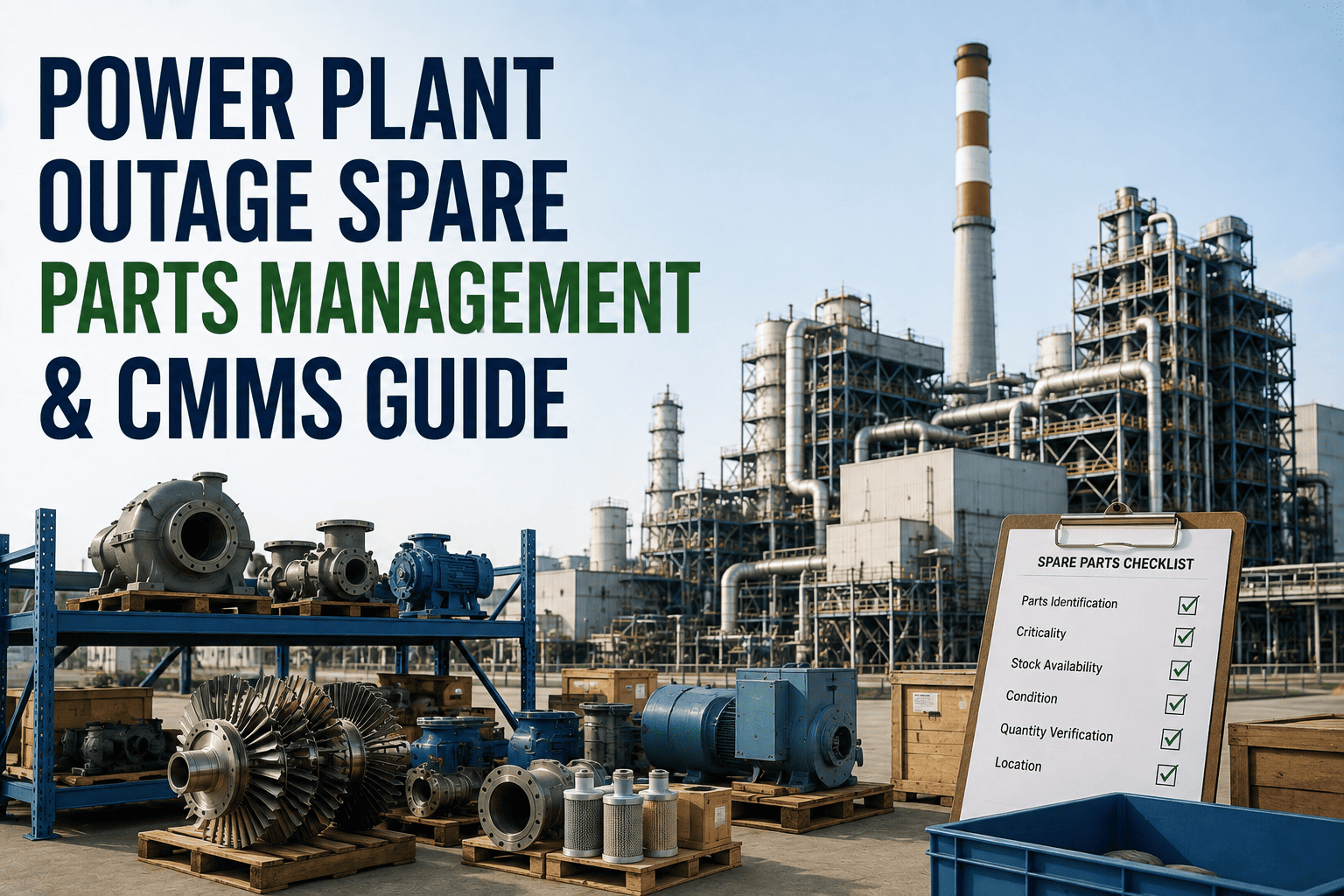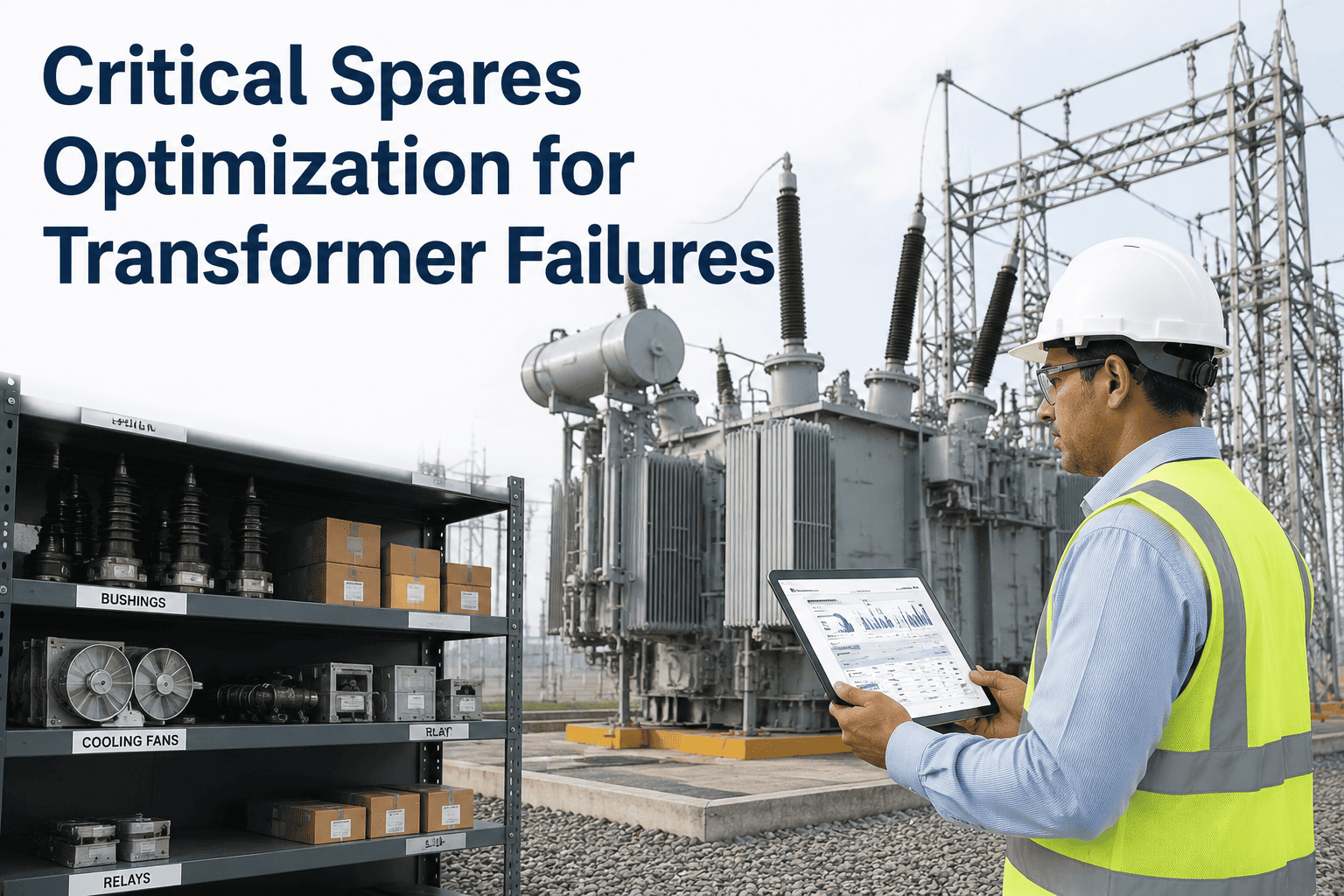
Critical spare parts optimization for power plants is the difference between a 72-hour forced outage and a $4M revenue loss — yet most generation fleets still manage turbine rotor spares, generator spare windings and HRSG tube banks on spreadsheets that cannot see lead times, min/max levels or consumption trends in real time. A modern CMMS like OxMaint brings AI-driven demand forecasting, automated reorder triggers and full criticality scoring into one platform so reliability teams hold the right spares at the right time without over-capitalizing inventory. Plants that implement structured spare parts strategy power solutions typically cut emergency procurement spend 20–35% and reduce mean-time-to-repair on critical assets by 40%. Ready to stop guessing at reorder points? Start Free Trial and see your spare-parts dashboard in under 24 hours.
When a turbine rotor is 18 months out, your spare parts strategy is your outage strategy.
Critical spares for power plants carry lead times of 6–24 months and unit costs from $50K to $3M+. OxMaint's AI-powered CMMS tracks every rotor, winding and tube bank against real-time asset condition, consumption history and supplier lead times — so you hold what matters, release capital from what doesn't, and never scramble during a forced outage.
What defines a critical spare in a power plant?
Not every spare deserves a spot on the critical-inventory list. The industry standard — aligned with ISO 55000 asset management principles — scores each part on four dimensions: consequence of failure, lead time, single-source risk and historical failure rate. Parts that score high on at least three dimensions earn a place in your critical spare parts power plant program and warrant dedicated stock, consignment agreements or rotable-pool participation.
Mission-Critical Long-Lead
Turbine rotors, generator spare windings, main transformer bushings. Failure causes full unit trip; lead time exceeds 12 months. Mandatory stock or rotable pool.
Essential Operational
HRSG tube banks, boiler feed pumps, condensate valves, ID/FD fan bearings. Failure degrades output 20–80%; lead time 2–6 months. Maintain min/max with automated reorder.
Standard Maintenance
Filters, gaskets, bearings, seals, common valves. Failure is recoverable; lead time under 4 weeks. Min/max with vendor-managed inventory where possible.
Power plant critical inventory: what to stock for turbines, generators and HRSGs
A 500 MW combined-cycle plant typically carries $8M–$15M in spare parts inventory, yet reliability studies show 40–60% of that stock has not turned over in three years while the parts that cause outages are the ones not on the shelf. Below is the spares map OxMaint helps you build for each major asset class.
| Asset Class | Critical Spare | Lead Time | Failure Mode | Recommended Strategy |
|---|---|---|---|---|
| Steam Turbine | Turbine rotor spare | 14–24 months | Blade fatigue / rotor bow | Rotable pool or OEM consignment; condition-based reorder triggered by vibration trend |
| Generator | Spare stator windings | 10–18 months | Insulation breakdown / partial discharge | Hold one set per two identical units; trigger reorder on PD activity above threshold |
| HRSG | Tube bank modules | 6–12 months | Thermal fatigue / caustic corrosion | Pre-fabricate replacement panels; stock refractory and welding consumables for patch repairs |
| Boiler Feed Pump | Rotating element / mechanical seal | 4–8 months | Bearing wear / seal degradation | Maintain one spare rotating element per operating pump; reorder at 30% seal life remaining |
| Main Transformer | HV bushings + OLTC spares | 8–14 months | Dielectric failure / gassing | Stock bushings for each voltage class; DGA-triggered reorder for OLTC contacts |
| Condenser | Tube plugs + titanium tubes | 3–6 months | Erosion / microbiologically-influenced corrosion | Min/max with automated reorder; CMMS tracks plug count trend as leading indicator |
The critical spare reorder formula OxMaint calculates automatically
Most plants set reorder points years ago and never adjusted them. OxMaint recalculates continuously using actual consumption data, supplier lead-time variance and asset condition scores from your predictive maintenance sensors. The result: you never stock out on a critical part and you free up capital trapped in slow-moving inventory.
OxMaint pulls Avg Daily Demand from 36 months of work-order consumption data and Lead Time from your supplier performance records — adjusting both monthly.
Z = service-level factor (1.96 for 97.5%), σd = demand standard deviation, LT = lead time in days. OxMaint auto-selects Z per criticality tier.
A 180-asset combined-cycle plant spending $42K/yr on emergency boiler feed pump seals
Before OxMaint: the plant stocked one seal, reordered manually when it hit zero, and averaged 3.2 stock-outs per year — each causing 11 hours of degraded output at $175K/hr. After implementing OxMaint's AI reorder logic with a 97.5% service level on Tier 2 spares: ROP recalculated to 2 units, safety stock set at 1.4, automatic PO generated at 30% seal life remaining. Result: zero stock-outs in 14 months, emergency procurement spend dropped to $3,100, and $1.9M in avoided degradation losses. Payback on the CMMS investment: under 60 days.
OxMaint CMMS for power plant spare parts: 4 capabilities, measurable outcomes
OxMaint is an AI-powered CMMS and EAM platform built for maintenance and reliability teams in asset-intensive industries. For power plant spare parts optimization specifically, four capabilities translate directly to reduced downtime, lower inventory carrying cost and audit-ready compliance.
AI Demand Forecasting
Machine learning models consume 36 months of your work-order history, asset condition data and seasonal demand cycles to forecast spare parts needs with 92%+ accuracy. OxMaint flags upcoming demand spikes for HRSG tube banks and boiler feed pump seals before they become emergencies.
Automated Reorder Triggers
When stock hits the dynamically-calculated ROP, OxMaint generates a purchase requisition pre-filled with supplier, quantity, lead time and approved cost — routed to the right approver instantly. No more discovering you're out of generator spare windings during an outage.
Condition-Linked Inventory
OxMaint connects spare parts directly to asset condition monitoring — vibration, oil analysis, partial discharge, DGA. When a turbine bearing's vibration trend crosses the ISO 10816 alarm threshold, the CMMS auto-checks rotor spare availability and pre-stages the work order.
NERC CIP & Audit-Ready Records
Every spare part transaction — issue, receipt, transfer, disposal — is logged with timestamp, user, asset ID and work-order reference. OxMaint maintains a full chain-of-custody trail for NERC CIP-007/010 and ISO 55000 audits, eliminating the documentation scramble.
Spare parts CMMS vs spreadsheets: what changes when you switch
Most power plants still run critical spare parts on Excel — or on a CMMS that only stores min/max numbers without connecting them to asset condition, lead-time variance or work-order consumption. The gap between reactive spreadsheet management and an AI-powered CMMS is measured in millions of dollars per outage event.
- Reorder points set in 2019, never recalculated for actual consumption
- Lead times taken from supplier catalogs, not measured performance
- Spare parts inventory disconnected from asset condition and PM schedules
- Average 3–5 critical stock-outs per year per generating unit
- $2M+ in dead stock sitting on shelves for 3+ years
- Audit prep takes 2–3 weeks of manual record reconstruction
- ROP and safety stock recalculated monthly using 36-month consumption + condition data
- Supplier lead-time variance tracked automatically; ROP adjusts to real delivery performance
- Spare parts linked to asset condition sensors — predictive reorder before failure
- 95%+ critical-spare fill rate; stock-outs become rare, not routine
- Slow-mover reports free up 20–30% of tied-up capital within first year
- Full chain-of-custody trail generated in real time — audit prep in hours, not weeks
Book a 30-minute demo and watch OxMaint map your critical spares in real time
We will load a sample of your BOM and asset register, show you the AI reorder engine running live, and calculate your potential inventory savings before the call ends. No slide deck — just the product on your data.
Power plant spare parts optimization: questions reliability leaders ask
How do you determine critical spare parts for a power plant?
Critical spares are determined by scoring each part on four dimensions: consequence of asset failure (does it trip the unit?), supplier lead time (can you get it in weeks or months?), single-source risk (are there alternate manufacturers?), and historical failure rate. Parts scoring high on at least three dimensions — such as a turbine rotor spare with a 14-month lead time and single-source supply — enter the critical inventory list. OxMaint automates this scoring using your asset hierarchy and failure-history data, then continuously updates it as conditions change.
What is the ideal inventory turn rate for power plant spare parts?
For standard maintenance spares (Tier 3), a turn rate of 1.5–3x per year is healthy. For Tier 2 essential spares like boiler feed pump rotating elements, 0.5–1x is typical and acceptable. Tier 1 mission-critical long-lead items like turbine rotors and generator windings may turn once every 5–10 years — their value is insurance, not turnover. The real metric is service level: OxMaint targets 95%+ fill rate on Tier 1–2 spares while minimizing total carrying cost, which for a 500 MW plant typically means 18–25% of inventory value in Tier 1, 35–45% in Tier 2, and the remainder in Tier 3.
How does a CMMS improve spare parts management over spreadsheets?
A CMMS like OxMaint replaces static spreadsheet reorder points with dynamically recalculated ROPs that factor in actual consumption trends, measured supplier lead-time variance and real-time asset condition data. It auto-generates purchase requisitions at the right moment, links every spare to its parent asset and work-order history, and provides full audit traceability for NERC CIP and ISO 55000 compliance. You can Book a Demo to see a side-by-side comparison on your own BOM data, or start a Start Free Trial to import your inventory and test the reorder engine immediately.
Should we hold a spare turbine rotor, or join a rotable pool?
A single forged turbine rotor costs $1.5M–$3M and has a 14–24 month lead time. For a single-unit plant, holding a dedicated spare is often justified because the revenue at risk during a 14-month outage exceeds $600M. For multi-unit fleets or plants with identical turbines, a rotable pool shared across units — or an OEM consignment agreement — spreads the capital cost while maintaining availability. OxMaint's criticality model factors in your fleet size, unit revenue and rotor lead time to recommend the lowest-total-cost strategy for each specific situation.
How long does it take to implement OxMaint for spare parts optimization?
Most power plants are live on OxMaint's spare-parts module within 2–4 weeks. The process includes importing your existing BOM and asset hierarchy (we provide templates and migration support), configuring criticality tiers and reorder parameters, integrating supplier lead-time data, and training storeroom and reliability teams. You can accelerate this by starting a Start Free Trial today — the platform is designed for self-onboarding, and our team supports every migration at no additional cost.
Your critical spares should work as hard as your turbines.
Stop managing power plant inventory on spreadsheets. OxMaint's AI-powered CMMS recalculates reorder points, links spares to asset condition, and cuts emergency procurement 20–35% — all in one platform built for generation fleets.
Free 14-day trial · No credit card