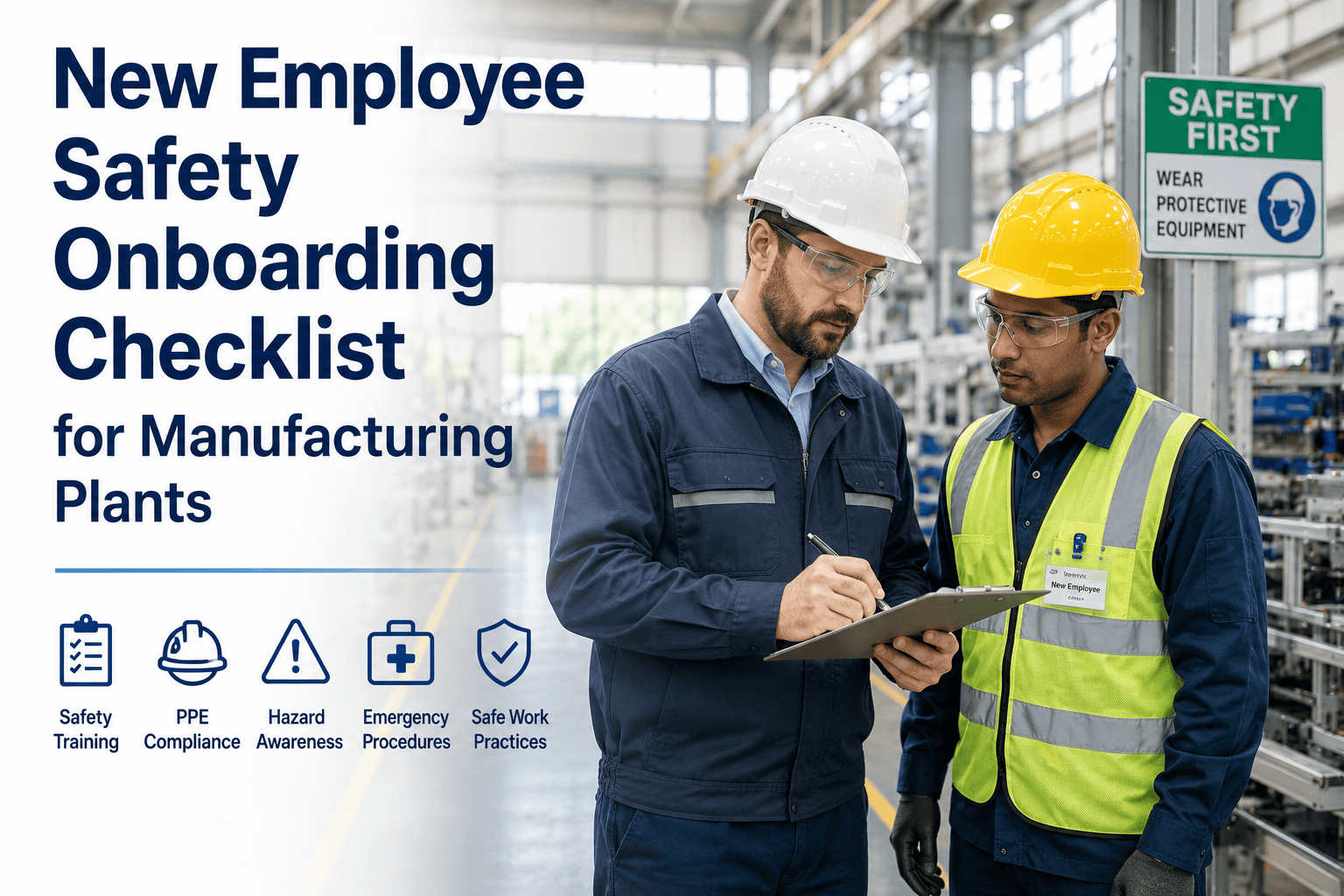
New Employee Safety Onboarding Checklist for Manufacturing Plants

By Johnson on May 6, 2026

new-employee-safety-onboarding-checklist-manufacturing

Manufacturing plant safety begins on day one — when new employees learn site hazards, PPE requirements, emergency procedures, and lockout-tagout protocols before they ever touch production equipment. Without comprehensive safety onboarding, new hires operate machinery without understanding hazards, enter restricted areas unprepared, and miss critical safety signals that experienced workers recognize instinctively. A structured safety induction checklist ensures every new employee completes hazard awareness training, demonstrates proper PPE usage, understands emergency evacuation routes, and passes competency assessments before independent work authorization. AI-driven safety platforms like Oxmaint digitize safety onboarding, track training completion automatically, verify competency with photo evidence and digital signatures, and maintain permanent OSHA-compliant training records for every employee. Book a free demo to see digital safety onboarding and compliance tracking in action.

Checklist · Safety Onboarding · Manufacturing · 2026
New Employee Safety Onboarding Checklist for Manufacturing Plants
A comprehensive day-one safety induction checklist covering site hazards, PPE requirements, emergency procedures, LOTO protocols, chemical safety, and machine guarding — ensuring every new hire is safety-ready before entering the production floor.
12
mandatory safety topics every new manufacturing employee must complete before production floor access
85%
reduction in new employee safety incidents when comprehensive onboarding is completed digitally
100%
OSHA compliance when digital training records document competency verification with timestamps
Zero
production floor access until all safety modules are completed and supervisor approval is recorded

The 12 Critical Safety Topics in Manufacturing Onboarding

Effective safety onboarding is not a single orientation session — it is a multi-topic curriculum covering site-specific hazards, regulatory requirements, and operational safety procedures. New employees must understand electrical hazards, moving machinery risks, chemical exposures, confined space dangers, and fall protection requirements before they encounter these hazards on the production floor. Each topic requires demonstration of understanding, not just passive attendance. This checklist breaks safety onboarding into 12 structured modules that new hires complete sequentially before receiving production floor authorization.

01
Site Safety Rules
02
PPE Requirements
03
Emergency Procedures
04
Lockout-Tagout
05
Chemical Safety
06
Machine Guarding
07
Electrical Safety
08
Fall Protection
09
Confined Spaces
10
Incident Reporting
11
Material Handling
12
Hot Work Permits

Module 1: Site Safety Rules and General Hazard Awareness

Every manufacturing facility has site-specific safety rules — traffic patterns, restricted areas, smoking zones, visitor protocols, and disciplinary procedures for safety violations. New employees learn these rules before entering production areas, understand the consequences of non-compliance, and acknowledge their responsibility to follow all safety requirements. Digital onboarding platforms like Oxmaint require new hires to confirm understanding with digital signatures and pass knowledge checks before advancing to the next module.

Module 1
Site Safety Rules and General Hazard Awareness
Duration: 45 Minutes
Site layout and restricted area identification completed
New hire shown site map, production areas, maintenance zones, electrical rooms, chemical storage areas, and restricted access points requiring special authorization.
Traffic rules and pedestrian walkways explained
Forklift traffic patterns, designated walkways, vehicle intersection protocols, and pedestrian right-of-way rules reviewed to prevent vehicle-pedestrian collisions.
Housekeeping standards and slip-trip-fall prevention reviewed
Clean workplace expectations, proper material storage, spill cleanup procedures, and tripping hazard elimination protocols explained with real plant examples.
Safety signage and color coding system demonstrated
OSHA color codes, warning signs, danger tags, caution labels, and emergency equipment markings explained — ensuring new hire can interpret all plant signage.
Disciplinary policy for safety violations acknowledged
Progressive discipline procedures for safety rule violations reviewed — new hire confirms understanding that safety non-compliance can result in termination.
Module 1 knowledge check passed and digitally signed
New hire completes competency assessment covering site safety rules — minimum 80% score required before advancing to PPE module.

Module 2: Personal Protective Equipment Requirements

PPE is the last line of defense against workplace hazards — protecting employees when engineering controls and administrative procedures cannot eliminate risk completely. New employees must understand which PPE is required for each work area, how to inspect equipment for damage, proper donning and doffing procedures, and replacement criteria. Hands-on demonstration ensures new hires can select, wear, and maintain PPE correctly before entering production zones where protection is mandatory.

Module 2
Personal Protective Equipment Requirements
Duration: 60 Minutes
Mandatory PPE for production floor identified and issued
Safety glasses, hearing protection, safety shoes, and hard hats issued to new hire — proper fit verified and usage requirements explained per work area.
Hearing protection demonstration and noise zone identification
High-noise areas identified on site map, hearing protection types demonstrated, proper insertion of earplugs shown, and audiometric testing requirements explained.
Respiratory protection fit testing completed where required
Areas requiring respiratory protection identified, respirator types explained, quantitative fit testing performed, and medical clearance verified before respirator issuance.
Hand and eye protection selection criteria reviewed
Chemical-resistant gloves, cut-resistant gloves, safety goggles, face shields, and welding helmets shown — selection criteria based on task hazards explained.
PPE inspection and replacement procedures demonstrated
Pre-use inspection for cracks, tears, and damage shown — replacement request procedures explained and PPE storage requirements reviewed.
Module 2 practical demonstration passed and recorded
New hire demonstrates proper PPE donning, doffing, and inspection procedures — supervisor confirms competency before emergency procedures module begins.

Module 3: Emergency Procedures and Evacuation Routes

Manufacturing emergencies — fires, chemical releases, medical emergencies, severe weather — require immediate, coordinated response. New employees must know evacuation routes from their work areas, assembly point locations, emergency alarm sounds, and whom to contact when emergencies occur. Walking the evacuation route physically ensures new hires can exit the building during actual emergencies when visibility may be reduced and normal exits may be blocked. Oxmaint tracks emergency drill participation and verifies evacuation competency digitally.

Module 3
Emergency Procedures and Evacuation Routes
Duration: 45 Minutes
Emergency alarm types and response procedures explained
Fire alarm, chemical release alarm, tornado warning, and evacuation signals demonstrated — appropriate response to each alarm type reviewed.
Primary and secondary evacuation routes physically walked
New hire walks evacuation routes from work area to assembly point, identifies emergency exits, locates pull stations, and confirms route understanding.
Assembly point location and headcount procedures reviewed
Assembly point location shown on site map, headcount procedures explained, and importance of remaining at assembly point until all-clear confirmed.
Emergency contact numbers and reporting chain confirmed
Emergency coordinator contact information provided, internal emergency number posted, and 911 calling procedures for life-threatening emergencies explained.
Fire extinguisher locations and PASS method demonstrated
Fire extinguisher locations shown, PASS method demonstrated, and limitations of portable extinguishers explained — evacuation priority emphasized over firefighting.
Module 3 evacuation drill participation completed
New hire participates in supervised evacuation drill — demonstrates ability to evacuate quickly using correct route and reports to assembly point without prompting.

Digitize Safety Onboarding and Track Compliance Automatically

Oxmaint converts paper safety checklists into interactive digital modules, tracks completion automatically per new hire, captures photo evidence and digital signatures at each step, and maintains permanent OSHA-compliant training records accessible for audits instantly.

Module 4: Lockout-Tagout and Machine Energy Control

Lockout-tagout prevents unexpected equipment startup during maintenance and servicing — protecting employees from crushing injuries, amputations, electrocution, and burns caused by uncontrolled energy release. New employees must understand LOTO procedures before performing any maintenance task, even simple adjustments. This module covers energy source identification, isolation procedures, lockout device application, and stored energy release verification. Only employees who demonstrate LOTO competency receive authorization to service machinery independently.

Module 4
Lockout-Tagout and Machine Energy Control
Duration: 90 Minutes
Energy source types and hazards explained with site examples
Electrical, mechanical, pneumatic, hydraulic, thermal, and chemical energy sources identified — injury mechanisms from uncontrolled release shown using site incident history.
Authorized employee responsibilities and restrictions reviewed
Authorized employee definition explained, responsibilities during LOTO procedures reviewed, and restrictions on servicing equipment without authorization emphasized.
Six-step LOTO procedure demonstrated on actual equipment
Preparation, shutdown, isolation, lockout application, stored energy release, and isolation verification demonstrated on production equipment — new hire observes complete procedure.
Personal lockout devices issued and identification confirmed
Personal padlock, key, and tag issued to new hire — lock uniquely identified to employee and one-employee-one-lock principle explained.
Group lockout and shift change procedures explained
Group lockbox usage, lockout transfer during shift changes, and multi-employee lockout coordination procedures reviewed for complex maintenance tasks.
Module 4 practical LOTO demonstration passed
New hire performs complete LOTO procedure on designated equipment under supervision — competency confirmed before independent servicing authorization granted.

Module 5: Chemical Safety and Hazard Communication

Manufacturing facilities use hundreds of chemicals — solvents, lubricants, cleaners, paints, adhesives, and process chemicals that pose fire, health, and reactivity hazards. New employees must understand chemical labeling systems, safety data sheet locations, exposure routes, and emergency response procedures before handling any hazardous material. GHS pictogram recognition, SDS interpretation, and spill response training prevent chemical exposures that cause burns, respiratory injuries, and chronic health effects.

Module 5
Chemical Safety and Hazard Communication
Duration: 60 Minutes
GHS labeling system and pictogram meanings explained
Nine GHS pictograms shown with hazard meanings, signal words, and precautionary statements explained — new hire demonstrates ability to interpret chemical labels.
Safety data sheet location and interpretation training completed
SDS binder location shown, online SDS database access demonstrated, and 16-section SDS format explained — new hire locates SDS for common plant chemicals.
Chemical exposure routes and health effects reviewed
Inhalation, skin contact, ingestion, and injection exposure routes explained — acute and chronic health effects of common plant chemicals reviewed using SDS examples.
Spill response procedures and eyewash station locations shown
Small spill cleanup procedures demonstrated, emergency eyewash and shower locations identified, and 15-minute flushing requirement explained.
Chemical storage and compatibility requirements explained
Segregation requirements for incompatible chemicals reviewed, proper storage container selection explained, and secondary containment requirements shown.
Module 5 chemical safety assessment passed
New hire completes competency test covering GHS labeling, SDS interpretation, and spill response — minimum 80% score required before chemical handling authorization.

Modules 6-12: Additional Safety Training Components

The remaining onboarding modules cover machine guarding, electrical safety, fall protection, confined space awareness, incident reporting, material handling, and hot work permits. Each module follows the same structure — hazard identification, control measures, regulatory requirements, practical demonstration, and competency verification. Digital platforms like Oxmaint schedule these modules based on job role requirements, track completion automatically, and prevent production floor access until all mandatory modules are finished and supervisor approval is recorded.

Module 6
Machine Guarding and Point of Operation Safety
Guard types, interlock systems, barrier guards, and prohibited guard removal procedures — protecting employees from crushing, cutting, and entanglement hazards.
Module 7
Electrical Safety and Arc Flash Awareness
Electrical panel clearances, arc flash boundaries, qualified person restrictions, and procedures for reporting electrical hazards to maintenance teams.
Module 8
Fall Protection and Working at Heights
Guardrail systems, personal fall arrest equipment, ladder safety, and elevated work platform procedures — preventing fall injuries from heights above 4 feet.
Module 9
Confined Space Entry Awareness
Confined space definition, permit-required spaces, atmospheric testing, and strict prohibition on unauthorized entry — preventing asphyxiation and toxic exposure fatalities.
Module 10
Incident Reporting and Near-Miss Documentation
Injury reporting requirements, first aid vs medical treatment distinction, near-miss reporting culture, and digital incident reporting system usage.
Module 11
Material Handling and Lifting Ergonomics
Proper lifting techniques, team lift requirements, mechanical lifting aids, and cumulative trauma disorder prevention through correct material handling.
Module 12
Hot Work Permits and Fire Prevention
Welding, cutting, grinding permit requirements, fire watch procedures, combustible material clearances, and hot work completion verification protocols.

Final Onboarding Verification and Production Floor Authorization

Safety onboarding is not complete until all modules are finished, competency assessments are passed, and supervisor approval is recorded digitally. The final verification step confirms new hire readiness for independent work — reviewing module completion status, checking competency scores, verifying practical demonstrations, and obtaining final authorization signatures. Only after this verification gate passes can new employees receive production floor access credentials and begin working without direct supervision.

Final Onboarding Verification Checklist
All 12 safety modules completed with passing scores above 80%
Practical demonstrations passed for PPE, LOTO, and evacuation procedures
Digital signatures and photo evidence captured for all competency verifications
Job-specific safety training scheduled and completion dates assigned
Supervisor final approval obtained and production floor access credentials activated
85%
reduction in new employee safety incidents when comprehensive onboarding is completed
100%
OSHA compliance when digital records document training completion and competency verification
Zero
production floor access until all safety modules are completed and supervisor approval is recorded

Complete Safety Onboarding for Every New Manufacturing Employee

Oxmaint ensures every new hire completes comprehensive safety training before production floor access — digitizing all safety modules, tracking competency verification automatically, maintaining permanent training records for OSHA compliance, and preventing unauthorized floor access until all onboarding gates are passed and supervisor approval is recorded digitally.
Frequently Asked Questions

What safety topics must be covered in new employee onboarding for manufacturing plants?
Manufacturing safety onboarding must cover site safety rules, PPE requirements, emergency procedures, lockout-tagout, chemical safety, machine guarding, electrical safety, fall protection, confined spaces, incident reporting, material handling, and hot work permits. Each topic requires competency verification before production floor authorization. Oxmaint digitizes all 12 modules and tracks completion automatically.
How long does comprehensive safety onboarding take for new manufacturing employees?
Comprehensive safety onboarding typically requires 8-12 hours spread across the first week of employment, including classroom training, practical demonstrations, facility walkthroughs, and competency assessments. Digital platforms reduce onboarding time by 30% through interactive modules and automated tracking while improving retention and compliance documentation.
What documentation is required for OSHA compliance in safety onboarding?
OSHA requires written training records showing employee name, training date, training content, trainer identity, and competency verification for each safety topic. Digital platforms like Oxmaint automatically capture timestamps, digital signatures, photo evidence, test scores, and supervisor approvals — creating permanent audit-ready compliance records for every new hire. Book a demo to see OSHA-compliant digital training records.
Can safety onboarding be customized for different job roles in the same facility?
Yes, safety onboarding should be role-specific — production operators require different training than maintenance technicians, forklift drivers need additional certification modules, and supervisors require incident investigation training. Digital platforms assign modules based on job role automatically and track role-specific competency requirements without manual coordination.
How do digital safety onboarding platforms improve compliance compared to paper checklists?
Digital platforms eliminate lost paperwork, capture photo and video evidence automatically, timestamp every training activity, prevent module skipping with sequential locks, require passing scores before advancement, and maintain searchable training records accessible during audits instantly — reducing OSHA citation risk by 75% compared to manual record-keeping systems.

Share This Story, Choose Your Platform!