Industrial HVAC systems do more than regulate temperature — they protect equipment from thermal stress, maintain air quality standards that affect worker health, and keep humidity levels within the tolerances that production processes require. When an industrial HVAC system fails in a manufacturing plant, the consequences extend well beyond discomfort: production lines overheat, controlled environments lose certification, and food or pharmaceutical products may need to be discarded. Yet despite this, only 30% of facility managers maintain a structured preventive maintenance programme for their HVAC systems. This guide covers the PM schedules, compliance obligations, energy optimisation techniques, and CMMS-driven approaches that industrial facility managers need to maintain HVAC reliability in 2025 and beyond. For plants that want to see how this works in practice, OxMaint's HVAC maintenance module provides a working example of CMMS-driven scheduling.
OxMaint — Industrial Facility Guide
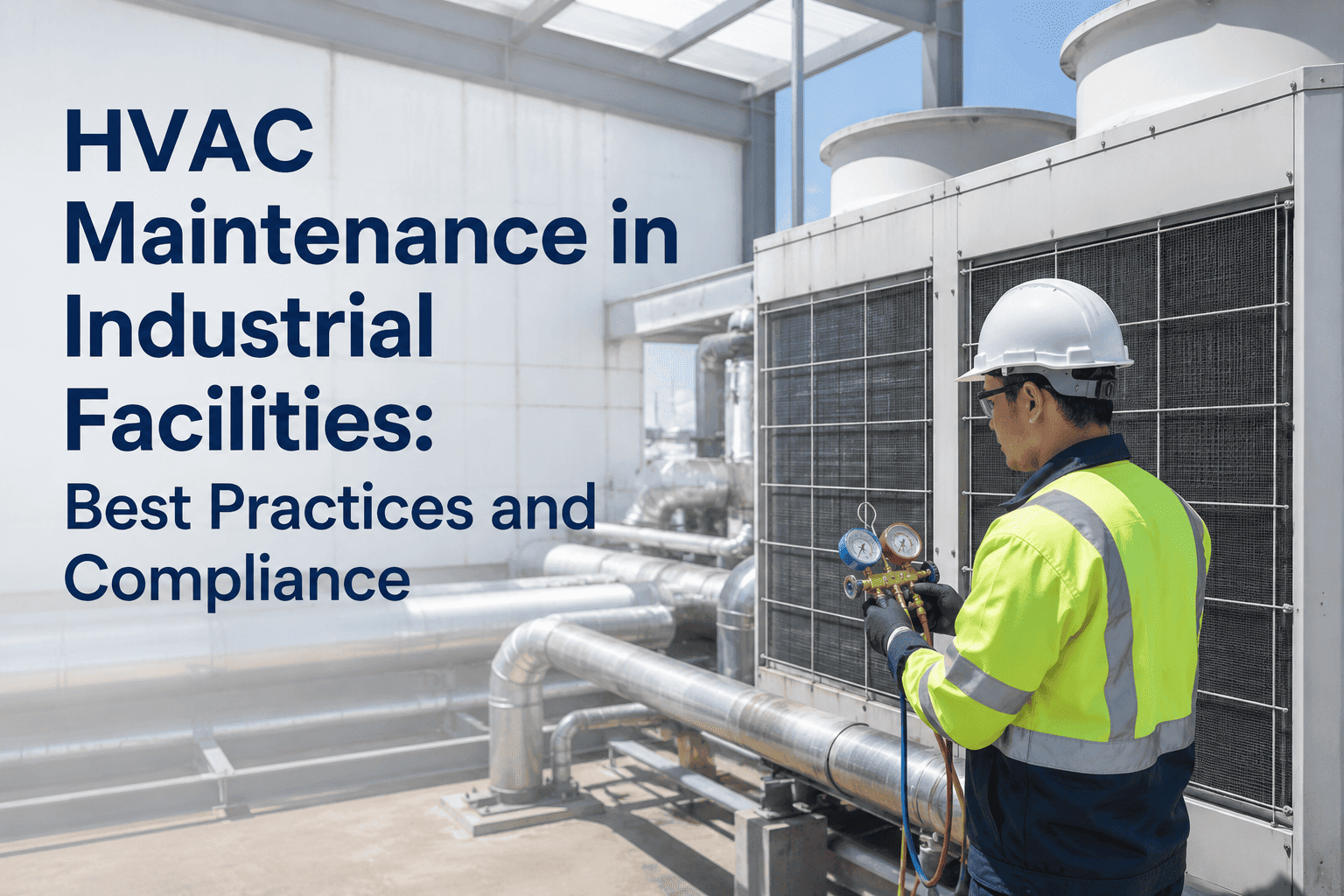
HVAC Maintenance in Industrial Facilities: Best Practices and Compliance
PM scheduling, energy optimisation, refrigerant compliance, and CMMS-driven HVAC management for manufacturing and industrial facility managers.
35–40%
of total facility energy consumed by HVAC systems
3–10×
higher cost to run HVAC to failure vs. structured PM
5 yrs
additional equipment lifespan from structured PM vs. reactive
$4
in capital renewal for every $1 of deferred HVAC maintenance
Why It Matters
What Happens When Industrial HVAC Maintenance Is Skipped
Industrial facilities carry consequences for HVAC failure that commercial buildings do not. In a manufacturing environment, HVAC failure affects not just comfort but operational continuity, product quality, and regulatory standing. A 20-ton rooftop unit that fails after nine years of reactive maintenance would typically last fourteen years under a structured PM programme — that five-year gap represents a capital replacement that was funded by skipped service visits.
Production Impact
Overheated equipment shuts down automated production lines. CNC machines, injection moulding equipment, and electronics assembly processes have thermal tolerance limits. HVAC failure during a heatwave can halt production for the duration of a repair that could have been prevented with a quarterly coil clean.
Product Quality Risk
Food processing, pharmaceutical manufacturing, and precision electronics require controlled humidity and temperature. HVAC failure during production can invalidate an entire batch — and if the failure is not documented with a maintenance failure record, insurance claims may not succeed.
Compliance Exposure
OSHA requires adequate ventilation in industrial workplaces. EPA Section 608 mandates certified technicians for refrigerant handling and leak repair within 30 days for systems with over 50 lb of refrigerant. ASHRAE 62.1 governs minimum ventilation rates. A failed HVAC system with no maintenance documentation creates multiple simultaneous violations.
Energy Cost Surge
Dirty coils, clogged filters, and refrigerant undercharge force the system to work harder for the same output. HVAC energy consumption rises 8–15% when basic PM is deferred for a single season. In an industrial facility with multiple large AHUs and chillers, that percentage translates directly to five-figure annual utility overruns.
PM Schedule
Industrial HVAC Preventive Maintenance Schedule — Frequency by Task
Industrial HVAC maintenance intervals must be set by actual equipment duty cycles and operating environment — not by generic manufacturer defaults. A plant running continuous 24-hour production with high dust loading requires more frequent service than a light-manufacturing facility with single-shift operation. The schedule below reflects best practice for continuous-process industrial environments.
Monthly
Inspect and replace pre-filters (replace when pressure drop exceeds 0.5 in. w.g. above clean baseline)
Check condensate drain lines — clear blockages, verify pan is draining
Visual inspection of belts, pulleys, and fan blades for wear or damage
Verify BMS setpoints and scheduling — correct overnight setback errors add 8–15% to energy costs
Quarterly
Clean evaporator and condenser coils — dirty coils are the single largest cause of HVAC inefficiency
Lubricate all bearings, fan shafts, and motor mounts
Test and calibrate thermostats and pressure sensors against reference instruments
Check refrigerant charge — verify sub-cooling and superheat values at full load
Inspect electrical connections — tighten terminals, check for heat discolouration
Test VFD operation across full speed range — review fault log for recent trips
Twice Yearly
Replace final filters (MERV 13+) — interval 3–6 months depending on environment
Full refrigerant leak check — EPA requires repair within 30 days for systems above threshold
Clean cooling tower fill and basin — inspect for biological growth (Legionella risk management)
Test freeze stat safety cutout — a failed freeze stat can cause $15,000–$80,000 heating coil damage
Annual
Full functional performance test of each AHU — verify economiser, warm-up, setback, and DCV sequences
Chiller water treatment analysis — tube cleaning, compressor and oil sample analysis
Infrared thermography of all electrical panels — identify hot connections before failure
Ductwork inspection — identify and seal leaks (duct leakage adds 10–25% to fan energy consumption)
Full compliance documentation export — ASHRAE 180, EPA Section 608, OSHA ventilation records
Compliance Requirements
HVAC Compliance Standards Every Industrial Facility Must Know
Industrial HVAC maintenance is governed by multiple overlapping standards. Compliance failures are common not because facilities skip maintenance, but because they do not generate the documentation that regulators and insurers require. Below are the primary frameworks and what they require from your maintenance records.
| Standard |
What It Requires |
Documentation Needed |
Who Enforces It |
| EPA Section 608 |
Certified technicians for refrigerant handling; leak repair within 30 days above threshold |
Technician certification on record; dated leak check reports; repair completion records |
US EPA |
| ASHRAE 62.1 |
Minimum ventilation rates for occupant health; filter maintenance to sustain airflow |
Filter replacement log with dates; airflow measurement records |
Local building authorities |
| ASHRAE 180 |
Standard practice for inspection and maintenance of commercial HVAC systems |
Inspection checklist completion records; findings and corrective actions documented |
Building owners / insurers |
| OSHA 1910.94 |
Adequate ventilation in industrial settings; protection from airborne hazards |
Ventilation assessment records; corrective action logs for non-conformances |
US OSHA |
| R-410A Phase-Out (2025) |
New equipment must use low-GWP refrigerants (R-454B, R-32) from January 2025 |
Equipment refrigerant type on record; servicing notes confirming approved refrigerant used |
US EPA / DOE |
OxMaint HVAC Module
Auto-Scheduled PM. Compliance Records Built In. Zero Manual Assembly Before Audits.
OxMaint's HVAC maintenance module auto-schedules every PM task by frequency, captures technician readings with pass/fail thresholds, and generates compliance-ready reports for EPA, ASHRAE, and OSHA requirements — automatically, as part of normal work order completion.
Energy Optimisation
Six HVAC Energy Optimisation Measures With the Highest Return
In an industrial facility where HVAC accounts for 35–40% of total energy spend, efficiency improvements deliver immediate, measurable returns. The following measures are ranked by implementation cost relative to energy saving, prioritising actions that pay back quickly without capital investment in new equipment.
01
BMS Setpoint and Schedule Audit
Saves: 8–15% HVAC energy
Incorrect overnight scheduling — equipment running in occupied mode through the night — is the single most common energy waste discovered in facility audits. Takes under half a day to fix. Zero capital cost.
02
Coil Cleaning — Evaporator and Condenser
Saves: 5–10% per unit
Dirty coils force the compressor to work harder for the same heat transfer. A single thorough coil clean on a large chilled water system typically pays back its cost in energy savings within six to eight weeks.
03
VFD Installation on AHU and Pump Motors
Saves: 20–40% fan/pump energy
Variable frequency drives allow fans and pumps to operate at actual demand rather than full speed. In partial-load conditions — which account for the majority of operating hours — VFDs typically pay back within two to four years.
04
Duct Leak Detection and Sealing
Saves: 10–25% fan energy
Leaking ductwork forces fans to move more air than reaches the intended zones. Annual duct pressure testing followed by mastic sealant on detected leaks is a high-ROI maintenance task frequently overlooked in industrial PM schedules.
05
Demand-Controlled Ventilation (DCV)
Saves: 15–30% ventilation energy
CO2-based DCV reduces outdoor air intake when occupancy is low — the system ventilates to actual demand rather than design maximum. Maintenance teams must keep CO2 sensors calibrated to sustain DCV effectiveness.
06
Refrigerant Charge Optimisation
Saves: 5–15% per unit
Systems operating with undercharged or overcharged refrigerant run inefficiently and experience compressor stress. A quarterly charge check and correction costs relatively little and consistently returns energy savings that exceed the technician time spent.
CMMS Integration
How CMMS Changes HVAC Maintenance Outcomes
The gap between knowing what HVAC maintenance is required and consistently executing it at scale is a scheduling and accountability problem. CMMS platforms close this gap by automating the scheduling, capturing the results, and generating the compliance documentation that manual systems consistently fail to produce under operational pressure.
Without CMMS
PM dates stored in spreadsheets — missed during busy periods
No escalation when a filter change is overdue
Emergency breakdowns cancel scheduled PM — backlog grows silently
Repeat-failure assets look identical to reliable ones in scattered records
Compliance documentation assembled manually before audits
Multi-site visibility impossible without manual reporting
With OxMaint CMMS
PM auto-scheduled by frequency, asset, and operating hours
Overdue PM triggers escalation notification automatically
Emergency WO linked to asset — PM backlog visible to manager
Asset history shows failure frequency, cost, and trend per unit
Compliance records generated as byproduct of WO completion
Multi-site dashboard with PM compliance rate per facility
Frequently Asked Questions
HVAC Maintenance Questions From Industrial Facility Managers
How often should industrial HVAC systems be fully serviced?
Full HVAC service — coil clean, refrigerant check, electrical inspection, control calibration — should be performed at least twice per year in continuous-process industrial environments. Facilities with high dust loading, 24-hour operation, or temperature-sensitive processes typically require quarterly full service. Filter changes and condensate drain checks should happen monthly.
OxMaint can configure your exact schedule based on equipment type and operating hours.
What does the R-410A phase-out mean for industrial facilities in 2025?
From January 2025, new HVAC equipment must use low-GWP refrigerants (R-454B or R-32) instead of R-410A. Existing systems using R-410A can continue to be serviced, but replacement refrigerant costs are rising as production decreases. Facilities should document their current refrigerant types in their CMMS and begin planning transitions for systems approaching end-of-life to avoid emergency replacement at peak-cost refrigerant prices.
What HVAC maintenance records do industrial facilities need for EPA Section 608 compliance?
Section 608 requires that any technician handling refrigerant holds a valid certification (type I, II, III, or universal depending on system size). Facilities must maintain dated records of leak inspections, refrigerant additions, and leak repair completions. For systems with more than 50 lb of refrigerant, any leak above the applicable threshold must be repaired within 30 days and documented. A CMMS that timestamps and technician-signs all refrigerant-related work orders satisfies this requirement automatically.
What is the biggest energy saving available from existing HVAC systems without capital investment?
BMS scheduling errors — equipment running in occupied mode overnight or on weekends — consistently deliver the highest single return of any no-capital intervention. Correcting scheduling errors typically saves 8–15% of HVAC energy with no equipment cost. Following that, coil cleaning and refrigerant charge correction are the next highest-return PM tasks, each delivering 5–15% efficiency improvement on affected units.
Book a demo to see energy tracking in OxMaint.
Can CMMS software manage HVAC maintenance compliance documentation automatically?
OxMaint generates timestamped, technician-signed compliance records for ASHRAE 180, EPA Section 608, and OSHA ventilation requirements as a byproduct of normal work order completion. Every completed PM checklist generates a structured record exportable as PDF or CSV for audits, insurer reviews, and regulatory inspections — without any manual compilation. Multi-site portfolios can export consolidated compliance records across all facilities.
OxMaint — Industrial HVAC Maintenance Platform
Stop Managing HVAC Maintenance in Spreadsheets. Start Getting PM Compliance Rates Above 90%.
OxMaint auto-schedules HVAC PM tasks by equipment type and frequency, captures technician readings with threshold alerts, generates compliance records automatically, and gives multi-site facility managers a single dashboard to confirm PM is happening — everywhere, every time.