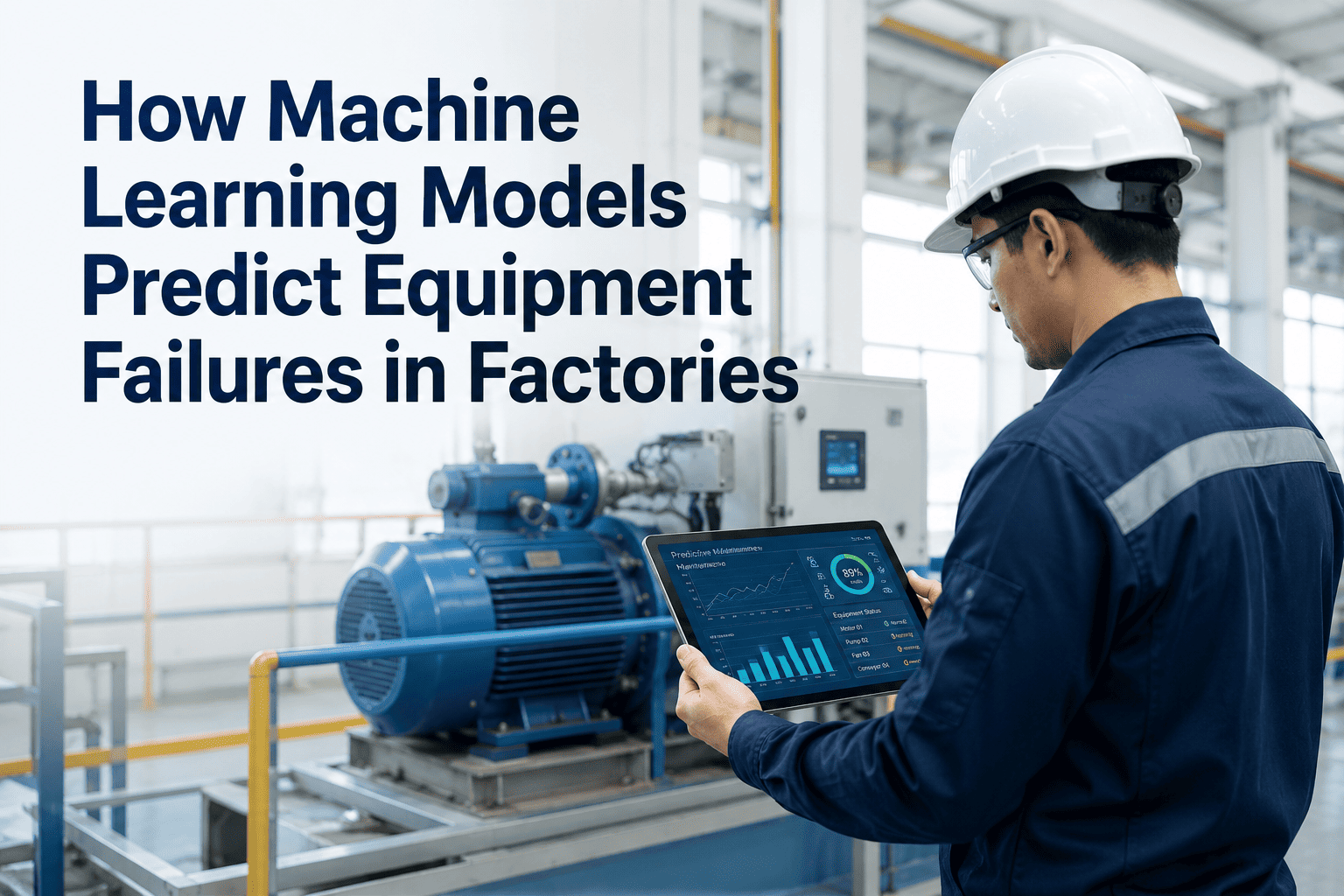
A bearing failure that shuts down a production line for 18 hours costs your plant far more than the bearing itself. The real expense is the emergency labour, the expedited parts, the idle downstream workers, and the missed customer commitments. Machine learning changes this equation by detecting the failure signature weeks before the bearing actually fails — not by luck, but by learning the specific degradation pattern of your equipment from the data your sensors already generate. This guide explains how ML models are trained to predict factory equipment failures, what data they need, which algorithms perform best for which failure types, and what manufacturing teams need to understand before integrating ML predictions with their CMMS.
OxMaint — Technical Guide
How Machine Learning Models Predict Equipment Failures in Factories
From sensor data collection to CMMS integration — how ML failure prediction models are trained, validated, and deployed in real manufacturing environments.
92–97%
Prediction accuracy for rotating machinery with mature ML models
2–4 wks
Typical advance warning window for well-trained failure models
50×
Cost of missed failure vs. false alarm in manufacturing environments
12–18 mo
Operational data needed for 95%+ prediction accuracy
How It Works
The Four Stages of ML Failure Prediction — From Sensor to Work Order
ML-based failure prediction is not a black box. It follows a defined pipeline that begins with raw sensor data and ends with a work order created before the failure occurs. Understanding each stage helps maintenance managers evaluate vendor claims and set realistic expectations for deployment timelines.
1
Data Collection
Sensors collect continuous readings — vibration, temperature, pressure, current draw, acoustic emission. IoT gateways aggregate this data and stream it to the ML platform. The quality and frequency of sensor data at this stage directly determines prediction accuracy downstream.
Vibration
Temperature
Pressure
Current
Acoustic
OBD / OPC-UA
↓
2
Feature Engineering
Raw sensor readings are transformed into meaningful features the model can learn from. For a motor, this might include RMS vibration amplitude, spectral frequency peaks at bearing fault frequencies, or rate of temperature rise per operating hour. This stage requires domain expertise — a data scientist alone cannot create useful features for industrial equipment without input from plant engineers.
↓
3
Model Training and Validation
The ML model is trained on historical sensor data labelled with known failure events. It learns which feature patterns preceded past failures and builds a probabilistic model of failure likelihood over time. Validation uses held-out historical data to confirm the model generalises to unseen failure events — not just the ones it was trained on.
↓
4
Deployment and CMMS Integration
The deployed model scores each asset continuously against live sensor data. When an asset's health score crosses a threshold, the system generates an alert — and if integrated with a CMMS, automatically creates a work order with the predicted failure type, recommended action, and estimated time to failure. No human intervention required between prediction and work order.
Algorithm Comparison
Which ML Algorithm for Which Failure Type
No single ML algorithm outperforms all others across all failure types. The choice of algorithm depends on the type of data available, the failure mode being predicted, and whether the failure examples in your historical data are labelled. Here is how the main algorithm families compare for manufacturing maintenance.
| Algorithm |
Best For |
Data Requirement |
Accuracy Range |
Typical Use Case |
| Random Forest |
Labelled fault classification |
Historical failures required |
88–94% |
Pump fault type classification |
| LSTM (Deep Learning) |
Time-series degradation sequences |
Long historical series required |
90–96% |
Bearing wear progression, RUL prediction |
| CNN-LSTM Hybrid |
Multi-sensor complex failure modes |
Large labelled dataset needed |
94–97% |
CNC spindle, compressor failure |
| Isolation Forest |
Anomaly detection, no labels |
Only normal operation data needed |
Varies — anomaly-based |
New equipment with no failure history |
| XGBoost |
Tabular sensor feature data |
Moderate historical data |
89–95% |
Multi-feature fault classification |
| Bayesian Causal Models |
Rare failure events with high cost asymmetry |
Domain knowledge + some data |
High precision |
Safety-critical systems, low failure rate |
Research published in 2025 confirms that CNN-LSTM hybrid models consistently outperform standalone architectures, achieving around 96% accuracy and F1-scores above 95% across diverse manufacturing datasets. The trade-off is that hybrid models require larger labelled datasets and more compute — which is why simpler models like Random Forest or XGBoost remain the practical choice for most initial deployments.
Training Requirements
What Data Your ML Model Needs — and What Happens Without It
The most common cause of ML predictive maintenance failure is not the algorithm — it is the data. Specifically, three data problems account for the majority of underperforming deployments: insufficient failure examples, poor sensor coverage, and no domain expertise applied during feature engineering.
12–24 months of continuous sensor readings per asset
At least 10–20 labelled failure events per failure mode
Sensor readings at 1-minute or finer intervals for critical assets
Maintenance records linked to sensor timestamps
Multiple sensor types covering the failure mechanism
Domain-engineered features reviewed by plant engineers
Less than 6 months of sensor history available
Failure events not recorded with timestamps in CMMS
Single temperature sensor covering multiple failure modes
Data collected at 15-minute intervals or coarser
No domain engineering — raw sensor values fed directly
Sensor gaps or dropout periods in historical record
Deployment Success Rate by Data Strategy
Comprehensive sensor strategy + domain expertise
85–95% success
Adequate sensors, no domain engineering
45–55% success
Limited sensors, minimal historical data
Under 30% success
OxMaint Predictive Platform
ML Failure Prediction Already Trained for Common Industrial Equipment
OxMaint's platform includes pre-trained ML models for common failure modes in pumps, motors, compressors, and conveyors — dramatically reducing the data requirement for your first predictions. Feed in your sensor data and see predictions within 30 days.
CMMS Integration
Connecting ML Predictions to Your Maintenance Workflow
An ML failure prediction that lives in a standalone analytics dashboard has limited value. The prediction needs to trigger a maintenance action before the failure occurs — which requires integration with your CMMS so that work orders are created, parts are reserved, and technicians are assigned automatically. Without this connection, the prediction arrives but the repair does not happen in time.
Live Sensor Data
OBD / IoT / OPC-UA streaming
→
ML Health Scoring
Continuous per-asset scoring
→
Failure Alert
Threshold crossed — alert triggered
→
Auto Work Order
CMMS creates WO — no human step
→
Planned Repair
Repair before breakdown occurs
What the Work Order Must Include
Predicted failure type, probability confidence, estimated time to failure, recommended action, and the sensor readings that triggered the alert. Without this context, technicians cannot prioritise effectively.
Parts Auto-Reservation
When the ML model predicts a bearing replacement, the integration should check parts inventory and auto-raise a purchase order if the required part is not in stock. The prediction is only useful if the part arrives before the repair is due.
Feedback Loop to the Model
When the technician completes the work order and confirms whether the predicted failure was found, that outcome feeds back into the model. This closed loop is what drives accuracy improvement from the initial 80% range toward 92–97% over 12–18 months.
Setting Realistic Expectations
What ML Failure Prediction Cannot Do
Responsible vendors are transparent about ML limitations. Understanding these constraints helps you evaluate predictions correctly and avoid both over-reliance and under-utilisation.
01
ML Cannot Predict Failure Modes It Has Never Seen
If a specific failure type has never occurred in your historical data, the model has no pattern to learn from. Anomaly detection (unsupervised) fills some of this gap, but cannot provide the same precision as a supervised model trained on labelled failure examples.
02
Accuracy Always Beats 96.7% With No-Failure Baseline
In a dataset where equipment fails only 3.3% of the time, predicting "no failure" every time achieves 96.7% accuracy. Good ML evaluation must use precision, recall, and F1-score — not accuracy alone — to show real predictive value.
03
Sensor Coverage Gaps Create Prediction Blind Spots
A model can only predict failure modes that its sensors can observe. Equipment without adequate sensor coverage will have failures the model cannot detect — not because the ML is wrong, but because the failure leaves no signal in the observed data.
04
Sudden Catastrophic Failures Are Rarely Predictable
ML excels at predicting gradual degradation failures — wear, fatigue, contamination, thermal drift. Sudden catastrophic failures caused by external events (power surge, operator error, foreign object impact) typically leave no predictable sensor signature in advance.
Frequently Asked Questions
ML Predictive Maintenance — Technical Questions Answered
How much historical data does an ML model need before making reliable predictions?
Most models begin generating useful predictions after 3–6 months of sensor data, reaching 85–90% accuracy. Achieving 92–97% accuracy typically requires 12–18 months of continuous data including multiple failure events. Pre-trained models for common equipment types — like those in OxMaint — compress this timeline significantly by incorporating cross-industry failure patterns.
See how OxMaint handles early-stage prediction.
What is the difference between anomaly detection and failure prediction?
Anomaly detection identifies when a sensor reading deviates from normal — it does not tell you what the deviation means or when failure will occur. Failure prediction uses a trained model to identify specific degradation patterns and estimate time to failure. Both have roles: anomaly detection works on new equipment with no failure history, while failure prediction delivers actionable lead time on equipment with sufficient historical data.
Does OxMaint use pre-trained models or train on our plant data only?
OxMaint uses pre-trained models for common failure modes combined with fine-tuning on your plant's specific data. This hybrid approach means you see meaningful predictions within 30 days of deployment, rather than waiting 12–18 months for a model trained only on your data. The model accuracy improves continuously as your plant data accumulates.
Book a demo to see the model approach.
Which failure types are best suited to ML prediction in manufacturing?
Rotating machinery failures — bearing wear, imbalance, misalignment — consistently achieve the highest prediction accuracy (92–97%) because they produce clear, measurable sensor signatures over weeks or months. Pump cavitation, motor insulation degradation, compressor valve wear, and conveyor belt tension failures are also well-suited. Sudden impact failures or electrical faults with no thermal or vibration precursor are the main exceptions.
How does the ML model know the difference between a genuine failure signal and normal process variation?
This is solved through feature engineering and contextual data integration. The model learns to distinguish normal operating variation (load changes, ambient temperature, product changeover) from genuine degradation signals by incorporating operating context alongside raw sensor readings. Plants that provide operating logs, shift data, and production variables alongside sensor data consistently see lower false alarm rates.
OxMaint — ML Failure Prediction Platform
Stop Analysing Failures After They Happen. Start Predicting Them 2–4 Weeks Ahead.
OxMaint combines pre-trained failure models for common industrial equipment with your plant's sensor data to start delivering predictions within 30 days. Predictions automatically generate work orders, reserve parts, and close the loop back to the model to improve accuracy continuously.