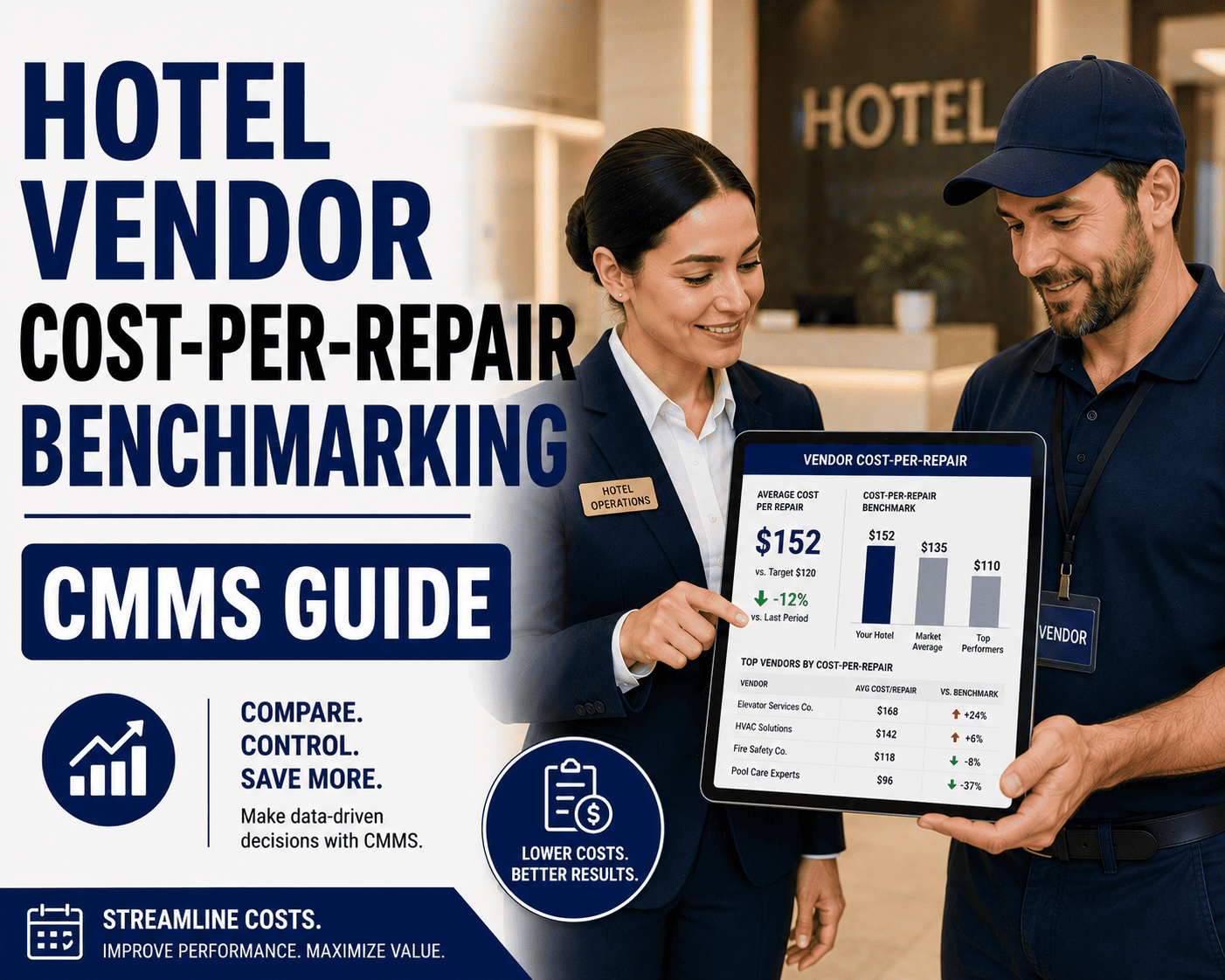
Hotel vendor cost-per-repair benchmarking is the process of comparing outsourced maintenance expenses across repair categories, vendors and properties to identify overcharges and negotiate from data rather than habit. For hotel engineering and reliability teams, a CMMS is the central tool that captures actual work-order costs, verifies vendor invoices against completed tasks, and exposes cost leakage across a portfolio. This 2026 benchmarking guide covers how to use a CMMS for cross-vendor cost comparison, invoice verification and rate negotiation leverage — and how OxMaint automates the entire workflow so you can Start Free Trial and stop overpaying for outsourced repairs.
Are you negotiating vendor repair rates from data — or overpaying from habit?
Most hotels lack a reliable cost-per-repair baseline. Without CMMS benchmarking, vendor invoices go unchecked, duplicate charges slip through, and contract renewals happen without leverage. OxMaint turns every completed work order into negotiable cost data.
Where hotel vendor cost-per-repair data hides (and leaks)
In a typical 200-room property managing 400+ work orders per month across HVAC, plumbing, electrical and general repair vendors, cost leakage occurs in four predictable places. A CMMS built for hotel vendor cost benchmarking plugs each one.
Unverified invoice charges
Vendor invoices that don't match actual work-order scope, labor hours or parts used. Without invoice verification in a hotel CMMS, finance approves charges blindly.
Cross-vendor rate disparity
The same refrigerant recharge costs $180 from Vendor A and $340 from Vendor B. Cross-vendor comparison in a CMMS surfaces these gaps across your portfolio instantly.
Duplicate and phantom repairs
Repeat work orders for the same asset because the root cause was never logged. CMMS asset history prevents paying twice for a repair that should have been a replacement.
Emergency-rate premium creep
Vendors default to after-hours emergency rates when preventive maintenance is deferred. CMMS-based PM scheduling reduces emergency callouts by 30–50%.
How to calculate true cost per repair in a hotel CMMS
Cost-per-repair is not just the invoice total. A CMMS calculates the fully loaded cost of each repair event so you can benchmark apples-to-apples across vendors, asset categories and properties.
180-asset hotel portfolio, HVAC chiller repairs
A 3-property hotel group spent $42,000/year on outsourced chiler and RTU repairs across two vendors. Invoice-only benchmarking showed Vendor A at $28K and Vendor B at $14K — making Vendor A look more expensive. But after loading internal labor (engineering staff time coordinating and supervising), parts consumed from on-site inventory, and average downtime cost ($85/hour of lost guest-room revenue), the CMMS revealed Vendor A's true cost-per-repair was $312 while Vendor B's was $389 — because Vendor B required 40% more repeat visits and longer equipment downtime. The group consolidated to Vendor A, saving $11,800/year and cutting guest-room downtime by 22%.
CMMS hotel vendor cost comparison: building your 2026 rate card
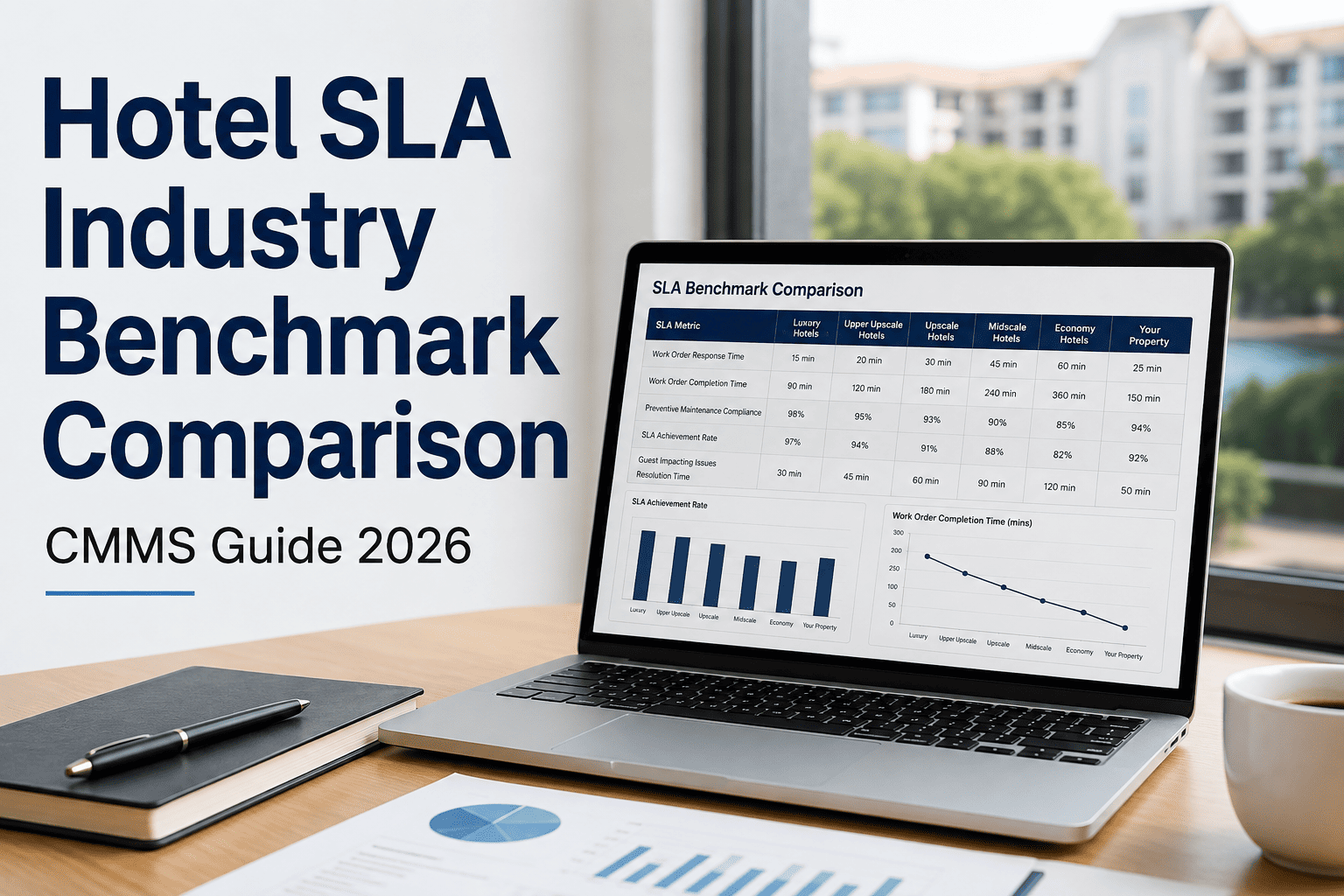
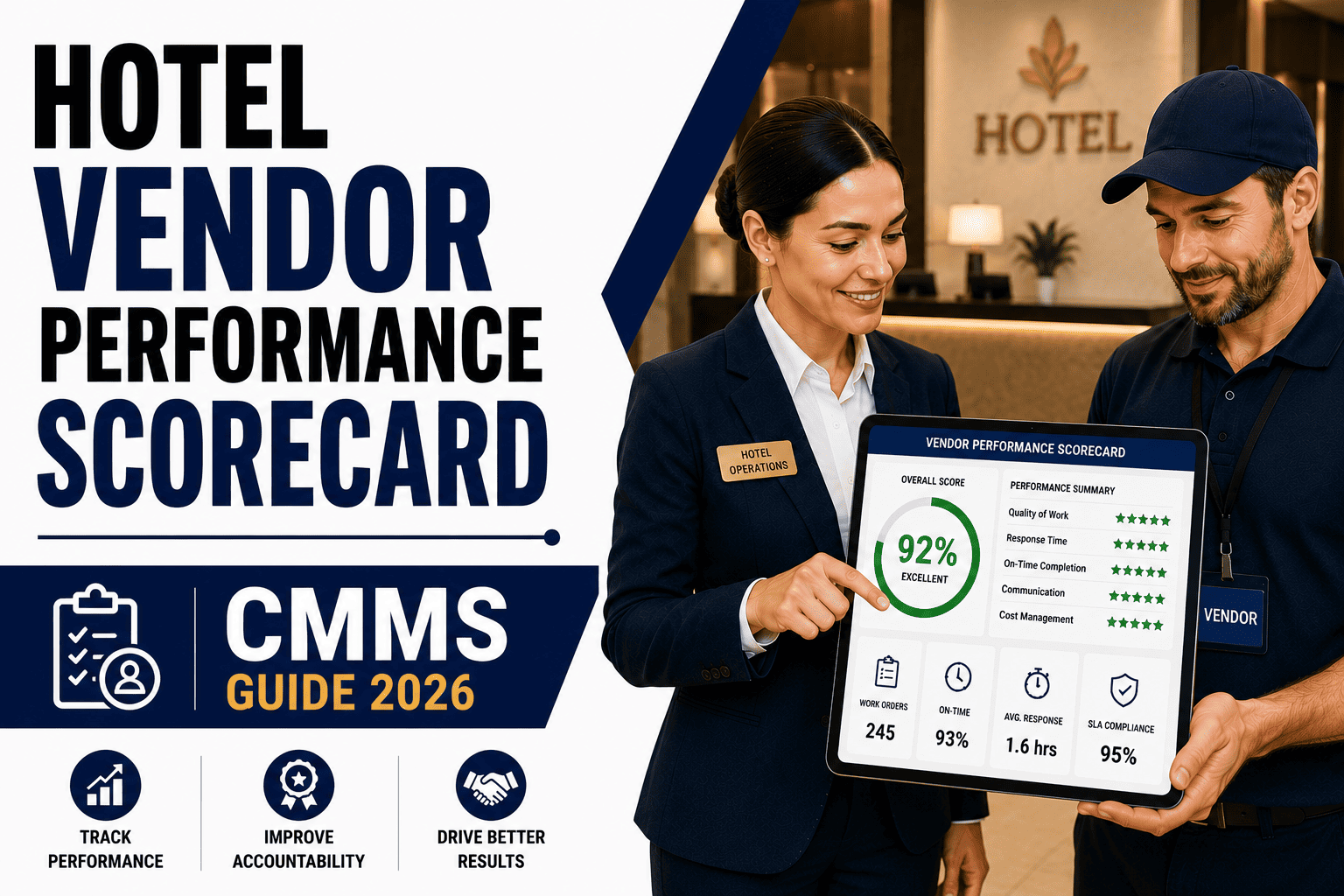
A CMMS cross-vendor comparison report ranks every vendor by cost-per-repair category, response time, first-time-fix rate and repeat-repair percentage. This becomes your negotiation leverage at contract renewal.
| Repair Category | Vendor A — Cost/Repair | Vendor B — Cost/Repair | Vendor C — Cost/Repair | Portfolio Avg | First-Time-Fix Rate |
|---|---|---|---|---|---|
| HVAC / Refrigeration | $312 | $389 | $345 | $349 | 82% |
| Plumbing / Domestic Water | $148 | $165 | $210 | $174 | 91% |
| Electrical / Lighting | $95 | $112 | $88 | $98 | 94% |
| Kitchen Equipment | $220 | $198 | $275 | $231 | 78% |
| Guest-Room General | $67 | $85 | $72 | $75 | 88% |
| Laundry Equipment | $185 | $240 | $195 | $207 | 81% |
Data sample: 12-month rolling CMMS cost benchmarking across a 5-property hotel portfolio. Costs include vendor invoice + internal labor + parts + downtime. Use this format to build your 2026 vendor rate card.
How to verify hotel vendor invoices against CMMS work orders
Invoice verification is the single highest-ROI activity in vendor cost management. A hotel CMMS matches every line item on a vendor invoice to the corresponding completed work order — flagging mismatches before finance approves payment.
Work order created and dispatched
Every vendor repair begins as a CMMS work order with scope, asset ID, priority level and estimated cost range. No work order — no invoice approval.
Vendor completes and logs repair details
Vendor enters labor hours, parts used, travel time and repair notes directly in the CMMS mobile app. Photos and asset condition data attach automatically.
Invoice matched to work order automatically
CMMS cross-references invoice line items against the work order record. Quantity, unit price, labor rate and parts cost are validated against the vendor contract rate card stored in the system.
Mismatches flagged for review
Overcharges, unauthorized parts markups, duplicate line items and out-of-contract labor rates are flagged automatically — reducing manual invoice review time by 60–80%.
Approved cost feeds benchmarking dashboard
Verified cost data flows into the cross-vendor benchmarking dashboard, updating cost-per-repair by category, vendor and property in real time — ready for your next contract negotiation.
How OxMaint CMMS eliminates hotel vendor cost leakage
OxMaint is an AI-powered CMMS and EAM platform that automates vendor cost capture, invoice verification and cross-vendor benchmarking — so hotel engineering and finance teams negotiate from data, not guesses.
Automated invoice-to-work-order matching
OxMaint AI matches every vendor invoice line to its corresponding completed work order — flagging scope creep, duplicate charges and out-of-contract rates before payment. Cuts invoice review time by 60–80%.
Live cross-vendor cost benchmarking dashboard
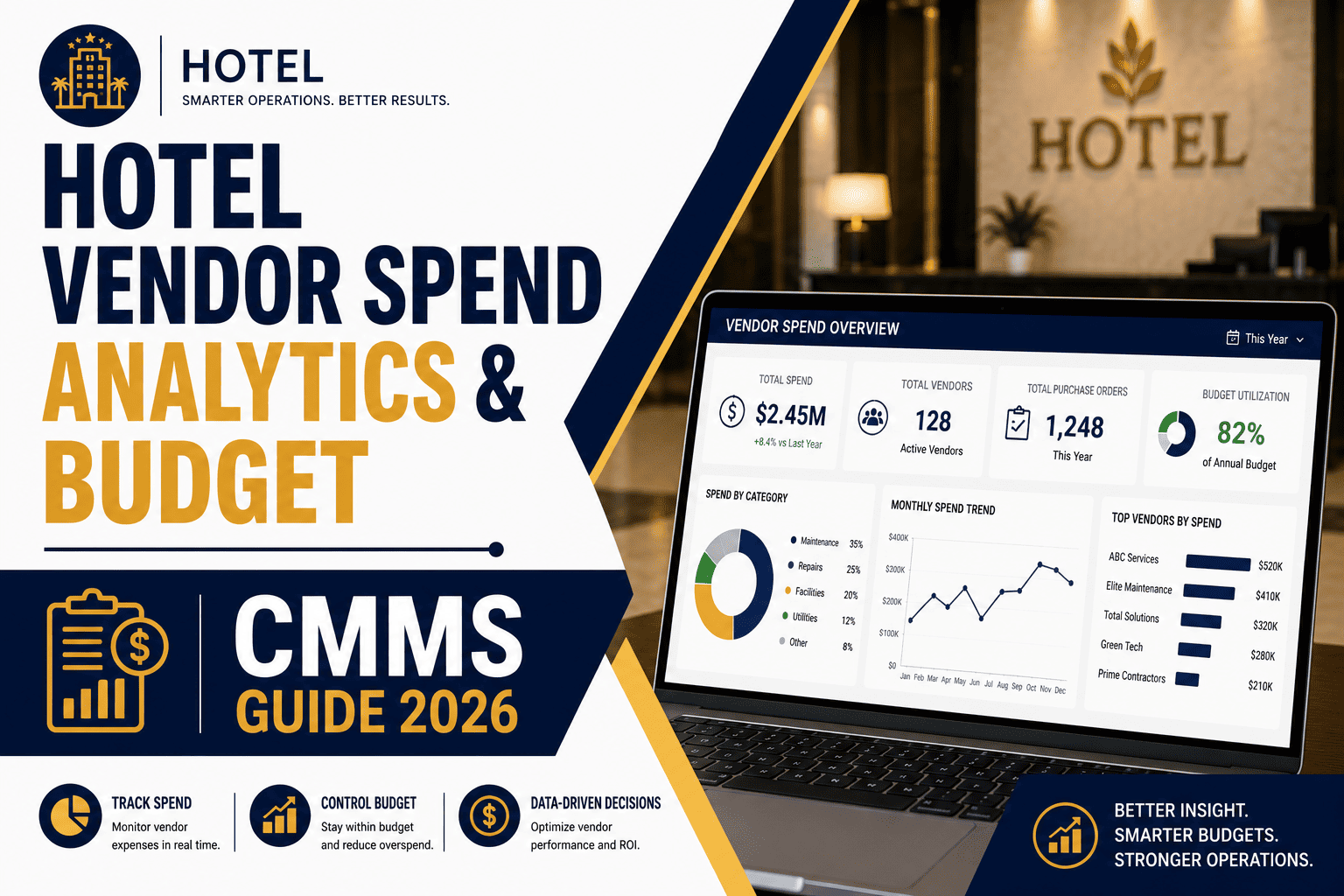
Real-time cost-per-repair by category, vendor, asset type and property — updated as work orders close. Export your 2026 rate card in one click and walk into contract renewals with hard numbers.
Contract rate card stored per vendor
Every vendor's negotiated labor rates, parts markup caps, travel fees and after-hours premiums live in OxMaint — so invoice verification always checks against the actual contract, not a guess.
Portfolio-level benchmarking across properties
Compare cost-per-repair across your entire hotel portfolio — identify which properties overpay for the same repair category and standardize on the best-performing vendors. Typical savings: 12–18% on annual vendor spend.
See OxMaint benchmark your vendor costs in 30 minutes
Book a demo and we'll load a sample hotel portfolio, show you cross-vendor cost gaps and walk through automated invoice verification on your repair categories.
Hotel vendor cost-per-repair benchmarking: frequently asked questions
What is hotel vendor cost-per-repair benchmarking in a CMMS?
Hotel vendor cost-per-repair benchmarking is the process of using a CMMS to capture the fully loaded cost of each outsourced repair — vendor invoice plus internal labor, parts and downtime — and comparing those costs across vendors, repair categories and properties. A CMMS like OxMaint automates this by tying every invoice to a completed work order, giving you a defensible cost-per-repair baseline for rate negotiations and contract renewals.
How does a CMMS verify vendor invoices for hotel maintenance?
A CMMS verifies vendor invoices by automatically matching each invoice line item to the corresponding completed work order record. It checks labor hours, parts quantities, unit prices and travel fees against the vendor's stored contract rate card. Mismatches — such as unauthorized markups, duplicate charges or out-of-contract rates — are flagged for review before finance approves payment. You can see this in action when you Book a Demo.
How much can a hotel save with CMMS-based vendor cost benchmarking?
Hotels typically recover 7–18% of annual vendor maintenance spend through CMMS-driven invoice verification and cross-vendor cost comparison. A 3-property portfolio spending $120K/year on outsourced repairs can save $8,400–$21,600 annually by consolidating to lower-cost-per-repair vendors and eliminating invoice overcharges and duplicate repairs.
What repair categories should hotels benchmark first?
Start with the highest-volume and highest-cost categories: HVAC and refrigeration, plumbing and domestic water, kitchen equipment, and laundry equipment. These typically represent 60–70% of outsourced vendor spend in hotels and show the widest cost-per-repair variance between vendors — making them the fastest path to measurable savings.
How long does it take to implement CMMS vendor cost benchmarking?
With OxMaint, a hotel can begin capturing vendor cost-per-repair data within the first week of implementation. Existing vendor contracts and rate cards are uploaded, work-order workflows are configured for your repair categories, and the benchmarking dashboard goes live as soon as completed work orders and invoices flow through the system — typically 2–4 weeks for full portfolio coverage.
Stop overpaying for vendor repairs. Start benchmarking from data.
OxMaint turns every work order and vendor invoice into negotiation leverage. See your cost-per-repair gaps, automate invoice verification, and renew contracts with real numbers.
Free 14-day trial · No credit card