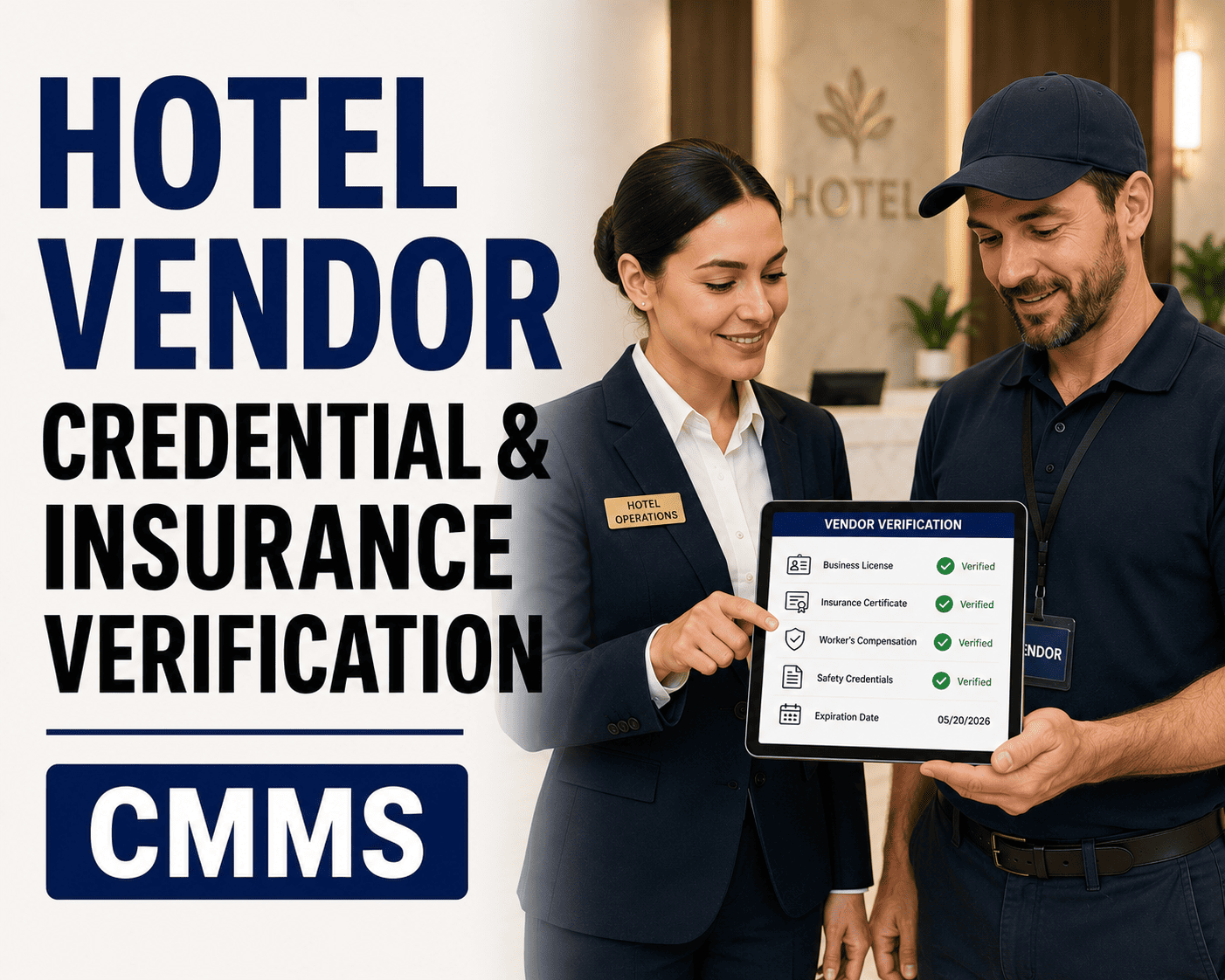
Hotel vendor credential verification is the process of confirming that every contractor stepping onto your property holds valid licenses and adequate insurance before a single work order is dispatched. When an uninsured or unlicensed vendor causes property damage or personal injury on hotel grounds, the liability ultimately falls on the property, not the vendor. This CMMS credential verification guide for hotels breaks down required insurance coverage, trade-specific license verification, and how a hotel vendor credential CMMS automates Certificate of Insurance (COI) tracking. Ready to eliminate compliance gaps? You can Start Free Trial today or explore the platform in a live walkthrough.
2026 Credential Guide
Can you prove every vendor on your property is insured and licensed right now?
A single expired COI or lapsed trade license can transfer six-figure liability directly to your hotel. OxMaint's CMMS credential verification intercepts out-of-compliance vendors before they ever receive a work order.
Vendor Risk Management
Why hotel vendor credential verification is non-negotiable in 2026
Hotels rely on hundreds of third-party vendors — from HVAC technicians and commercial plumbers to landscape crews and elevator inspectors. Under standard premises liability laws, if an underinsured vendor injures a guest or damages property, the hotel is named in the lawsuit. Relying on a spreadsheet or a paper binder of insurance certificates is a high-stakes gamble: documents expire silently, policies get cancelled, and trade licenses lapse without notice. A modern CMMS hotel vendor credential system shifts this process from reactive paper-chasing to proactive, automated compliance gatekeeping.
Coverage Requirements
Required insurance coverage and license verification by trade
General liability is only the baseline. A proper hotel insurance guide for vendor management requires trade-specific coverage limits. If an electrician causes a fire or a plumber floods a guest wing, standard minimums will not cover the cascading business interruption costs. Below is the verification matrix every hotel should enforce before approving a vendor work order.
| Vendor Trade | Required Insurance Coverage | License Verification Focus | CMMS Enforcement |
|---|---|---|---|
| HVAC & Refrigeration | $2M General Liability, $1M Auto | EPA Section 608 Certification | Block work order on expiry |
| Electrical Contractors | $2M GL, $5M Umbrella | State Master Electrician License | Auto-flag 30 days prior |
| Plumbing & Water Remediation | $2M GL, Pollution Liability | State Journeyman Plumber License | Require COI upload annually |
| Elevator & Escalator | $5M GL, Professional Liability | QEI Certified Inspector | Strict access control dispatch |
| General Janitorial | $1M GL, Workers' Comp | Business Registration Verification | Batch verify quarterly |
The Cost of Inaction
The financial impact of unqualified vendor dispatch
Consider a 250-room hotel property dispatching an HVAC vendor to repair a rooftop unit. The vendor's general liability policy lapsed six weeks ago, but the maintenance manager is working from a static spreadsheet and never caught the expiration. During the repair, the technician drops a 40-pound compressor through the roof membrane, causing $48,000 in structural damage and a 12-hour closure of the top floor. Because the vendor is uninsured, the hotel's own property insurance must absorb the loss — driving up premiums and triggering a massive deductible. A CMMS hotel vendor insurance workflow prevents this entirely by locking the work order until a valid, unexpired COI is on file.
OxMaint Solution
How OxMaint CMMS prevents out-of-compliance vendor dispatch
OxMaint transforms hotel vendor credential verification from a manual administrative burden into an automated, hard-stop gate. By binding insurance documents and trade licenses directly to the vendor profile inside the CMMS, the system ensures that no technician — internal or third-party — can be assigned a work order unless their compliance status is 100% green. This is how OxMaint drives measurable ROI for maintenance and reliability teams.
Automated COI Tracking & Expiry Alerts
OxMaint flags expiring certificates 30, 15, and 5 days out. Vendors receive automated emails requesting updated documents, eliminating manual chasing and reducing lapsed coverage by over 95%.
Work Order Dispatch Lockout
The system physically prevents a work order from being assigned to a vendor with expired insurance or a lapsed license, shifting compliance from a "best effort" to an engineering constraint.
Audit-Ready Compliance Reporting
Generate a complete, time-stamped compliance log for any vendor or property in seconds. OxMaint cuts audit preparation time from weeks to minutes, protecting your brand during corporate risk reviews.
Trade-Specific License Verification
Custom compliance fields allow you to track specific certifications (e.g., QEI, EPA 608) alongside general insurance, ensuring the exact right credential is verified for the exact right task.
Implementation Timeline
CMMS hotel vendor credential verification: A 30-day rollout timeline
Vendor Data Migration & Onboarding
Upload existing vendor lists, historical COIs, and trade licenses into OxMaint. The AI engine scans documents, extracts expiry dates, and builds dynamic vendor profiles.
Compliance Rule Configuration
Set insurance minimums by trade and establish the work order lockout parameters. Define alert cadences for internal managers and external vendor emails.
Pilot Run & Gap Remediation
Run a live test on incoming preventive maintenance work orders. Identify vendors with already-lapsed documents and trigger automated update requests.
Full Go-Live & Audit Readiness
All dispatched work orders now require verified credentials. The maintenance team operates with a fully automated, audit-proof vendor compliance gate.
Stop gambling with unverified vendor credentials
See how OxMaint automates COI tracking, license verification, and work order lockouts to protect your property from unnecessary liability.
Frequently Asked Questions
Hotel vendor credential verification CMMS FAQs
What is hotel vendor credential verification in a CMMS?
Hotel vendor credential verification in a CMMS is the automated process of validating that third-party contractors have valid, unexpired insurance policies and trade-specific licenses before they are assigned maintenance work orders. The CMMS acts as a digital gatekeeper, physically preventing the dispatch of any vendor who fails compliance checks.
How does a CMMS track vendor insurance certificates (COIs)?
A CMMS tracks COIs by storing digital copies of the certificates in vendor profiles and extracting key data like policy numbers and expiration dates. The system then sends automated expiry alerts to vendors and internal managers, ensuring documents are renewed before they lapse. You can see this in action when you Book a Demo with our team.
Can OxMaint block a work order if a vendor's license is expired?
Yes. OxMaint uses a work order dispatch lockout feature that physically prevents maintenance managers from assigning a task to any vendor with an expired insurance policy or lapsed trade license. This engineering control eliminates human error and guarantees zero out-of-compliance vendor dispatches.
What insurance coverage limits should hotels require from vendors?
Hotels should generally require a minimum of $1 million to $2 million in general liability coverage, with $5 million umbrella policies for high-risk trades like electrical, elevator repair, and HVAC. Workers' compensation and commercial auto coverage should also be mandatory, verified continuously through the CMMS.
How long does it take to implement vendor credential tracking software?
Implementation typically takes 30 days. The first week involves migrating vendor data and historical COIs into the CMMS, followed by configuring compliance rules, running a pilot on live work orders, and going fully live. You can start building your compliance gate today with a Start Free Trial.
Secure your hotel's vendor compliance today
Join the maintenance teams using OxMaint to automate credential verification, eliminate liability gaps, and dispatch with total confidence.
Free 14-day trial · No credit card