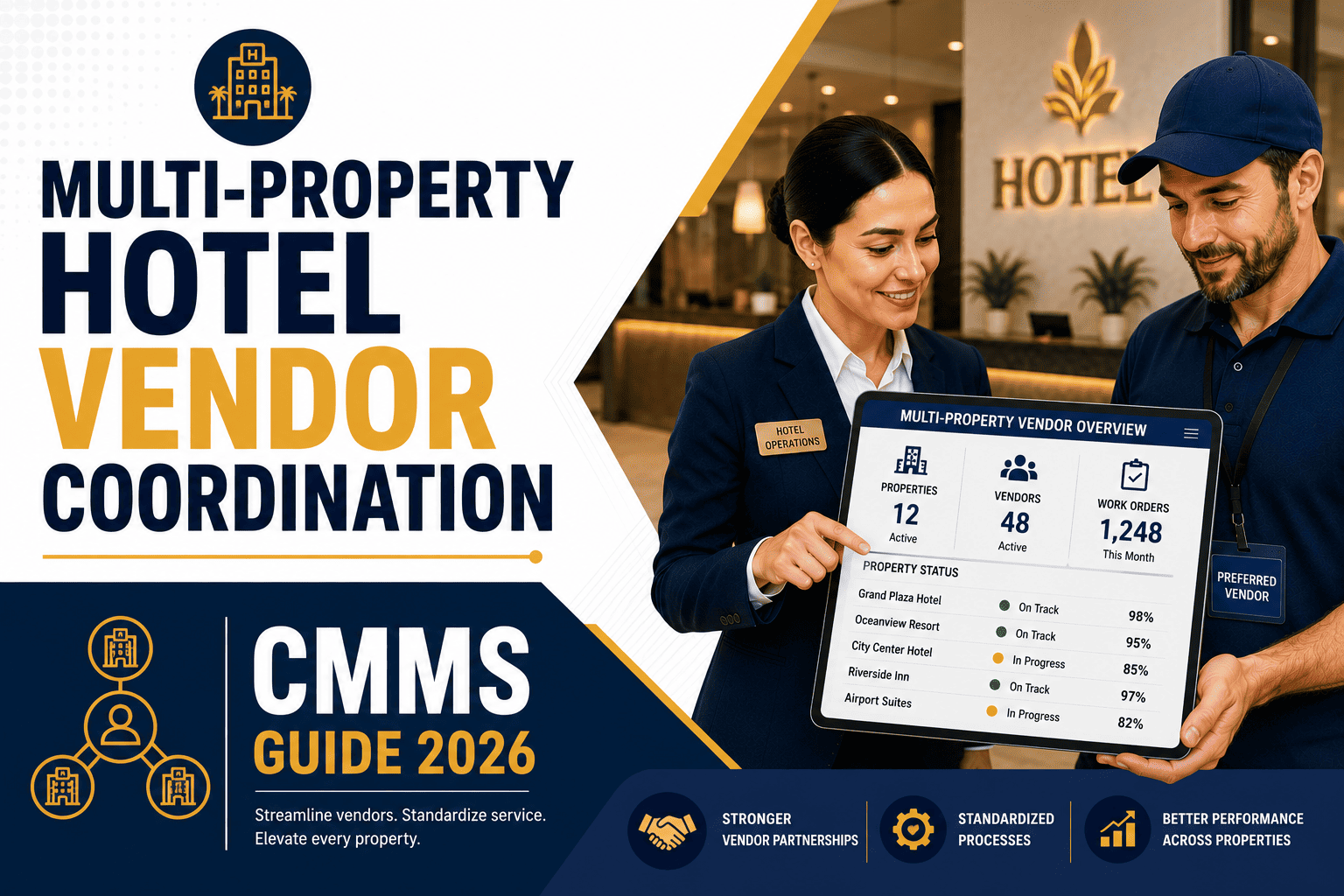
Multi-property vendor coordination is where portfolio operations either compound leverage or lose it — same vendor, same terms, same performance expectations across every property. This 2026 CMMS guide covers multi-property hotel vendor coordination: portfolio vendor programs, master service agreements, centralized dispatch, and the CMMS structure that supports true multi-property vendor coordination across regional properties. Hotel chains that centralize vendor management through a shared CMMS typically cut vendor spend 12–18% and reduce emergency dispatch response times by 35% within the first six months. If you are ready to see this in action, you can Start Free Trial or continue reading to understand how a centralized vendor CMMS transforms multi-property operations.
Can every regional property share the same vendor pool — without the chaos?
Multi-property hotel vendor coordination breaks down when properties dispatch independently, negotiate in silos, and track performance on spreadsheets. OxMaint's CMMS centralizes your shared vendor pool, master service agreements, and dispatch — one platform, every property, every vendor.
The hidden cost of fragmented hotel chain vendor management
A 12-property hotel chain running vendor coordination through email, phone calls, and property-level spreadsheets loses an average of $87,000 per year in duplicate dispatch fees, inconsistent pricing, and untracked SLA breaches. Multi-property vendor coordination fails not because vendors are unreliable — but because there is no single source of truth for vendor performance, contracts, and dispatch history across regional properties.
Centralized vendor pool architecture for hotel chains
A CMMS built for multi-property vendor coordination uses a hierarchical structure: one corporate vendor database linked to every regional property, with property-level work orders feeding back into shared performance dashboards. This means a fire-suppression vendor servicing properties in three states has one contract, one SLA, one performance score — visible to every GM and regional director in real time.
Shared vendor pool with regional property assignment
Every vendor — HVAC, elevator, pest control, fire safety, linen — lives in one centralized database. Each vendor record carries certifications, insurance expiration dates, MSA pricing, and a list of assigned properties. When a GM in Property A creates a work order, the CMMS surfaces only approved, insured, contracted vendors for that region.
Master service agreement enforcement at the work-order level
When a work order is assigned, the CMMS auto-populates the negotiated MSA rate for that service category and property tier. If a vendor submits an invoice above the MSA rate, the system flags it before approval — eliminating the 23% invoice discrepancy rate typical in spreadsheet-managed portfolios.
Centralized dispatch with property-level visibility
Regional directors can dispatch vendors across properties from a single dashboard, see real-time status of every active work order, and reassign jobs when a vendor is delayed. GMs see only their property's work orders but benefit from the shared vendor pool's faster response times and pre-negotiated rates.
Cross-property vendor performance scoring
Every completed work order feeds a vendor scorecard: response time, first-time-fix rate, invoice accuracy, and guest-impact downtime. A vendor servicing 8 properties gets one aggregate score — so a regional director can decide whether to renew or replace based on portfolio-wide data, not one GM's opinion.
What a shared vendor pool saves a 15-property hotel chain
Consider a 15-property hotel portfolio spending $1.2M annually on outsourced maintenance vendors — HVAC, elevators, fire systems, plumbing, and grounds. Moving from property-by-property vendor management to a centralized CMMS vendor pool delivers measurable, compounding returns within the first quarter.
Based on a 15-property portfolio with $1.2M vendor spend and 85% MSA compliance post-CMMS rollout vs. 61% pre-rollout.
| Vendor Cost Category | Pre-CMMS (Siloaded) | Post-CMMS (Centralized) | Annual Savings |
|---|---|---|---|
| HVAC service contracts (15 properties) | $340,000 | $282,000 | $58,000 |
| Elevator maintenance & repair | $195,000 | $168,000 | $27,000 |
| Fire suppression & safety inspections | $128,000 | $104,000 | $24,000 |
| Plumbing & emergency repairs | $210,000 | $156,000 | $54,000 |
| Duplicate dispatch & after-hours premium | $97,000 | $28,000 | $69,000 |
| Portfolio Total | $970,000 | $738,000 | $232,000 |
OxMaint CMMS capabilities for hotel chain vendor management
OxMaint was built for multi-property portfolios that need centralized vendor control without losing property-level flexibility. These four capabilities directly address the coordination breakdowns that cost hotel chains six figures annually.
Unified Vendor Database with Property-Level Permissions
One vendor pool, every property, role-based access. Corporate sees all vendors and contracts; GMs see only their assigned vendors and active work orders. Insurance and certification expirations trigger automatic alerts 30/60/90 days out — no vendor works a property with expired coverage.
Eliminates 100% of uninsured-vendor exposure and cuts vendor onboarding time by 60%MSA-Linked Work Orders with Auto-Pricing Enforcement
Every work order pulls the negotiated MSA rate for the vendor, service category, and property tier. Invoices above the contracted rate are flagged before approval. Regional directors approve exceptions — GMs cannot accidentally pay above-contract pricing.
Recovers 12–18% of annual vendor spend lost to invoice discrepancies and rate creepCentralized Dispatch Dashboard with Real-Time Status
Regional directors dispatch vendors across all properties from one screen. Real-time work-order status, vendor GPS check-in, and photo verification mean no more "Did the tech show up?" phone calls. Auto-escalation triggers fire when SLA response windows are breached.
Cuts emergency vendor response time 35% and eliminates 4+ hours of weekly GM status-chasingCross-Property Vendor Performance Analytics
Every completed work order feeds a vendor scorecard: response time, first-time-fix rate, invoice accuracy, guest-impact downtime, and repeat-call frequency. Compare vendors head-to-head across properties and make renewal decisions with portfolio-wide data.
Identifies bottom-quartile vendors 3x faster, enabling contract renegotiation or replacement before seasonal peaks90-day rollout for multi-property CMMS vendor centralization
A 10–20 property hotel chain can fully centralize vendor coordination in OxMaint within 90 days. The timeline below reflects a typical rollout — most properties see vendor spend reductions by Week 6 and full ROI by Day 90.
Vendor database migration & MSA upload
Import all vendor records, contracts, insurance certificates, and pricing schedules from spreadsheets or legacy systems. OxMaint's onboarding team handles data migration and validates MSA rates against existing invoices.
Property-level onboarding & role configuration
Configure each property's GM, maintenance lead, and regional director permissions. Map assets to properties. Train GMs on creating work orders from the shared vendor pool — typically a 2-hour session per property cluster.
Centralized dispatch go-live & SLA enforcement
All new vendor work orders flow through OxMaint. SLA timers activate on dispatch. Regional directors begin monitoring the cross-property dispatch dashboard. First vendor spend reductions appear as MSA pricing auto-enforces.
Performance analytics & vendor optimization
First full vendor scorecards available. Regional directors identify bottom-quartile vendors, renegotiate or replace contracts, and optimize the shared vendor pool. Full ROI realized — most portfolios report $15K–$25K monthly vendor spend reduction by Day 90.
A 14-property boutique hotel chain's vendor coordination transformation
A 14-property boutique hotel group operating across three states was spending $890,000 annually on maintenance vendors, managed entirely through property-level spreadsheets and email. Each GM negotiated independently — the same HVAC vendor charged $145/hour at one property and $185/hour at another. Three properties had vendors working with expired liability insurance. Emergency dispatch response averaged 6.5 hours because GMs called vendors individually with no shared escalation protocol.
The chain recovered $184,000 in annual vendor spend, eliminated all uninsured-vendor exposure, and cut emergency response times by 42%. The Regional Director of Operations now reviews vendor performance across all 14 properties in a single 20-minute weekly dashboard review — replacing 6+ hours of phone calls and email chains.
See OxMaint coordinate vendors across your portfolio
Book a 30-minute demo and we'll show you exactly how multi-property vendor coordination works in OxMaint — shared vendor pool, MSA enforcement, centralized dispatch, and cross-property performance analytics on your real property data.
Multi-property hotel vendor coordination CMMS questions answered
How does a CMMS handle multi-property vendor coordination for hotel chains?
A multi-property CMMS like OxMaint centralizes all vendor records, contracts, and insurance documentation in one shared database linked to every regional property. GMs create work orders from the approved vendor pool, the system auto-applies MSA pricing, and regional directors monitor dispatch status and vendor performance across all properties from a single dashboard. This eliminates duplicate vendors, inconsistent pricing, and uninsured-vendor exposure.
Can a shared vendor pool CMMS work with existing master service agreements?
Yes. OxMaint ingests your existing MSAs during onboarding and links each contract's pricing schedule to the corresponding vendor and service category. When a GM creates a work order, the CMMS auto-populates the negotiated rate — and flags any invoice that exceeds the MSA price before approval. You can Book a Demo to see MSA enforcement on your actual contracts.
What does a multi-property CMMS cost for a 10–20 property hotel chain?
Most 10–20 property hotel chains invest $18,000–$42,000 annually in OxMaint, including all properties, users, and vendor records. With typical vendor spend recovery of $150K–$250K in the first year, payback generally occurs within 60–90 days of go-live. Pricing scales by property count and asset volume, not by user seat — so every GM, maintenance tech, and regional director gets access without per-seat cost inflation.
How long does it take to roll out centralized vendor coordination across multiple properties?
A typical 10–20 property hotel chain completes full vendor centralization in 90 days: Days 1–14 for vendor database and MSA migration, Days 15–35 for property-level onboarding and role configuration, Days 36–60 for centralized dispatch go-live, and Days 61–90 for performance analytics and vendor optimization. Most properties see first vendor spend reductions by Week 6.
What happens if a vendor's insurance or certification expires mid-contract?
OxMaint tracks every vendor's insurance expiration and certification renewal dates, triggering automated alerts to the regional director 90, 60, and 30 days before expiry. If a vendor's coverage lapses, the system automatically removes them from the approved dispatch pool for any property — preventing uninsured vendors from working on-site. You can Start Free Trial to test automated compliance alerts on your vendor records.
Stop losing $87K+ a year to fragmented vendor coordination
Centralize your shared vendor pool, enforce MSAs, and track performance across every property — all in one CMMS built for multi-property hotel chains.
Free 14-day trial · No credit card