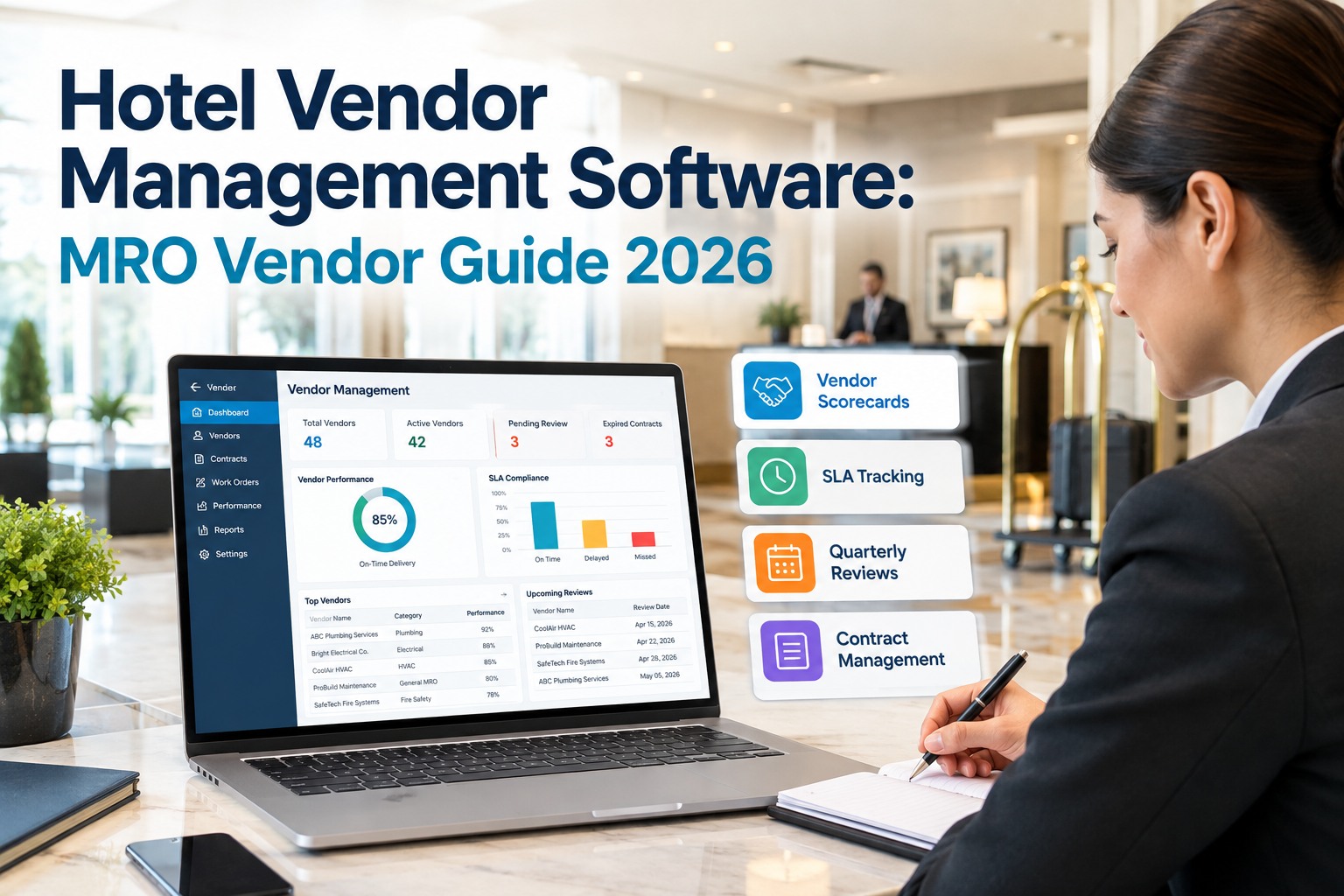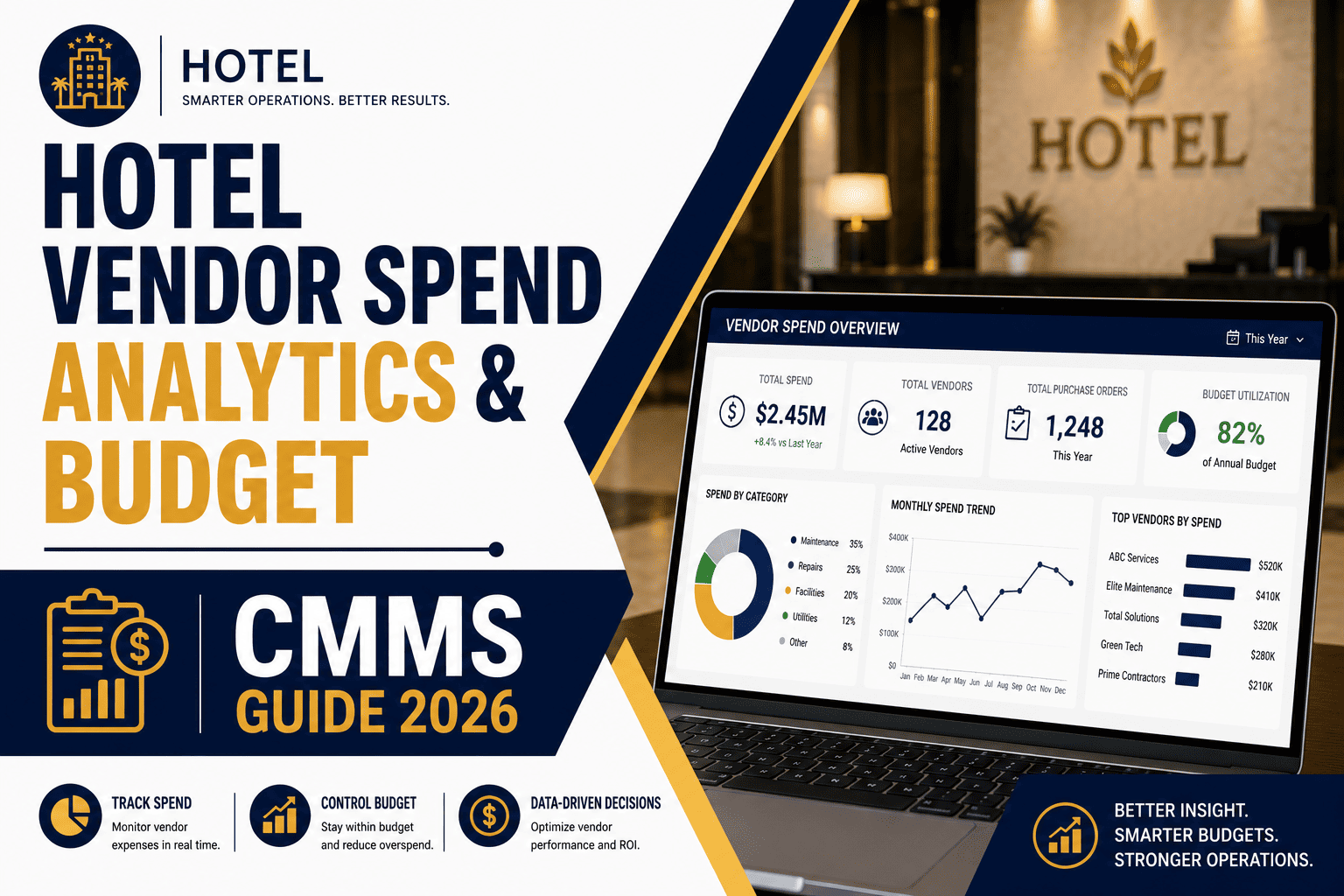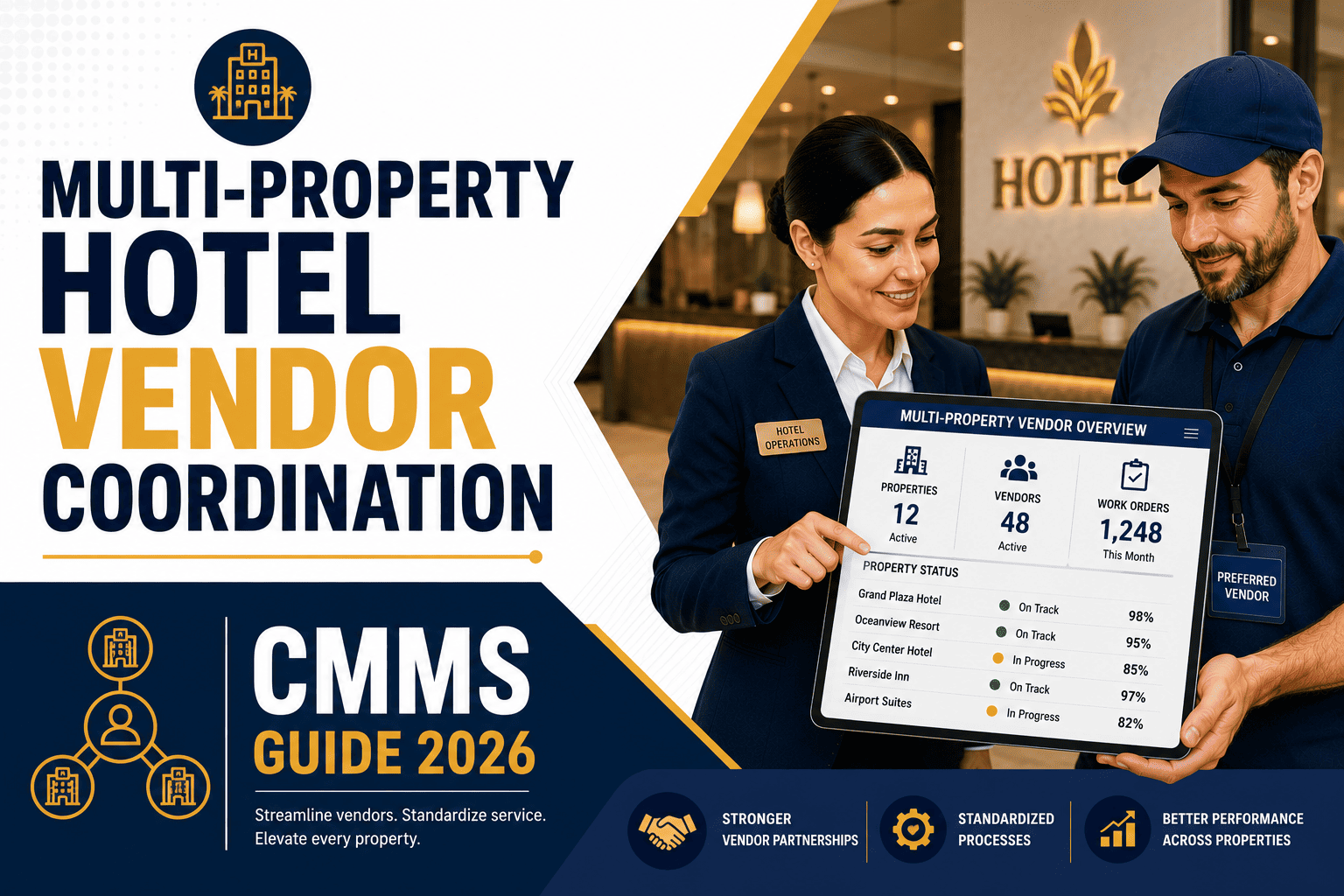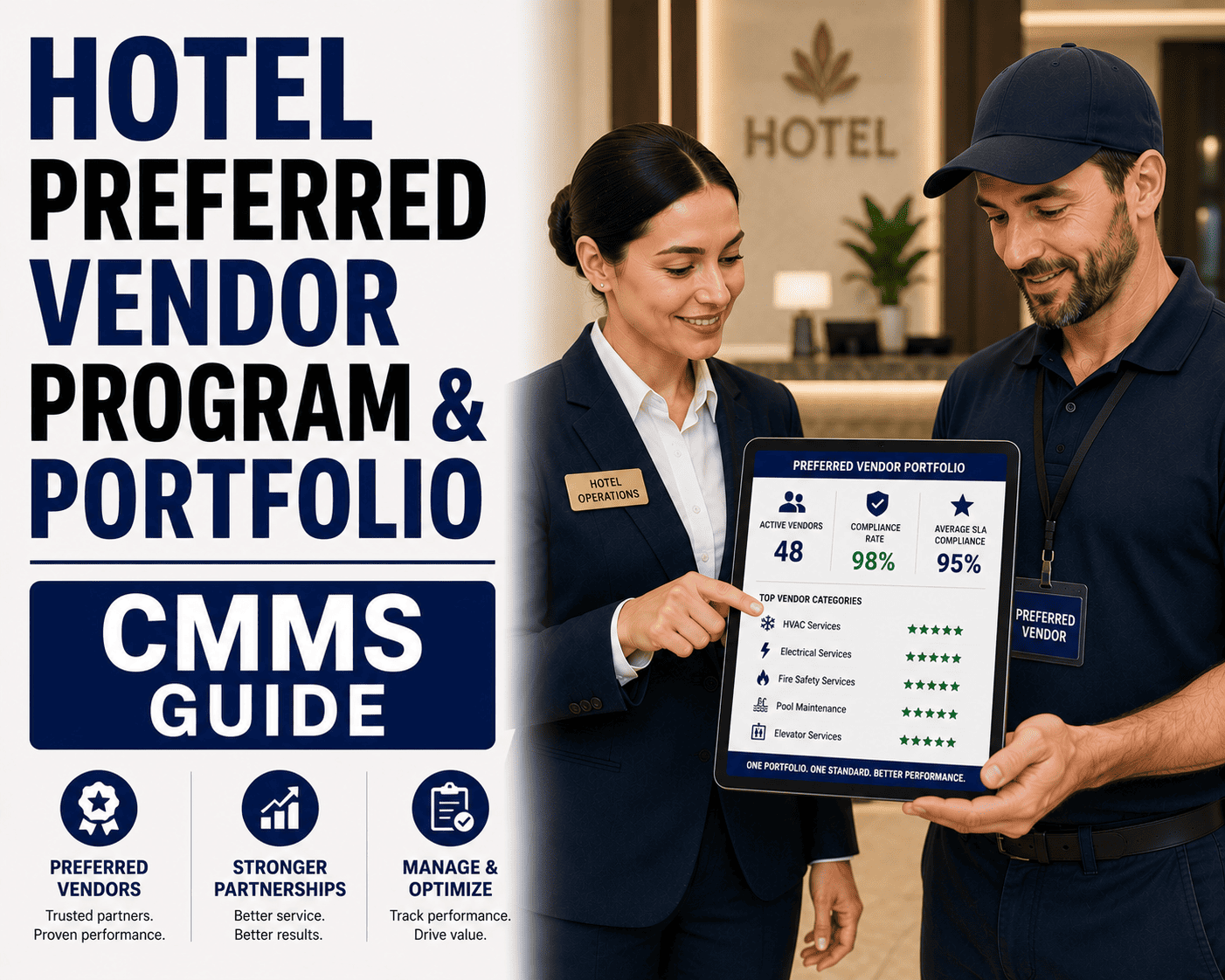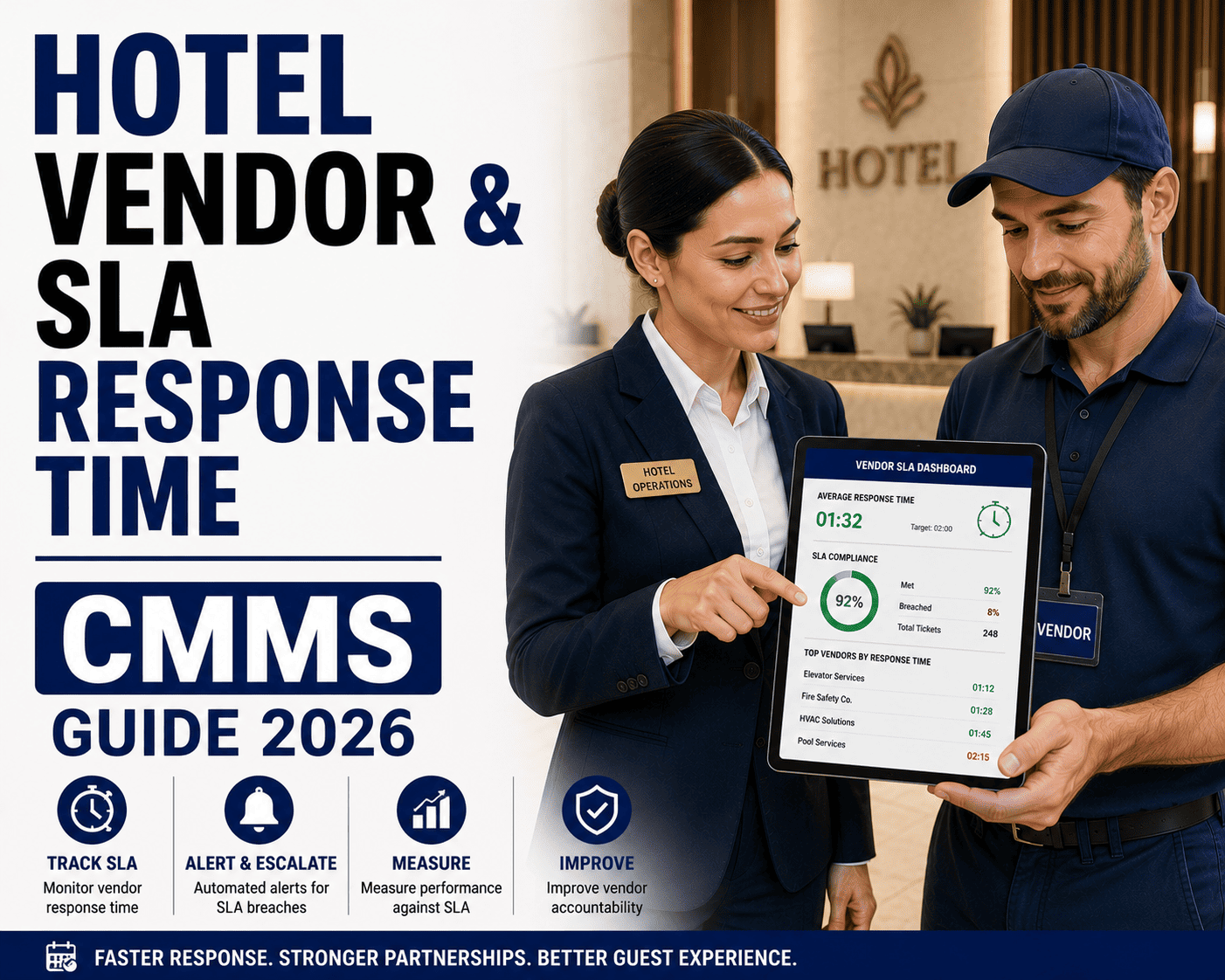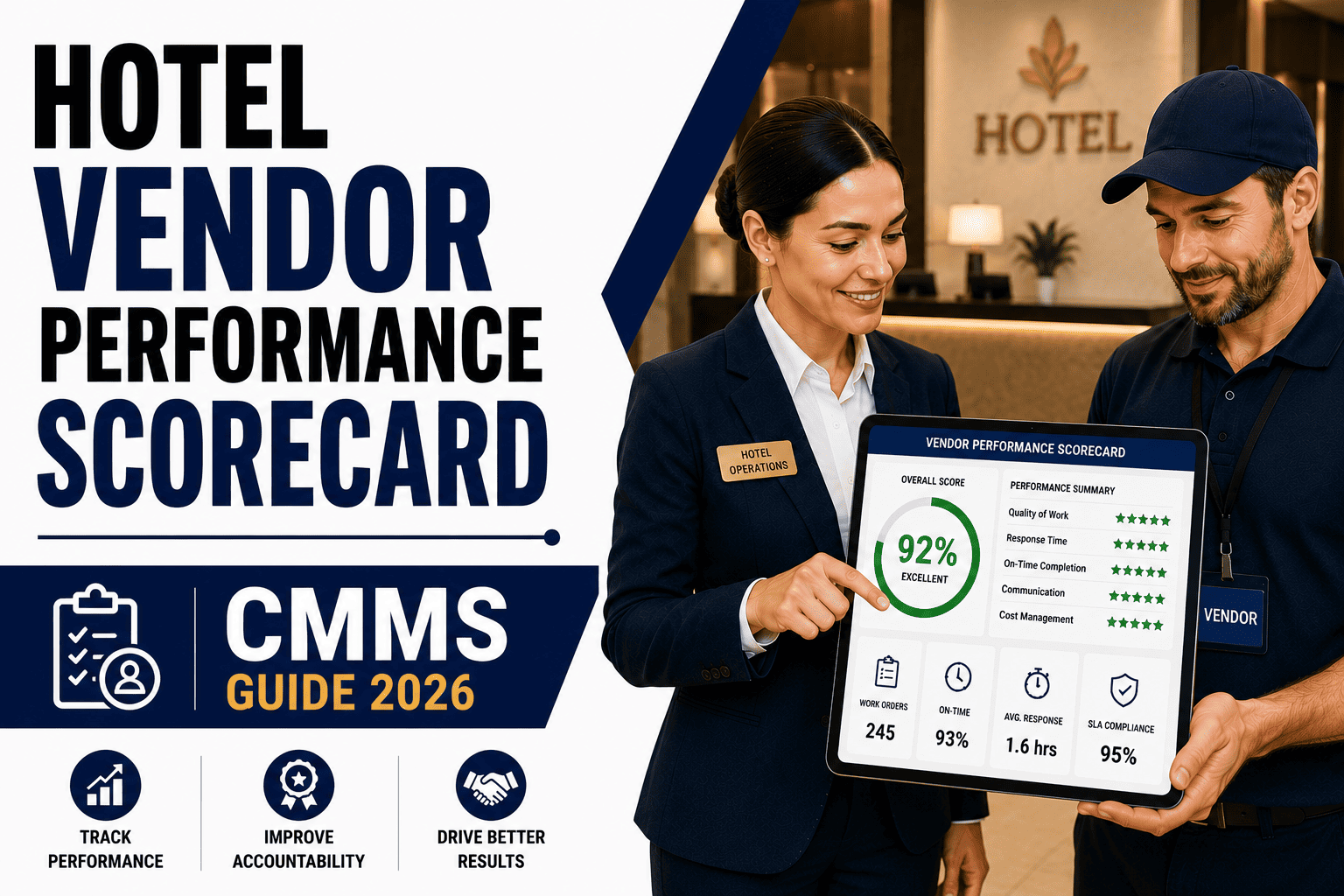
A hotel vendor performance scorecard transforms contractor management from subjective opinion into measurable, data-driven decisions — and in 2026, building that scorecard inside your CMMS is the fastest way to tie SLA compliance, completion rates, and quality scoring directly to contract renewals. This guide walks maintenance and reliability teams through the scoring dimensions, review cadence, and CMMS structure that produce vendor scorecards automatically, so you can reward top performers and cut underperforming vendors on evidence, not instinct. If you want to skip the spreadsheet chaos and see automated vendor scoring in action, Start Free Trial or read on for the full framework.
Are you renewing hotel vendor contracts on instinct — or on data?
A CMMS-based vendor performance scorecard turns every completed work order, SLA breach, and quality inspection into an objective score. Stop guessing. Start measuring completion rate, response time, and quality — then let the data decide who stays on your approved vendor list.
Why Hotels Need a CMMS Vendor Scorecard in 2026
A typical 200-room hotel engages 15–40 external vendors across HVAC, plumbing, fire-life-safety, elevator, landscaping, and janitorial services. Without a structured scorecard, general managers and chief engineers rely on memory, email threads, and gut feel — which means underperforming vendors keep getting renewed and top-tier partners go unrecognized. A performance scorecard CMMS eliminates that gap by automatically capturing data your team is already generating inside work orders.
The cost of inaction compounds. A vendor that consistently misses response-time SLAs on HVAC repairs during peak summer occupancy doesn't just inconvenience your team — it drives guest complaints, negative reviews, and revenue loss. A hotel vendor scorecard built inside your CMMS surfaces these patterns months before contract renewal, giving you the leverage to renegotiate rates, enforce penalties, or switch providers with documented evidence.
The Five Dimensions of a Hotel Vendor Performance Scorecard
An effective scorecard measures vendors across five weighted dimensions. Each dimension pulls data automatically from your CMMS work-order lifecycle — no manual data entry, no spreadsheet chasing.
SLA Compliance & Response Time
Measures the delta between the vendor's committed response window and actual on-site arrival. Target: 95% of emergency calls within 2 hours, routine calls within 24 hours. Your CMMS timestamps every status change automatically.
Completion Rate & First-Time Fix
Tracks the percentage of work orders resolved without a return visit. A CMMS hotel completion rate below 85% signals parts-availability issues, skill gaps, or misdiagnosis — all quantifiable inside your work-order history.
Quality Scoring
Post-work-order inspection ratings on a 1–5 scale, logged by your engineering team or automated checklist. CMMS hotel quality scoring aggregates these ratings into a rolling 90-day average per vendor, flagging downward trends before they escalate.
Cost Competitiveness
Compares invoiced amounts against contracted rates and benchmarks similar work orders across vendors. Flags overbilling variances above 5% and tracks cost-per-asset-maintained over time.
Communication & Compliance
Evaluates documentation completeness (COIs, permits, photos uploaded in CMMS), on-time invoice submission, and responsiveness to follow-up requests. Critical for audit-readiness and brand-standard compliance.
How to Calculate a Composite Vendor Score
Your CMMS should compute this automatically every time a work order closes. Here's the underlying formula so you can validate the outputs and customize weights for your property.
Worked example: An HVAC vendor with 92% SLA compliance, 81% first-time-fix, 4.2 quality average (scale to 84), 88 cost score, and 95 compliance score would earn: (92×.25) + (81×.25) + (84×.20) + (88×.15) + (95×.15) = 23 + 20.25 + 16.8 + 13.2 + 14.25 = 87.5 — a solid performer worth renewing, with a clear improvement target on first-time-fix rate.
Scorecard Cadence: Monthly Tracking, Quarterly Reviews
Data without rhythm is just noise. A vendor scorecard guide hotel framework requires a disciplined cadence — automated monthly snapshots and structured quarterly business reviews.
Automated Score Snapshot
CMMS generates a one-page vendor scorecard PDF on the 1st of each month, distributed to the GM, chief engineer, and director of engineering. No manual compilation — scores update in real time as work orders close.
Vendor Review Meeting
45-minute structured review with each strategic vendor. Share the scorecard, discuss trends, set improvement targets. Top-quartile vendors get recognition; bottom-quartile vendors get a documented 30-day corrective plan.
Contract Renewal Decision
Full 12-month scorecard history informs renew, renegotiate, or replace decisions. Preferred vendors earn multi-year terms; borderline vendors move to competitive bid; chronic underperformers are removed from the approved list.
Vendor Tiering: Turn Scores Into Contract Decisions
Scores only create value when they drive action. Use this tiering matrix to translate your CMMS hotel performance scorecard into concrete vendor management outcomes.
| Tier | Score Range | Designation | Contract Action | Work Allocation |
|---|---|---|---|---|
| Tier 1 | 90–100 | Preferred Partner | Multi-year renewal, rate lock | Priority dispatch, 60% of spend |
| Tier 2 | 75–89 | Approved Vendor | Annual renewal at current terms | Standard dispatch, 30% of spend |
| Tier 3 | 60–74 | Conditional | 30-day improvement plan required | Limited dispatch, 10% of spend |
| Tier 4 | Below 60 | Under Review | Competitive bid or removal | Emergency only, then exit |
Consider a 180-room full-service hotel spending $48K annually across 22 vendors. After implementing a CMMS-driven scorecard, the property consolidated 6 Tier-4 vendors into 2 Tier-1 partners, negotiated a 12% rate reduction with preferred providers in exchange for volume commitment, and cut average response time by 31% — a combined $11K annual savings with measurably better service quality.
How OxMaint Automates Your Hotel Vendor Scorecard
OxMaint is an AI-powered CMMS and EAM platform that turns every work order, inspection, and invoice into structured vendor-performance data — automatically. No spreadsheets, no manual scoring, no end-of-month scrambling.
Auto-Scored Work Orders
Every closed work order feeds SLA timestamps, first-time-fix status, and quality ratings into a live vendor dashboard. Zero manual data entry — scores update the moment your team signs off.
Real-Time Performance Trends
AI-powered analytics flag vendors whose scores trend downward over 30, 60, or 90 days — so you intervene before a minor dip becomes a guest-impacting failure during peak season.
One-Click Scorecard Reports
Generate branded vendor scorecard PDFs for quarterly review meetings in seconds. Each report includes score breakdowns, trend charts, and documented work-order history — audit-ready by default.
Tier-Based Vendor Routing
OxMaint automatically routes new work orders to Tier-1 vendors first, enforces compliance documentation checks (COIs, licenses) before dispatch, and blocks Tier-4 vendors from non-emergency assignments.
See OxMaint Score Your Vendors in Real Time
Book a 30-minute demo and we'll show you how a CMMS hotel vendor scorecard works on real work-order data — from SLA tracking to tier-based routing.
Hotel Vendor Scorecard CMMS — Frequently Asked Questions
What is a hotel vendor performance scorecard in a CMMS?
A hotel vendor performance scorecard is a structured, data-driven evaluation tool built inside your CMMS that rates external contractors across SLA compliance, completion rate, quality, cost, and communication. It replaces subjective vendor reviews with objective scores computed automatically from work-order data, enabling fair contract decisions. You can see this in action when you Book a Demo of OxMaint.
How does a CMMS calculate vendor completion rate for hotels?
The CMMS calculates completion rate by dividing the number of work orders resolved without a return visit by the total number of work orders assigned to that vendor in a given period. For example, if a plumbing vendor closes 42 of 50 work orders without a callback, the first-time-fix completion rate is 84%. This metric is tracked automatically as work orders move through status changes in the system.
What is a good vendor score for hotel maintenance contractors?
A composite score of 75 or above out of 100 is generally considered acceptable for hotel vendors, with 90+ qualifying a vendor for preferred-partner status. Scores below 60 typically trigger a formal improvement plan or contract review. The exact thresholds should align with your property's brand standards and risk tolerance for guest-impacting failures.
How often should hotels review vendor performance scorecards?
Hotels should generate monthly scorecard snapshots automatically from the CMMS and conduct formal quarterly review meetings with each strategic vendor. Annual reviews should inform contract renewal, renegotiation, or replacement decisions. This cadence ensures early detection of performance declines and provides documented evidence for contract negotiations.
Can OxMaint automate vendor scorecards for multiple hotel properties?
Yes — OxMaint supports multi-property vendor scorecards that roll up individual property scores into a portfolio-level view. A regional director can compare vendor performance across all properties, identify consistently strong partners for portfolio-wide contracts, and spot property-specific issues. Start Free Trial to configure your vendor tiers and scoring weights today.
Turn Vendor Opinions Into Data-Driven Decisions
Join hotels using OxMaint to score vendors automatically, enforce SLAs, and cut maintenance spend by up to 23% — all from one AI-powered CMMS platform.
Free 14-day trial · No credit card