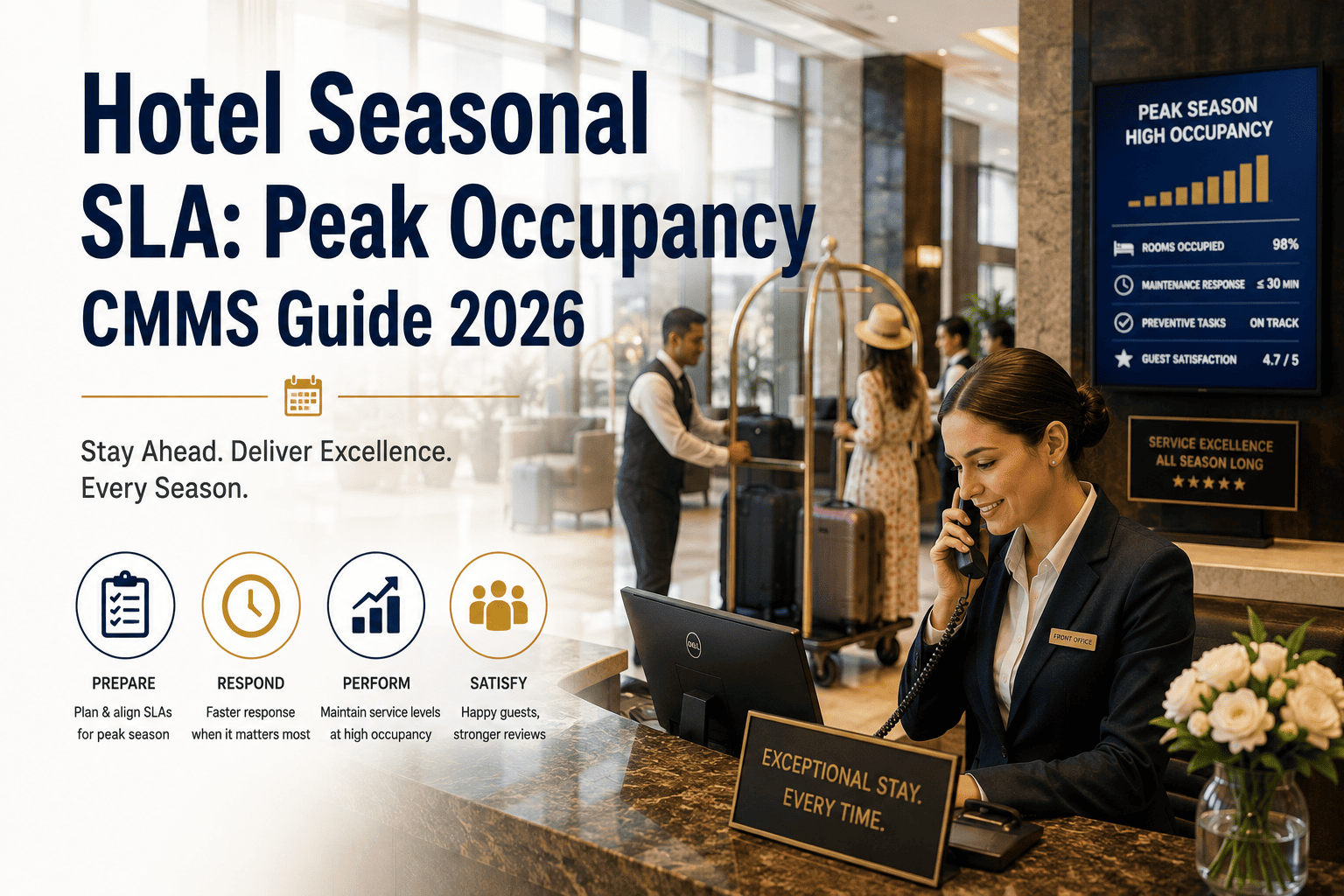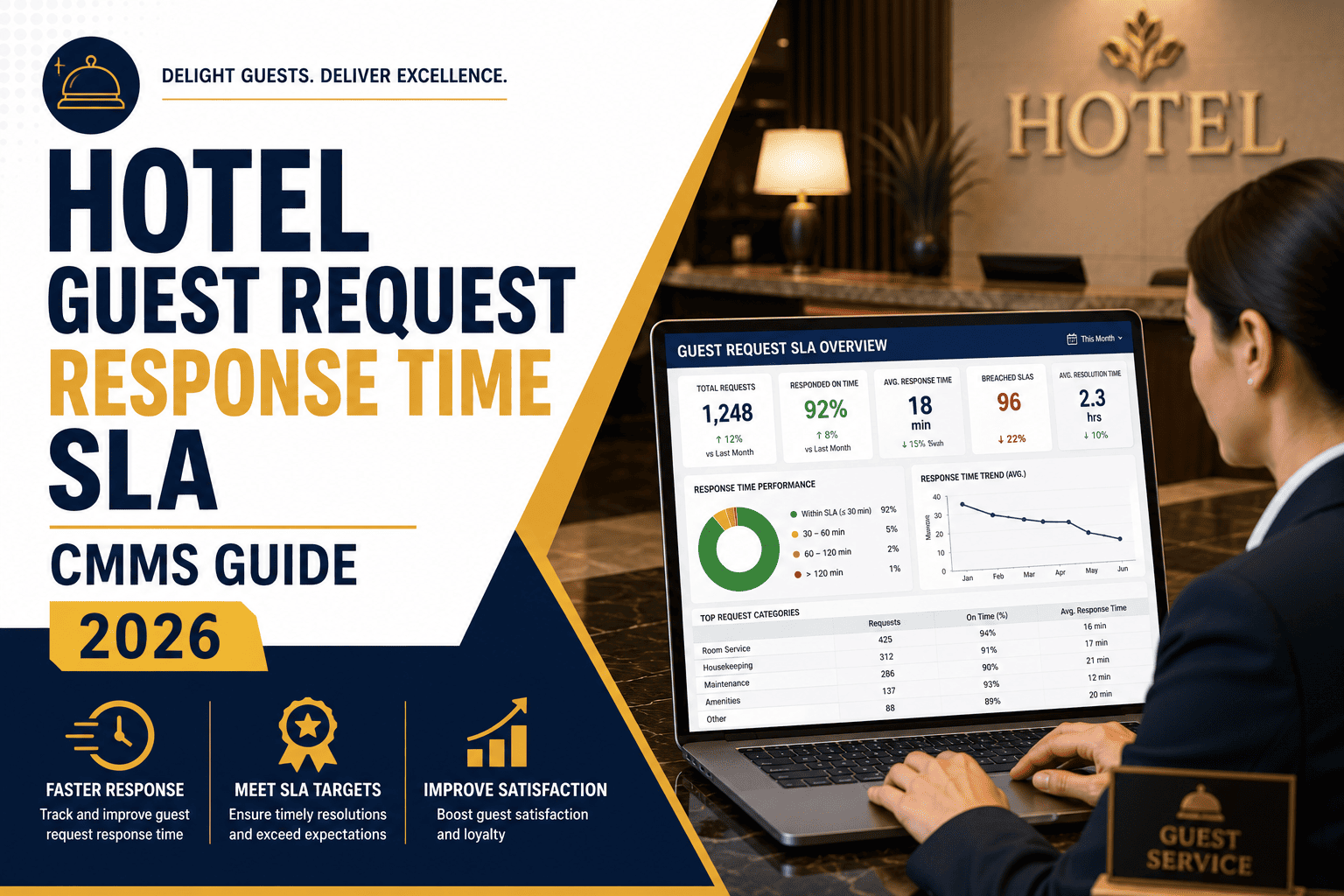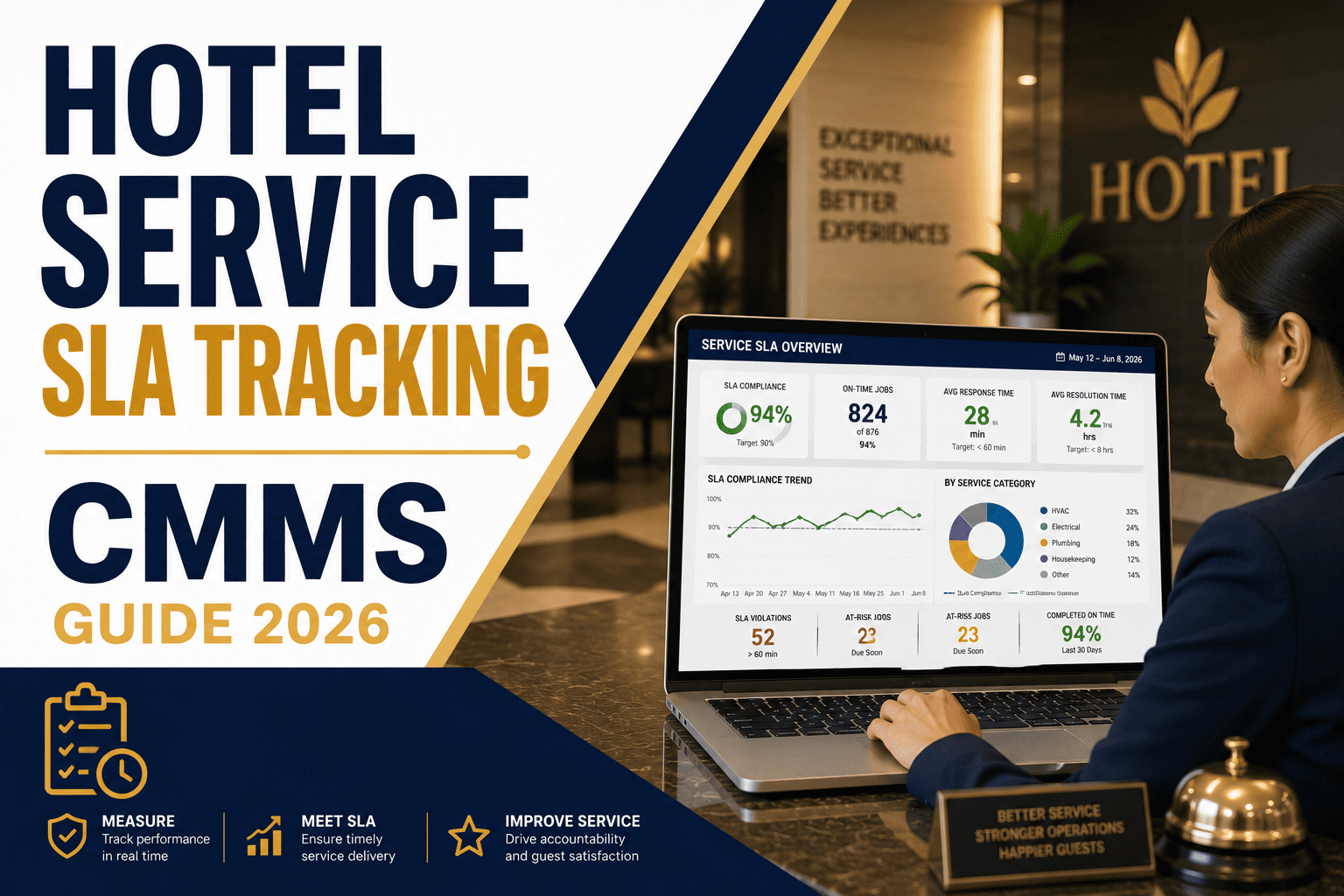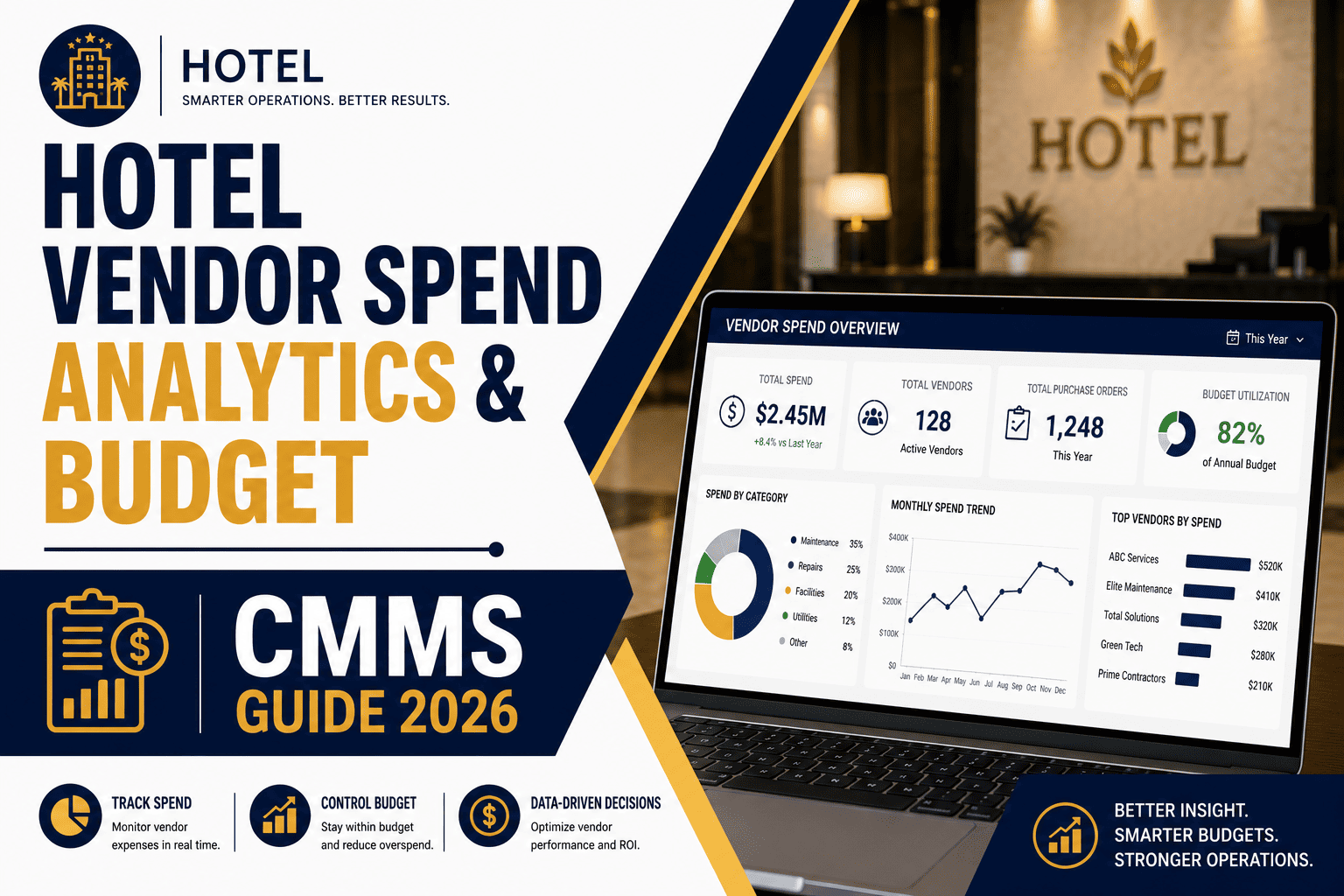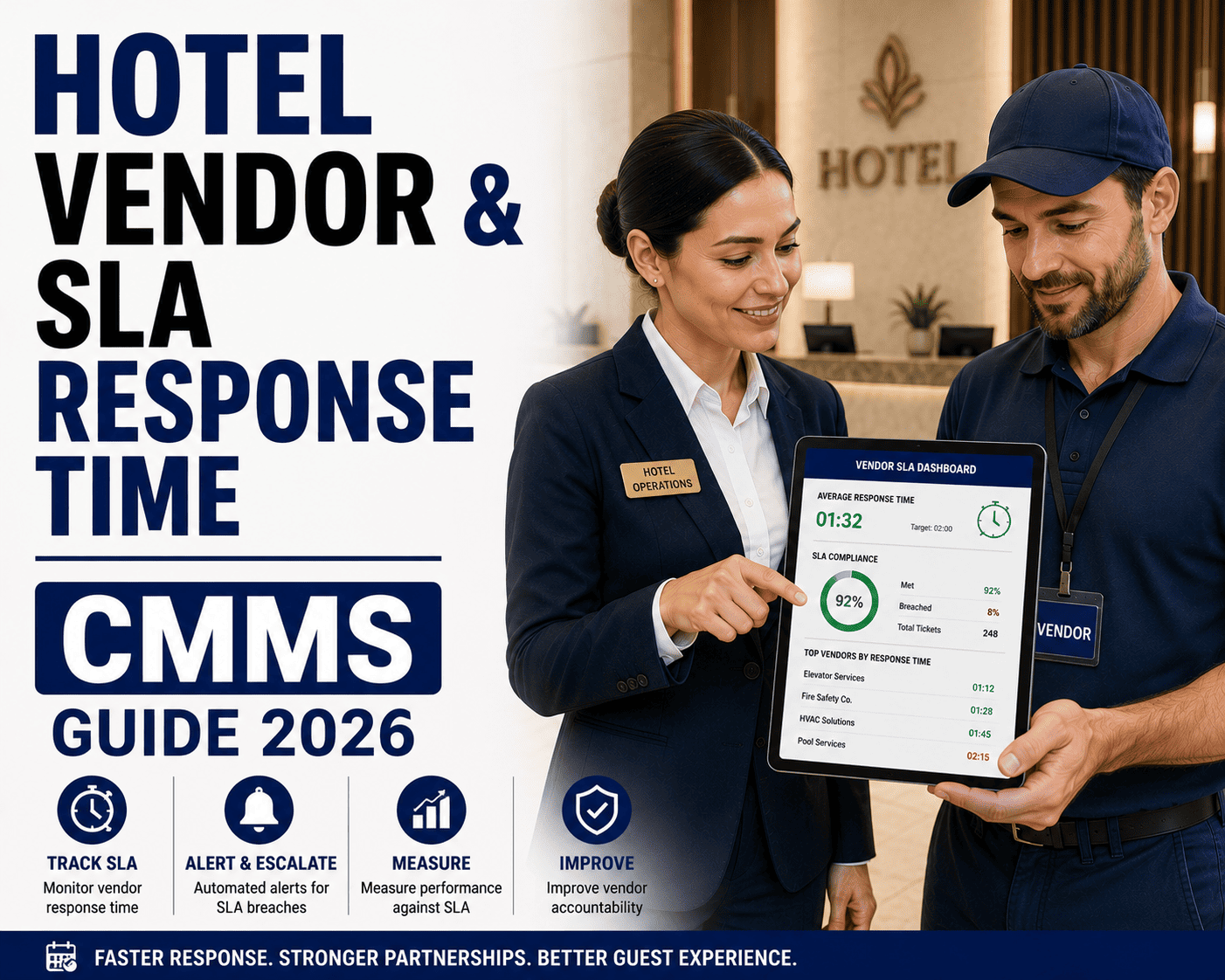
Hotel vendor SLA response time tracking is the difference between a maintenance contract that protects guest experience and one that exists only on paper. This 2026 CMMS guide shows how hotel engineering and facilities teams use a CMMS to measure vendor SLA performance, enforce resolution-time targets, and move underperforming vendors down a tier before a single guest complaint is filed. If your team still tracks vendor response in a spreadsheet, you are likely losing 4–6 hours per critical work order — and the data to prove it never makes it back to procurement. See how OxMaint turns every work order into SLA evidence when you Start Free Trial.
CMMS Hotel Vendor SLA Guide 2026
Are Your Hotel Vendor SLAs Being Met — or Just Hoped For?
Response-time commitments in a contract mean nothing without automated measurement. A CMMS captures every dispatch, arrival, and resolution timestamp so vendor SLA performance becomes measurable, auditable, and consequential.
SLA DESIGN BY TRADE & PRIORITY
How to Structure Hotel Vendor SLA Response and Resolution Times
A defensible hotel vendor SLA defines two clocks — response time (vendor acknowledges and dispatches) and resolution time (guest-impacting issue is restored) — tiered by trade and priority. Below is the baseline framework used by 200+ room full-service properties in 2026.
| Trade | Priority | Response Target | Resolution Target | Guest Impact Trigger |
|---|---|---|---|---|
| HVAC | P1 — Critical | 30 min | 4 hrs | Room temp exceeds 78°F; guest relocated |
| Plumbing | P1 — Critical | 30 min | 2 hrs | Active leak in occupied room or corridor |
| Elevator | P1 — Critical | 15 min | 8 hrs | Car out of service with guests on property |
| Electrical | P1 — Critical | 30 min | 4 hrs | Loss of power to guest floor or life-safety system |
| HVAC | P2 — High | 2 hrs | 24 hrs | Intermittent cooling; vacant room |
| Plumbing | P2 — High | 2 hrs | 8 hrs | Slow drain, no active leak |
| General | P3 — Routine | 4 hrs | 72 hrs | Preventive or cosmetic work in back-of-house |
Why this matters: Without priority tiers, every work order is treated as urgent — which means nothing is. A CMMS lets you encode these targets as automated SLA rules so the clock starts the second a work order is created, not when a manager remembers to email the vendor.
CMMS SLA MEASUREMENT
Response Time Hotel CMMS: How the SLA Clock Actually Works
CMMS hotel response time tracking relies on three timestamp gates. Each gate is captured automatically — no manual entry, no disputed invoices.
CORE SLA EQUATION
SLA Compliance % = (Work Orders Resolved Within Target ÷ Total Work Orders Assigned to Vendor) × 100
A vendor with 42 P1 work orders and 38 resolved within the contractual response + resolution window has a 90.5% SLA compliance rate. Anything below 95% triggers a tier-review flag in OxMaint.
Work Order Created
Front desk, housekeeping, or engineering submits a request. The CMMS auto-assigns priority based on asset, location, and guest-impact rules — the SLA clock starts at this exact second.
Vendor Acknowledges
Vendor receives an automated dispatch with the work order, asset history, and priority. Acknowledgment is captured via mobile check-in — response time is locked and measured against the P1/P2/P3 target.
Resolution & Sign-Off
Vendor marks the work order complete with photo proof and parts used. The CMMS stops the clock, calculates resolution time, and updates the vendor scorecard in real time — no spreadsheet reconciliation at month-end.
VENDOR SCORECARD
Build a Vendor Scorecard That Drives Tier Movement
SLA performance is only consequential if it changes vendor behavior. A CMMS-based vendor scorecard weights compliance, first-time-fix rate, and cost variance — then feeds tier status directly into procurement reviews.
Tier 1 — Preferred
Score: 90–100
First-call dispatch · Net-30 terms · Volume rate locked
Tier 2 — Standard
Score: 75–89
Dispatched when Tier 1 unavailable · Net-45 · Standard rate
Tier 3 — Probation
Score: Below 75
90-day improvement plan · No new contract renewal until score recovers
WORKED EXAMPLE
A 280-room resort in Arizona tracked its HVAC vendor in a shared spreadsheet for two years. The vendor's contract promised a 30-minute P1 response, but the engineering team had no automated timestamp. After implementing OxMaint's CMMS hotel vendor SLA monitoring, the scorecard revealed a 61% P1 response compliance rate — not the 95% the vendor reported. Within one quarter, the property moved the vendor to Tier 3, opened a competitive bid, and cut average guest-room HVAC downtime from 6.2 hours to 2.8 hours. The ROI: an estimated $38K saved in guest-comp stays and SLA penalty credits in the first six months alone.
HOW OXMAINT HELPS
CMMS Hotel Vendor Performance: OxMaint Capabilities That Enforce SLAs
OxMaint turns vendor SLA tracking from a manual reporting exercise into an automated, auditable system. Four capabilities map directly to hotel vendor management outcomes.
Automated SLA Clocks
Every work order starts a priority-based response and resolution timer the moment it is created. Vendors receive dispatch notifications with the countdown visible — eliminating "I didn't know it was urgent" disputes.
Outcome: Cut disputed vendor invoices by up to 70%
Live Compliance Dashboard
A real-time dashboard shows SLA compliance by vendor, trade, property, and priority. Engineering directors and GMs see a single source of truth — no month-end spreadsheet reconciliation.
Outcome: Surface SLA breaches in minutes, not 30 days
Vendor Scorecards & Tiering
OxMaint auto-calculates a weighted vendor score from SLA compliance, first-time-fix rate, and cost variance. Score thresholds trigger automated tier-movement alerts to procurement.
Outcome: Move underperforming vendors to probation automatically
Audit-Ready SLA Evidence
Every work order carries a timestamped, tamper-evident log of creation, acknowledgment, arrival, and resolution — with photo proof. Export a full vendor SLA report for any date range in one click.
Outcome: Pass brand-compliance audits in hours, not weeks
SLA MONITORING CMMS GUIDE
CMMS SLA Performance Hotel: What to Measure in 2026
Beyond raw compliance, leading hotel engineering teams track a set of leading indicators that predict vendor failures before they affect guests. These four KPIs should be on every property's monthly vendor review.
95%
SLA Compliance Target
Minimum acceptable P1+P2 compliance for Tier 1 preferred vendors in 2026
≤45 min
Avg. P1 Response Time
Benchmark across full-service hotels using CMMS-based vendor dispatch
85%+
First-Time Fix Rate
Percentage of vendor work orders resolved without a return visit
100%
Audit Evidence Coverage
Share of vendor work orders with complete timestamp + photo documentation
SEE OXMAINT ON YOUR VENDOR SLAs
Stop Guessing Whether Vendors Met Their SLA — Prove It
Book a 30-minute demo and see how OxMaint automates hotel vendor SLA tracking, builds real-time scorecards, and gives you the evidence to renegotiate or replace underperforming vendors.
FREQUENTLY ASKED QUESTIONS
Hotel Vendor SLA Tracking: Your Questions Answered
What is a hotel vendor SLA response time?
A hotel vendor SLA response time is the contractually agreed window within which a vendor must acknowledge and dispatch a technician after a work order is issued — typically 15–30 minutes for P1 critical issues like elevator outages or active leaks. A CMMS like OxMaint automatically timestamps this acknowledgment so compliance is measurable and dispute-free.
How does a CMMS track hotel vendor SLA performance?
A CMMS tracks SLA performance by capturing four automated timestamps — work order creation, vendor acknowledgment, on-site arrival, and resolution — and comparing them against priority-based targets. OxMaint calculates compliance rates per vendor in real time and flags breaches before the resolution window closes. You can Start Free Trial to see the full audit trail on your own work orders.
What response time targets should hotel vendor SLAs include?
Hotel vendor SLAs should tier response times by priority: P1 critical issues (HVAC failure, elevator out, active leak) at 15–30 minutes, P2 high-priority issues at 2 hours, and P3 routine work at 4 hours. Resolution targets should also be tiered — 2–8 hours for P1, 8–24 hours for P2, and 72 hours for P3 — with guest-impact triggers clearly defined in the contract.
Can a CMMS help renegotiate or penalize underperforming vendors?
Yes. A CMMS provides tamper-evident, timestamped records of every breach — the exact evidence procurement needs to enforce SLA penalty credits, move a vendor to probationary tier status, or justify a competitive rebid. Without CMMS data, disputes typically devolve into vendor word against hotel word. Book a demo at calendly.com/oxmaintapp/30min to see the vendor scorecard in action.
How long does it take to implement CMMS vendor SLA tracking in a hotel?
A single-property hotel can configure vendor SLA rules, priority tiers, and scorecards in OxMaint within 2–3 days. Multi-property portfolios typically need 1–2 weeks for full rollout including vendor onboarding and dashboard configuration. OxMaint imports existing vendor lists, asset registries, and SLA contract terms so your team starts with a working system, not a blank database.
READY TO ENFORCE YOUR VENDOR SLAs?
Turn Every Work Order Into SLA Evidence
Join hotel engineering teams using OxMaint to cut vendor response disputes, protect guest experience, and renegotiate contracts with real data. Start free or book a personalized demo today.
Free 14-day trial · No credit card