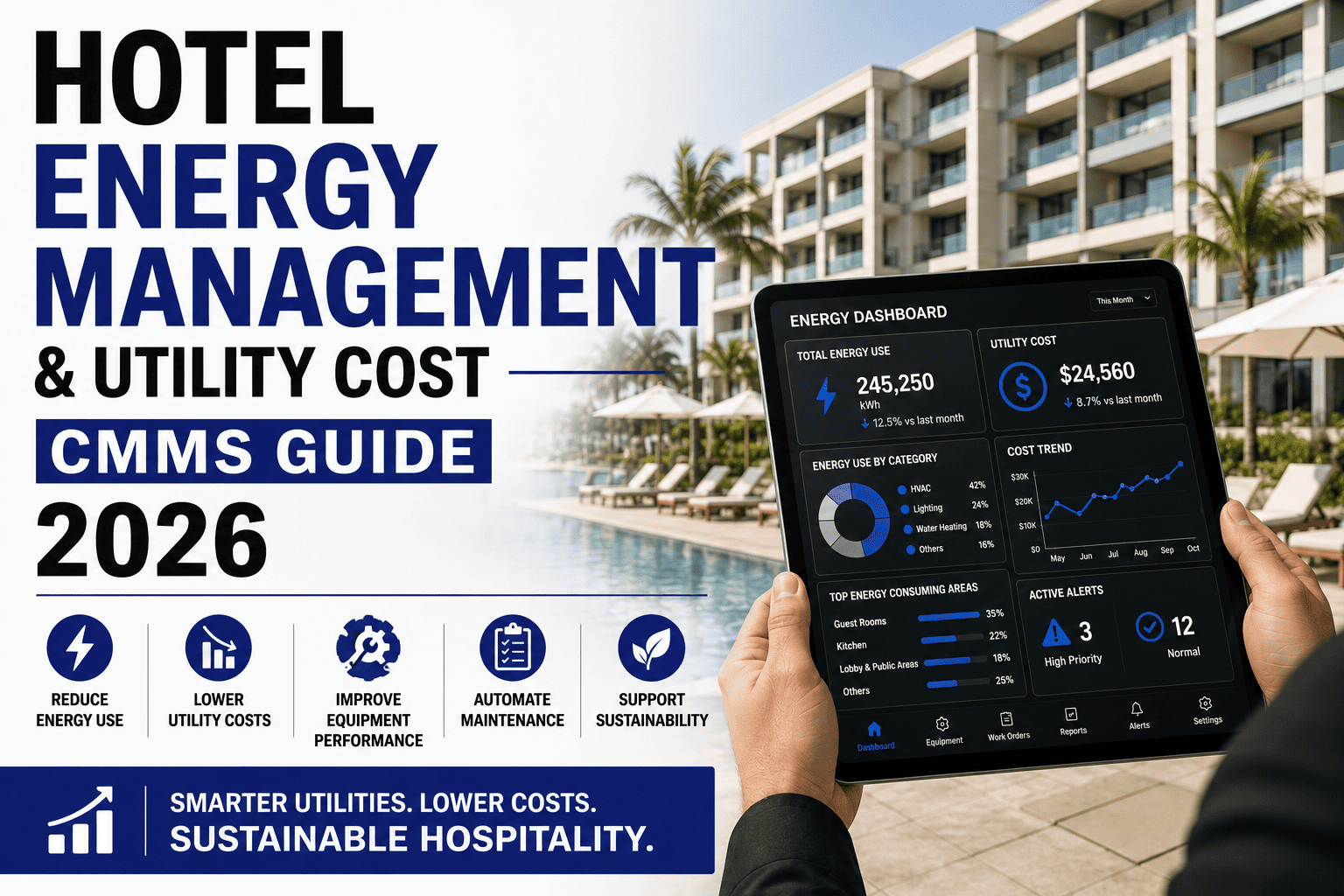
Energy is the second-largest hotel operating expense after labor, yet most general managers treat it as fixed rather than controllable. Outdated HVAC schedules, uncoordinated lighting, and guestrooms conditioned for guests who left hours ago quietly drain 20 to 30 percent of monthly utility spend. A modern CMMS closes that gap by tying occupancy data, sub-meter readings, and preventive maintenance into one utility cost KPI dashboard. Book a free demo to see the dashboard live, or keep reading for the five-phase program engineering teams use to stack savings into NOI.
HVAC
Heating, cooling, ventilation across guestrooms and public space
Water Heating
Domestic hot water, recirculation loops, boiler firing
Lighting
Corridors, parking, back-of-house fixtures running around the clock
Plug Loads
In-room electronics, mini-fridges, office equipment
Laundry, Kitchen & Pool
Elevators, laundry, kitchen equipment, pool pumping
The Hidden Third of Every HVAC Dollar
Within that 44 percent HVAC share, roughly a third is lost to simultaneous heating and cooling, stuck dampers, oversized fans running at constant speed, and guestrooms conditioned for occupancy that left the building hours earlier. Lighting waste typically traces back to ballast-era fixtures in corridors and parking structures that ignore daylight and traffic entirely. Water heating losses cluster around recirculation loops with no demand controls and boilers fired without combustion tuning. A CMMS-based energy program attacks each category with metered visibility and preventive maintenance triggers, converting invisible waste into a line item on the monthly utility reconciliation. Engineering directors who want granular visibility before committing capital typically start by sub-metering major loads, which is exactly where the five-phase program below begins.
$2,196
Avg. annual energy cost per guestroom
30%
Guestrooms conditioned while unoccupied
20–30%
Total utility reduction achievable in 12–18 months
The Five-Phase Hotel Energy Program
Permanent savings require sequence. Properties that jump straight to capital projects without metering and scheduling discipline routinely overspend on equipment yet still miss the operational savings that compound month over month. The program below has run across boutique, full-service, and resort portfolios, consistently delivering 20 to 30 percent utility reductions within 12 to 18 months — without a full mechanical system replacement. Ready to map this against your own property? Sign up free and start your baseline sub-metering plan.
01
Sub-Meter & Baseline
Install sub-meters on guestroom floors, kitchen, laundry, pool plant, and rooftop units. Tag every meter in the CMMS asset hierarchy so consumption data links directly to work orders. A 14-day baseline at 15-minute resolution reveals load profiles and phantom overnight draws that monthly bills hide.
02
Recommission BMS Schedules
Audit building management system schedules against real occupancy calendars and event bookings. Default factory schedules typically over-condition lobbies and meeting space by four to six hours a day — correcting this costs nothing but engineering time.
03
Deploy Guestroom Energy Management
Occupancy-based guestroom controls setback temperature and lighting once a room sits empty past a defined dwell time. Keycard, PIR, and door sensors feed the CMMS, which auto-generates a work order the moment a unit runs continuously without occupancy.
04
Optimize HVAC & Plant
Apply variable frequency drives to fans and pumps, reset chilled water temperature against outside air, tune boiler combustion, and clean coils on a CMMS-triggered cadence — each task carrying an estimated kWh recovery value.
05
Monitor KPIs & Sustain
Roll kWh per occupied room, therms per guest night, and cost per square foot into a live CMMS dashboard reviewed at the daily standup. Automated variance alerts catch drift within 24 hours, before it erodes savings back to baseline.
See Your Utility Cost Dashboard in Action
Watch how sub-meter data, occupancy signals, and preventive maintenance roll into one live KPI view. Our 30-minute demo walks through a real hotel energy program end to end.
What Each Initiative Actually Delivers
The single highest-impact initiative in the entire program is occupancy-based guestroom scheduling. Most properties still run every room on a static schedule regardless of whether a guest is present, checked out, or never arrived. Occupancy-linked controls close that gap automatically, and the difference shows up in the very next utility cycle — as the before-and-after comparison below shows.
Before: Static Schedule
Checkout to setbackNever — runs until next reset
Vacant room conditioningFull HVAC, full lighting
Failure visibilityNone until guest complains
Energy cost per room$2,196/year baseline
After: Occupancy-Linked CMMS
Checkout to setbackWithin 20 minutes
Vacant room conditioningSetback temp, lights off
Failure visibilityAuto work order within 24 hrs
Energy cost per room8–14% lower, same year
Not every initiative moves the needle equally. The ranges below reflect realized savings across 2025 hotel portfolio deployments, weather-normalized against pre-project baselines. Results vary by climate zone and building vintage, but this relative order holds consistently across property types.
1
Guestroom Occupancy Controls8–14%
Eliminates conditioning of unoccupied rooms — the single most common waste source in any hotel.
2
BMS Schedule Recommissioning5–10%
Corrects default factory schedules and accumulated overrides on lobby, corridor, and meeting space HVAC.
3
LED Conversion & Lighting Controls4–8%
Back-of-house and exterior LED with occupancy and daylight harvesting — fastest payback, often under 18 months.
4
HVAC Plant Optimization & PM3–7%
VFDs, chiller tuning, coil cleaning, and combustion calibration sustained through CMMS-triggered PM cadence.
Expert Perspective: Why Sequence Beats Capital Spend
Energy is the only hotel operating expense where the GM can write a check to the engineering team and get it back within fourteen months — yet most properties still run guestrooms at full condition for guests who checked out hours ago. The properties winning here aren't buying new equipment first; they're metering, scheduling, and sequencing what they already own.
Meter Before You Modernize
Capital projects without a sub-metered baseline routinely overspend on equipment while missing the operational savings sitting in plain sight.
Occupancy Data Is the Multiplier
Every phase after sub-metering compounds faster once BMS schedules and guestroom controls are tied to real PMS occupancy signals.
Sustain or Slide Back
Without a live KPI dashboard and variance alerts, savings drift back toward baseline within 18 months as overrides quietly accumulate.
Myths That Keep Engineering Budgets Stuck
Three assumptions come up in nearly every hotel energy audit, and all three hold budgets back from the highest-return work. Sign up free to see which myth is costing your property the most.
Myth
We need a full HVAC replacement to move the needle on energy spend.
Reality
Recommissioning schedules and deploying occupancy controls typically capture 12–18% savings at a fraction of replacement cost, often with payback under 14 months.
Myth
Guests complain when we setback temperature during unoccupied periods.
Reality
Properly tuned controls recover to setpoint within 8–12 minutes of occupancy detection. Complaint rates actually drop because rooms avoid manual thermostat overcorrection cycles.
Myth
Our BMS already handles scheduling, so a CMMS layer is redundant.
Reality
A BMS executes schedules; a CMMS verifies outcomes and triggers maintenance when they drift. Without it, BMS schedules silently degrade as overrides pile up unchecked.
Results Across Property Types
Every deployment below used the same five-phase sequence, adjusted for property size and vintage. Sign up free to model your own property's savings range against these benchmarks.
Full-Service Hotel
420-Room Urban Business Hotel
Recommissioned BMS schedules across 18 meeting rooms and lobby plant, deployed occupancy controls on every guestroom, and tuned two 500-ton chillers.
24% utility cost reduction in 11 months
Resort
280-Key Beachfront Resort
Sub-metered pool plant, laundry, and kitchen separately for the first time, uncovering pool heating and kitchen exhaust running 24/7 unnoticed.
$184K in annual energy savings
Select-Service
145-Room Extended-Stay Property
Converted all guestroom and corridor lighting to LED with occupancy controls, then replaced boiler recirculation with demand-controlled pumps.
31% lighting savings, 19% water heating savings
Getting Started Without a Capital Project
Implementing this program doesn't require rewiring the property or a mechanical replacement budget. Modern wireless sub-meters and occupancy sensors install in weeks, not months, and begin establishing a usable baseline almost immediately once tagged into the CMMS asset hierarchy.
For engineering directors ready to move from a fixed utility line item to a managed KPI, the sequence is straightforward: sub-meter the major loads, recommission BMS schedules against real occupancy, deploy guestroom controls, tune the plant, then sustain it all on a live dashboard. Book a free demo to see which phase would deliver the fastest payback for your property.
Stop Treating Energy as a Fixed Cost
Join hotels using OxMaint to turn sub-meter data, occupancy signals, and preventive maintenance into one live utility cost KPI dashboard — and permanent NOI gains.
Frequently Asked Questions
How much can a hotel realistically save on energy with a CMMS-based program?
Properties executing the full five-phase program — sub-metering, BMS recommissioning, guestroom occupancy controls, HVAC optimization, and sustained KPI monitoring — typically capture 20 to 30 percent utility cost reductions within 12 to 18 months. Guestroom occupancy controls alone often deliver 8 to 14 percent, making them the highest-impact single initiative for most properties.
Do we need to replace our HVAC system to see meaningful savings?
No. Most hotels capture the majority of available savings through operational and controls improvements — recommissioning BMS schedules, deploying occupancy-based setbacks, tuning existing plant, and enforcing energy-tagged preventive maintenance. Full HVAC replacement is typically justified only after these measures are exhausted and equipment reaches end of useful life.
How is a CMMS different from the building management system we already have?
A BMS executes control sequences and schedules; a CMMS verifies outcomes, manages maintenance workflow, and ties consumption to cost. The CMMS layer catches schedule drift, sensor failures, and maintenance gaps a BMS cannot self-diagnose, and connects energy data to work orders and financial reporting the BMS was never designed to handle.
Will occupancy-based guestroom controls increase guest complaints?
Properly tuned systems actually reduce complaints. Rooms recover to setpoint within 8 to 12 minutes of occupancy detection, eliminating the overcooling and overheating cycles caused by manual thermostat manipulation. Portfolio data shows complaint rates drop 15 to 25 percent after deployment when setback temperatures stay within a comfortable band.
How long does it take to deploy a hotel energy management CMMS?
A typical 200 to 400-room property completes sub-meter integration, BMS schedule recommissioning, and CMMS dashboard configuration within 6 to 10 weeks. Guestroom occupancy control deployment scales with room count and usually runs concurrent with the software rollout, with first measurable savings appearing on the utility bill within 60 days of go-live.

-and-cmms-integration.png)

