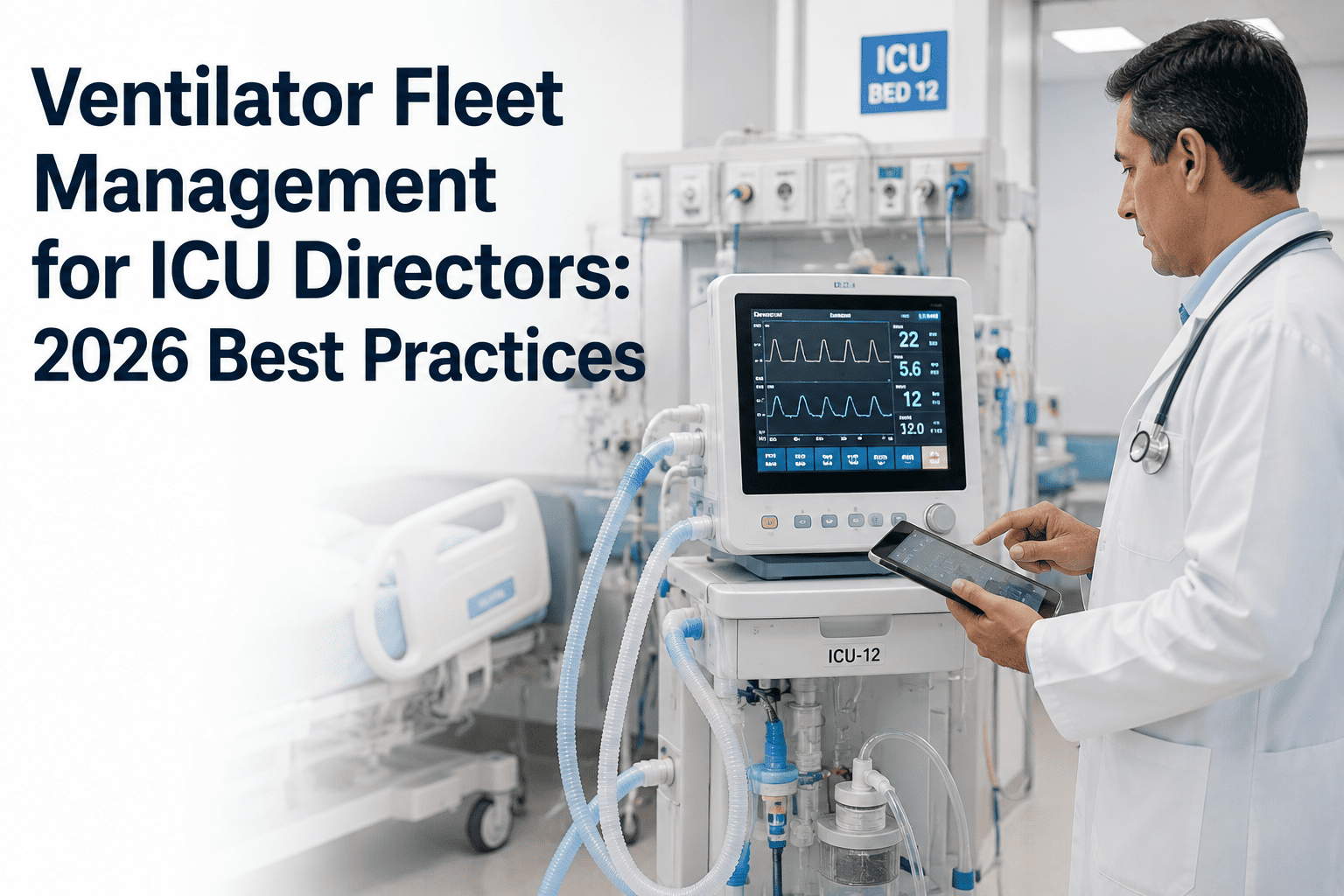
An ICU director managing a ventilator fleet of 40, 80, or 200 units faces a maintenance challenge that has no equivalent elsewhere in hospital operations — equipment that must be clinically ready at any moment, calibrated to precise specifications, and fully documented for Joint Commission review, while simultaneously being surge-deployable within hours during a mass casualty event or respiratory illness wave. The 2026 ventilator fleet management challenge is not procurement — most ICUs have adequate unit counts post-pandemic. The challenge is maintaining calibration compliance, managing preventive maintenance across diverse OEM models with different PM intervals, and building the spare-unit and rapid-deployment strategy that ensures no patient waits for a ventilator because a unit is out of service for unplanned repair. See how Oxmaint manages ventilator fleet PM compliance and calibration tracking for ICU teams.
Blog · ICU Equipment Management · Ventilator Fleet · 2026
Ventilator Fleet Management for ICU Directors: 2026 Best Practices
Calibration cycles, surge capacity planning, spare unit strategy, and CMMS-tracked compliance — the complete operational playbook for ICU directors managing multi-model ventilator fleets in 2026.
ICU Ventilator Fleet — Live Status
Draeger Evita V800
Cal: 91 days
Puritan Bennett 980
Cal: 12 days
Maquet Servo-i
Overdue — WO Open
The 2026 ICU Ventilator Fleet Challenge — By the Numbers
34%
Of hospital ventilators have at least one overdue PM at any given time — AAMI biomedical survey 2024
6 models
Average number of different ventilator models in a 300-bed ICU fleet — each with different PM intervals and calibration requirements
72 hrs
Maximum acceptable surge deployment time for ventilator reserve units per CMS emergency preparedness standards
$8,200
Average cost of an unplanned ventilator repair vs $420 for the equivalent planned PM — ECRI benchmarks
Ventilator PM Schedule — By Component and Model Class
Ventilator PM intervals are not uniform across OEM models, and managing a multi-model fleet on a single generic PM schedule creates compliance gaps that surface during Joint Commission surveys. The framework below organizes PM by component class with model-specific interval notes.
| Component / Task |
Typical Interval |
Model Variation |
Calibration Required |
Joint Commission Relevance |
| Flow sensor calibration |
Every 6 months |
Hamilton: 6 mo · Draeger: 12 mo · PB: 6 mo |
Yes — traceable to NIST standard |
EC.02.04.01 — medical equipment PM compliance |
| Pressure sensor calibration |
Every 6–12 months |
Per OEM service manual — varies by sensor type |
Yes — ±2 cmH₂O accuracy required |
Direct patient safety impact — calibration record required |
| Exhalation valve and membrane |
Every 12 months or 5,000 hrs |
High-use ICU units may trigger at hours, not calendar |
No — replacement and function test |
Failure causes PEEP loss — PM record supports RCA if event occurs |
| Internal filters (inlet and bacterial) |
Every 6 months or per contamination |
COVID/respiratory season may require quarterly |
No — visual + replacement |
Infection control documentation — IPCP review |
| Battery backup test and replacement |
Test: annual · Replace: 2–3 years |
Per OEM specification; transport models: 18 mo |
No — load test to spec runtime |
Emergency management — EC.02.01.01 |
| Safety alarm function test |
Every 6 months |
All models — required by AAMI standards |
No — functional test with pass/fail record |
NPSG.06.01.01 — alarm management compliance |
| Full performance verification (EPM) |
Annual |
Annual for all critical care ventilators |
Yes — full parameter set per OEM spec sheet |
Primary PM compliance document for Joint Commission |
| Software / firmware update check |
Per OEM release schedule |
Varies — some OEMs release quarterly |
No — version log + installation record |
FDA 21 CFR 820 software change documentation |
Track Every Ventilator PM and Calibration Across Your Entire Fleet
Oxmaint registers each ventilator as an individual asset with model-specific PM intervals, calibration due dates, and Joint Commission documentation — all visible in one fleet dashboard for ICU directors and biomed teams.
Surge Capacity Strategy — The 3-Tier Ventilator Reserve Model
CMS emergency preparedness regulations and Joint Commission EC.02.01.01 require hospitals to demonstrate surge capacity for critical equipment. For ventilators, the standard framework is a three-tier reserve model that ensures deployable units are always available within defined response windows.
Unit count: 10–15% of licensed ICU beds — fully set up and PM-current in dedicated storage
PM status required: Current calibration, full EPM within 90 days, battery fully charged, circuits installed
CMMS management: Oxmaint tags each Tier 1 unit with "Surge Reserve — Immediate" status. PM compliance is monitored separately with shorter alert thresholds than in-service units
Unit count: Additional 15–20% of ICU capacity — stored in central biomed or warehouse with circuits separate
PM status required: Annual EPM current, calibration current — circuit and patient interface require pre-deployment setup
CMMS management: Separate PM schedule from in-service units; biomed receives 30-day advance alert before any Tier 2 unit's EPM or calibration expires
Unit count: Mutual aid agreements, state stockpile access, or vendor emergency loan programs — not hospital-owned
PM status required: Incoming units from external sources require rapid acceptance testing and safety check before patient use
CMMS management: Oxmaint supports temporary asset registration for incoming loaned units — acceptance test work orders generated on receipt, units tracked through return
Multi-Model Fleet Management — The CMMS Asset Hierarchy
Managing six or more ventilator models under a single PM program requires an asset hierarchy that enforces model-specific PM intervals without creating separate tracking systems for each model. Oxmaint solves this with a parent-child asset structure that applies model-specific templates automatically.
Ventilator Fleet — ICU Portfolio
Draeger Evita V800 (14 units)
PM Template: Draeger — 12-mo EPM · 12-mo calibration · 6-mo filter
PB 980 Series (18 units)
PM Template: Covidien — 6-mo flow cal · 12-mo EPM · 6-mo alarm test
Hamilton G5 / G3 (9 units)
PM Template: Hamilton — 6-mo calibration · 12-mo EPM · battery annual
Transport / MRI-Compatible (8 units)
PM Template: Transport class — 18-mo battery · 6-mo EPM · quarterly alarm
Expert Review
SC
"After the 2020 surge events, every ICU director I know was doing ad hoc inventory counts to figure out what they actually had, what was calibrated, and what was deployable. The answer was almost always worse than expected — not because units were missing, but because calibration records were in four different places and nobody had a current status view. The ICUs that recovered fastest were the ones with a CMMS that gave biomed and clinical leadership the same real-time view of every unit's PM status, location, and readiness. That visibility is the surge plan, not the number of units you own."
Sandra Chen, RRT, CCFP
Critical Care Fleet Program Director · Academic Medical Center · Former ICU Respiratory Therapy Director · 19 years in critical care equipment management
Frequently Asked Questions
How does Oxmaint handle different PM intervals for multiple ventilator models in the same ICU fleet?
Oxmaint uses model-specific PM templates that are applied at the individual serial number level. A PB 980 with a 6-month flow calibration interval and a Draeger Evita with a 12-month interval are each tracked against their own schedule — both appear in the fleet dashboard but generate PM work orders on their respective timelines. When you add a new unit to the fleet, selecting its model class automatically assigns the correct template. Biomed supervisors see a unified compliance rate across all models, while individual work orders are model-specific.
Configure your ventilator fleet templates in Oxmaint's free trial.
What documentation does Oxmaint generate for Joint Commission ventilator PM compliance review?
Oxmaint generates per-unit PM compliance reports showing each completed PM work order with task detail, technician name, completion date, and calibration test results. For Joint Commission EC.02.04.01 surveys, the system exports a fleet-wide PM compliance summary showing the percentage of units with current EPM, calibration dates, and any overdue items with the overdue duration. Calibration records include the as-found and as-left values required for traceability. These reports can be pulled in under 5 minutes for any date range the surveyor requests.
Book a demo to see the Joint Commission compliance report format.
How should surge reserve ventilators be maintained differently from in-service units in a CMMS?
Surge reserve units require the same PM and calibration compliance as in-service units — in fact, CMS emergency preparedness standards require that reserve units be maintained in deploy-ready condition, which means current EPM and calibration are non-negotiable. The difference in CMMS management is alert timing: reserve units should generate PM due alerts 45–60 days before the due date rather than the standard 30 days, because mobilizing a reserve unit for PM while maintaining surge readiness requires more lead time to coordinate. Oxmaint allows different alert thresholds per asset status group, so reserve units automatically get earlier warnings than in-service units.
ICU Equipment Management Platform
Every Ventilator. Every Calibration Due Date. Every Surge Unit's Readiness Status — In One Dashboard.
Oxmaint gives ICU directors and biomed teams the real-time fleet visibility, model-specific PM scheduling, and Joint Commission documentation that ventilator fleet management requires in 2026.