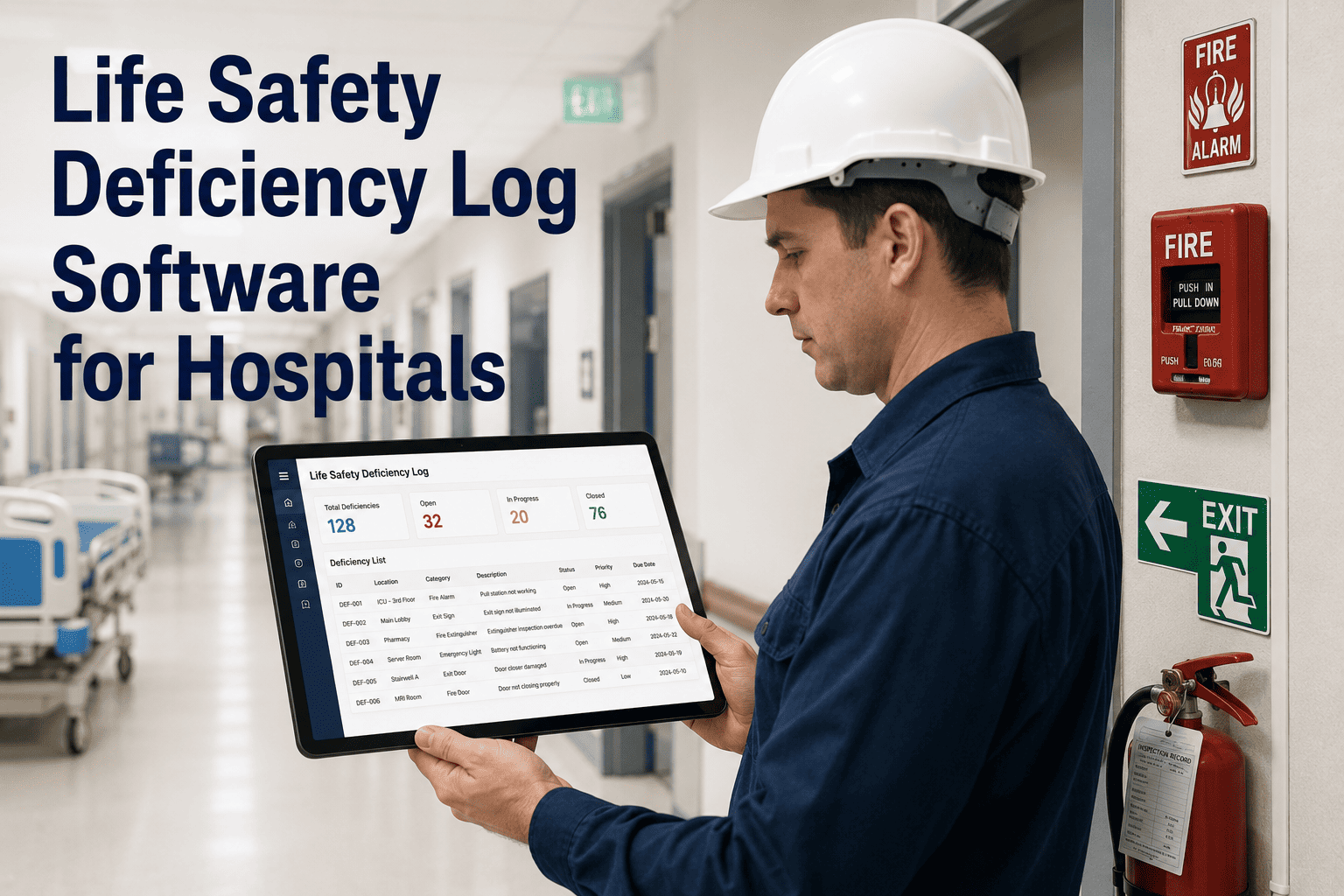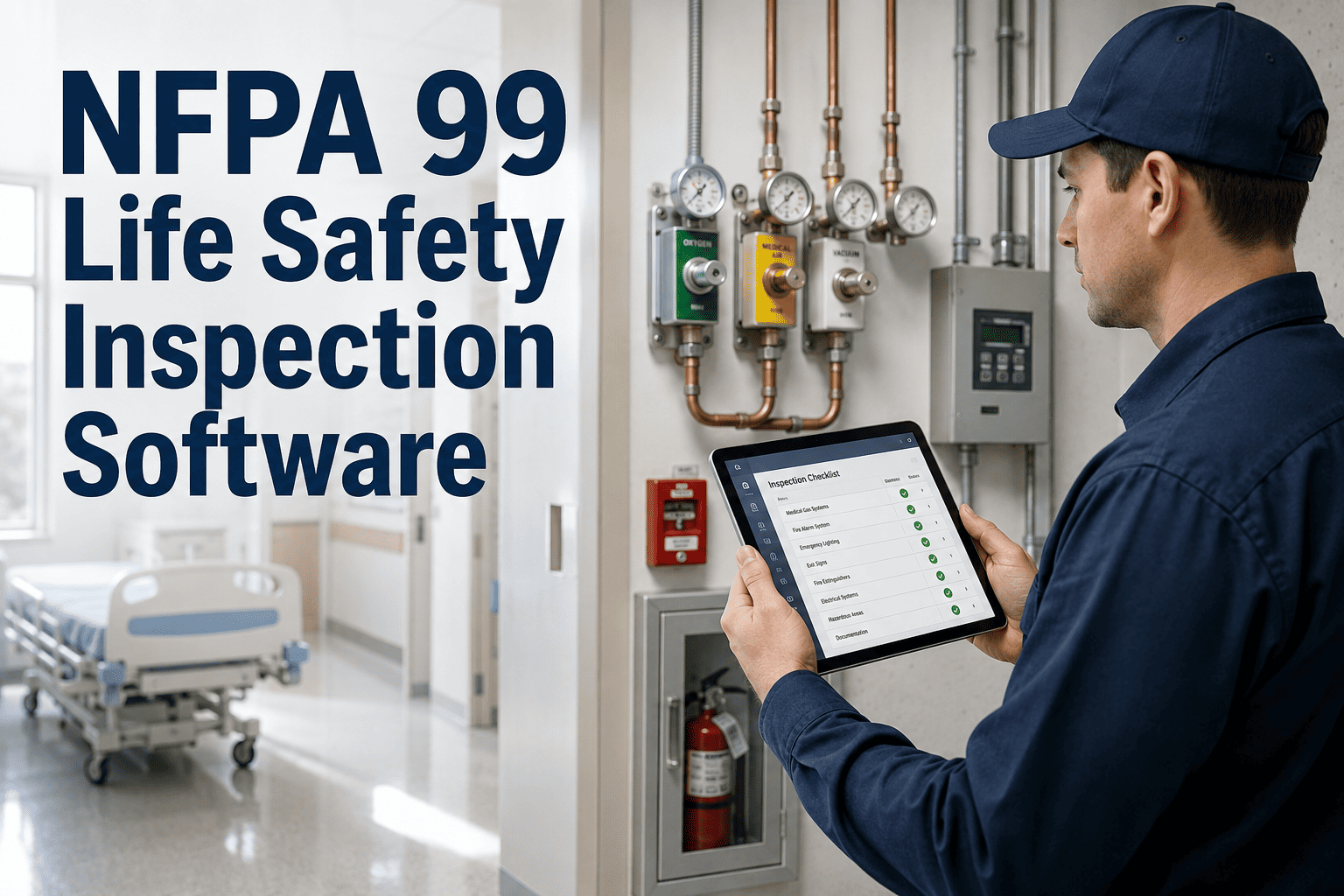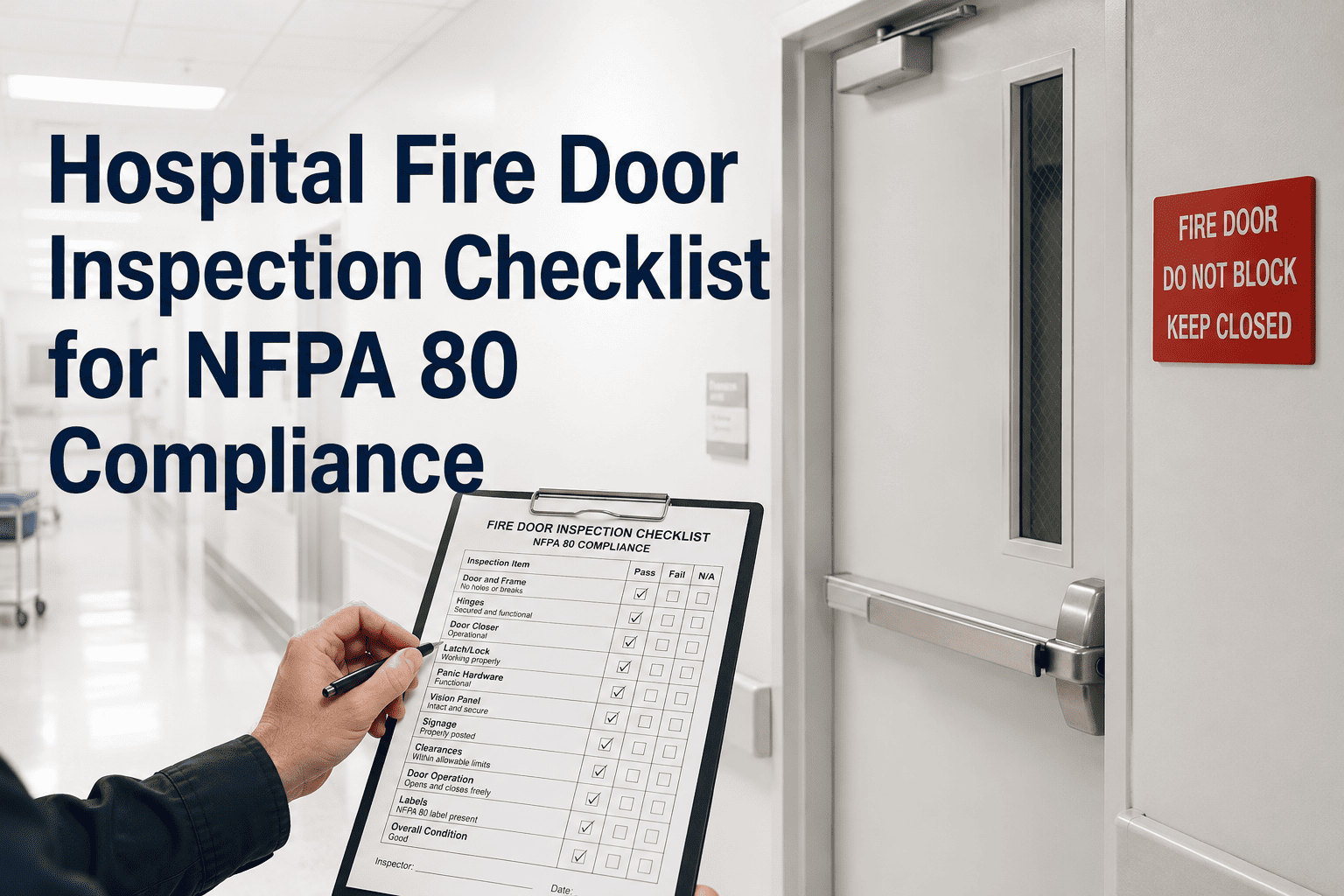
Hospitals face annual Joint Commission and authority-having-jurisdiction (AHJ) surveys where a single improperly maintained fire door can trigger a citation, a Plan of Correction, and — in worst cases — conditional accreditation. NFPA 80 (Standard for Fire Doors and Other Opening Protectives) mandates annual inspection and testing of every fire door assembly in a healthcare facility. This checklist gives biomedical and facility teams a structured, CMMS-ready inspection framework that satisfies NFPA 80 Section 5.2 and TJC Environment of Care standard EC.02.03.05. Start logging inspections free on Oxmaint or book a demo to see the compliance dashboard.
Hospital Fire Door Annual Inspection Checklist
NFPA 80 Section 5.2 compliant — clearances, hardware, closers, smoke seals, signage, and CMMS documentation fields. Built for biomedical and facilities teams.
Why Hospital Fire Door Compliance Fails
Fire door deficiencies are the most cited Environment of Care finding in Joint Commission surveys — not because hospitals lack doors, but because inspection programmes are paper-based, incomplete, and disconnected from corrective work orders. The four failure patterns below account for over 80% of cited deficiencies.
NFPA 80 Annual Inspection Checklist
Complete this checklist for every fire door assembly in the facility. Each item maps to a specific NFPA 80 section. Mark Pass, Fail, or N/A. Any Fail requires a corrective work order generated on the same day of inspection.
| Item | NFPA 80 Ref | Inspection Criteria | Result |
|---|---|---|---|
| A-01 | 5.2.1.2 | Door leaf free from holes, breaks, or damage to the door face | PassFail |
| A-02 | 5.2.1.2 | Frame free from distortion, gaps, or separation from wall | PassFail |
| A-03 | 5.2.1.3.1 | Door label (UL or FM) legible and present on door edge or frame | PassFail |
| A-04 | 5.2.1.4 | No field modifications (holes, cutouts) not in original listing | PassFail |
| A-05 | 5.2.1.5 | Vision panel (if present) is fire-rated glazing with intact label | PassFailN/A |
| Item | NFPA 80 Ref | Inspection Criteria | Result |
|---|---|---|---|
| B-01 | 5.2.1.7.1 | Clearance at door bottom: ≤ 3/4 inch (non-corridor) or per AHJ | PassFail |
| B-02 | 5.2.1.7.1 | Clearance at top and sides: ≤ 1/8 inch | PassFail |
| B-03 | 5.2.1.7.2 | Meeting edge clearance (pairs): ≤ 1/8 inch | PassFailN/A |
| Item | NFPA 80 Ref | Inspection Criteria | Result |
|---|---|---|---|
| C-01 | 5.2.1.8 | Door closer present and operational (self-closing function confirmed) | PassFail |
| C-02 | 5.2.1.8 | Door closes fully from 90° open — no manual assist required | PassFail |
| C-03 | 5.2.1.8 | Magnetic hold-open (if installed) releases on smoke/fire alarm signal | PassFailN/A |
| C-04 | 5.2.1.9 | Door latches fully on closure — latch bolt engages strike plate | PassFail |
| Item | NFPA 80 Ref | Inspection Criteria | Result |
|---|---|---|---|
| D-01 | 5.2.1.6 | Smoke seal / intumescent strip intact around full perimeter | PassFail |
| D-02 | 5.2.1.6 | No visible gaps, compressions, or missing sections of gasketing | PassFail |
| D-03 | 5.2.1.6 | Door bottom sweep or threshold seal (where required) intact | PassFailN/A |
| Item | NFPA 80 Ref | Inspection Criteria | Result |
|---|---|---|---|
| E-01 | 5.2.1.10 | Hinges — all present, no missing screws, no play in leaves | PassFail |
| E-02 | 5.2.1.10 | Flush bolts (pairs) engage properly into top/bottom strike | PassFailN/A |
| E-03 | 5.2.1.11 | Coordinator (for pairs) sequences active and inactive leaves correctly | PassFailN/A |
| E-04 | 5.2.1.12 | No impediments — wedges, door stops, equipment blocking path of closure | PassFail |
Oxmaint lets you run this checklist on a mobile device, auto-generate corrective work orders for failed items, and produce a timestamped inspection log for your next TJC survey — no paper, no spreadsheets.
Deficiency Classification and Response Times
Not all fire door deficiencies carry the same risk. This classification matrix — based on NFPA 80 and TJC life safety guidance — helps facilities triage corrective work orders by severity so high-risk deficiencies receive immediate response while lower-risk items are tracked to scheduled completion.
| Severity | Deficiency Type | Example Findings | Required Response | Interim Measure |
|---|---|---|---|---|
| Critical | Door cannot close or latch | Failed closer, missing latch, wedged open | Same day correction or 24-hr ILSM | Post staff fire watch at door |
| High | Label missing or defaced | No UL label visible, label painted over | Within 30 days — AHJ verification | Document door listing from original specs |
| High | Smoke seal damaged or missing | Gasket missing, large gap at frame | Within 30 days | Interim seal tape pending repair |
| Moderate | Clearance out of tolerance | Bottom gap over 3/4 inch | Within 60 days | Interim fire watch log for area |
| Low | Hardware cosmetic / minor | Missing screw in hinge, paint on closer | Next scheduled PM cycle | Log in CMMS for tracking |
CMMS Documentation Requirements Under NFPA 80
NFPA 80 Section 5.2.3 specifies that inspection records must be maintained and available to the authority having jurisdiction on request. TJC surveyors commonly request 12–24 months of fire door inspection records during Environment of Care review. The fields below are the minimum required for a defensible, compliant inspection record.
Expert Review
The most expensive fire door compliance mistake I see facilities make is conflating a fire door walk-through with an NFPA 80 annual inspection. Walking a corridor and eyeballing doors is not an inspection — it produces no defensible record, no per-item pass/fail, and no corrective work order trail. When TJC surveyors ask for your fire door programme, they want a complete asset list, a dated inspection record for every door, and an open deficiency log showing current status of any failed items. The shift to CMMS-based inspection — where each door has its own digital inspection record tied to corrective work orders — is the single change that most consistently eliminates TJC EC findings in hospitals I have worked with.
Fire door clearances are a frequently overlooked failure point — specifically the 1/8 inch maximum at the top and sides. That tolerance exists because smoke migrates through surprisingly small gaps during a fire event, and the gap that looks minor in a routine walk becomes a compartmentation failure when lives depend on the door. The same applies to smoke gaskets — a compressed or missing gasket at the latch edge effectively creates an open air path. Every hospital I consult for sees at least a 30% reduction in fire door deficiencies within 12 months of implementing a systematic, CMMS-driven annual inspection programme where findings generate same-day work orders rather than going on a to-do list.
Run Your Fire Door Inspections in Oxmaint — TJC-Ready Records Automatically
Oxmaint's mobile inspection app guides your team through this checklist door by door, auto-generates corrective work orders for any failed item, and maintains a complete, timestamped inspection log that surveyors can review on the day of survey. Most hospitals complete their first digital inspection round within 2 weeks of setup.