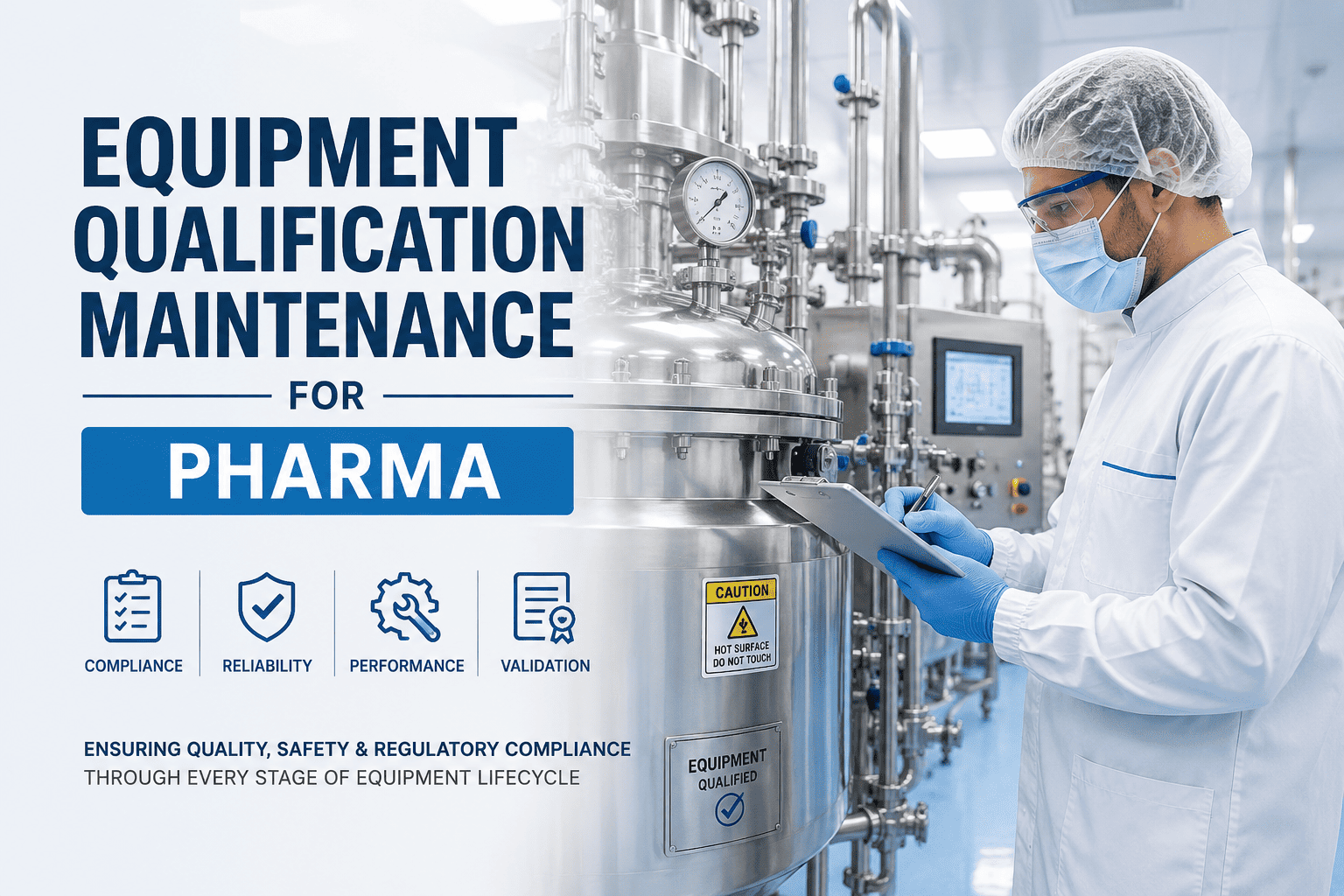
Equipment qualification in a pharma facility is not a one-time event — it is a lifecycle state that must be actively maintained through preventive maintenance, calibration, change control, and periodic requalification. The most common FDA 483 observation in pharmaceutical manufacturing is not failure to qualify equipment originally, but failure to demonstrate the equipment remained in its qualified state between inspections. A single out-of-tolerance calibration, an unevaluated maintenance event, or a gasket replacement that was never assessed for qualification impact is enough to invalidate years of validated production. Oxmaint's GMP qualification module links every PM, calibration, change control event, and requalification trigger into a single auditable workflow — so the qualified state is maintained continuously, not reconstructed under inspection pressure.
Equipment Qualification Maintenance for Pharma — PM, Calibration, Change Control & Requalification in One CMMS Workflow
A practical guide for QA, validation, and maintenance teams on how to keep equipment in its qualified state across IQ, OQ, PQ — and the requalification triggers that demand structured CMMS-driven response.
The Qualified State — and Why It Decays Without a CMMS
A piece of pharmaceutical equipment enters its qualified state at the moment IQ, OQ, and PQ are signed by Quality. From that moment, every maintenance event, every calibration, and every component change is either evidence that the qualified state is preserved — or evidence that it has been broken. Without a CMMS workflow linking these events, the qualified state slowly decays in the background until an FDA investigator asks for the trail.
The Four Pillars That Maintain the Qualified State
Preventive Maintenance Linked to Qualification
Every PM task on qualified equipment must be tied to the function it preserves. A gasket replacement on an autoclave door is not a routine PM — it is a maintenance event that potentially affects the sterilization performance verified during PQ. PM qualification linkage in the CMMS captures the qualification impact at the time of task definition, not retroactively.
Calibration — Tolerance & Impact Assessment
An out-of-tolerance calibration is the single most common trigger for retroactive batch review. The CMMS must capture as-found and as-left values, route OOT findings into a quality impact assessment workflow, and link the calibration record to every batch produced since the last in-tolerance reading. Calibration-to-batch traceability is the difference between a contained deviation and a 30-batch recall.
Change Control with Qualification Impact
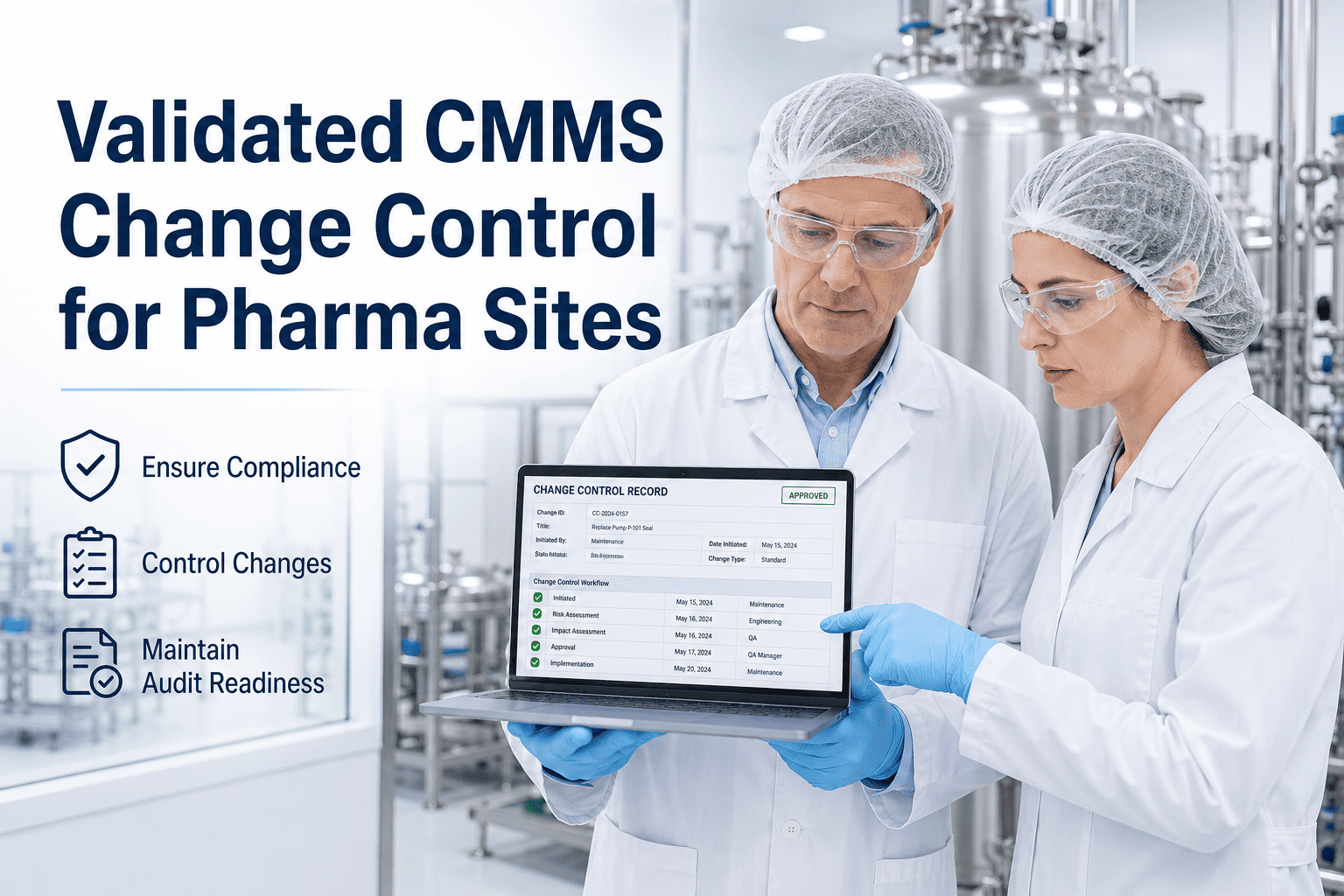
Every maintenance event that modifies a component, parameter, or location of qualified equipment must trigger a qualification impact assessment before the change is executed — not after. The assessment determines whether the change is like-for-like (no qualification impact), partial requalification, or full requalification. CMMS-driven change control closes the gap where repairs reinstate production without QA visibility.
Periodic Requalification
EU GMP Annex 15 and FDA process validation guidance establish a risk-based requalification frequency: annually for critical equipment, every 2–3 years for major equipment, and every 3–5 years for minor equipment. Requalification work orders must be generated 90 days before expiry, with pre-defined scope and acceptance criteria locked at protocol approval. Trigger-driven requalification prevents the gap where production continues on overdue qualification.
Requalification Trigger Matrix — When the CMMS Must Act
A defensible requalification programme is built on a pre-approved trigger matrix that defines the scope of requalification for each type of event. The matrix below reflects EU GMP Annex 15 and FDA expectations — and is the structure Oxmaint enforces automatically when a maintenance, calibration, or change control event occurs.
| Trigger Event | Example | Requalification Scope | Pre-Approved Protocol Lock |
|---|---|---|---|
| Critical component replacement | Tablet press turret, autoclave door gasket, HVAC HEPA filter | Full OQ + PQ | At protocol approval — before test execution |
| Equipment relocation | Move from Suite A to Suite B, even within same facility | Full IQ + OQ + PQ | Before equipment is reconnected to utilities |
| Out-of-tolerance calibration | Temperature probe drift on lyophiliser shelf reading | Partial OQ on affected parameter | After impact assessment, before re-release |
| Software update / firmware change | PLC firmware upgrade on filling line, HMI version change | OQ + PQ per GAMP 5 category | Before update is installed in production environment |
| Major maintenance | Chamber refurbishment, motor replacement, pump rebuild | Risk-based scope per matrix | At work order creation, before execution |
| Periodic — risk-based | Critical equipment annual; major 2–3 yr; minor 3–5 yr | Per qualification master plan | 90 days before due date — auto WO |
| Repeated deviation pattern | 3+ deviations on same equipment within 12 months | Targeted requalification on failure mode | Triggered at 3rd deviation per CAPA SOP |
Stop Reconstructing the Qualification Trail Under Inspection Pressure
Oxmaint links every PM, calibration, change control, and requalification event into one auditable workflow — so when FDA asks for the qualification lifecycle of your tableting line, the answer takes 20 minutes, not 3 weeks.
CMMS Workflow — How a Maintenance Event Preserves Qualification
The structural difference between a paper-based qualification programme and a CMMS-enforced one is what happens between the moment a work order is created and the moment equipment is returned to production. Each step below is a control point where the qualified state is either preserved or quietly broken.
Equipment Qualification Status — KPIs That Matter
Qualified Equipment Coverage
Percentage of GMP-critical equipment with current IQ/OQ/PQ records on file. Below 100% is an immediate FDA exposure point.
Overdue Requalifications
Number of qualified assets past their requalification due date. Any non-zero value requires interim production restriction or batch review.
PM Compliance — Qualified Assets
On-time PM completion rate on equipment in qualified state. Sustained PM compliance below 95% triggers QA review of qualification status.
OOT Calibration Rate
Out-of-tolerance findings as a percentage of total calibrations. Rising trend indicates extended calibration intervals beyond instrument capability.
Change Control Pre-Approval
Percentage of changes to qualified equipment with QA approval before execution. Any post-hoc approval is a Part 11 / data integrity exposure.
Audit Package Retrieval Time
Time to assemble full qualification lifecycle package for a single asset on FDA request. Paper-based programmes average 3 weeks; CMMS under 20 minutes.
The most consistent qualification finding I issued as an FDA investigator was not a failure to test — it was acceptance criteria filled in after results were known, in the same ink and same handwriting as the result itself. The investigator cannot distinguish pre-defined acceptance from post-hoc rationalisation, and Part 11 does not give the company the benefit of the doubt. The failure mode is entirely structural: if the protocol is not approved before testing begins, the integrity of the acceptance criteria is compromised. CMMS-enforced qualification workflows that lock acceptance criteria at protocol approval and block test execution until that approval is timestamped solve this entire category of finding. The shift from paper qualification binders to a CMMS-driven qualification lifecycle is the single change that most reduces 483 exposure on inspection.
Frequently Asked Questions
The Qualified State Is Continuous. Your CMMS Should Be Too.
Stop maintaining qualification in spreadsheets, paper binders, and disconnected calibration files. Oxmaint links every PM, calibration, change control, and requalification trigger into one auditable workflow — keeping qualified equipment in its qualified state continuously, not retroactively under inspection pressure.