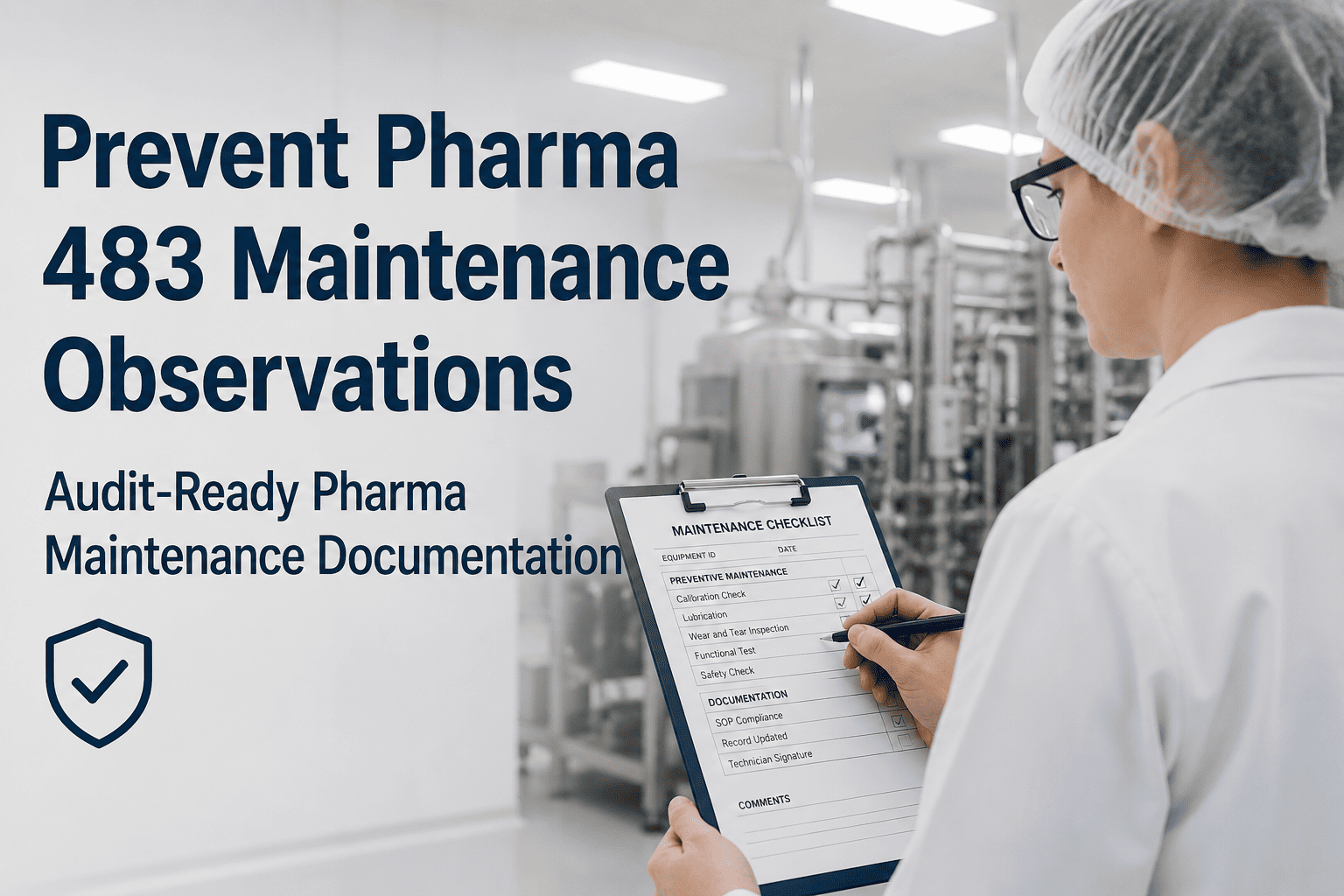
An FDA Form 483 observation related to maintenance is not just a documentation problem — it is a signal that your quality management system has a structural gap. Maintenance-related 483 observations are among the most cited in pharmaceutical inspections, and they carry real consequences: warning letters, import alerts, consent decrees, and production shutdowns. The good news is that the vast majority of maintenance 483 findings are preventable — not through better intentions, but through better systems. OxMaint's pharma CMMS closes the specific gaps that generate maintenance 483 observations before inspectors arrive.
How to Prevent FDA 483 Observations Caused by Maintenance Failures
A practical breakdown of the most common maintenance-related 483 observations in pharma — what triggers them, what they cost, and exactly how to eliminate them with the right CMMS configuration.
The 6 Most Common Maintenance-Related 483 Observations
These observation types appear repeatedly in FDA warning letters and inspection reports across pharmaceutical manufacturing sites globally. Each one has a specific documentation or process root cause — and each one is directly addressable with a structured digital CMMS.
The PM was completed, but it was 30, 60, or 90 days late. No investigation was conducted. No assessment of impact on batches produced during the gap was documented. This is a § 211.67 finding and a data integrity concern.
Calibration certificates present but do not include the out-of-tolerance readings found before adjustment, the calibration standard lot number used, or the measured values for each parameter. Partial records are treated the same as missing records.
The inspector requests the full maintenance history for a specific blender, reactor, or filling line — and the records take hours or days to locate, or cannot be found at all. Even if the work was done, retrieval failure is a critical finding.
When a contamination deviation is investigated, the cleaning records for the equipment involved cannot be tied to the specific batches produced before the contaminated batch. The investigation is therefore inconclusive and the finding remains open.
The maintenance log shows a technician completed a critical equipment overhaul, but no training record confirms that technician was qualified for that specific procedure. Personnel qualification is a GMP requirement for maintenance roles.
Maintenance was performed, but the work order contains only a description of what was done — not a reference to an approved written procedure. GMP requires all maintenance activities to follow written procedures, not improvised steps.
Stop Repeating the Same 483 Observations. Build the System That Prevents Them.
OxMaint addresses every maintenance-related 483 observation type through structural enforcement — not reminders, not checklists, but system-level controls that make compliant record-keeping the only way to complete a work order. See a demonstration built around your specific equipment types and observation history.
483 Observation Data: Maintenance Finding Frequency by Sector
Based on FDA inspection outcome data and industry compliance reports, maintenance-related observations appear at the following rates across pharmaceutical manufacturing categories. Understanding your segment's risk profile helps prioritize where to close gaps first.
| Manufacturing Segment | Maintenance 483 Rate | Top Observation Type | Most Common Regulation Cited |
|---|---|---|---|
| Solid dose (tablets, capsules) | 41% of inspections | PM overdue — no deviation | 21 CFR § 211.67 |
| Sterile injectables | 57% of inspections | Environmental monitoring equipment calibration gaps | 21 CFR § 211.68 |
| API manufacturing | 48% of inspections | Equipment cleaning record incomplete | 21 CFR § 211.67(b) |
| Biotech / biologics | 52% of inspections | Calibration out-of-tolerance findings not investigated | 21 CFR § 211.68 |
| Contract manufacturing | 39% of inspections | Maintenance records not available on request | 21 CFR § 211.180 |
Why Deviation Linkage Is Critical to 483 Prevention
One of the most underappreciated 483 risk areas is the failure to connect equipment maintenance history with product quality deviations. When a deviation is investigated and the root cause involves equipment — a miscalibrated instrument, a degraded seal, or a missed PM — the investigation file must be able to demonstrate that the maintenance history was reviewed and that any relevant maintenance events were evaluated as contributing factors.
In OxMaint, all three records — maintenance event, calibration event, and deviation — are linked to the same equipment asset. An investigator can view the complete timeline for any asset with a single click during the investigation or the inspection.
"483 observations related to maintenance are almost always preventable. I have never seen a case where the observation was caused by a lack of effort from the maintenance team. The root cause is always structural — the system allowed an incomplete record to be submitted, a PM to slip past its due date without escalation, or a deviation to be investigated without access to the relevant maintenance history. A CMMS that enforces completion at the point of execution closes all three of these gaps at once. That is the difference between a site that gets the same 483 five inspections in a row and one that closes the finding permanently."
— GMP Compliance Director, pharmaceutical manufacturing, 25 years of FDA inspection experience
Frequently Asked Questions
483 Observations Are Easier to Prevent Than to Remediate. Start Now.
Every maintenance 483 observation your site receives represents a documentation gap that existed before the inspector walked in. OxMaint closes those gaps at the system level — enforcing complete records, preventing PM slippage, and linking maintenance history to deviations automatically. Book a 30-minute demo and see the prevention system built for pharma compliance.