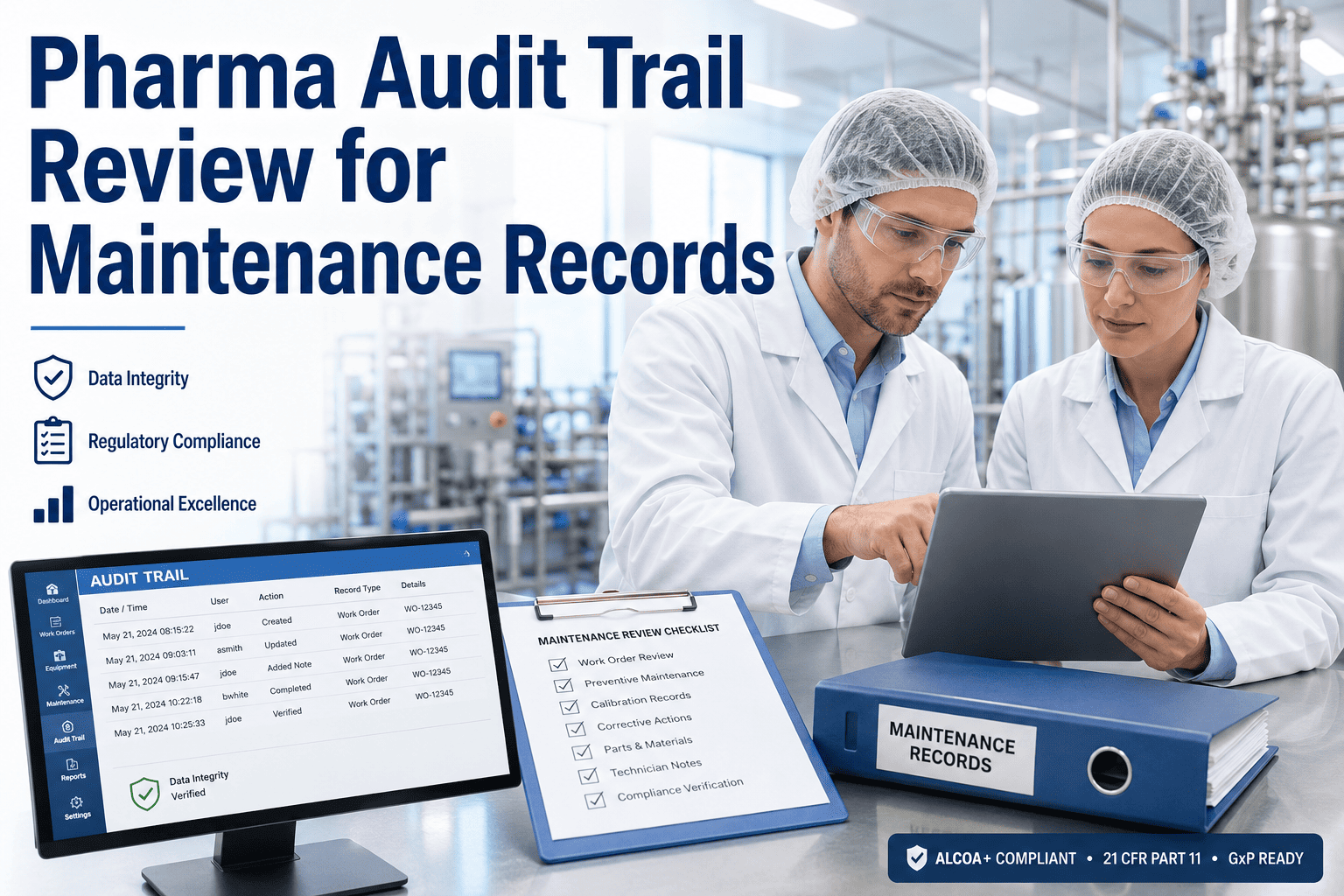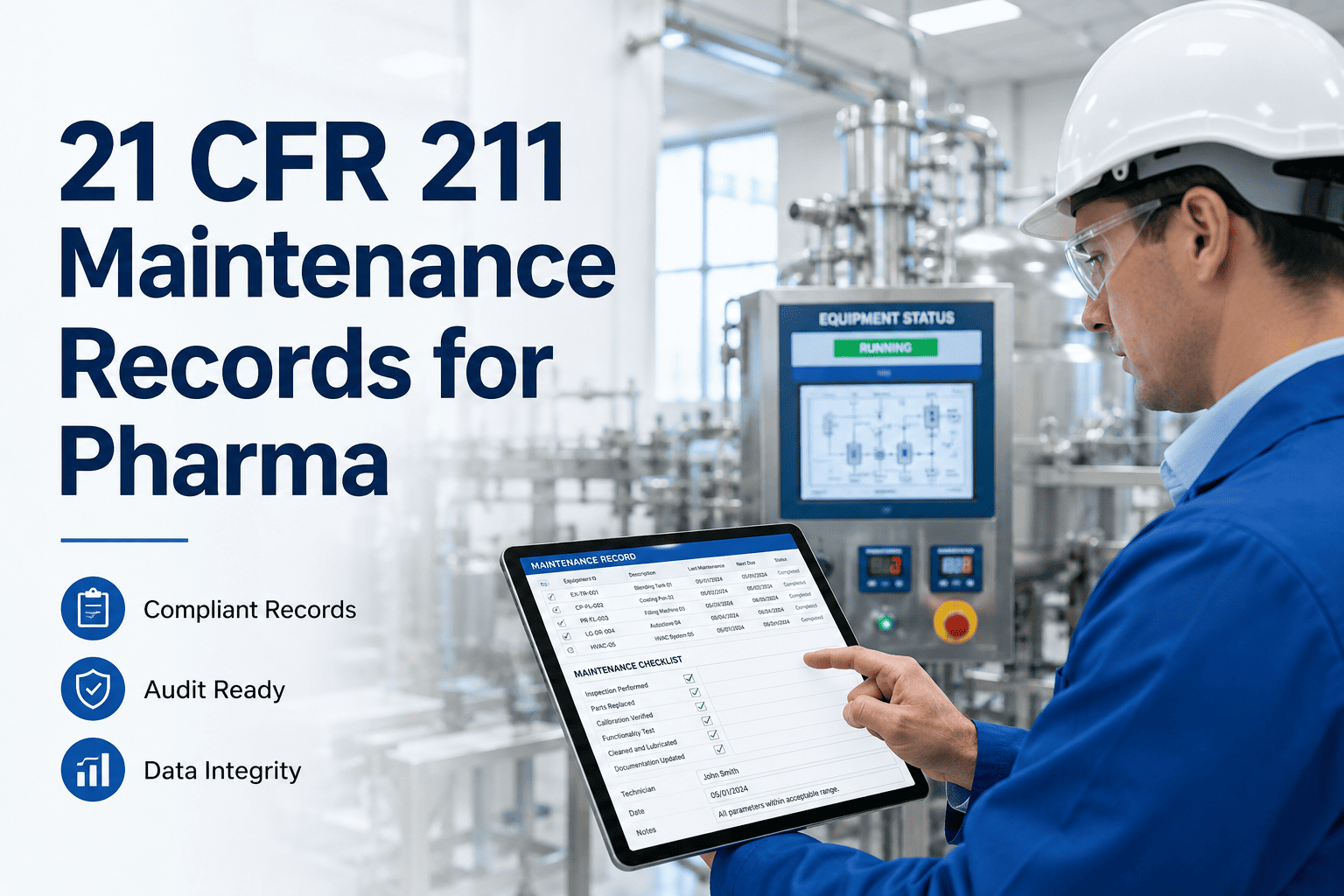
Title 21 CFR Part 211 — the FDA's current Good Manufacturing Practice regulations for finished pharmaceuticals — is specific and unambiguous about maintenance records: every piece of equipment used in drug manufacturing must have written maintenance procedures, and evidence of compliance must be retained and retrievable. When an FDA investigator arrives for an inspection, the question is not whether your team did the work — it is whether your records prove it. OxMaint's digital maintenance workflows are built to answer that question without hesitation, every time.
21 CFR 211 Maintenance Records: What FDA Requires and How to Stay Ready
A complete breakdown of FDA maintenance record requirements under 21 CFR Part 211 — with practical guidance on how digital CMMS workflows eliminate the documentation gaps that generate 483 observations.
Book a Demo — See Compliant Records in ActionThe Specific 21 CFR 211 Sections That Govern Maintenance Records
Understanding exactly what the regulation requires — not a general interpretation — is the first step to building a compliant maintenance recordkeeping system. Below is a section-by-section breakdown of the key maintenance record obligations under 21 CFR Part 211.
Written procedures describing maintenance and cleaning of equipment. Records showing when and by whom equipment was cleaned, maintained, and sanitized. Equipment in a state of disrepair must be removed from use until repaired and qualified.
Equipment used for production, processing, measuring, and testing must be routinely calibrated, inspected, and checked according to written programs. Calibration records must include date, time, person performing calibration, and deviations found.
Equipment must be identified to indicate its contents, batch information, and current operational status. Equipment under maintenance must be clearly labeled as out of service — and that label must be backed by an active maintenance record.
Any unexplained discrepancy in a batch record must be fully investigated. If the discrepancy could be related to equipment maintenance status or a calibration gap, that maintenance record must be traceable and available as part of the investigation file.
The Four Categories of Maintenance Records Required Under 21 CFR 211
| Record Type | What Must Be Captured | Retention Requirement | OxMaint Field |
|---|---|---|---|
| Preventive Maintenance | Date, technician, procedure followed, parts used, equipment returned to service | 1 year past product expiry or 3 years from manufacture date | PM Work Order with mandatory completion fields |
| Cleaning Records | Equipment ID, cleaning agent, concentration, contact time, rinse verification, person performing | Same as above — retained with batch record | Cleaning log template attached to equipment asset |
| Calibration Records | Instrument ID, calibration standard used, tolerance limits, actual readings, pass/fail, next due date | 1 year past last use of instrument in a batch | Calibration work order with certificate attachment |
| Repair / Breakdown Records | Failure description, root cause, parts replaced, downtime duration, verification of return-to-service | Full operational life of equipment plus 3 years | Corrective work order with failure coding and RCA field |
21 CFR Part 11: When Electronic Records Replace Paper
Most pharma plants are moving maintenance records to digital systems — and must comply with 21 CFR Part 11 when doing so. Part 11 sets the conditions under which electronic records have the same legal standing as paper records signed in ink. Meeting these requirements is not optional once you go digital.
Every technician and supervisor must have a unique login. Shared accounts are a Part 11 violation — electronic signatures must be attributable to a specific individual.
Each signature must capture the signer's printed name, the date and time of signing, and the meaning of the signature — such as "completed by" or "reviewed by." OxMaint enforces all three.
Any change to a completed maintenance record must create an audit trail entry showing what was changed, by whom, when, and the reason for the change. The original entry must remain visible.
Electronic records must be retrievable throughout the retention period in a human-readable format. Records that can only be read by proprietary software that may no longer be available are non-compliant.
Stop Recreating Maintenance Records Before Every FDA Inspection
OxMaint generates audit-ready maintenance, calibration, and cleaning records as a natural byproduct of daily operations — no separate documentation step, no last-minute compilation. See it demonstrated on your equipment types in 30 minutes.
How Maintenance Record Gaps Lead Directly to 483 Observations
The FDA's 483 observation database shows recurring patterns in pharmaceutical maintenance findings. The common thread across all of them is not that maintenance was not performed — it is that the records do not demonstrate it was performed correctly, completely, or on time.
"The most avoidable 483 observations I see involve maintenance records that exist — the work was done — but the record is incomplete, in the wrong format, or cannot be retrieved during the inspection window. Investigators are experienced at identifying these patterns. A CMMS that enforces record completeness at the point of execution, not after the fact, eliminates this category of finding almost entirely. Plants still running paper maintenance logs are one audit away from a significant finding."
— FDA Compliance Consultant, former pharmaceutical regulatory affairs director, 22 years of audit experience
Frequently Asked Questions
Your Maintenance Records Are Either Audit-Ready or They Are Not. Make Them Ready.
OxMaint enforces complete, compliant maintenance records for every PM, cleaning event, calibration, and repair — automatically, at the point of execution. Inspectors find what they are looking for. Your team moves on. Start with a 30-minute demo and see how OxMaint handles your specific equipment types and regulatory requirements.