The neonatal intensive care unit operates at the narrowest margin of acceptable equipment performance in the entire hospital. An infant warmer that drifts 0.5°C outside set temperature, an incubator with a failed humidity sensor, or a phototherapy unit delivering below-therapeutic irradiance can all produce adverse neonatal outcomes before a clinical alarm fires. This daily checklist gives NICU charge nurses and biomedical staff a structured, unit-level safety verification protocol covering every device category in the neonatal environment — built to the alarm ranges and tolerance standards specific to neonatal physiology. Deploy this checklist in Oxmaint CMMS as a digital daily round, or book a session to configure NICU-specific equipment schedules for your unit.
Why NICU Checks Are Different
Neonatal Equipment Tolerances Are Narrower Than Adult ICU Standards
±0.3°C
Acceptable temperature variation in a neonatal incubator (vs ±1°C in adult warming)
35–37%
Required humidity range for incubated preterm infants <30 weeks gestational age
88–95%
Target SpO2 range for preterm infants — narrower than adult alarm defaults
35–45 hr
Phototherapy lamp replacement interval based on irradiance measurement, not appearance
Daily Safety Checklist
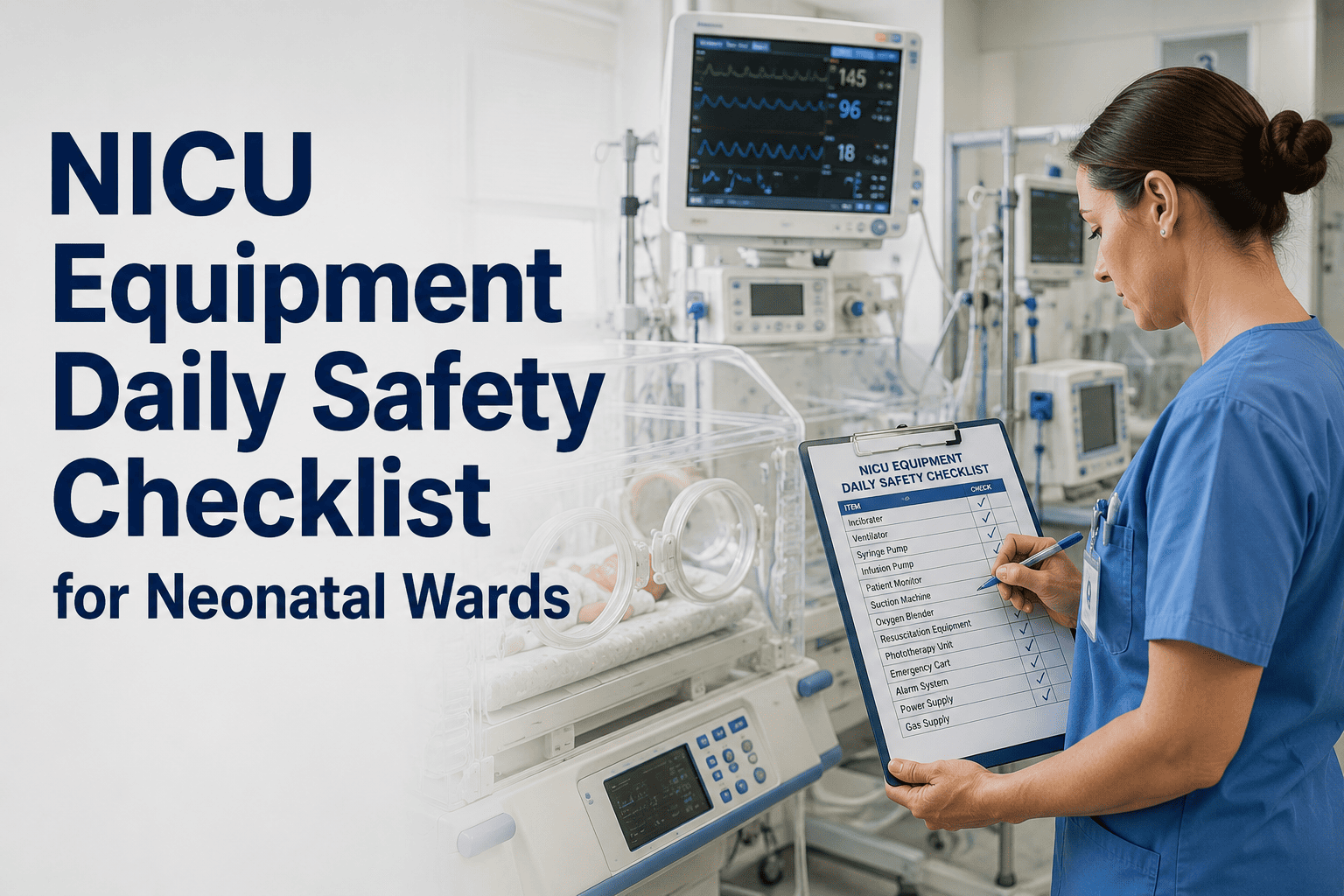
NICU Equipment Daily Safety Checklist — All Device Categories
Complete this checklist at the start of each shift for every occupied bay and every device in the NICU. Items marked with a critical flag require immediate escalation if not within tolerance — do not defer to end of shift.
Section 1 — Infant Warmers (Radiant Warmer / Open Care System)
| Check Item |
Acceptable Range / Spec |
Pass |
Flag |
Notes |
| Skin probe attachment and contact |
Secure contact, no air gap |
✓ |
△ |
|
| Set temperature vs displayed temperature |
Within ±0.3°C of setpoint |
✓ |
△ |
|
| High/low temperature alarm limits |
High ≤38.5°C, Low ≥35.5°C |
✓ |
△ |
|
| Radiant heater element — visual inspection |
No discoloration, no debris |
✓ |
△ |
|
| Side rail integrity and locking mechanism |
Fully raised, locked in position |
✓ |
△ |
|
| Mattress surface and pad condition |
No tears, cracks, or visible contamination |
✓ |
△ |
|
Section 2 — Incubators
| Check Item |
Acceptable Range / Spec |
Pass |
Flag |
Notes |
| Air temperature — set vs displayed |
Within ±0.3°C of setpoint |
✓ |
△ |
|
| Humidity level (for preterm <30 wks) |
35–37% RH (per physician order) |
✓ |
△ |
|
| Water reservoir level (humidified units) |
Above minimum fill line |
✓ |
△ |
|
| Canopy seal and porthole closures |
No gap, portholes closed when not in use |
✓ |
△ |
|
| Alarm system — high/low temp functional test |
Alarms activate within 30 sec of limit breach |
✓ |
△ |
|
| Fan filter — visual cleanliness |
No visible dust or blockage |
✓ |
△ |
|
Section 3 — Neonatal Ventilators
| Check Item |
Acceptable Range / Spec |
Pass |
Flag |
Notes |
| Circuit leak test (pre-use) |
Leak <10 mL/min at set PEEP |
✓ |
△ |
|
| Delivered tidal volume vs set tidal volume |
Within ±10% of set value |
✓ |
△ |
|
| Humidifier temperature and water level |
37°C ±1°C; water above minimum |
✓ |
△ |
|
| Apnea and high-pressure alarm test |
Alarms active, response within 20 sec |
✓ |
△ |
|
| Inspired oxygen (FiO2) verification |
Measured O2% within ±3% of set FiO2 |
✓ |
△ |
|
| Expiratory valve and filter condition |
No visible moisture accumulation or obstruction |
✓ |
△ |
|
Section 4 — Patient Monitors (Neonatal Configuration)
| Check Item |
Acceptable Range / Spec |
Pass |
Flag |
Notes |
| SpO2 alarm limits — neonatal range |
Low 88%, High 95% (term); per physician order for preterm |
✓ |
△ |
|
| Heart rate alarm limits |
Low 100 bpm, High 180 bpm (neonatal defaults) |
✓ |
△ |
|
| ECG lead connection and signal quality |
All leads connected; signal artifact <5% |
✓ |
△ |
|
| Apnea alarm — delay and sensitivity setting |
Delay 15–20 sec per unit protocol |
✓ |
△ |
|
| Temperature probe — type and placement |
Neonatal-rated probe; per physician placement order |
✓ |
△ |
|
| Battery backup — charge status |
Battery ≥80% charge |
✓ |
△ |
|
Section 5 — Phototherapy Units
| Check Item |
Acceptable Range / Spec |
Pass |
Flag |
Notes |
| Irradiance measurement (radiometer) |
Standard: ≥30 µW/cm²/nm; Intensive: ≥30 µW/cm²/nm at skin surface |
✓ |
△ |
|
| Lamp/LED hours — cumulative usage log |
Replace at 35–45 hours or when irradiance falls below threshold |
✓ |
△ |
|
| Eye protection in place before activation |
Approved neonatal eye shield, confirmed fitting |
✓ |
△ |
|
| Treatment distance — lamp to skin |
Per manufacturer spec (typically 35–50 cm) |
✓ |
△ |
|
| Reflective blanket or bassinet liner condition |
No tears, stains, or deformation |
✓ |
△ |
|
Run This Checklist Digitally in Oxmaint
Convert every section of this checklist into a mobile-ready daily NICU round in Oxmaint CMMS. Capture shift-by-shift data, flag items instantly, and build a compliance record that protects your unit during every accreditation survey.
Expert Review
NICU Specialists on Equipment Safety Culture
"In the NICU, equipment drift is not a maintenance problem — it is a patient safety event waiting to happen. A 0.4-degree temperature deviation in an incubator for a 26-week infant is clinically significant. Daily structured checks, documented in a system with trending, are the only reliable defense against undetected drift between PM cycles."
"We implemented a digital daily check for all NICU equipment and saw our biomedical-related adverse event rate drop to zero within eight months. The key wasn't the checklist itself — it was the trending data that let us catch deteriorating devices before they reached tolerance limits."
Frequently Asked Questions
NICU Daily Equipment Checks: Common Questions
Protect Every Infant. Document Every Check. Catch Every Drift Before It Becomes a Crisis.
Oxmaint CMMS turns this checklist into a digital daily round — with mobile completion, automatic escalation for flagged items, and a compliance history your surveyors can verify in minutes.