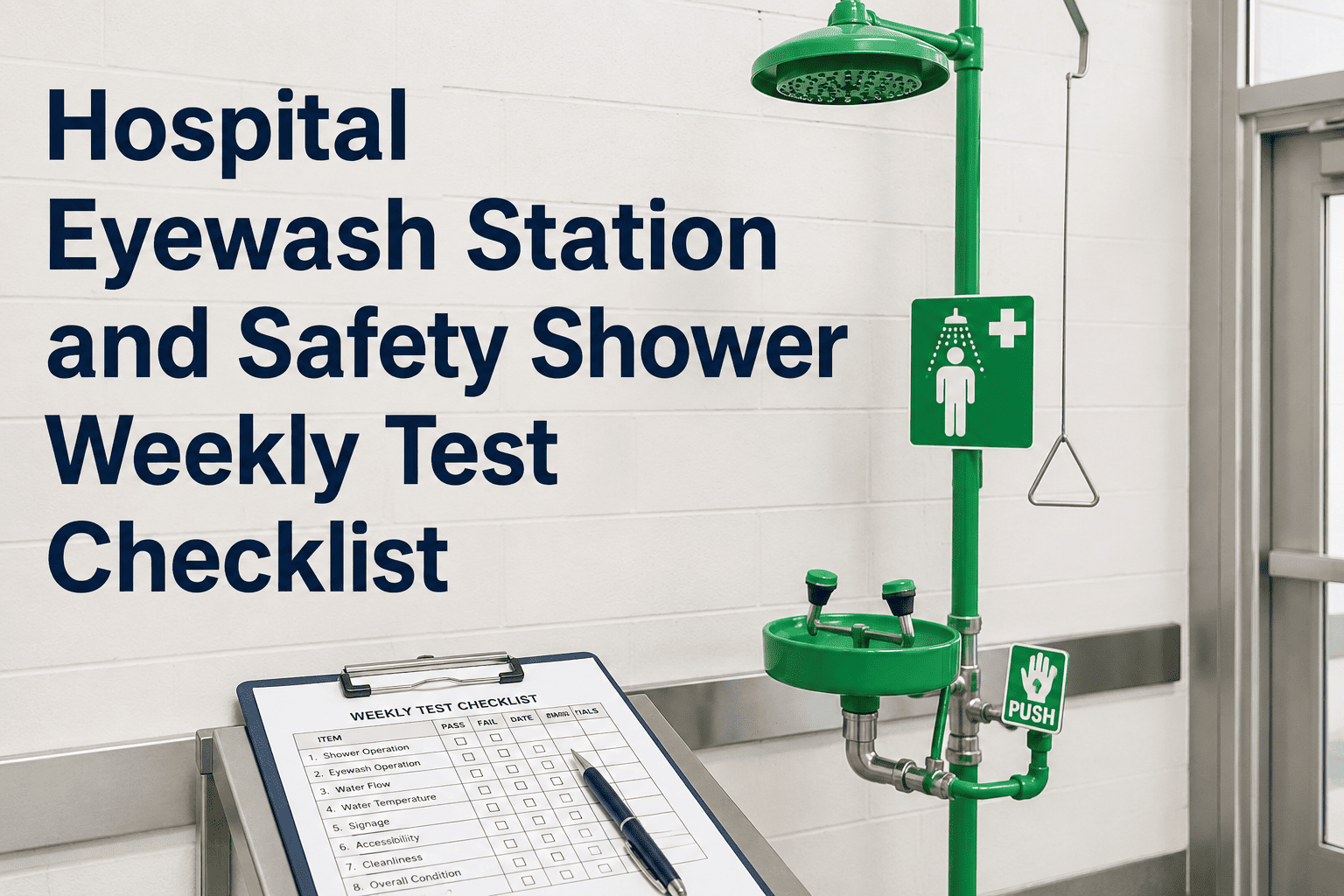
Chemical splash injuries in hospital laboratories, pharmacy compounding areas, and sterile processing departments can result in permanent vision loss within 10–15 seconds of eye contact with hazardous substances. ANSI/ISEA Z358.1-2014 — the governing standard for emergency eyewash and shower equipment — requires weekly activation testing of every eyewash and drench shower as the primary mechanism for preventing injury escalation. This checklist gives hospital safety officers and facilities teams a structured, CMMS-ready weekly test framework that satisfies both ANSI Z358.1 and OSHA 29 CFR 1910.151 requirements. Automate weekly test logging in Oxmaint or book a demo to see the compliance tracker.
Hospital Eyewash Station and Safety Shower Weekly Test Checklist
Weekly activation testing, flow verification, temperature check, accessibility audit, and CMMS documentation — for every eyewash and drench shower in your hospital.
What ANSI Z358.1 Requires — and Why Weekly Testing Matters
ANSI/ISEA Z358.1-2014 establishes performance requirements for emergency eyewash and shower equipment in facilities where hazardous materials are present. The weekly activation requirement exists specifically to flush stagnant water from supply lines — bacteria including Legionella and Pseudomonas can colonise water that sits in unused fixture lines, creating a secondary infection risk on top of the original chemical injury. The table below maps each key ANSI Z358.1 requirement to the responsible hospital department and the consequence of non-compliance.
| ANSI Z358.1 Requirement | Section | Hospital Responsible Party | Non-Compliance Consequence |
|---|---|---|---|
| Weekly activation and flushing | 4.6.1 | Facilities / EHS | OSHA citation + stagnant water / Legionella risk |
| Tepid water (60–100°F / 16–38°C) | 4.6.3 | Facilities (plumbing) | Injury escalation; patients exit shower prematurely |
| 10-second unobstructed travel path | 4.6.4 | Safety Officer / Facilities | OSHA 1910.151 violation; injury severity increase |
| Hands-free operation for full 15 minutes | 4.5.4 | Biomedical / Facilities | Equipment deficiency; surveyor citation |
| Minimum 0.4 gpm flow (eyewash) / 20 gpm (shower) | 4.5.2 / 5.4.4 | Facilities (plumbing) | Inadequate dilution of chemical agents |
| Inspection records maintained | 4.6.5 | Safety Officer / CMMS | No evidence of compliance during OSHA inspection |
Weekly Test Checklist — Eyewash Stations
Complete this section for every plumbed and self-contained eyewash station in the hospital. Test must include full activation — not a visual inspection only. Record actual water temperature where a thermometer is accessible at the eyewash outlet.
Weekly Test Checklist — Safety Drench Showers
Safety showers require the same weekly activation test. Note that a full weekly shower test requires draining provisions — ensure floor drains are clear before activation and that the activation pull rod is accessible without obstruction overhead.
Tepid Water Temperature — Hospital Location Risk Map
Tepid water delivery (60–100°F) is one of the most frequently failed ANSI Z358.1 requirements — particularly in hospitals where plumbing systems are designed for domestic hot water delivery rather than emergency fixture blending. The risk varies by hospital zone and plumbing configuration.
Expert Review
The weekly activation requirement in ANSI Z358.1 is not a checkbox exercise — it is a functional test of equipment that is supposed to work within one second when someone has acid in their eyes. What I consistently find in hospitals that have not systematised their eyewash programme is that 20–30% of units have some form of deficiency at the time of an unannounced OSHA inspection: stuck valves, cold water, blocked paths, or expired solution in self-contained units. The shift from paper logs to CMMS-based testing — where each unit has a scheduled weekly work order that cannot be closed without passing results entered — reduces deficiency rates to under 5% in my experience within one inspection cycle.
From a clinical perspective, the 10-second access requirement is grounded in real injury physiology — alkaline chemicals begin irreversible corneal damage within 15 seconds of exposure, and acid injuries within 30 seconds. The difference between a worker who reaches an eyewash in 10 seconds versus one who spends 30 seconds finding it is often the difference between full vision recovery and permanent partial vision loss. I have evaluated hospital chemical exposure cases where compliant, functional eyewash access reduced what could have been a blinding injury to a minor corneal abrasion that resolved within days. The weekly test programme is the only way to guarantee that equipment works when those 10 seconds arrive.
Frequently Asked Questions
Never Miss a Weekly Eyewash Test — Automate Compliance in Oxmaint
Oxmaint schedules weekly tests for every eyewash and shower unit in your facility, routes mobile work orders to the responsible technician, captures pass/fail results with timestamps, and flags deficiencies for same-day corrective work orders. OSHA-ready records available instantly on demand.