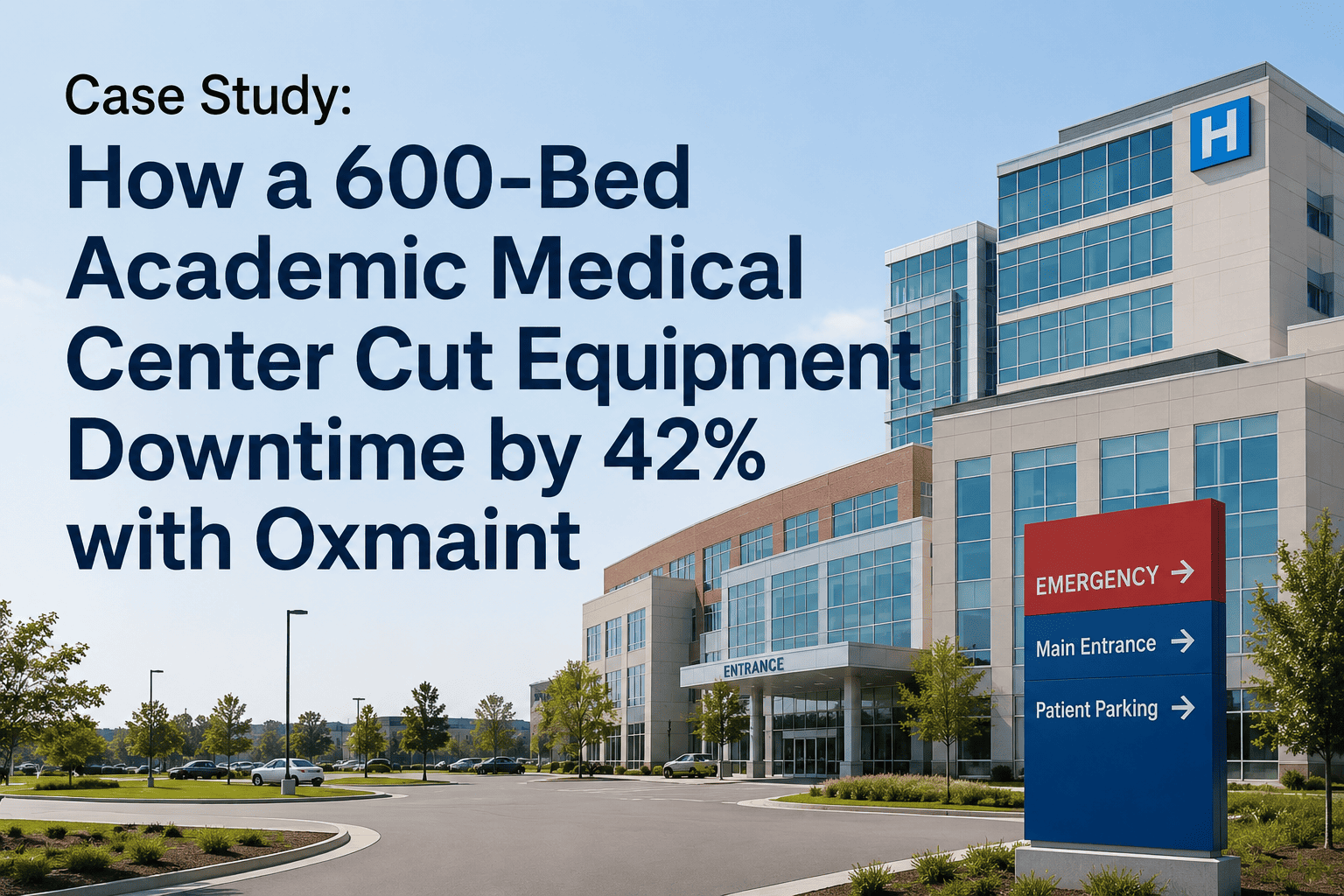
When a 600-bed academic medical center in the southeastern United States began its search for a CMMS platform in early 2022, the biomedical engineering team was logging over 1,200 reactive work orders per quarter. Equipment downtime was impacting clinical operations, and Joint Commission survey preparation was consuming six weeks of staff time each cycle. Eighteen months after deploying Oxmaint's healthcare CMMS, the facility had cut equipment downtime by 42%, reduced emergency work order volume by 61%, and completed its most recent TJC survey in under two days. This case study documents what changed, how the team implemented it, and what the numbers actually look like.
Case Study — Academic Medical Center
600-Bed Academic Medical Center Cut Equipment Downtime by 42%
600 beds
18-month deployment
Southeastern USA
42%
Reduction in equipment downtime within 18 months of Oxmaint deployment
-61%
Emergency work order volume
-42%
Total equipment downtime hours
2 days
TJC survey documentation review
94%
PM compliance rate at 12 months
The Problem: Reactive Maintenance at Scale
Before deploying Oxmaint, the biomedical engineering department was operating in a state of continuous reactive management. The facility had over 8,400 managed medical devices across inpatient units, procedural areas, imaging suites, and the emergency department. PM completion rates were tracked on paper logs supplemented by a legacy spreadsheet system that had not been updated in three years. Work orders were assigned via radio and whiteboard, with no digital tracking of open or aging items. The result was predictable: critical equipment — infusion pumps, patient monitors, ventilators — was failing during use rather than during scheduled maintenance.
No PM Visibility
PM schedules lived in spreadsheets. Overdue items had no automated notification. Technicians learned about missed PMs at survey prep — not in real time.
Reactive Work Order Flood
Over 60% of work orders were reactive. Biomedical staff spent the majority of their time responding to clinical calls rather than executing preventive maintenance.
Survey Documentation Gap
Preparing for a TJC survey required six weeks of manual log compilation. Equipment maintenance history existed across three separate systems — none of them connected.
Clinical Impact
Unplanned equipment downtime was reaching clinical leadership. OR procedure delays and ICU equipment substitutions were escalating complaints from nursing and physician staff.
Implementation: 90 Days to Operational
The implementation team at Oxmaint worked with the facility's biomedical director and IT department to complete a phased deployment over 90 days. The team chose a phased approach specifically to avoid disrupting ongoing biomedical operations during the transition period.
Days 1–21
Asset Import and Inventory Verification
8,400+ assets migrated from legacy spreadsheets and paper records into Oxmaint. Asset data enriched with manufacturer PM protocols, risk tier classifications, and TJC equipment categories.
Days 22–45
PM Schedule Build and Staff Training
PM schedules configured for all device categories. 14 biomedical technicians trained on mobile work order workflow. Supervisor dashboard configured for PM compliance tracking by unit and technician.
Days 46–75
Work Order Workflow Go-Live
All reactive and PM work orders routed through Oxmaint. Paper and whiteboard system retired. Work order aging alerts activated — open items over 72 hours escalated to biomedical director.
Days 76–90
Reporting and Compliance Dashboard Activation
TJC-ready compliance reports configured. Department heads given read-only dashboard access for equipment status. Biomedical director began weekly PM compliance review meetings using Oxmaint data.
Results: 6-Month and 18-Month Outcomes
The facility tracked outcomes at 6-month intervals after go-live. The results below reflect verified data from the biomedical department's Oxmaint reporting dashboard, cross-referenced with equipment downtime logs provided to clinical operations.
| Metric |
Before Oxmaint |
6 Months |
18 Months |
Change |
| PM compliance rate |
58% |
81% |
94% |
+36 pts |
| Reactive work orders / quarter |
1,247 |
824 |
486 |
-61% |
| Equipment downtime hours / quarter |
2,840 hrs |
2,110 hrs |
1,647 hrs |
-42% |
| TJC survey prep time |
6 weeks |
3 weeks |
2 days |
-93% |
| Mean time to repair (MTTR) |
6.8 hours |
5.1 hours |
4.0 hours |
-41% |
| Open work orders aging over 5 days |
No tracking |
34 avg open |
9 avg open |
-73% |
Book a 30-Minute Demo
See How Oxmaint Transforms Biomedical Operations at Your Facility
The outcomes above came from a structured deployment, not a technology change alone. Oxmaint's implementation team builds your asset inventory, PM schedules, and reporting dashboards before you go live — so your biomedical team starts with a working system, not a blank platform. Book a demo to see how this works for your facility size and asset mix.
Biomedical Team Workflow: Before and After
Before Oxmaint
PM schedule tracked in Excel — manually updated monthly
Work orders assigned by radio call — no digital record at assignment
Technicians carried paper work orders — documentation lost or incomplete
Equipment history searched across three separate systems
Survey prep required all-hands manual log compilation for six weeks
Downtime reported retroactively from nursing complaints — no real-time visibility
After Oxmaint
PM schedule auto-generates work orders by device and interval — nothing falls through
Work orders assigned digitally — technicians receive mobile notifications instantly
All documentation captured on mobile at point of service — photos attached
Complete equipment history in one dashboard — searchable by asset, tech, date, or unit
TJC compliance report exported in under 10 minutes — no manual compilation
Real-time downtime tracking — clinical leadership has equipment status visibility
Expert Review
A 42% reduction in equipment downtime at a 600-bed facility is not a small number — that represents thousands of hours of avoided clinical disruption over 18 months. The underlying driver is almost always the same: when you can see what's overdue before it fails, you prevent failures. The PM compliance rate improvement from 58% to 94% is the mechanism — the downtime reduction is the outcome.
BD
Biomedical Engineering Director
Academic medical center, 22 years clinical technology management
The metric that surprises most facilities directors is TJC survey prep time. Going from six weeks to two days is not an exaggeration — it happens because every inspection record, every PM completion, every corrective action is already timestamped and in the system. The survey becomes a data export, not an archaeological dig. That alone justifies the CMMS investment for most academic medical centers I work with.
MK
Healthcare Facilities Compliance Consultant
TJC survey preparation specialist, 200+ hospital engagements
Frequently Asked Questions
How long does it take to implement Oxmaint in a 600-bed hospital?
The facility in this case study completed full implementation in 90 days — from contract execution through go-live with all biomedical staff trained and all work orders routed through the platform. Implementation time varies based on asset inventory size, the condition of existing data, and IT integration requirements. Oxmaint's implementation team handles data migration, asset inventory build, PM schedule configuration, and staff training.
Book a demo to review a deployment timeline specific to your facility's size and complexity. For most mid-size hospitals, a 60–90 day timeline is realistic when data is reasonably organized and IT resources are allocated.
How does Oxmaint reduce equipment downtime — not just track it?
Oxmaint reduces downtime through the same mechanism as any effective preventive maintenance system: it ensures PMs happen before failures occur. Specifically, Oxmaint auto-generates PM work orders by device and interval, sends mobile notifications to assigned technicians, escalates overdue PMs to supervisors automatically, and tracks PM completion rates in real time. When a PM is completed on schedule, the failure it was designed to prevent does not happen. At scale — across 8,000-plus devices — this creates a compounding effect on downtime reduction.
Start a free trial to see how Oxmaint PM scheduling works with your device inventory and PM protocols.
Will Oxmaint work with our existing biomedical PM protocols and TJC equipment categories?
Yes. Oxmaint is built for healthcare CMMS requirements and ships with configurable PM templates aligned to manufacturer protocols and TJC equipment categories. The platform supports AEM (Alternative Equipment Management) program documentation, risk tier classification, and the device-category-level reporting that TJC EC.02.04.03 requires. During implementation, Oxmaint's team maps your existing PM protocols into the platform — you do not start from scratch.
Book a demo to see how your specific device mix maps to Oxmaint's healthcare CMMS structure.
Your Facility's Results Start With a 30-Minute Conversation
The 600-bed facility in this case study achieved a 42% downtime reduction not by adding biomedical staff, but by giving the team they had a system that worked. Oxmaint's implementation includes everything — asset inventory, PM schedules, mobile workflows, and compliance reporting. Book a demo to see what that looks like for your facility's specific device mix, team size, and regulatory requirements.