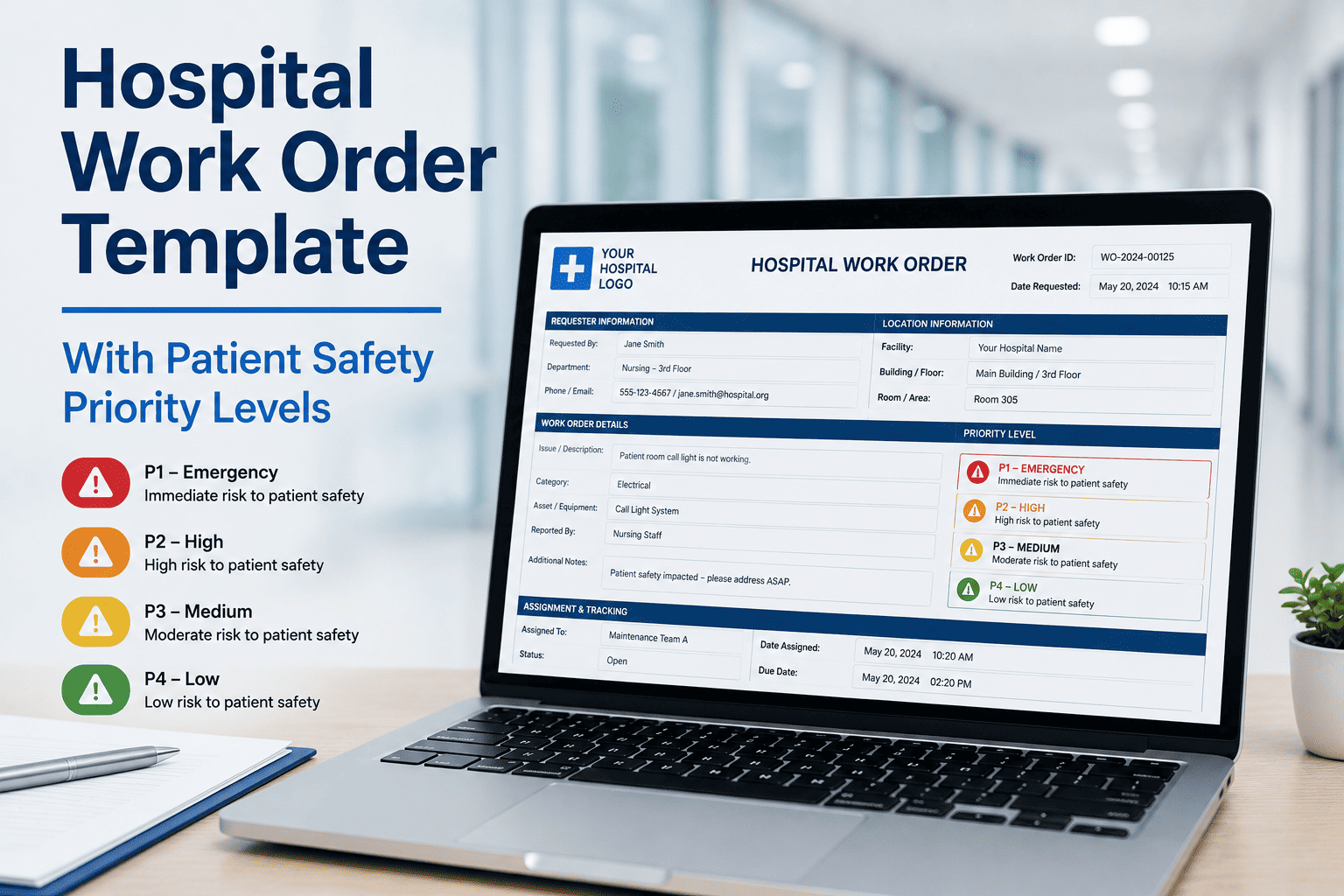
Hospital Work Order Template With Patient Safety Priority Levels

By James Smith on May 19, 2026

hospital-work-order-template-patient-safety-priority-levels

Government maintenance records are audited more frequently than most public works directors expect — and the compliance risks they expose are rarely the dramatic failures. They are the quiet gaps: a playground inspection that was completed but never logged, an elevator certificate that expired two months ago, a generator test run that a technician verbally reported but nobody recorded. These documentation failures are invisible until an auditor, an attorney, or an incident investigation makes them catastrophically visible. OxMaint's compliance tracking module eliminates all ten risks on this list by structuring maintenance documentation before the audit arrives, not after.

Top 10 · Government Compliance · Maintenance Records · 2026

Top 10 Compliance Risks Hiding in Government Maintenance Records

The audit findings that cost municipalities the most — missing inspection logs, expired certifications, gap-filled PM records, and the legal exposure they create when they surface at the worst possible moment


73% of government facilities have at least one of these ten compliance gaps active right now — most don't know it until an audit, injury, or public records request
$50K+
Average regulatory fine per compliance finding — government facilities
68%
Of audit findings in public sector relate to missing or incomplete maintenance documentation
3.2x
Higher litigation cost for municipalities without documented maintenance records
90 days
Typical notice before a state or federal compliance audit — not enough time to reconstruct records

The 10 Compliance Risks — Ranked by Audit Impact

01
Critical
Missing Playground Safety Inspection Logs
ASTM F1292, CPSC guidelines, and most state statutes require documented playground safety inspections at defined intervals — typically monthly visual and annual comprehensive. When a child is injured on playground equipment, the first document a plaintiff's attorney requests is the inspection log. A missing log is not a defence — it is evidence of negligence per se in most jurisdictions. Many municipalities have inspection programmes but no structured log — technicians do the check, nothing is recorded.
Typical Audit Finding: "No documented evidence of routine playground safety inspections for 14 of 22 sites reviewed. Programme exists but records not maintained."
02
Critical
Expired Elevator Inspection Certificates
Elevator operating permits in most states are annual statutory requirements — operation of an elevator with an expired certificate is a violation regardless of mechanical condition. State elevator inspectors and building code officers routinely check certificate currency during facility inspections. Certificate expiry also voids most property insurance coverage for elevator-related incidents during the lapse period.
Typical Audit Finding: "4 of 11 elevators at municipal facilities operating with expired annual inspection certificates. Certificate tracking not managed in any central system."
03
Critical
Undocumented Generator Load Tests
Emergency generators at public safety facilities, EOCs, water treatment plants, and wastewater lift stations are subject to NFPA 110 and state-specific testing requirements — typically monthly no-load runs and annual full-load tests. The test must be documented with load, runtime, fuel consumption, and transfer time. A verbal report or mental note is not a compliance record. When a generator fails during an actual emergency, the absence of test records becomes a critical finding in every investigation that follows.
Typical Audit Finding: "Generator test records for 8 of 14 critical facilities are incomplete or absent. Testing appears to occur but results are not formally documented or retained."
04
High
Fire Alarm and Suppression System Inspection Gaps
NFPA 72 (fire alarm) and NFPA 25 (sprinkler/suppression) require documented quarterly and annual inspections with technician credentials recorded. Fire marshal inspections cross-reference these records against previous findings — repeated gaps accumulate into enforcement actions. For government buildings occupied by the public, fire system inspection gaps create direct civil liability exposure for municipal officials, not just the organisation.
Typical Audit Finding: "Quarterly fire alarm inspection records for community centre campus are not on file for two consecutive quarters. Annual sprinkler inspection overdue by 4 months at main library."
05
High
Backflow Preventer Test Records Not Retained
Annual backflow preventer testing is required by most state plumbing codes and water utility contracts for all government facilities connected to the public water supply. The test report from a licensed tester must be filed with the water authority and retained by the facility — typically for a minimum of five years. Many municipalities complete the test but lose the record, or never file it with the appropriate authority, creating both utility compliance violations and a documentation gap during facility inspections.
Typical Audit Finding: "Backflow preventer test records cannot be produced for 6 facilities. Water authority records confirm tests were performed but facility copies are absent."
06
High
HVAC Filter and Inspection Records Absent for Public Buildings
Indoor air quality complaints in government buildings — schools, courthouses, community centres — frequently trigger investigations that begin with HVAC maintenance records. When filter change logs, coil cleaning records, and duct inspection documentation cannot be produced, the municipality is in an indefensible position regardless of the actual HVAC condition. Several state education departments now require documented HVAC maintenance records for school buildings as a condition of facility operating approvals.
Typical Audit Finding: "HVAC maintenance documentation for school facilities is incomplete — no filter change logs available for current school year. Programme appears to be performed but is undocumented."

OxMaint automatically logs every inspection, generates overdue alerts, and maintains a tamper-proof audit record for all 10 risk categories on this list. Book a demo or start free today.

07
High
Fleet Vehicle Inspection and Maintenance Gaps
Government fleet vehicles — including emergency vehicles, public works trucks, and transit vehicles — are subject to DOT inspection requirements, state vehicle inspection statutes, and increasingly, FMCSA compliance for vehicles over 10,001 lbs. Missing pre-trip inspection logs, overdue PM records, or undocumented brake and tire inspections create direct liability when government vehicles are involved in accidents. Several municipalities have faced multimillion-dollar judgements where the absence of maintenance records was the decisive factor.
Typical Audit Finding: "Pre-trip inspection logs for heavy equipment fleet are maintained by operators but not centralised or retained — records unavailable beyond 30 days."
08
Medium
Water/Wastewater Asset Maintenance Documentation Missing
EPA and state drinking water/wastewater programmes require documented maintenance of treatment and collection system assets as part of operator certification compliance and permit conditions. During sanitary surveys (typically every 3–5 years), regulators review maintenance records for pumps, blowers, chemical feed systems, and control equipment. Absent records trigger permit conditions, compliance schedules, or enforcement actions that can restrict system capacity — affecting the municipality's ability to issue building permits.
Typical Audit Finding: "Lift station maintenance records are incomplete — no documentation of wet well cleaning or pump inspection for 11 of 24 stations in the 24-month review period."
09
Medium
ADA Accessibility Equipment Maintenance Not Documented
Wheelchair lifts, automatic door operators, accessible restroom fixtures, and accessible parking lot surfaces require documented maintenance programmes under ADA transition plan obligations. DOJ and state civil rights investigators increasingly review maintenance records during ADA compliance complaints — a broken accessible door that was reported but not repaired within a reasonable timeframe, with no work order to document the timeline, is an ADA violation regardless of whether the door eventually gets fixed.
Typical Audit Finding: "No documented maintenance programme for ADA accessibility equipment. Work orders for accessible door operator repairs cannot be produced — response timeline to known deficiencies unknown."
10
Medium
No Maintenance Response Record for Citizen-Reported Hazards
When a resident reports a hazard — a broken sidewalk, a failed streetlight, a damaged park structure — the government's liability exposure begins at the moment of documented notice, not at the moment of injury. If a citizen submits a request that is not logged in a traceable system and an injury subsequently occurs at that location, the municipality cannot demonstrate when it learned of the hazard or how quickly it responded. This is the "notice" element of municipal tort liability — and a CMMS with a citizen portal is the only reliable protection.
Typical Audit Finding: "Citizen service requests are received by phone and email but not systematically logged. No documented response timeline available for requests received in the 18-month review period."

Risk Severity Summary — Audit Exposure at a Glance

Risk Severity Primary Exposure OxMaint Solution
Playground inspection logs missing Critical Civil liability, negligence per se Auto-scheduled mobile inspection with sign-off
Expired elevator certificates Critical Statutory violation, insurance void Certificate expiry tracking + auto-renewal WO
Undocumented generator tests Critical NFPA 110 violation, emergency failure liability Scheduled load test WO with result logging
Fire system inspection gaps High Fire marshal enforcement, civil liability NFPA-aligned PM schedule + credential logging
Backflow test records absent High Water authority violation, plumbing code Test record storage + authority filing tracking
HVAC records missing High IAQ liability, state education compliance Scheduled filter/coil PM with photo log
Fleet inspection gaps High DOT/FMCSA violation, accident liability Mobile pre-trip log + PM schedule tracking
Water/wastewater PM absent Medium EPA permit conditions, sanitary survey Asset-level PM history + compliance reporting
ADA equipment undocumented Medium DOJ ADA enforcement, civil rights complaint ADA asset registry + response timeline tracking
Citizen hazard reports not logged Medium Municipal tort liability — notice element Citizen portal → WO with timestamped receipt

Close All 10 Compliance Gaps — Before the Auditor Does

OxMaint's compliance tracking module manages certificate expiry, inspection scheduling, citizen request logging, and audit-ready record export for every asset class on this list. Most government teams are live in one week.

Expert Review

MB
Marcus Belford
Municipal Risk Manager — Regional Government (18 facilities, 14 parks), 20 years · Certified Risk Manager (CRM), PRIMA Member

"I've reviewed post-incident litigation files for municipal governments across three states, and the pattern is identical every time: the maintenance was usually done, but the record wasn't kept. Playground equipment got inspected by a dedicated crew — but on a clipboard that got thrown away at the end of the season. Generators got tested — but the shift supervisor just ticked a box nobody ever reviewed. The injury happens, the attorney sends a public records request, and the municipality discovers it cannot produce a single document in its defence. OxMaint changes this structurally — not by creating more work for maintenance teams, but by making documentation the natural outcome of the work they were already doing. The platform has become part of our standard risk management recommendation for every public works client. Learn more at app.oxmaint.ai."

Frequently Asked Questions

How long must government maintenance records be retained for compliance purposes?
Retention requirements vary by record type and jurisdiction — but the standard minimum for most government maintenance records is 5–7 years, with some categories (elevator certificates, fire safety inspections, OSHA-related records) requiring 10+ years or permanent retention. For records related to capital assets, many state archiving laws require retention for the life of the asset plus a defined period. OxMaint maintains all maintenance records permanently in the system and exports them in formats acceptable for state archive requirements. Consult your state's local government records retention schedule for specific categories. Start free to configure your retention settings.
Can a CMMS protect a municipality from liability in an injury lawsuit?
A CMMS does not prevent injuries — but it fundamentally changes a municipality's legal position when injuries occur on government property. Documented inspection records demonstrate that a reasonable maintenance programme was in place, that hazards were being actively monitored, and that the municipality responded within a reasonable timeframe to known conditions. This evidence directly addresses the "negligence" and "notice" elements most commonly at issue in premises liability claims. Municipalities with documented CMMS records consistently achieve better litigation outcomes than those relying on verbal accounts of maintenance activity. Book a demo to see OxMaint's audit trail and incident-linked record retrieval.
What is the fastest way to close the most critical compliance gaps on this list?
Prioritise in this order: first, conduct an immediate certificate inventory for elevators, fire alarm systems, and generators — anything with a statutory annual requirement — and identify all expired or missing certificates. Second, establish a CMMS-tracked PM schedule for playground inspections and fire system inspections, as these carry the highest injury liability. Third, implement a citizen service request portal so all reported hazards receive a logged, timestamped work order. These three steps address the top six risks on this list and can be operational within two weeks using OxMaint. Start building your compliance programme today.
How does OxMaint handle compliance certificate expiry tracking across multiple facilities?
OxMaint maintains a certificate registry for every asset across all facilities — elevator permits, fire alarm inspection certificates, backflow test records, generator compliance certificates, and custom certificate types you define. The system sends automated alerts to facility managers and compliance officers 60, 30, and 7 days before each certificate expires, and automatically generates a renewal work order with the responsible contractor or internal team assigned. All certificates are stored digitally in the asset record and are accessible for immediate retrieval during an audit or inspection. Book a demo to see the certificate management dashboard.

Your Compliance Gaps Are Hidden — Until They're Not

OxMaint surfaces every missing inspection, expired certificate, and undocumented hazard response before an auditor, attorney, or incident investigation does. Structured documentation. Automatic alerts. Audit-ready records — always.
Share This Story, Choose Your Platform!