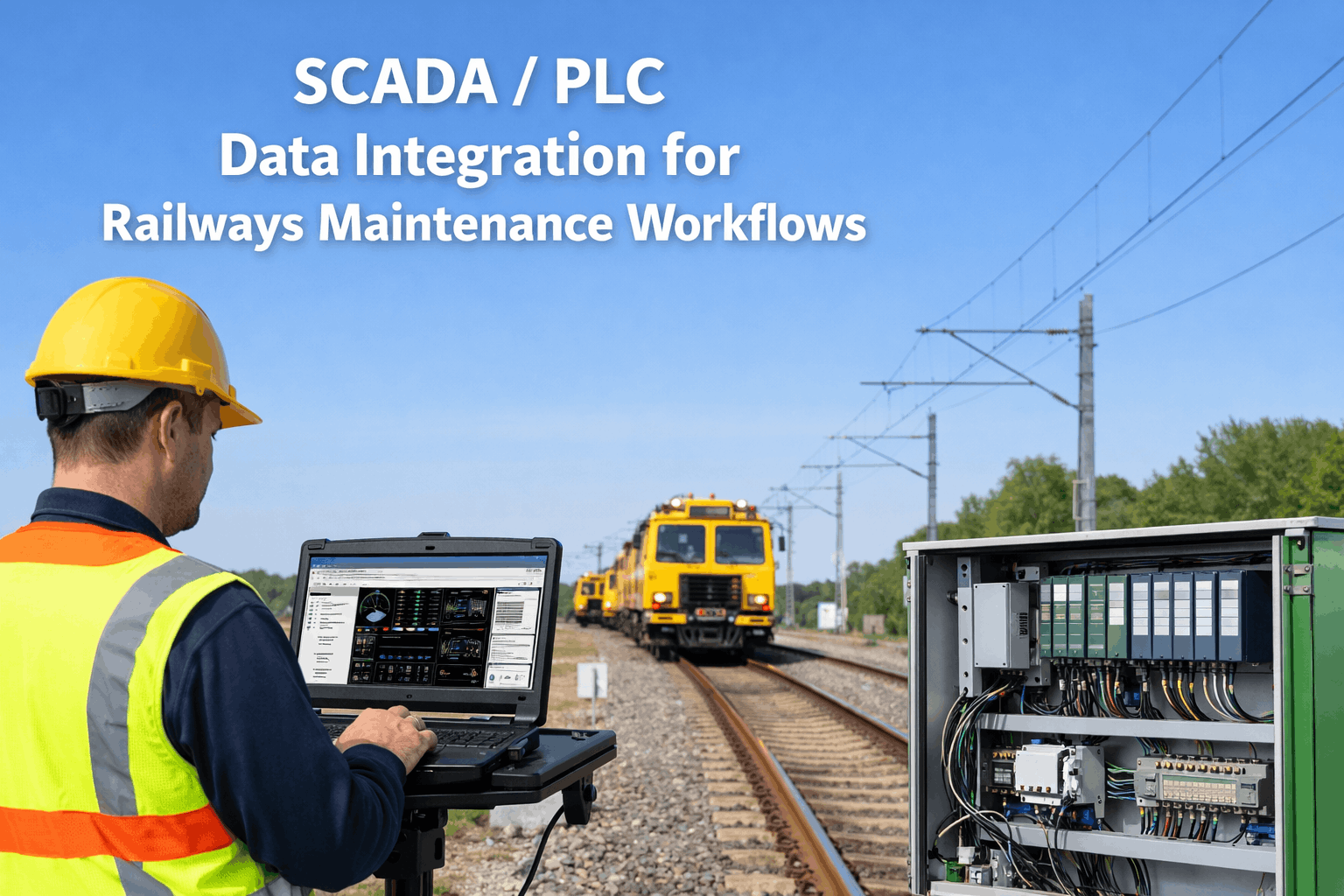
SCADA/PLC Data Integration for Railways Maintenance Workflows
By Taylor on March 14, 2026
Railway operations generate an enormous volume of real-time data through SCADA systems, PLCs, interlockings, train management systems, and trackside equipment controllers — data that captures the operational state of every signal, every point machine, every traction power feed, and every train movement across the network, every second of every day. Yet in most railway maintenance organisations, this data exists in a completely separate world from the maintenance management systems where work orders are created, asset histories are recorded, and maintenance teams receive their assignments. The consequence is a maintenance program that is systematically blind to the operational signals that best indicate when and where maintenance is needed. SCADA and PLC data integration with railway maintenance workflows closes this gap — transforming real-time operational data into predictive maintenance triggers, condition-based work orders, and evidence-based asset management decisions that reactive and time-based maintenance programs cannot achieve. Schedule a free SCADA integration assessment with our team and find out exactly how much predictive maintenance value is locked inside your existing operational data systems.
The Data Disconnect That Costs Railways Millions Every Year
Railway SCADA systems were designed to operate trains safely and efficiently. Railway maintenance management systems were designed to manage work orders and asset records. Neither was designed to talk to the other — and the gap between them is where billions of dollars of preventable maintenance cost and service disruption hide every year.
SCADA / PLC World
Point machine operation time trending
Signal aspect failure and recovery events
Traction power current and voltage anomalies
Track circuit occupancy and shunting failure patterns
Crossing barrier cycle count and fault history
Tunnel ventilation fan performance data
Substation transformer temperature trends
No Connection
→
←
$2M–$15M average annual maintenance cost premium from this gap in a mid-size national railway
CMMS / Maintenance World
Work orders created from human reports only
Asset history updated manually post-repair
PM schedules based on calendar, not condition
No knowledge of operational failure patterns
Reactive to failures the SCADA already knew about
Parts ordered after failures, not before
Reporting based on lagging incident data
73%
Of railway signalling failures have detectable SCADA precursor signals in the 48 hours before the fault — precursors that no maintenance work order was generated to address
4–6 hrs
Average delay between a SCADA-detected fault and a maintenance work order being manually created and assigned — time during which the failure may have already caused service disruption
85%
Of point machine failures are preceded by measurable operation time deviation in SCADA data — deviation that integrated analytics converts into a predictive maintenance alert 2–6 weeks before failure
Integration Architecture: How SCADA Connects to Maintenance Workflows
A well-designed SCADA-to-CMMS integration is not a direct database link — it is a structured pipeline that transforms raw operational data into maintenance-relevant events and insights. Understanding the architecture helps railway organisations make informed decisions about what to integrate, how to process it, and what actions it should trigger.
Data Sources
SCADA System
PLC / RTU Networks
Train Management System
Asset Monitoring Systems
Operational Historians
OPC-UA / IEC 61968 / REST API
Integration Middleware
Real-time data normalisation and quality filtering
Cybersecurity isolation — OT/IT network boundary control
Asset identity mapping — SCADA tag IDs to CMMS asset records
Event aggregation and time-series storage
Structured maintenance events and alerts
Analytics and Decision Engine
Threshold Alerting
Parameter exceeds defined limit → immediate work order
Maintenance history enriched with operational data
Regulatory compliance reporting
Critical: OT/IT Boundary Security. Railway SCADA systems are classified as Critical National Infrastructure in most jurisdictions. Any integration must implement strict unidirectional data flow from OT to IT (data diode architecture), prohibiting any return path that could allow IT network threats to reach safety-critical SCADA systems. Network segmentation, demilitarised zones, and railway-specific cybersecurity standards (IEC 62443, NIST CSF) must govern the integration architecture from the design stage.
Connect Your SCADA Data to Your Maintenance Workflows
Oxmaint integrates with railway SCADA and PLC systems through secure, standards-compliant interfaces — automatically generating maintenance work orders from operational data, enriching asset records with real-time condition data, and giving maintenance teams the predictive intelligence their SCADA systems already contain.
High-Value SCADA Data Sources by Railway Asset Class
Not all SCADA data is equally valuable for maintenance decision support. The highest-return integration points are those where SCADA data contains the strongest predictive signal for the highest-consequence failure modes. The following asset classes consistently deliver the largest measurable maintenance benefit from SCADA integration.
01
Point Machines and S&C Equipment
Most Critical — Direct Safety Dependency
25–40% fault reduction documented
SCADA Data Available
Operation time (ms) — every throw, every direction
Motor current profile — force required per throw
Failure codes and detection flags — locked/detected
Temperature of motor housing (some systems)
Operation count — cumulative cycle tracking
Predictive Maintenance Triggers
Alert
Operation time deviation >15% from baseline over 7-day rolling average → planned inspection and lubrication
Urgent
Motor current spike >2σ above normal profile → immediate inspection before next peak service period
PM Trigger
Operation count exceeds 50,000 cycles → schedule planned maintenance based on usage not calendar
The single highest-value SCADA integration for most railway networks. A single prevented peak-hour points failure avoids service disruption costs of £50,000–£200,000 per event — payback of the entire integration investment from two to three prevented failures.
02
Traction Power and Substations
High Criticality — Capacity Constraint
20–30% substation maintenance cost reduction
SCADA Data Available
Transformer temperature — winding and oil temperature trends
Rectifier output voltage and current — load and efficiency
Circuit breaker operation count and fault tripping history
Harmonic distortion levels — power quality indicators
Cooling system performance — fan current, temperature differential
Predictive Maintenance Triggers
Alert
Transformer winding temperature trending above seasonal norm → schedule oil sampling and cooling system check
Urgent
Circuit breaker fault trip rate exceeding threshold → inspect mechanism and contact wear before next high-load period
Transformer failures are among the most expensive maintenance events in railway operations — replacement costs of £500K–£2M and lead times of 6–18 months. SCADA temperature trending provides 4–12 weeks of advance warning before most failure modes.
03
Signalling — Track Circuits and Axle Counters
Critical — Train Detection Safety System
35–50% fault response cost reduction
SCADA Data Available
Track circuit feed current and receive voltage — continuous
Ballast resistance estimation from circuit parameters
Axle counter reset history and evaluation count anomalies
Signalling relay vital circuit response times
Joint bonding current flow and continuity monitoring
Predictive Maintenance Triggers
Alert
Track circuit receive voltage trending down over 30 days → schedule ballast resistance survey and bond inspection
Urgent
Axle counter evaluation anomaly rate exceeding acceptable threshold → emergency inspection before next train movement
PM Trigger
Relay operation count approaching maintenance interval → schedule relay maintenance during next available possession
Track circuit faults are the most common cause of signalling failures and service disruption across all railway types. SCADA circuit voltage and current trending can identify 70–80% of developing track circuit failures 1–4 weeks before they cause operational failures.
04
Level Crossings
High Criticality — Public Safety Interface
40–60% crossing fault reduction achievable
SCADA Data Available
Barrier operating times — raise and lower cycle duration
Motor current profiles — force required per cycle
Obstacle detection system activation frequency
Warning device (lights and bells) activation confirmation
Crossing activation count — cumulative per installation
Predictive Maintenance Triggers
Alert
Barrier operating time deviation >10% from seasonal baseline → schedule lubrication and mechanism inspection
Urgent
Warning device failure to confirm activation → immediate inspection required before next train crossing
Level crossing failures directly impact public safety and generate significant reputational and legal consequences for railway operators. SCADA barrier performance data provides the most direct early warning available for the mechanical failures that cause crossing incidents.
Cybersecurity Requirements for Railway SCADA Integration
Railway SCADA systems are safety-critical, and railway infrastructure is designated Critical National Infrastructure in most nations. Any integration between SCADA operational technology and IT-based maintenance management systems must be governed by cybersecurity requirements that protect the safety systems from IT-side threats while enabling the data flows that maintenance analytics requires.
Data Diode Architecture
Mandatory
Data flow from OT (SCADA) to IT (CMMS) must be strictly unidirectional — no return path that could allow IT network threats to reach safety-critical SCADA systems. Hardware data diodes or one-way gateways enforce this at the physical network layer, not just through software configuration. Any integration architecture that does not implement hardware-enforced unidirectional flow does not meet railway SCADA security requirements.
Applicable Standards
Required
IEC 62443 (Industrial Automation and Control Systems Security) provides the foundational security framework for railway SCADA integration. IEC 62280 covers railway communication security. The NIST Cybersecurity Framework and national Critical Infrastructure Protection standards (NIS2 in Europe, NERC CIP derivatives in North America) apply to operators of national railway infrastructure. Security case documentation is required before any integration goes live.
Network Segmentation
Mandatory
OT networks (SCADA, PLC, signalling) must be physically or logically segmented from IT networks (CMMS, ERP, internet-connected systems) with a demilitarised zone (DMZ) between them. The integration middleware operates in the DMZ, never directly bridging OT and IT. All network traffic crossing zone boundaries must be logged and monitored for anomalies. Firewall rules are restrictive — only explicitly defined data flows are permitted.
Audit and Penetration Testing
Required
Integration architectures must undergo security audit and penetration testing before go-live and at defined intervals thereafter. Any change to the integration — new data sources, modified processing rules, updated software components — requires a security impact assessment before deployment. For government railway operators, security assurance reports are typically required by the national cybersecurity authority as part of the CNI protection regime.
Implementation Metrics and KPIs
SCADA integration for railway maintenance must demonstrate measurable outcomes against the baseline maintenance program. These KPIs provide the evidence base for continued investment and expansion of integrated maintenance capabilities.
73%
Predictable Faults with SCADA Precursors
Proportion of railway infrastructure faults that have detectable SCADA data patterns in the hours to weeks before failure — representing the addressable opportunity for predictive maintenance conversion through integration.
< 15 min
Alert-to-Work-Order Generation Time
Time between SCADA anomaly detection and a structured maintenance work order appearing in the CMMS with asset identification, evidence, priority, and assignment. Target versus the 4–6 hour average for manual work order creation in unintegrated programs.
30–50%
Emergency Maintenance Reduction — Year 1
Reduction in emergency engineering responses on integrated assets versus the three-year baseline average before integration. The primary financial return metric demonstrating value to Treasury and oversight bodies.
False Positive Alert Rate
< 10%
SCADA alerts that do not result in confirmed maintenance need — above 20% erodes maintenance team trust in the system
PM Interval Optimisation
15–25% extension
Average extension of preventive maintenance intervals on low-condition-risk assets once SCADA-derived condition data replaces calendar scheduling
Reactive-to-Planned Ratio
< 20% reactive
Share of maintenance work triggered by emergency versus planned — programme maturity KPI benchmarked against national rail standards
Delay Minutes Reduction
25–40%
Reduction in infrastructure-caused delay minutes on integrated assets — direct service performance metric linked to regulatory performance obligations
From Raw SCADA Data to Predictive Maintenance Action — Oxmaint Makes It Operational
Oxmaint's railway maintenance platform integrates with SCADA, PLC, and operational technology systems through secure, standards-compliant interfaces — automatically converting operational data signals into structured work orders, condition-based PM triggers, and asset health dashboards that give railway maintenance teams the predictive intelligence their infrastructure already generates.
Does connecting SCADA to a CMMS create cybersecurity risk to safety-critical railway systems?
Connecting SCADA to a CMMS introduces cybersecurity risk only if the integration architecture is incorrectly designed. The correct architecture uses hardware-enforced unidirectional data flow — a data diode — that physically prevents any communication from the IT side (CMMS) to the OT side (SCADA). This means that even if the CMMS or the IT network it resides on is compromised, there is no electronic pathway through which that compromise can reach the safety-critical SCADA system. The data diode architecture is not a software configuration — it is a hardware device that makes return-path communication physically impossible. Government railway operators must also implement the full network segmentation and DMZ architecture described in IEC 62443 and applicable national CNI protection standards. A correctly designed integration with these controls in place carries no meaningful additional cybersecurity risk to safety systems — and the risk of not integrating (emergency maintenance events caused by undetected SCADA precursors) is significantly higher.
02
How long does it take to implement SCADA integration with a railway CMMS?
A focused initial integration targeting one asset class — point machines, for example — typically takes 3–6 months from architecture design to live operation. This timeline covers: cybersecurity architecture design and approval, middleware configuration and SCADA tag mapping, CMMS asset record alignment, alert threshold calibration, and maintenance workflow process change. The timeline is driven more by internal approval processes and security case review than by technical implementation complexity. Expanding to additional asset classes after the initial deployment is significantly faster — typically 6–10 weeks per additional asset class once the data pipeline infrastructure is established. Full multi-asset integration across a major national railway network is typically a 12–24 month programme depending on the number of legacy SCADA systems involved and their data accessibility.
03
What data standards are used to connect railway SCADA systems to maintenance platforms?
The primary open standard for railway operational data integration is IEC 61968/61970 (CIM — Common Information Model) for utility and transport network data exchange. OPC Unified Architecture (OPC-UA) is the dominant industrial standard for SCADA data publication and is supported by most modern railway SCADA platforms and PLCs. For legacy systems that predate OPC-UA, MODBUS, DNP3, and IEC 60870-5 are common protocol bridges. Railway-specific standards include IEC 61375 (Train Communication Network) for rolling stock data and IEC 62386 for digital addressable lighting and control — relevant for tunnel and station environments. Most CMMS integration architectures use a middleware layer that handles protocol conversion, abstracting the legacy diversity of railway SCADA systems into a normalised data model that the CMMS can consume via REST API or message queue interfaces. This approach avoids the need to replace legacy SCADA systems to achieve integration — most operational SCADA systems can be integrated through middleware regardless of their age or protocol.
04
How does Oxmaint support railway SCADA integration for maintenance workflows?
Oxmaint's railway maintenance platform supports SCADA integration through a secure, standards-compliant data ingestion layer that receives structured event and condition data from integration middleware via REST API or message queue interfaces. Incoming SCADA events are mapped to CMMS asset records using configurable asset identity mappings, converted into work orders with automatic priority classification based on configurable threshold and pattern rules, and assigned to maintenance teams or contractors with supporting evidence — SCADA event data, trend charts, and asset history context. Maintenance planners can review SCADA-derived work orders alongside manually created work orders in a unified dashboard, with full evidence chains visible for engineer review before maintenance decisions are taken. Completed work orders feed back into the asset history with SCADA context attached, progressively enriching the maintenance record with operational data that improves future predictive model accuracy. All SCADA-derived maintenance actions are recorded with full audit trails supporting railway safety management system compliance and regulatory reporting requirements.