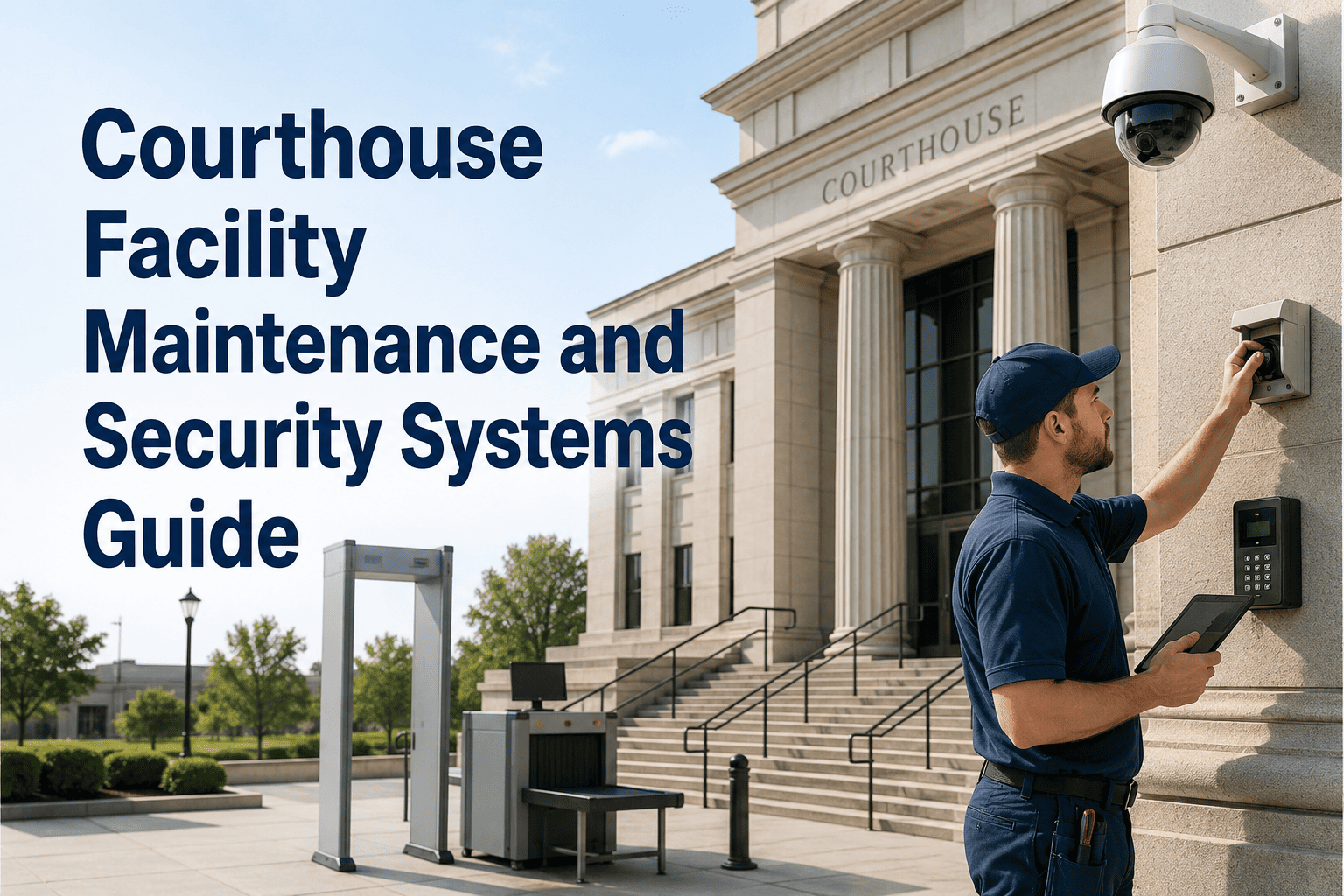
Courthouse Facility Maintenance and Security Systems Guide

By James Smith on May 22, 2026

courthouse-facility-maintenance-and-security-systems-guide

Federal courthouses, district courts, and county judicial facilities operate under a maintenance burden unlike any other public building — every door, every camera, every screening lane, every secure circulation route is both a building system and a security asset. The U.S. Marshals Service maintains more than 1,600 residential security systems and protects over 800 federal facilities, with the Judicial Facility Security Program receiving over $783 million in annual appropriations. OxMaint AI's compliance tracking platform handles courthouse asset records, security system inspections, and chain-of-custody documentation in a single workflow — or book a 30-minute demo for a walkthrough built specifically for judicial facility teams.

Government Buildings · Compliance Tracking

Courthouse Maintenance Is Security Maintenance

From the public lobby through the judge's chambers and the cellblock, every courthouse asset carries a security classification. A failed CCTV camera is not just a maintenance ticket — it is a documented vulnerability. OxMaint AI runs both workflows in one platform built for judicial facility operations.

800+
Federal facilities under U.S. Marshals Service security
6,000+
Court Security Officers managed nationwide
94
U.S. district courts plus 12 circuit appellate courts
$783M
FY judicial facility security appropriation

The Three-Zone Courthouse Security Model

Modern federal and state courthouse design — codified in the GSA U.S. Courts Design Guide and the Whole Building Design Guide — separates the facility into three distinct circulation zones: public, restricted, and secure. Each zone has different access controls, different inspection cycles, and different documentation requirements. A maintenance program that does not respect these zones risks creating an access breach with a single mis-routed work order.

Zone 1 · Public Circulation
Lobby, Screening, Public Corridors
Magnetometer screening lanes, X-ray belts, entry portals, public restroom corridors, courtroom public gallery access. Maintenance access is open during business hours but every work order requires logged escort.
Magnetometers X-ray Belts Entry Doors Public CCTV Duress Buttons
Zone 2 · Restricted Operations
Courtrooms, Clerk Offices, Jury Areas
Courtrooms, jury deliberation rooms, attorney conference rooms, clerk offices, evidence storage. Access requires court-issued credential and access-control logging. Maintenance work requires advance authorization.
Access Control Courtroom AV Evidence Lockers Jury Room Locks Audio Recording
Zone 3 · Secure Judicial
Judge Chambers, Cellblock, Sallyport
Judicial chambers, judge circulation corridors, prisoner holding cells, sallyports, secure parking, judicial residences. Maintenance access requires U.S. Marshals coordination and dual-custody documentation on all work.
Cell Block Sallyport Doors Judge Elevator Residential Alarm Threat Monitoring

The Eight Critical Courthouse System Categories

Courthouse maintenance plans break down into eight system categories, each with its own inspection cadence, certification authority, and documentation requirement. The matrix below maps every category to its responsible inspector, frequency, and the audit trail OxMaint generates automatically when work orders close.

System Category Frequency Certifying Body Documentation
Screening Equipment Daily function test, monthly calibration USMS / GSA / OEM service Daily log, monthly calibration certificate
CCTV & Video Surveillance Weekly imagery check, quarterly storage audit USMS Judicial Security Division Imagery sample log, retention period audit
Access Control Systems Monthly door schedule audit, quarterly credential review Court Clerk + USMS Credential register, door event log
Duress & Panic Systems Monthly silent test, quarterly response drill USMS + Court Security Test certificate, response time record
HVAC & Life Safety Quarterly inspection, annual certification Licensed mechanical contractor BAS alarm history, life safety report
Courtroom Technology Pre-trial check, quarterly full system test AV systems contractor System test log, evidence presentation cert
Detention & Holding Daily pre-shift inspection, weekly engineering check USMS + facilities engineer Cell condition log, lock function record
Judicial Residential Security Quarterly alarm test, annual full-system review USMS Judicial Protection Investigations Encrypted residential security log
For Court Facility Administrators

One Workflow. Three Security Zones. Every Asset Tracked.

OxMaint segments your asset register by security zone, restricts work order visibility by clearance level, and produces the chain-of-custody documentation U.S. Marshals coordination requires — without parallel spreadsheets.

Work Order Routing in a Courthouse Environment

Standard CMMS work order routing fails in a courthouse the moment a technician is dispatched to Zone 3 without coordinated escort. OxMaint's role-based workflow handles the additional approval and escort logic that judicial facility operations require, so the same field crew can handle a Zone 1 magnetometer ticket and a Zone 3 sallyport ticket on the same shift without violating either zone's access protocol.

A
Ticket Classified by Zone
Every work order is automatically tagged with the security zone of the affected asset. Zone 2 and Zone 3 tickets enter an approval queue before assignment.
B
Escort Coordination
Zone 3 tickets are held until a Court Security Officer escort is confirmed in the dispatch calendar. No technician arrives at a secure area without coordination.
C
Dual Sign-Off Required
Restricted and secure-zone tickets require both technician and CSO escort sign-off at closure, creating a verifiable chain-of-custody record for every entry.
D
Audit Export Ready
All work order events with timestamp, escort, photos, and credential logs export directly to the formats required by GAO, OIG, and judicial conference reviews.

The Cost Profile of Reactive Courthouse Maintenance

Courthouse downtime is not measured in dollars alone — it is measured in continuance orders, jury reseating, witness disruption, and judicial calendar slippage. A single failed courtroom AV system on a trial day can cost the court more than a year of preventive maintenance on the same asset. The breakdown below reflects the avoided-cost case OxMaint customers report after standardizing PM scheduling.

Reactive Maintenance
73%
Share of facility budget consumed by emergency repairs in agencies running reactive maintenance, per public sector audits.
  • Trial continuances from AV failure
  • Emergency security override costs
  • Overtime escort coordination
  • Auditor findings on documentation gaps
Preventive with OxMaint
80%
Planned-work share achievable on a structured PM program within twelve months of CMMS standardization.
  • Scheduled courtroom system checks
  • Pre-trial AV verification routines
  • Documented escort coordination
  • Audit-ready compliance package

Expert Review

RT
Robert Thompson, CFM, CPP
Court Facility Administrator · 22 years federal court operations · Certified Protection Professional
"What separates a working courthouse maintenance program from a paper one is the discipline of treating every work order as a security event. A CCTV camera in the lobby is not the same asset as a CCTV camera in the cellblock — even when they are the same make and model. The first is a routine fix, the second is a coordinated entry under USMS protocol. CMMS platforms designed for commercial facilities cannot tell the difference. OxMaint's zone-based work order routing is the first implementation I have seen that respects that distinction without adding three approval layers and a quarterly meeting to every ticket."

Frequently Asked Questions

How does OxMaint coordinate with U.S. Marshals Service security protocols?
OxMaint segments asset records by security zone and integrates dispatch with court security calendars so Zone 2 and Zone 3 work orders are not assigned until escort coordination is confirmed. The platform maintains an encrypted access log that satisfies USMS documentation requirements for facility entry, work performed, and personnel involved. Book a demo to see the courthouse-specific workflow.
Can the platform handle the documentation expectations of GSA and judicial conference audits?
Yes. OxMaint generates the standard audit packages reviewed by GSA Building Service Centers and the Administrative Office of the United States Courts — work order completion histories, preventive maintenance compliance percentages, asset condition trending, and capital request justification. Reports export to PDF and Excel and can be filtered to specific facilities, time ranges, and asset categories. Start a free trial to test report generation.
Does the system support state and county courts as well as federal facilities?
Yes. The three-zone model and security-aware work order routing applies to any judicial facility regardless of jurisdiction. State court administrative offices and county sheriff facility teams use the same workflow with role permissions adapted to their local security command structure. The platform scales from a single municipal courthouse to a multi-facility state judicial portfolio without architectural changes.
How does the platform protect access logs and security system records from external compromise?
Courthouse-tier deployments operate under role-based encryption, segregated tenancy, and audit logging on every credential change. Security-sensitive asset records can be restricted to a small approved user list, with all access events captured in an immutable activity log. Integration with single sign-on identity providers ensures credential changes propagate immediately when staff change roles or leave the agency.
Government Buildings · Compliance Tracking · Judicial Facility Operations

Court Continuity Starts With Maintenance Discipline

Every screening lane, every courtroom system, every cellblock door tracked through a workflow that respects the security zone it belongs to. Built for the way judicial facilities actually operate.
Share This Story, Choose Your Platform!