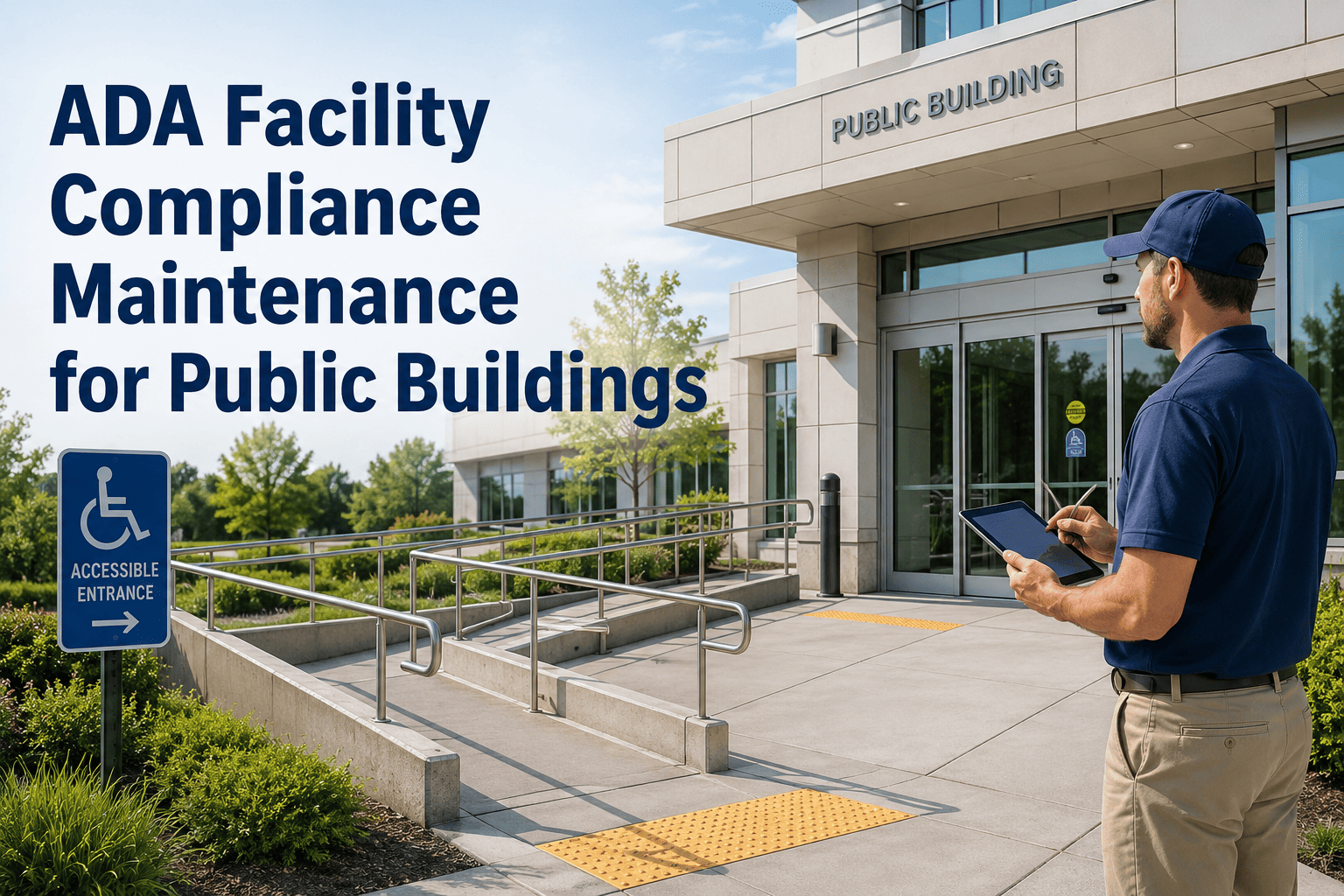
ADA compliance is not a one-time inspection — it is a continuous maintenance obligation, and the Department of Justice has made that point with $75,000 fines for a single first-time violation and $150,000 for repeat infractions. Public buildings, courthouses, libraries, and city halls accumulate accessibility drift between formal audits: a door closer is replaced with a non-compliant model, a grab bar is removed for repair and reinstalled at the wrong height, a curb ramp's detectable warnings wear away. OxMaint AI's compliance tracking platform turns ADA accessibility into a structured maintenance workflow with photo-verified inspections, every finding tied to the right asset — or book a 30-minute demo to see a complete ADA inspection workflow.
Why ADA Violations Happen in Compliant Buildings
Most accessibility violations are not caused by faulty original design — they are caused by maintenance and routine modification. A door knob is swapped during a routine repair without checking the operable parts standard. A directional sign is repositioned during a renovation to a height the wheelchair user cannot read. A water fountain is replaced with a model that the cane technique cannot detect. None of these are deliberate. All of them are now violations.
The Building-Zone ADA Inspection Checklist
A defensible ADA program covers every public-facing zone of every facility, not just the obvious entries. The checklist below is organized by inspection zone, with the dimensional tolerance, the recommended inspection frequency, and the most common drift failure. Each zone in OxMaint becomes a recurring scheduled inspection with photo-required fields and digital sign-off.
- 1 accessible space per 25 spaces (minimum)
- Van-accessible space: 11 ft minimum width with 5 ft access aisle
- Slope no greater than 1:48 in all directions
- Vertical clearance 98 inches minimum for van routes
- Signage 60 inches minimum from grade to bottom edge
- Door opening force 5 pounds maximum (interior, non-fire)
- Clear width 32 inches minimum when door is open 90 degrees
- Threshold 1/2 inch maximum height, beveled at 1:2
- Hardware operable with closed fist (no tight grasping or twisting)
- Door closer sweep period 5 seconds minimum from 70 to 0 degrees
- Continuous clear width 36 inches minimum (reducing to 32 inches max 24 inch length)
- Ramp slope 1:12 maximum, with 1:20 transitions preferred
- Handrails on both sides of ramps with 12 inch extensions
- Detectable warnings on transit platform edges and curb ramps
- Wayfinding signage with tactile and visual characters at 48-60 inch range
- Accessible stall 60 inch turning diameter, 56 inch depth minimum
- Grab bars 33-36 inches above floor with structural anchoring
- Mirror reflecting surface bottom 40 inches maximum above floor
- Dispensers and operable parts within 15-48 inch reach range
- Faucets operable without grasping, pinching, or twisting wrist
- Cab dimensions 51 x 68 inches minimum (centred opening)
- Call buttons 42 inch height with raised characters and braille
- Audible signal 1 ring for up, 2 rings for down at each landing
- Floor designations 60 inches above landing, raised characters
- Re-opening device that prevents door closure on a person or object
- Tactile characters 5/8 to 2 inch height, raised 1/32 inch minimum
- Mounting 48-60 inches above finished floor to baseline
- Non-glare finish with 70 percent contrast minimum
- Pictograms 6 inch field minimum height with tactile text below
- Braille Grade 2 directly below corresponding raised characters
Stop Tracking ADA in Spreadsheets
OxMaint converts this checklist into recurring scheduled inspections with mandatory photo capture, dimensional input fields, and digital sign-off. When a DOJ complaint arrives, the inspection trail is one export away — not three months of cross-referencing paper logs.
Compliance Inspection Frequency by Code Risk Tier
Not every accessible component carries the same drift risk. Door closers and operable parts fail or are tampered with constantly — they need monthly checks. Signage and elevator cab dimensions rarely change without a renovation work order — annual confirmation is enough. The matrix below sets the minimum cadence the U.S. Access Board considers a defensible maintenance program.
| Risk Tier | Components | Cycle | Common Failure Pattern |
|---|---|---|---|
| High | Door closers, operable parts, restroom grab bars, accessible route obstructions | Monthly | Hardware swapped during repair without ADA-spec verification |
| Med | Parking signage, ramp slopes, curb ramps, detectable warnings, lighting levels | Quarterly | Pavement settles, signage faded by weather, slopes drift after resurfacing |
| Low | Tactile signage, elevator cab dimensions, counter heights, fixed casework | Annually | Modified during a renovation that bypassed accessibility plan review |
| Event | All zones, after any renovation, repair, or modification work order | Triggered | Component changed under non-accessibility work order without re-verification |
How OxMaint Closes the Compliance Loop
The difference between a building that passes a federal audit and one that does not is rarely the underlying construction — it is whether every modification, repair, and replacement was captured in a compliance-aware system. OxMaint embeds ADA verification into the work order lifecycle itself, so accessibility is checked at the point of work, not weeks later by an auditor.
Expert Review
Frequently Asked Questions
Compliance Drift Is the Quiet Cost. OxMaint Stops It.
Every accessible component verified on schedule. Every work order checked against ADA specification. Every audit answered with one export. See the ADA workflow in 30 minutes.