Municipal assets are now operating in a climate they were never designed for — record heatwaves buckling roads, atmospheric rivers overwhelming stormwater systems, and wildfire smoke degrading HVAC filtration faster than maintenance budgets can absorb. The National Institute of Building Sciences has shown that every $1 invested in mitigation saves $6 in disaster recovery, yet most municipalities still operate maintenance programs built around historical weather averages that no longer apply. Oxmaint's analytics platform lets public works directors map every asset to its climate exposure, prioritize hardening investments, and capture the documentation trail FEMA reimbursement requires — or book a 30-minute live demo to see climate resilience planning in action.
Analytics & Reporting · Climate Resilience
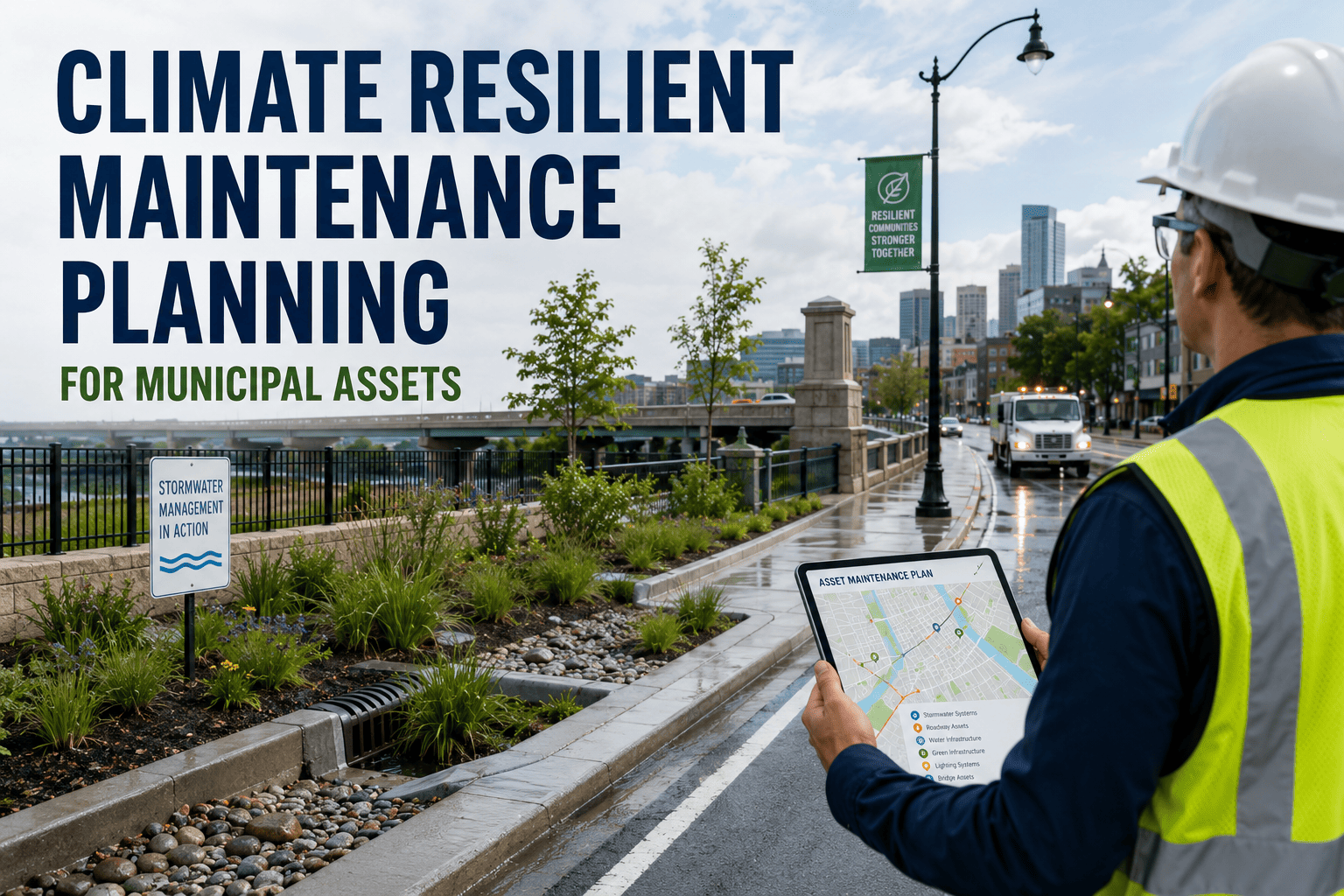
Climate Resilient Maintenance Planning for Municipal Assets
Floods, heatwaves, wildfire, and severe storms now strike cities outside historical patterns. This planning guide shows how municipalities use Oxmaint to score asset vulnerability, harden critical infrastructure, and turn every storm into a reimbursable, documented response.
6×
Return on every dollar invested in climate mitigation (NIBS)
40%
Faster post-event recovery for digitally resilient municipalities
10×
Cost of reactive emergency repair versus proactive hardening
The Climate Risk Reality for Municipal Assets
Roads, bridges, stormwater systems, public buildings, fleet vehicles, parks, and utility networks all share one vulnerability: they were specified, built, and maintained under climate assumptions that the last decade has invalidated. Maintenance plans built on 30-year historical averages now systematically underestimate failure frequency, severity, and cascading impact across asset categories.
| Climate Hazard |
Roads & Bridges |
Stormwater Network |
Public Buildings |
Fleet & Equipment |
| Extreme Heat |
High |
Moderate |
Critical |
Moderate |
| Flooding & Heavy Rain |
Critical |
Critical |
High |
High |
| Wildfire & Smoke |
Low |
Moderate |
High |
Critical |
| Severe Wind & Storms |
Moderate |
High |
High |
Moderate |
| Coastal & SLR Events |
High |
Critical |
Moderate |
Low |
The Four Pillars of Climate Resilient Maintenance
A resilience program is not a single product — it is a coordinated discipline that runs across asset planning, fieldwork, monitoring, and recovery. Municipalities that treat these pillars as one continuous loop recover faster, file cleaner reimbursement claims, and absorb future events with less budget shock.
01
Assess
Vulnerability Scoring
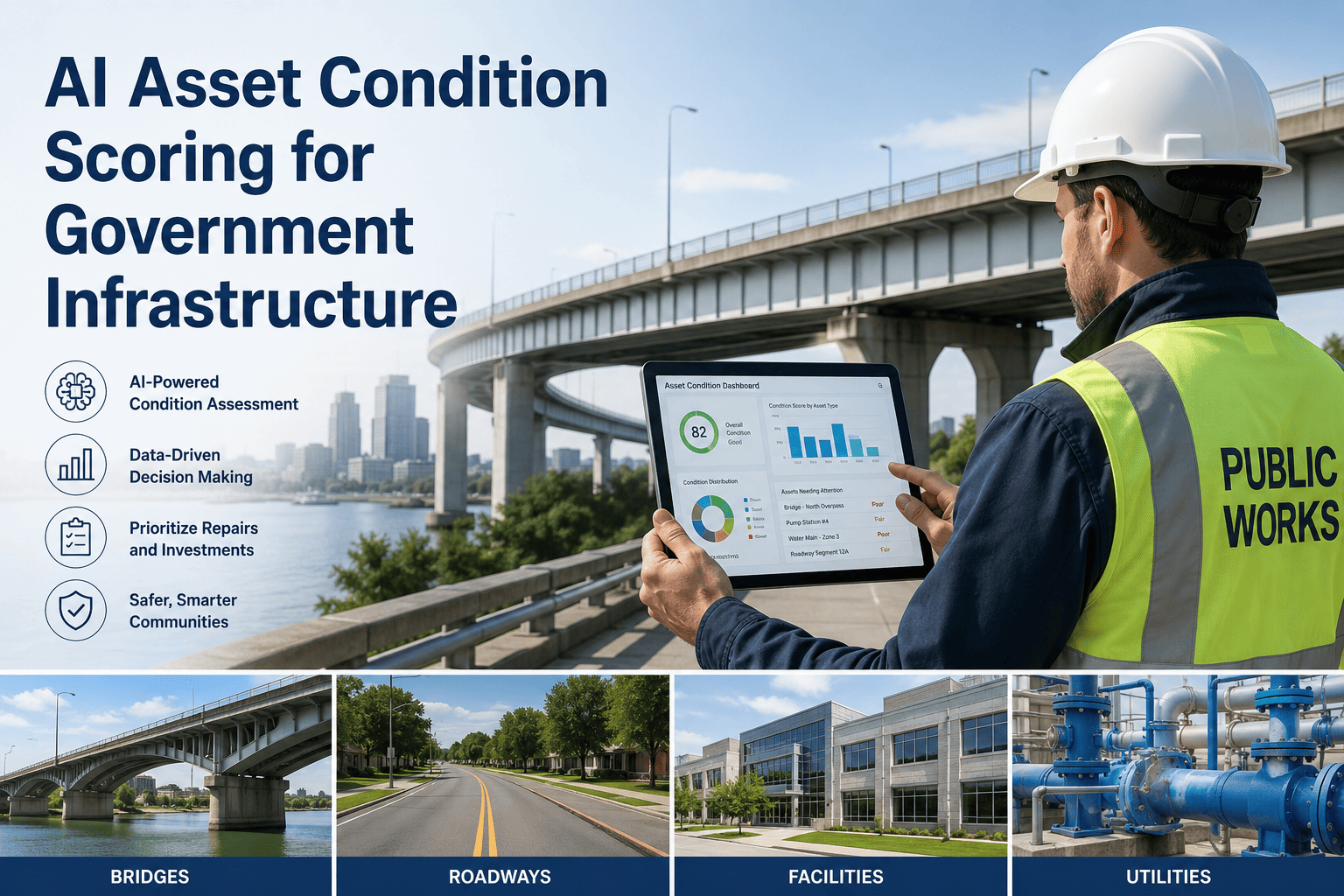
Every asset gets a climate exposure score combining hazard probability, asset age, condition, criticality, and population served. Scoring surfaces the 10 to 15% of assets that drive 70% of climate-related failure risk.
02
Harden
Mitigation Work Orders
Highest-scored assets enter a planned hardening pipeline: elevated electricals in flood zones, upgraded HVAC filtration for smoke, expansion-joint replacement for heat, and backup-power retrofits for storm continuity.
03
Monitor
Real-Time Condition Watch
IoT sensor data, weather alerts, and crew field reports flow into a single dashboard. Threshold breaches trigger work orders automatically so degradation is intercepted before it becomes a service outage.
04
Recover
Documented Response & FEMA Claim
Every post-event work order — labor hours, parts, contractor invoices, photos, GPS-tagged inspection notes — is captured in a single audit trail that maps directly to FEMA Public Assistance documentation requirements.
Build Your Resilience Roadmap
Score every asset against every hazard, automatically
The Storm Lifecycle: Before, During, After
Resilience is judged on three distinct timeline windows. Most municipalities have informal plans for "during" but lack disciplined workflows for "before" and "after" — which is where the largest cost savings and recovery acceleration actually sit.
Pre-Event Hardening Sweep
Auto-generate pre-storm inspection work orders for every critical asset on the affected geography
Confirm fuel, generator, pump, and chainsaw readiness through equipment status checks
Stage crews, vehicles, and parts inventory by event-zone proximity
Live Response Coordination
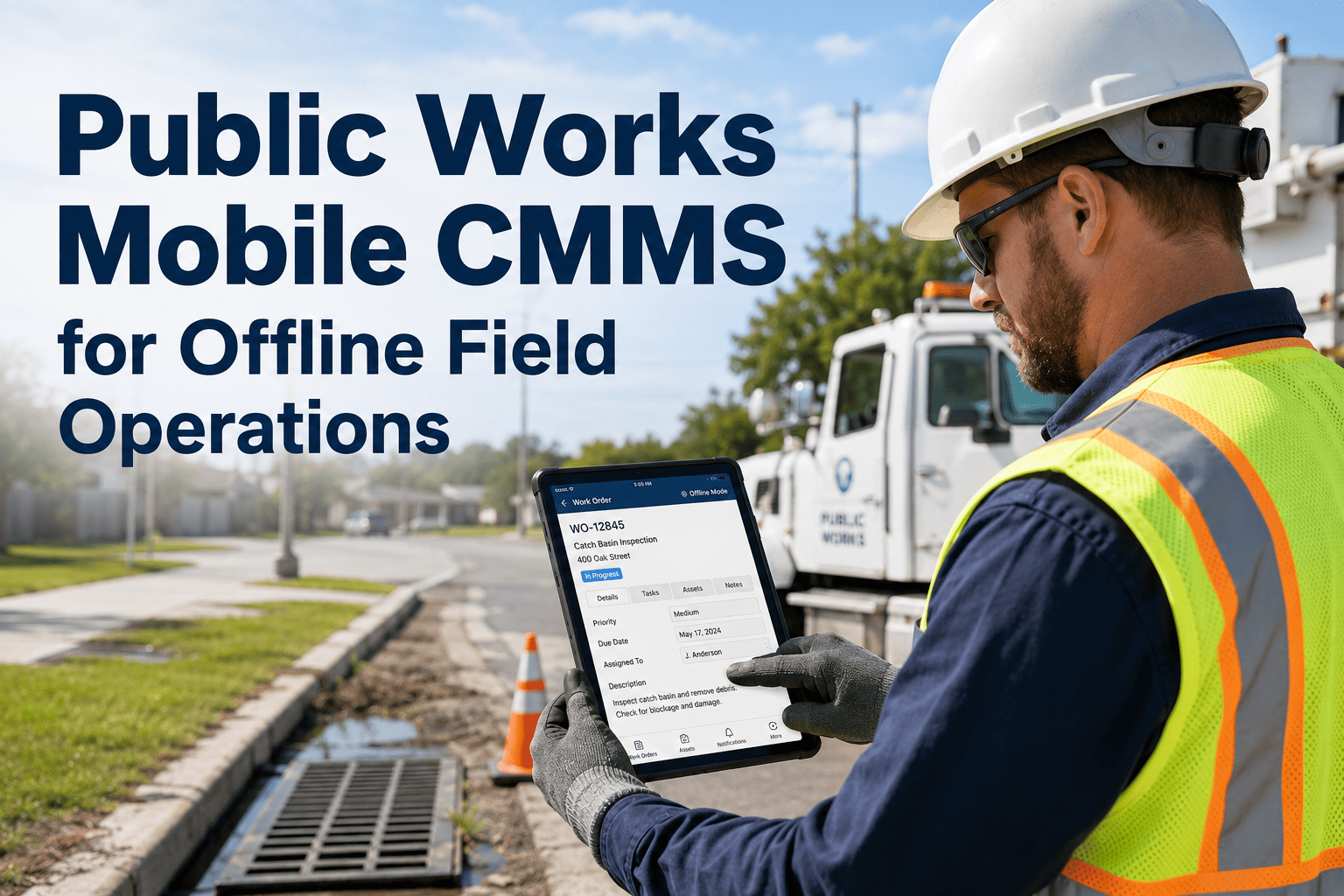
Field crews log incidents from mobile devices with GPS, photos, and condition notes — offline-capable in dead zones
Dispatch routes priority repairs first using real-time crew availability and asset criticality
Emergency operations center sees a live map of open incidents, in-progress work, and closed responses
Damage Audit & FEMA Submission
Export complete event work order log: labor, equipment, mutual aid, contractor, materials, with timestamps and photos
Match damage records against pre-event asset condition baseline to substantiate disaster impact
Package documentation for FEMA Public Assistance Category A through G claims with audit-ready completeness
FEMA Public Assistance Documentation Readiness
FEMA reimburses up to 75% of eligible disaster recovery costs — but only when documentation meets the standard. Most municipalities lose 20 to 40% of an otherwise-eligible claim to incomplete records, missing labor timesheets, or photos that cannot be matched to specific work orders. Oxmaint structures every post-event work order to capture exactly what Public Assistance reviewers require.
Cat A
Debris Removal
Labor hours by crew, equipment hours by unit, disposal tonnage, route GPS data, hazardous material handling logs
Cat B
Emergency Protective Measures
Sandbagging, evacuation support, generator deployment, shelter setup — itemized to crew, time, and location
Cat C
Roads & Bridges
Pre-event condition baseline, photo evidence of damage, repair scope, materials invoice trail, completion sign-off
Cat E
Public Buildings & Equipment
Asset record with insured value, post-event damage assessment, repair vs replace cost analysis, contractor selection records
Cat F
Utilities
Outage logs, restoration timeline, mutual aid crew records, parts and pole inventory consumed during the event
Cat G
Parks & Recreation
Tree damage tallies, playground equipment inventory, trail restoration scope, public space safety sign-off documentation
Measured Outcomes from Resilience-Driven Maintenance
Municipalities that move from reactive disaster response to a structured climate resilience program see four consistent operational gains within the first full budget cycle. The pattern holds across coastal, inland, mountain, and arid jurisdictions tracked by APWA member surveys and FEMA after-action reviews.
40%
Faster post-event service restoration vs reactive-only response
60%
Improvement in FEMA reimbursement capture rate with complete documentation
25%
Drop in unplanned emergency overtime once hardening priorities are funded
3.5×
Lifetime extension on hardened assets versus baseline replacement schedule
Expert Review
LH
Linda Harrington, P.E., CFM
Municipal Resilience Director · Certified Floodplain Manager · APWA Climate Action Task Force
"The cities that recover well from climate events are not the ones with the biggest emergency budgets — they are the ones with the best records. A CMMS that captures pre-event condition, every work order during the event, and every dollar spent in recovery is the difference between a clean 75% FEMA reimbursement and a contested claim that takes two years to settle. Climate resilience planning is not a separate program from maintenance; it is maintenance done with the next storm already on the calendar. Oxmaint gives municipal teams the asset-by-asset vulnerability view and the documentation discipline that FEMA, GAO auditors, and bond rating agencies all want to see."
Frequently Asked Questions
How does Oxmaint calculate climate vulnerability scores for municipal assets?
Each asset record stores location, age, condition rating, criticality tier, and population served. Oxmaint combines these with hazard exposure inputs you load — FEMA flood zones, NOAA heat days, wildfire risk maps, sea level rise projections — to produce a 0 to 100 vulnerability score. The top-scored 10 to 15% of your portfolio almost always drives the majority of disaster cost, which lets capital planning teams concentrate hardening dollars where reimbursement-adjusted ROI is highest.
Start a free trial to upload your asset register and see the score distribution.
Can field crews log post-event damage when network connectivity is down?
Yes. Oxmaint's mobile app runs fully offline for work order logging, photo capture, GPS tagging, parts consumption, and crew timesheets. When the device reconnects to cellular or Wi-Fi, queued records sync automatically to the central database with original timestamps preserved — which is what FEMA needs to validate that field documentation was created during the response and not reconstructed weeks later.
How does Oxmaint help capture FEMA Public Assistance reimbursement dollars?
Every event-related work order is tagged to the disaster declaration and the applicable PA category (A through G). The system captures labor by employee with rate and hours, equipment use by unit with FEMA Schedule of Equipment Rates lookup, contractor invoices with procurement justification, materials, mutual aid, and photos linked to each asset. The exportable Project Worksheet package is structured exactly the way FEMA reviewers expect, which is the single biggest factor in claim closure speed and capture rate.
Book a demo to see the FEMA-ready export workflow.
What climate data sources integrate with the vulnerability scoring model?
Oxmaint accepts hazard layer inputs from FEMA National Risk Index, NOAA Sea Level Rise Viewer, USGS streamgage flood data, USFS Wildfire Hazard Potential, and NWS extreme weather alerts. Municipalities that have invested in their own GIS-based climate vulnerability assessments — common in coastal and Western states — can load those layers directly so the asset scoring inherits the city's own approved planning assumptions rather than generic national defaults.
Analytics & Reporting · Climate Resilience · FEMA Reimbursement
The Next Storm Will Find Your Records, Not Your Memory
Score the assets at risk. Harden them on a budget that pays back six to one. Document every dollar of the next event in a system FEMA, GAO, and the city auditor can all read. That is climate resilient maintenance — and Oxmaint is built for it.