Per-day EPA fine for discharge permit violations in food processing — EPA enforcement data 2024
68%
Of food plant wastewater violations traced to missed PM tasks — not equipment failure — EPA audits
3–5×
Higher BOD loads in food processing effluent vs municipal sewage — requiring active, documented treatment
40%
Of DAF system failures caused by deferred maintenance on air dissolving tubes and skimmer mechanisms
Why This Checklist Exists
What Is Wastewater Treatment Maintenance in Food Processing?
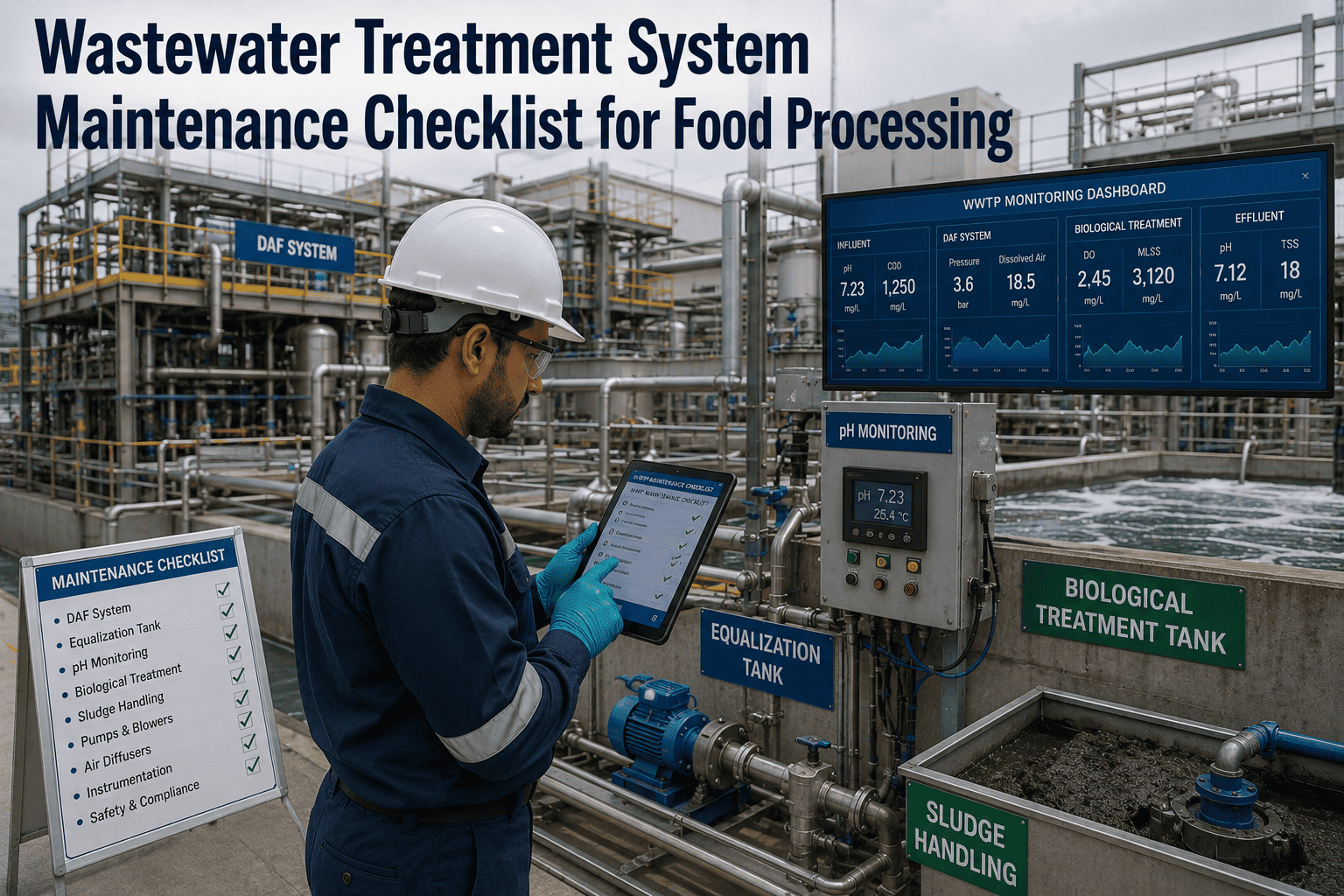
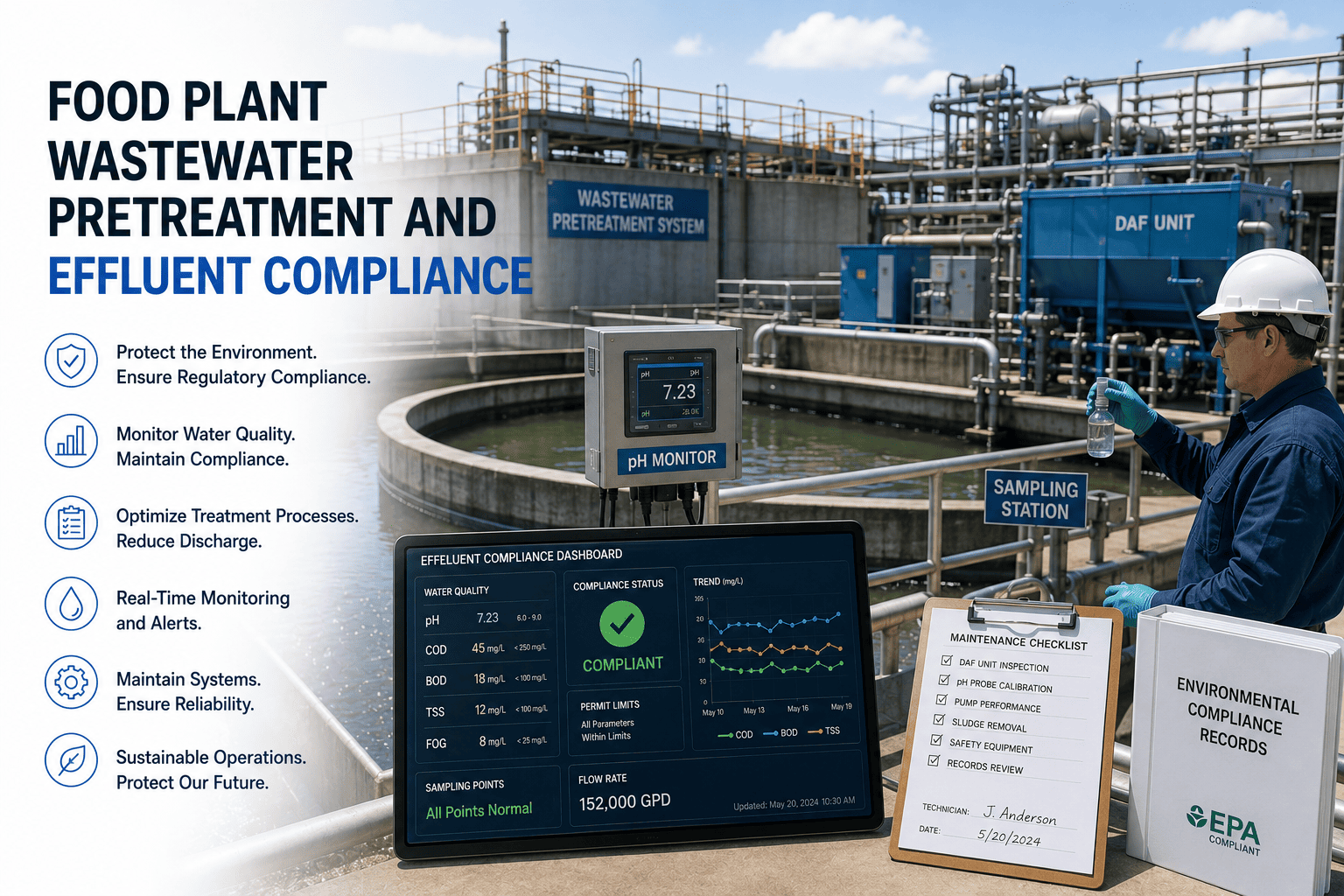
Food processing wastewater carries high loads of fats, oils, grease (FOG), suspended solids, BOD, and pathogenic organisms. Every production line generates effluent that must be treated to permit-compliant levels before discharge to municipal sewer or receiving waters. The treatment chain — screening, equalization, pH adjustment, DAF, biological treatment, effluent polishing — requires documented, scheduled maintenance at every stage to function within specification.
Six Core Treatment Stages — Maintenance at Each Level
01
Screening & Grit Removal
Bar screens and rotary drum screens remove solids before DAF or biological stages. Screen blinding causes upstream flooding and passes solids that choke downstream processes.
02
Equalization Tank
Buffers flow and load variability from batch production cycles. Mixing systems, level sensors, and aeration must be maintained to prevent stratification, odor events, and overflow during peak production.
03
pH Adjustment System
Acid and caustic dosing to maintain pH 6.5–8.5 for biological treatment and discharge compliance. Pump calibration, probe verification, and chemical inventory are daily critical tasks.
04
DAF System
Dissolved air flotation removes FOG and suspended solids. Skimmer mechanism, air dissolving tube, and chemical dosing require weekly inspection to maintain removal efficiency above 85%.
05
Biological Treatment
Activated sludge or MBR systems degrade dissolved organics. MLSS monitoring, DO levels, SVI, and membrane integrity define biological health — daily parameters that detect upset before BOD spikes.
06
Sludge Handling
Dewatering, storage, transport, and disposal of biological sludge require documented chain of custody. Missed hauling schedules cause tank overflow. Disposal records are mandatory for regulatory audits.
Most food plant discharge violations originate from a single missed pH calibration or an undocumented sludge disposal event — not catastrophic equipment failure. Documentation is the compliance risk, not just the hardware.
Pain Points
Four Ways Wastewater Maintenance Gaps Cost Food Plants
01
Permit Exceedances from Deferred Calibration
pH probes drift 0.3–0.5 pH units per week without calibration. An uncalibrated probe reading 7.2 may be discharging at 9.1 — above permit limits — for days before the next composite sample reveals the breach. Violation notices are already in process by then.
02
DAF Failure from Missed Skimmer PM
DAF skimmer blades worn beyond tolerance pass FOG directly to the biological stage. Activated sludge systems take 5–14 days to recover from a FOG shock load — during which BOD in final effluent can exceed permit limits by 300–500%.
Sludge storage tanks at food processing plants fill 40–60% faster during seasonal production peaks. Manual hauling schedules based on calendar intervals miss peak-volume periods — resulting in tank overflow events that create both environmental and worker safety incidents.
Before vs After
Paper Logs vs OxMaint Digital Compliance Tracking
Process Area
Paper / Manual System
OxMaint Digital Tracking
pH Calibration Records
Handwritten logbook — missing entries common, illegible dates at audit
Digital calibration record with timestamp, technician ID, and buffer values auto-filed
DAF PM Scheduling
Calendar reminder — missed during production peaks, no escalation if skipped
Auto-generated work order 7 days before due with escalation if not closed on time
Sludge Disposal Manifests
Paper manifests in folders — retrieval takes hours during audit
Digital manifest attached to work order, searchable by date, hauler, and volume in seconds
Discharge Compliance Reports
Manual compilation from multiple logbooks — 2–3 days per quarterly report
Auto-compiled from completed task records — report generated in under 10 minutes
Composite Sample Tracking
Lab results filed separately from maintenance records — no cross-reference
Lab results attached to sample collection work order and trended against permit limits
Missed Task Escalation
No system — supervisor discovers missed tasks at end-of-week review
Automatic notification to supervisor if critical task not completed within 2 hours of due time
ROI & Results
What Structured Wastewater Compliance Management Delivers
91%
Reduction in Permit Exceedances
Food plants implementing structured digital PM and calibration tracking — WEF Compliance Study 2023
$25K+
Per-Day Fine Avoided
Each prevented discharge violation funds compliance software for 3+ years
75%
Faster Audit Preparation
Digital records replace 3–5 days of manual logbook compilation before every regulatory inspection
40%
DAF Efficiency Improvement
From structured skimmer and air tube PM restoring FOG removal to design specification
FAQ
Wastewater Treatment Maintenance — Common Questions
How often should DAF systems be fully inspected in a food processing plant?
DAF units in food processing should receive daily operational checks (skimmer cycling, air pressure, float quality), weekly chemical performance reviews, and a full internal inspection quarterly — draining the unit to inspect baffles, nozzles, trough condition, and skimmer blade wear. Plants with high-fat product lines (dairy, poultry, fry operations) should increase the full inspection to every 6–8 weeks due to accelerated FOG loading. OxMaint auto-schedules all three frequencies and escalates if any inspection is overdue.
What records are required for a food plant wastewater discharge permit audit?
A typical NPDES or industrial pretreatment permit audit requires: all composite and grab sample results for the permit period, flow meter records, pH monitoring logs with calibration records, sludge disposal manifests with hauler information, chemical usage logs, corrective action records for any parameter exceedances, and equipment maintenance records for all treatment units. Auditors typically request 12–24 months of records on short notice. OxMaint stores all completed checklist tasks, calibration records, and attached lab results in searchable digital format — generating a complete audit package in under 10 minutes. Book a demo to see the audit report generation workflow.
How should sludge disposal be documented to satisfy regulatory requirements?
Every sludge removal event requires a chain of custody from point of generation to final disposal — hauler identity, vehicle registration, estimated or actual volume/weight, receiving facility name and permit number, and a signed manifest. Food plant sludge classified as non-hazardous industrial waste requires a minimum of one year of manifest retention in most US states. OxMaint attaches digital manifests directly to sludge removal work orders, creating an unbroken chain of custody for every hauling event that satisfies both state and federal record-keeping requirements.
What triggers a biological treatment upset in food processing wastewater?
The most common upset triggers are: sudden FOG load increases from a failed DAF, pH shock from cleaning chemical carryover into the drain system, temperature spikes from hot CIP discharge above 40°C, and toxic material introduction from sanitizers or pest control products reaching the drain system. Recovery from a biological upset takes 5–21 days depending on severity. Structured daily monitoring of MLSS, DO, and SVI in OxMaint detects early signs of biological stress — allowing intervention before the effluent quality is impacted.
Stop Managing Discharge Compliance with Logbooks and Memory
OxMaint structures every wastewater PM task, calibration, sample collection, and disposal record into a single auditable digital system — so your discharge permit is protected by a process, not a person.
Auto-scheduled PM tasks with escalation for overdue compliance items
Digital calibration and sample records — audit-ready in under 10 minutes
Sludge disposal chain of custody attached to every hauling work order
Used by operations teams managing 10,000+ assets · Live in days, not months · No heavy implementation required