Average cost of a food recall triggered by pest contamination — FDA recall cost data 2023
FDA 483
Pest evidence is a top-5 reason for FDA 483 observations in food facilities annually
72 hrs
Time from pest activity detection to required corrective action documentation under most GFSI schemes
3×
Higher rodent entry risk at facilities without documented quarterly building seal inspections — AIB benchmark
Why Documented IPM Is Non-Negotiable
What Is Integrated Pest Management in Food Manufacturing?
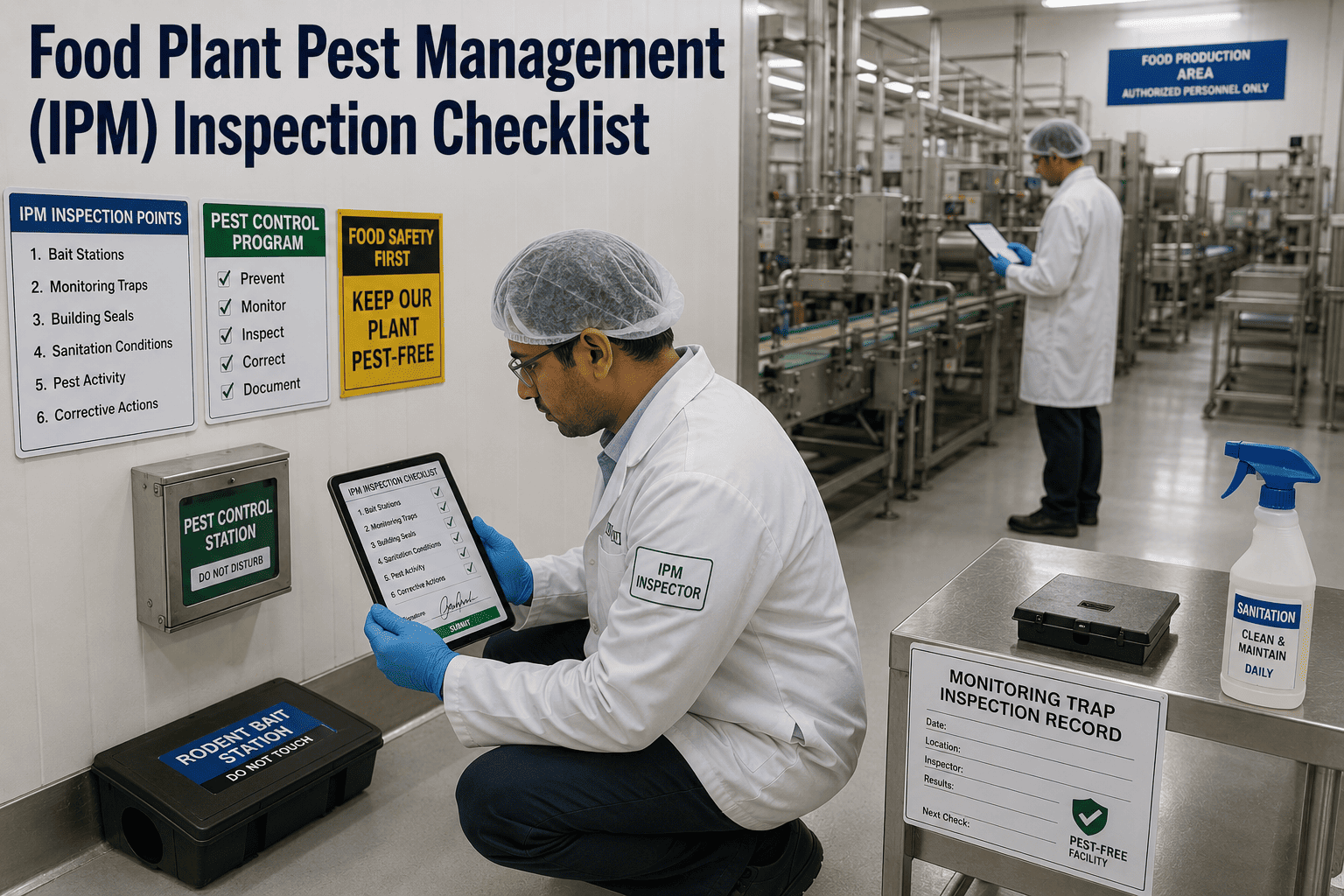
Integrated Pest Management in food manufacturing is a systematic, preventive approach combining physical exclusion, environmental controls, monitoring, and targeted interventions — each documented to create a continuous audit trail. Unlike reactive pest control, IPM prevents entry and detects activity early through scheduled monitoring of bait stations, insect light traps, pheromone traps, and structural exclusion points.
Interior and exterior rodent bait stations require scheduled inspection, activity logging, and tamper verification. Activity at any interior station triggers mandatory corrective action within 72 hours.
02
Insect Light Traps (ILTs)
Flying insect monitors catch and retain insects for species identification and population trending. Glue board replacement frequency, catch counts, and species composition changes are all auditable data points.
03
Facility Seal Inspection
Building envelope integrity — door seals, pipe penetrations, roof vents, loading dock gaps — is the first line of pest exclusion. Quarterly walk-arounds with documented findings are mandatory under all GFSI schemes.
04
Pheromone Traps
Grain and stored product pests — Indian meal moth, cigarette beetle, flour beetle — are detected by pheromone traps in raw material storage. Weekly catch counts trending upward signal an infestation before visual confirmation.
05
Pest Activity Logging
Every pest sighting — droppings, gnaw marks, live or dead pests — must be logged with date, time, exact location, and species/type. The activity log is primary evidence of proactive detection and drives corrective action priority.
06
Corrective Action Management
Every pest finding triggers a documented corrective action: root cause, immediate action, preventive action, and closure verification. Open corrective actions at time of audit are a critical finding under SQF and BRC standards.
Open corrective actions at the time of an SQF or BRC audit — regardless of severity — are automatic major non-conformances. The record of closure matters as much as the action itself.
Pain Points
Four IPM Failures That Show Up in Every Food Plant Audit
01
Trap Log Gaps That Fail Audits
A paper trap log with one missing inspection week is an audit finding under SQF and BRC — even if no pest activity occurred during that period. Auditors interpret gaps as evidence that the program was not being managed, not that nothing happened. Digital tracking eliminates gaps by recording every completed inspection automatically.
Bait station maps must match actual station placement. When a station is moved for a new production line and the map is not updated, the audit finds a mismatch — which auditors interpret as an undocumented program change. Digital station mapping with version control solves this permanently.
04
No Trend Analysis Documentation
GFSI standards require evidence that pest activity data is being analyzed for trends — not just recorded. Rising ILT catch counts in a specific zone should trigger an investigation even before a pest sighting occurs. Without a system that compiles and compares catch data across periods, trend analysis never happens.
Before vs After
Paper IPM Logs vs OxMaint Digital IPM Tracking
IPM Process
Paper / Manual System
OxMaint Digital Tracking
Weekly trap inspection logs
Paper forms — missing weeks create audit gaps with no escalation
Mobile checklist — each station checked off digitally with timestamp and technician ID
Pest activity recording
Sighting logged in notebook — no link to corrective action system
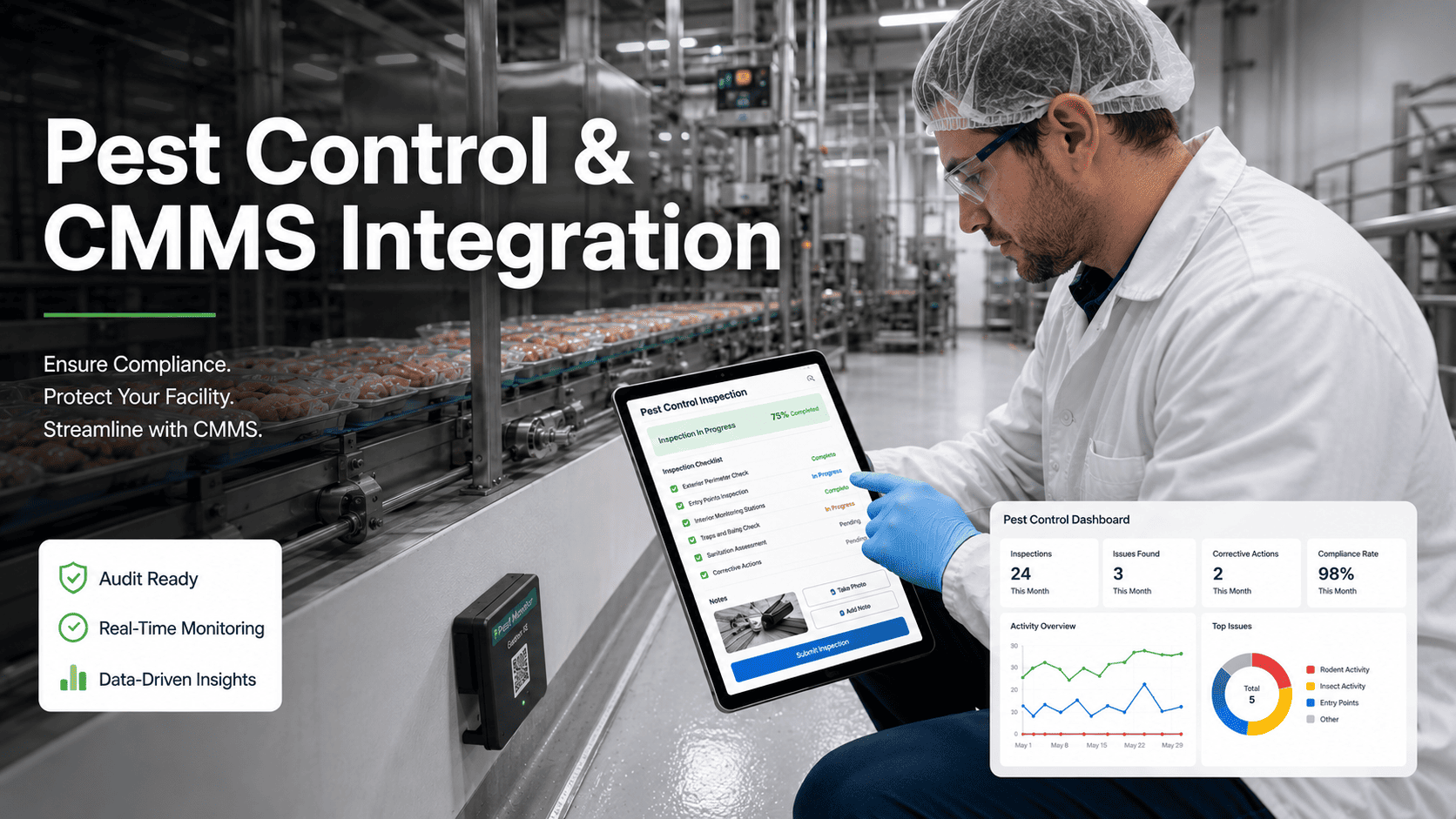
Activity logged via mobile app — automatic corrective action work order created within 60 seconds
Corrective action tracking
Paper form — no escalation if closure date missed, discovered at audit
Auto-escalation 48 hours before due date — manager notified if not closed
Bait station mapping
Laminated map updated occasionally — version mismatches common
Digital station map with version history — each move logged with date and reason
Trend analysis
Manual comparison of paper logs — rarely done outside formal audits
Auto-generated monthly trend chart comparing catch counts across zones and periods
Audit preparation
2–4 days compiling paper logs, corrective actions, and service reports
Complete IPM audit package exported in under 15 minutes — filterable by date and zone
ROI & Results
What a Documented IPM Program Delivers
Zero
Audit Findings from Log Gaps
Digital trap logging eliminates the incomplete-record finding that affects 60%+ of food plant IPM audits
72 hrs
Max Corrective Action Closure
Auto-escalation ensures no pest corrective action remains open beyond scheme requirements
85%
Faster Audit Preparation
Digital IPM records replace 2–4 days of log compilation — full audit package in under 15 minutes
3×
Earlier Pest Detection
Trend analysis from weekly trap data catches pest pressure 3 weeks before a visual sighting would occur — AIB benchmark
FAQ
Food Plant IPM — Common Questions
How many bait stations does a food plant typically need, and how are they mapped?
AIB International and most GFSI schemes recommend interior rodent bait stations at 30–50 foot intervals along all exterior walls and at all entry points. A 50,000 sq ft food plant typically requires 40–80 interior stations and 20–40 exterior stations. Each station must be numbered, secured to a fixed surface, and plotted on a scaled facility map. OxMaint maintains the digital station map with a version history — every station addition, removal, or relocation is recorded with date and reason, eliminating the version mismatch findings that occur with paper maps. Start a free trial to configure your facility's digital bait station map in OxMaint.
What is considered "pest activity" that requires a corrective action under SQF and BRC?
Under SQF Code Edition 9 and BRC Food Issue 9, any evidence of pest presence requires documented investigation and corrective action — including live pests, dead pests, rodent droppings, gnaw marks, bird droppings, insect frass, stored product pest larvae, and above-threshold trap catch counts. The corrective action must document the immediate control measure, root cause investigation, preventive action, and closure evidence with dates — all available to auditors on request within 24 hours.
Can our pest control contractor manage the IPM program documentation, or does it need to be internal?
GFSI schemes require the food manufacturer to maintain ownership of the IPM program — the pest control contractor provides technical service, but the documentation responsibility rests with the facility. Internal staff must verify contractor findings, maintain the activity log, initiate corrective actions for contractor-identified issues, and ensure the facility's own inspection records are complete between contractor visits. OxMaint supports both internal and contractor-assigned tasks in a single compliance record. Book a demo to see how OxMaint structures both internal and contractor IPM tasks.
How should a food plant respond if a pest sighting occurs within 30 days of a certification audit?
A pest sighting close to an audit is not automatically a major finding — the response documentation is what auditors evaluate. Required immediate actions: log the sighting with full details within 2 hours, assess and document product safety risk, raise a corrective action work order, implement immediate control measures, and increase monitoring frequency in the affected zone. If the corrective action is closed with full documentation before the audit, it demonstrates a functioning response system. An open corrective action with no documented closure is an automatic major non-conformance under both SQF and BRC.
IPM Compliance · OxMaint CMMS · Food Safety
Turn Your IPM Program from an Audit Risk into an Audit Advantage
OxMaint digitizes every trap log, pest activity record, corrective action, and building seal inspection — creating the continuous, unbroken compliance record that satisfies SQF, BRC, and FDA on any inspection day.
Digital trap logs with timestamp — no more missing inspection weeks
Auto-generated corrective actions with escalation before closure deadlines
Full audit package in under 15 minutes — ready for SQF, BRC, and FDA
Used by operations teams managing 10,000+ assets · Live in days, not months · No heavy implementation required