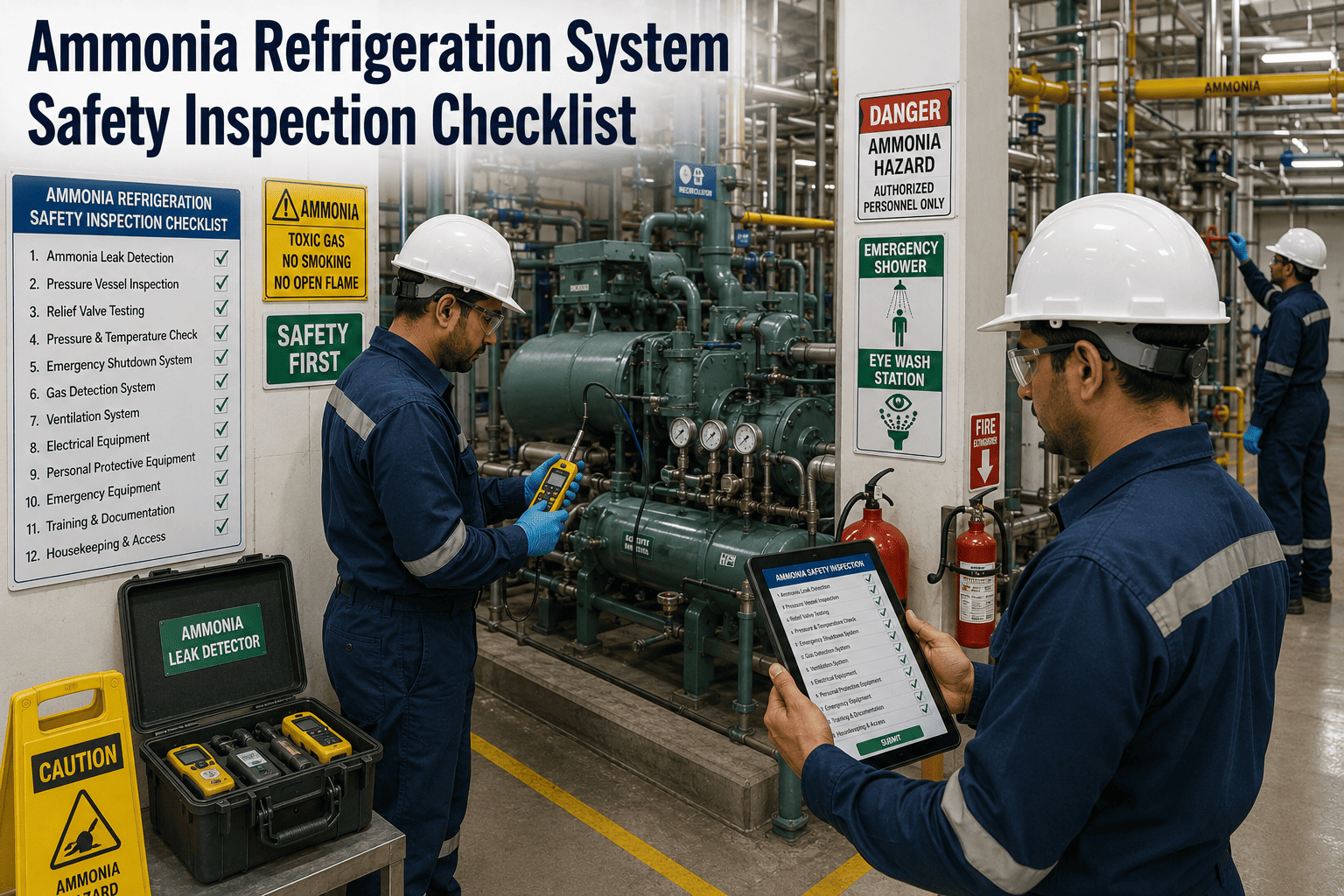
Ammonia Refrigeration System Safety Inspection Checklist
By Josh Turley on May 8, 2026
Ammonia refrigeration systems are the most energy-efficient refrigeration technology in food processing, cold storage, and distribution — and they carry a federally regulated Process Safety Management obligation the moment the system contains 10,000 pounds or more of anhydrous ammonia. PSM compliance is not optional: OSHA PSM citations for refrigeration systems average $156,000 per incident, with criminal liability attaching to fatalities. The difference between a facility that passes its PSM audit and one that faces enforcement action is not the quality of the refrigeration equipment — it is the completeness and continuity of the inspection and maintenance documentation. Start a free trial to see how OxMaint structures every ammonia refrigeration PM task, leak detection record, pressure vessel inspection, and PSM compliance item into an audit-ready digital system.
Average OSHA PSM citation cost for ammonia refrigeration violations — OSHA enforcement data 2023
10,000 lbs
Threshold triggering mandatory OSHA PSM and EPA RMP compliance for anhydrous ammonia systems
300 ppm
IDLH (Immediately Dangerous to Life or Health) ammonia concentration — LEL is 15% by volume
72%
Of PSM enforcement actions involve documentation gaps rather than direct system failures — OSHA data
Regulatory Context
PSM and RMP Compliance Requirements for Ammonia Refrigeration
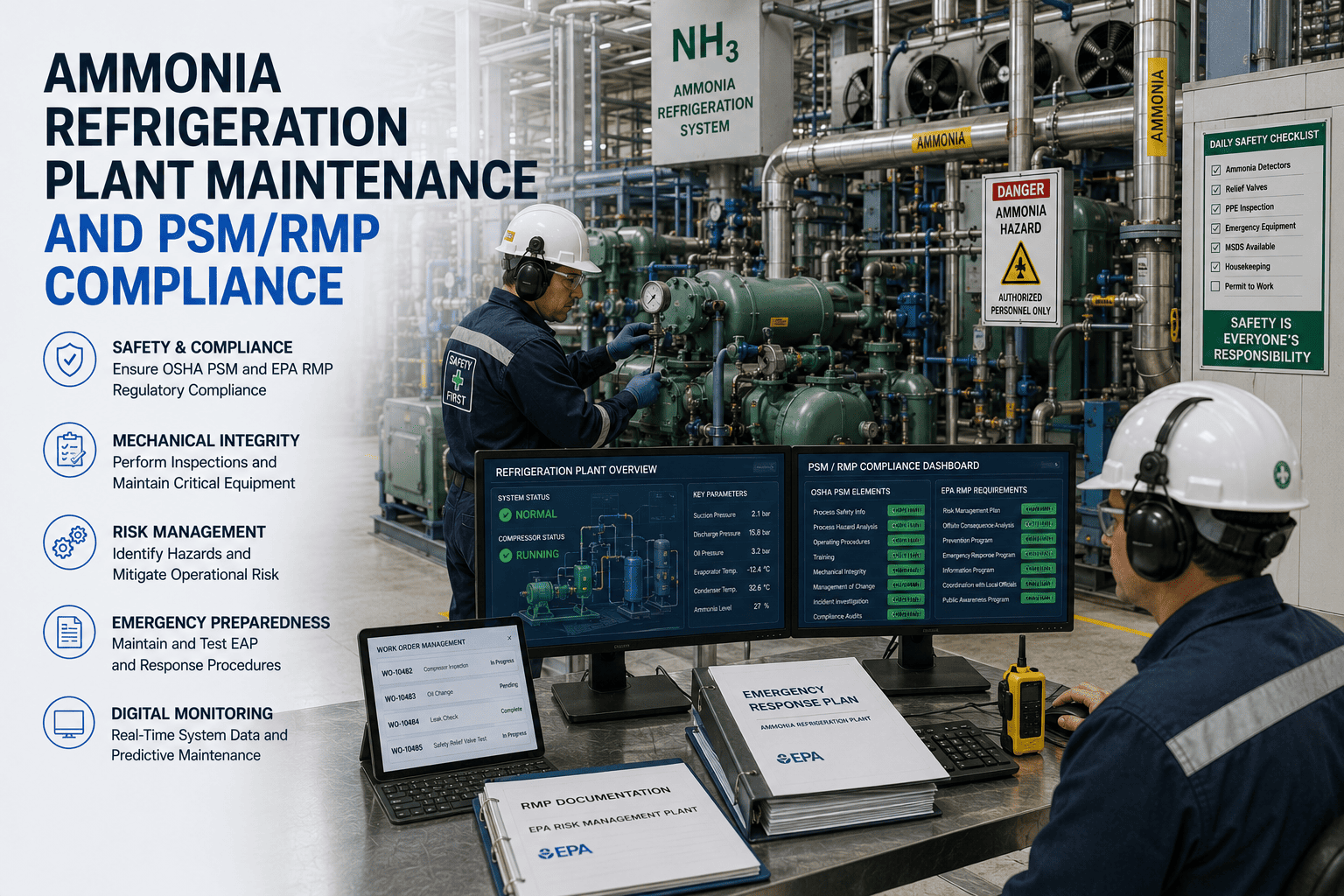
OSHA 29 CFR 1910.119 (Process Safety Management) and EPA 40 CFR Part 68 (Risk Management Program) impose parallel compliance obligations on facilities with 10,000 lbs or more of anhydrous ammonia. PSM requires a Process Hazard Analysis, written Operating Procedures, a Mechanical Integrity (MI) program covering all pressure vessels and critical components, Management of Change procedures, and Pre-Startup Safety Reviews. The MI program alone requires documented inspection of every pressure vessel, relief valve, pump, compressor, and heat exchanger on defined intervals — with records retained for the life of the equipment.
Six Critical Ammonia System Components Requiring Documented Inspection
01
Compressors
Screw and reciprocating compressors are the heart of the system. Oil pressure, discharge temperature, suction pressure, vibration, and shaft seal integrity are daily operating parameters that predict compressor failure and ammonia release events.
02
Pressure Vessels
High-pressure receivers, intercoolers, and low-pressure receivers are ASME-coded vessels requiring documented annual external inspection and periodic internal inspection under the National Board Inspection Code. Wall thickness trending is a mandatory MI record.
03
Pressure Relief Valves
Every pressure vessel requires PRV protection. IIAR 2 and ASHRAE 15 require PRVs to be tested or replaced on a maximum 5-year interval for ammonia service. Missing test records are automatic PSM citations.
04
Ammonia Detection System
Fixed ammonia gas detectors at compressor room and all occupied areas adjacent to refrigerated spaces require calibration on a defined schedule. Detector response at 25 ppm (alarm) and 150 ppm (evacuation) must be verified and documented.
05
Evaporators and Condensers
Air-cooled condensers and evaporators require coil integrity inspection, fan blade and motor condition checks, and defrost system verification. Ammonia leaks most frequently originate at evaporator coil headers and brazed joints.
06
Emergency Response Equipment
SCBA, supplied-air respirators, chemical protective suits, emergency eyewash/shower stations, and ammonia emergency shut-off systems require documented inspection on defined frequencies as PSM emergency planning requirements.
Interactive Checklist
Ammonia Refrigeration Safety Inspection Checklist
D
Daily Safety Checks — Every Operating Day
W
Weekly Safety Inspections
M
Monthly PM Tasks
A
Annual — PSM Mechanical Integrity Inspections
A PSM compliance audit is not a physical inspection of the refrigeration system — it is an audit of your documentation. A perfectly maintained system with incomplete records fails. Complete, accurate records demonstrate a functioning MI program.
Pain Points
Four PSM Compliance Gaps That Trigger OSHA Citations
01
Missing PRV Test Records
Pressure relief valves without documented test or replacement records within the 5-year IIAR interval are an automatic PSM Mechanical Integrity citation. OSHA requires records retained for the life of the pressure vessel — a PRV replaced 8 years ago with no documentation creates compliance exposure regardless of current valve condition.
Management of Change requirements mean that any modification to the ammonia system must be documented, hazard-reviewed, and authorized before implementation. Modifications found during audits with no MOC documentation are among the most serious PSM findings, often triggering enhanced inspection requirements across the entire facility.
04
Calibration Records Not Retained
Fixed ammonia detector calibration records must be retained and traceable to specific detector IDs, calibration gas concentrations, dates, and technician identity. Paper-based calibration logs discarded after 6 months, or lacking specific detector ID, fail to satisfy PSM record-keeping requirements even when the detectors themselves perform correctly.
Before vs After
Paper PSM Records vs OxMaint Digital MI Program
PSM Requirement
Paper / Manual System
OxMaint Digital Tracking
Pressure vessel inspection records
Binders per vessel — manual search at audit. Missing records create citation risk.
Digital records linked to vessel asset ID — instant retrieval by vessel, date, or inspector during audit
PRV test tracking
Calendar reminder — interval compliance not auto-calculated. Overdue PRVs discovered at audit.
OxMaint calculates each PRV's next due date from last test record and alerts 30 days before deadline
Refrigerant additions log
Paper logbook — entries made inconsistently, unsigned entries non-compliant with RMP requirements
Work order created for each addition with quantity, technician ID, and timestamp — feeds RMP inventory automatically
Detector calibration records
Paper calibration sheets filed by date — not linked to detector ID. Fails traceability requirement.
Calibration task linked to specific detector asset record. Certificate attached. Fully traceable per OSHA MI standard.
MOC documentation
Separate binder from maintenance records — coordination between maintenance and compliance manual
MOC work orders created in OxMaint with pre-PSSR checklist — maintenance and compliance in single system
PSM audit preparation
3–5 days manual compilation across multiple binders, logbooks, and filing cabinets
Full MI program record exported by date range and system in under 20 minutes — audit-ready instantly
ROI & Results
What a Documented Ammonia Refrigeration MI Program Delivers
$156K
Average PSM Citation Avoided
A single avoided citation fully funds MI documentation software across an entire portfolio
Zero
Missed PRV Intervals
Auto-calculated due dates with 30-day advance alerts — no PRV ever reaches audit without current test documentation
20 min
Full PSM Audit Package
vs 3–5 days manual compilation — complete MI records exported instantly for any OSHA or EPA audit
100%
Refrigerant Addition Traceability
Every ammonia addition logged as a work order with quantity, technician, and timestamp — RMP inventory automated
FAQ
Ammonia Refrigeration PSM Compliance — Common Questions
What is the inspection interval for pressure relief valves on ammonia refrigeration systems?
IIAR Standard 2 and ASHRAE Standard 15 both require pressure relief valves on ammonia refrigeration systems to be inspected and either tested in place or replaced on a maximum 5-year interval. Most facilities replace PRVs at the 5-year mark rather than testing in place, because in-place testing risks seat damage from ammonia service. The replacement record must include the valve serial number, set pressure, vessel it protects, date, and the technician. OSHA PSM requires these records to be retained for the life of the pressure vessel. OxMaint links each PRV replacement record directly to the pressure vessel asset, creating a permanent traceable history. Start a free trial to configure PRV tracking with automatic 5-year interval alerts in OxMaint.
What triggers an MOC review for an ammonia refrigeration system modification?
OSHA PSM 1910.119(l) requires a Management of Change procedure for any modification to the covered process — including changes to equipment, technology, procedures, or operating conditions. For ammonia refrigeration, this includes: adding or removing evaporators, changing compressor capacity, rerouting refrigerant piping, changing refrigerant charge, modifying defrost controls, adding ammonia detection equipment, and changing set points on relief valves or pressure controls. A Pre-Startup Safety Review is required before restarting the system after any modification that affects process safety.
How often must fixed ammonia detectors be calibrated, and what records are required?
IIAR 9 and most insurance carrier requirements specify that fixed ammonia gas detectors be calibrated at least annually, with bump testing or functional verification quarterly. PSM Mechanical Integrity requirements mean calibration records must be traceable to the specific detector ID, the calibration gas concentration used, the response reading achieved, the date, and the name of the technician. OSHA auditors specifically look for traceability — a calibration certificate that says "8 detectors calibrated" without individual detector ID references does not satisfy the PSM record-keeping standard. OxMaint links calibration tasks to individual detector asset records. Book a demo to see how OxMaint structures per-detector calibration records for your PSM compliance program.
What emergency response equipment is required in an ammonia refrigeration machine room?
IIAR 2 and OSHA 1910.119 require the following to be immediately accessible: at least two sets of full-face, air-purifying respirators suitable for ammonia concentrations up to IDLH (300 ppm), at least one set of supplied-air or SCBA equipment, chemical resistant gloves and boots, and emergency eyewash and shower within 10 seconds of any area where exposure may occur. All equipment must be inspected on a documented schedule — SCBA air cylinder pressure and fit check monthly, eyewash/shower weekly activation, and respirator cartridge date verification. OxMaint auto-generates all three inspection frequencies against the specific equipment assets in your machine room.
Stop Exposing Your Operation to Six-Figure PSM Citations
OxMaint structures your entire ammonia refrigeration Mechanical Integrity program — PRV intervals, vessel inspections, detector calibration, refrigerant logs, and MOC documentation — into one audit-ready digital system that satisfies OSHA and EPA requirements.
PRV interval tracking with 30-day advance alerts — zero missed compliance windows
Per-detector calibration records traceable to asset ID — satisfies PSM MI standard
Full PSM audit package generated in under 20 minutes — ready for any OSHA inspection
Used by operations teams managing 10,000+ assets · Live in days, not months · No heavy implementation required