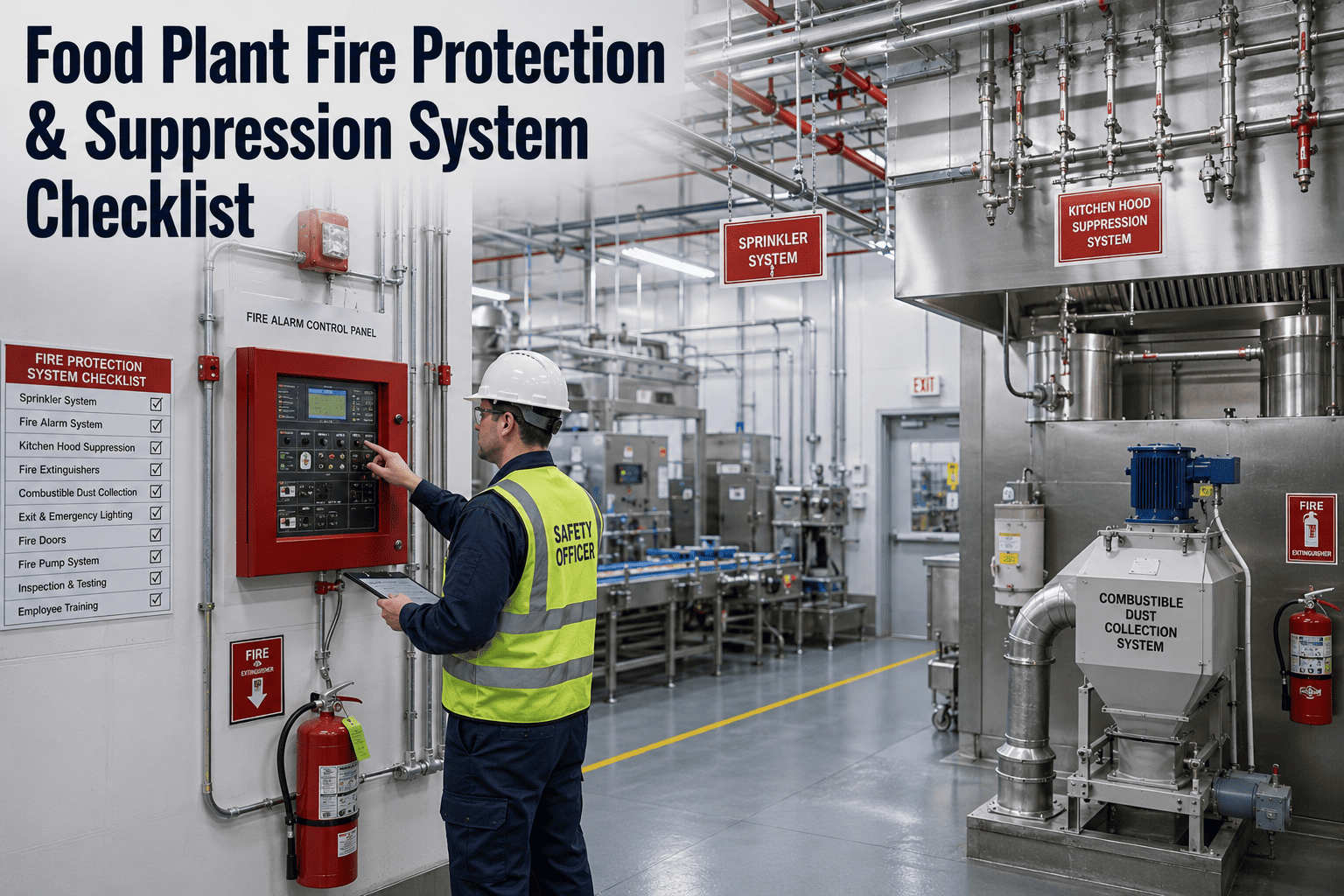
Food manufacturing plants face fire risks unlike most other industrial environments — combustible flour, sugar, and spice dust can ignite from a single spark, cooking oils burn at extreme temperatures, and continuous production schedules leave little room for unplanned shutdowns. The U.S. Fire Administration records over $1.3 billion in annual property losses from food and beverage manufacturing fires. NFPA 13, NFPA 654, NFPA 17A, and applicable local codes mandate structured inspection cycles for sprinkler systems, kitchen hood suppression, fire alarms, portable extinguishers, and combustible dust controls — yet most food plants still track those records in paper binders and disconnected spreadsheets that collapse under the scrutiny of a fire marshal audit. A missed semi-annual hood suppression service or an overdue sprinkler flow test is not just a paperwork issue — it is an active liability that can trigger regulatory shutdown and invalidate insurance coverage. Start a free trial on Oxmaint or book a demo to see how food manufacturing teams put every fire protection inspection on an automated, auditable schedule.
Stop Managing Fire Compliance in Spreadsheets
See how food plants eliminate missed inspection cycles and pass fire marshal audits without last-minute scrambles — using Oxmaint's automated fire protection PM scheduler.
Food Plant Fire Protection and Suppression System Checklist
Complete inspection framework for sprinkler systems, kitchen hood suppression, fire detection, portable extinguishers, combustible dust controls, and NFPA compliance documentation — purpose-built for food manufacturing.
Understanding Fire Protection Requirements in Food Manufacturing
Food plant fire protection covers every system designed to detect, suppress, and contain fire — from automatic sprinkler arrays and kitchen hood wet chemical suppression units to portable extinguishers and combustible dust collection systems. Unlike general industrial facilities, food plants must manage hazards specific to their processes: flour and sugar dust suspended in processing air, deep fryers operating at 400°F, high-pressure steam systems, and flammable cleaning agents applied in sanitation cycles. Each hazard requires a distinct suppression method, and each system carries its own NFPA-mandated inspection frequency ranging from daily visual checks to annual third-party certifications.
This checklist covers eight critical fire protection categories that food plant maintenance and EHS teams must inspect on monthly, quarterly, semi-annual, and annual cycles. Each item corresponds to a code requirement — NFPA 13 (sprinklers), NFPA 17A (wet chemical suppression), NFPA 654 (combustible dust), NFPA 72 (fire alarms), NFPA 10 (portable extinguishers), and NFPA 25 (water-based system maintenance). Completing and documenting these inspections protects your team, your facility, and your insurance coverage. Facilities that systematize fire protection inspections through a CMMS report 60% faster audit response times and near-zero inspection cycle gaps — start a free trial to automate your inspection schedule or book a demo to walk through your fire asset inventory.
Food Plant Fire Protection — Full Inspection Checklist
Use this checklist for monthly, quarterly, semi-annual, and annual fire protection inspections. Mark each item complete, assign a responsible technician, and log findings in your CMMS for compliance traceability.
8 Core Standards Every Food Plant Fire Program Must Address
Fire protection in food manufacturing is governed by a layered multi-standard framework. Each system you operate is tied to a specific NFPA code with defined inspection frequencies, testing requirements, and record-keeping obligations. Understanding which standard governs each of your systems is the foundation of a defensible compliance program — and teams that map their assets to code requirements spend 60% less time preparing for audits — start a free trial to map your fire assets to code requirements in Oxmaint or book a demo to see automated scheduling by NFPA standard.
Governs design, installation, and inspection of automatic sprinkler systems. Mandates quarterly waterflow alarm tests, annual full system inspections, and 5-year internal pipe assessments for food processing environments with high humidity or corrosive atmospheres.
Regulates kitchen hood suppression systems protecting fryers, grills, and cooking ranges. Requires semi-annual inspection and full service after any activation before the system is returned to operational status.
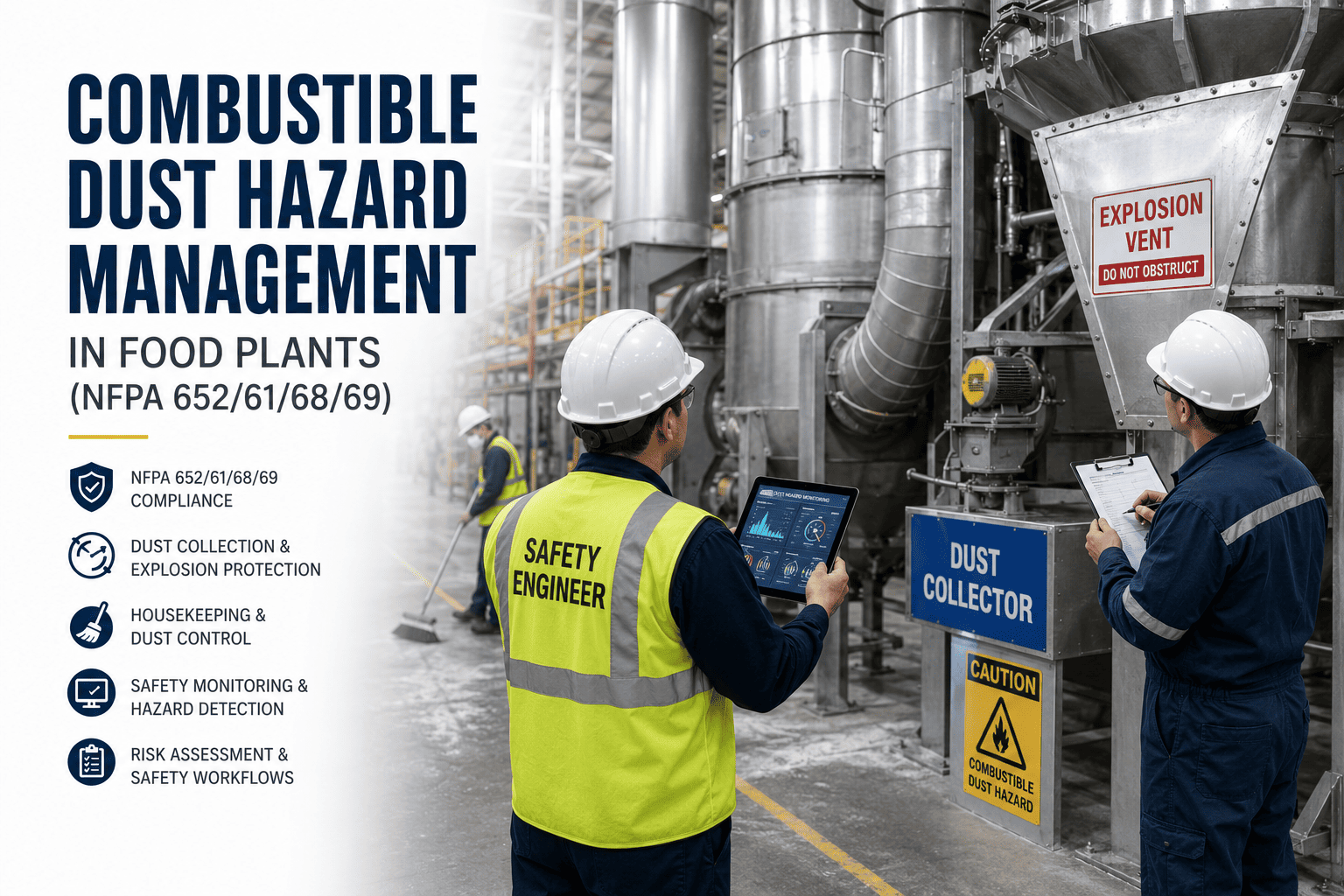
Applies to flour mills, sugar processing, spice grinding, and any operation generating combustible particulate. Requires a formal Dust Hazard Analysis, explosion protection systems, and documented daily housekeeping verification records.
Sets testing intervals for smoke detectors, heat detectors, duct detectors, manual pull stations, and notification devices. Annual full testing is mandatory; semi-annual testing applies to high-hazard food processing occupancies.
Mandates monthly visual inspections, annual licensed maintenance, 6-year internal examination, and hydrostatic testing at defined pressure intervals. Class K wet chemical extinguishers are required within 30 feet of all commercial cooking equipment.
Governs ongoing ITM for sprinkler systems, fire pumps, standpipes, and storage tanks. Defines the staggered inspection cadence — weekly, monthly, quarterly, annual, and 5-year — that drives the bulk of your water-based fire system schedule.
Governs electric and diesel fire pumps supplying sprinkler and standpipe systems. Weekly no-flow churn tests and annual full-flow pump tests are mandatory with documented pressure, flow, and RPM readings at each test point.
Specifically addresses fire and explosion hazards in food processing, grain handling, and agricultural operations. Extends combustible dust requirements with sector-specific guidance for silos, dryers, bucket elevators, and pneumatic conveying systems.
6 Fire Safety Failures That Shut Food Plants Down
These are the compliance failures and operational incidents that cost food manufacturers production time, regulatory standing, and insurance coverage. Each is preventable — and each traces back to a missed inspection cycle or a documentation gap. Plants that let these issues accumulate pay for it in the worst possible way — start a free trial to close these gaps now or book a demo to see how Oxmaint prevents every one of them.
Flour, sugar, and spice dust above 1/32 inch on overhead structures creates an explosive atmosphere. One spark — from a forklift, light switch, or static discharge — can trigger a secondary explosion that destroys an entire processing building. NFPA 654 requires documented daily removal, but most plants have no formal digital verification system.
Semi-annual service of hood suppression systems is mandatory under NFPA 17A — yet high-production food plants frequently defer service to avoid shutting down cooking lines. An unserviced system may fail to activate during a deep fryer fire, converting a contained incident into a facility-level event with structural losses.
When a fire marshal or insurer requests five years of fire system inspection records, facilities relying on binders and spreadsheets typically cannot produce a complete, organized set. Missing records trigger immediate citations and production holds — regardless of whether the actual physical inspections were completed on schedule.
Food plants reorganize storage, add packaging lines, and install new equipment frequently — but sprinkler clearance requirements are rarely factored into equipment installation approvals. A new pallet rack or conveyor installed within 18 inches of a sprinkler head creates a code violation and an actual suppression failure risk invisible until a fire occurs.
Class K wet chemical extinguishers are required within 30 feet of commercial cooking equipment under NFPA 10 — yet many food plants have only ABC dry chemical units near fryers and grills. Using the wrong extinguisher type on a cooking oil fire can spread burning fat rather than suppress it, escalating a contained incident into a structural fire.
Fire protection systems have staggered inspection intervals — monthly, quarterly, semi-annual, and annual — across eight or more distinct asset categories. Without an automated CMMS scheduler, maintenance supervisors manually track due dates across spreadsheets, and inspections regularly drift past NFPA-required windows without detection until a fire marshal audit reveals the gap.
6 Ways Oxmaint Closes Food Plant Fire Compliance Gaps
Oxmaint replaces the binder-and-spreadsheet approach to fire protection compliance with a structured CMMS that schedules, assigns, tracks, and archives every inspection cycle automatically. Food plant maintenance and EHS teams using Oxmaint report 60% faster audit preparation and zero missed inspection intervals across all NFPA-required fire protection systems — start a free trial to see it live or book a demo for a walkthrough of your fire asset structure.
Build inspection schedules for every NFPA-required frequency — monthly, quarterly, semi-annual, annual — and assign them to responsible technicians. Automated alerts fire before due dates so no inspection window is missed and no compliance cycle slips undetected.
Technicians complete fire system inspections on mobile — checking off each item, logging findings, and attaching photos of deficiencies in real time. Every record is timestamped, technician-attributed, and permanently archived for audit retrieval from any device.
Every fire protection asset — each sprinkler zone, each hood suppression system, each extinguisher location — is registered in Oxmaint with its own inspection history, service records, and code classification. Multi-site portfolios manage all facilities from one consolidated dashboard.
When an inspection reveals a deficiency — an obstructed sprinkler head, a low suppression cylinder, a failed alarm device — Oxmaint automatically generates a corrective work order, assigns it to the right technician, and tracks closure. Open deficiencies never fall through the cracks.
When a fire marshal, insurer, or auditor requests inspection records, Oxmaint generates a complete formatted report covering every system, every inspection date, every deficiency, and every corrective action in minutes — not days of manual document assembly.
Connect fire panel signals, suppression system pressure sensors, and alarm data feeds into Oxmaint. When a system generates a fault or supervisory alert, a work order fires automatically — bridging the gap between your fire protection systems and your maintenance team response.
Fire Protection Management: Paper-Based vs. Oxmaint-Managed
This comparison reflects the operational reality for food plant fire safety programs before and after implementing a structured CMMS. The difference is not just efficiency — it is regulatory defensibility, insurance standing, and measurable risk reduction across every system category.
| Fire Safety Area | Before — Paper / Spreadsheet | After — Oxmaint CMMS | Impact |
|---|---|---|---|
| Inspection scheduling | Manual calendar tracking — frequently missed or delayed | Auto-scheduled by NFPA interval with pre-due date alerts | Zero missed cycles |
| Inspection documentation | Paper forms filed in binders — often incomplete or misplaced | Digital checklists with photos — timestamped and permanently archived | 100% record completeness |
| Deficiency follow-up | Verbal or email hand-offs — no formal closure tracking | Auto-generated corrective work orders with closure verification | 3x faster resolution |
| Audit preparation | 2–5 days of manual document assembly under pressure | One-click export of complete inspection history and corrective actions | 60% time reduction |
| Multi-site oversight | No consolidated view — each site manages fire records independently | Portfolio dashboard — all sites, all systems, all compliance statuses | Full portfolio visibility |
| Combustible dust tracking | Verbal housekeeping instructions with no documented daily verification | Daily digital sign-off on dust removal tasks by zone and shift | NFPA 654 compliant records |
| Extinguisher management | Annual contractor visit only — no monthly tracking between visits | Monthly digital inspection per unit with location tagging and status | NFPA 10 fully documented |
What Structured Fire Protection Programs Deliver
The financial and operational case for systematic fire protection management is clear. These are outcomes from food manufacturing facilities that moved from reactive compliance to structured CMMS-driven inspection programs — representing real risk reduction and real cost savings. Teams making this shift see measurable results within the first 30 days — start a free trial to begin building your program or book a demo to model your specific ROI with our team.
Food Plant Fire Protection — Common Questions Answered
How often must kitchen hood suppression systems be inspected in a food plant?
What is the NFPA 654 threshold for combustible dust accumulation in food plants?
What type of fire extinguisher is required near commercial cooking equipment in a food plant?
How does Oxmaint help food plants prepare for fire marshal inspections and insurer audits?
Stop Risking Production — and Lives — to Missed Fire Inspections
Turn every fire protection asset in your facility into a scheduled, documented, auditable system with Oxmaint. No binders. No spreadsheets. No gaps in your compliance record that surprise you during an audit.


.png)
