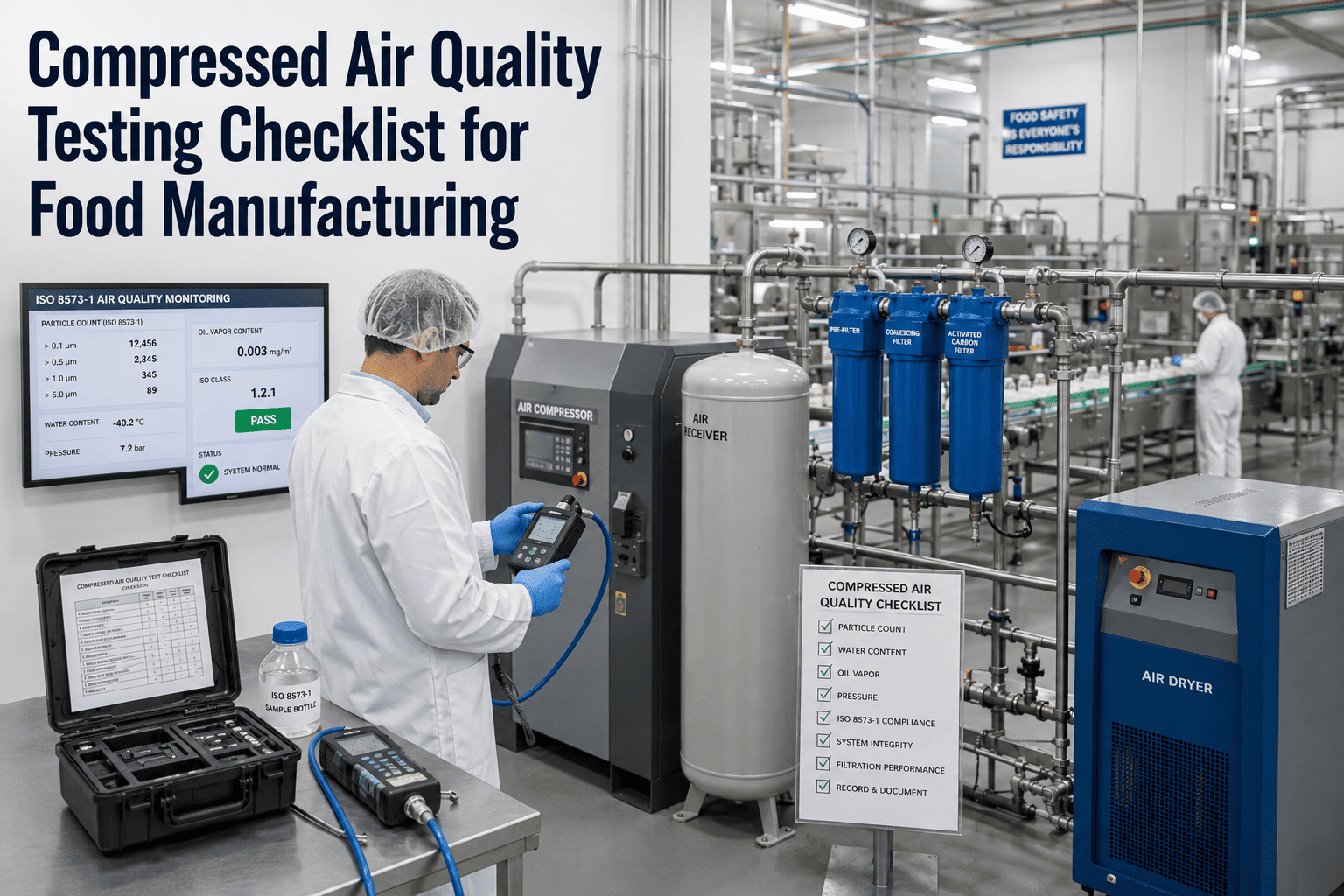
Food manufacturing facilities using compressed air for direct product contact, pneumatic control systems, or packaging operations face a critical challenge: contaminated air can introduce particles, moisture, oil aerosols, and microbial growth directly into the production stream. When compressed air systems operate without regular quality testing, facilities risk FSMA violations, product recalls, and contamination events that can cost millions in lost production and brand damage. A single moisture intrusion event in a bakery's flour pneumatic conveying system can create conditions for mold growth across an entire production batch. Organizations implementing structured compressed air quality testing report 60% fewer contamination incidents and achieve ISO 8573-1 compliance verification within 90 days of deployment. Start a free trial on Oxmaint or book a demo to see how digital air quality monitoring transforms your compliance workflow.
Compressed Air Quality Testing Checklist for Food Manufacturing
Complete inspection and testing protocol covering particle counts, moisture analysis, oil contamination, microbial testing, and ISO 8573-1 compliance verification — built specifically for food-grade compressed air systems.
What Is Compressed Air Quality Testing in Food Manufacturing?
Compressed air quality testing is the systematic measurement and verification of air purity parameters — particles, moisture, oil contamination, and microbial content — to ensure compressed air systems meet food safety standards and regulatory requirements. In food manufacturing environments, compressed air often contacts ingredients, packaging materials, or finished products directly through pneumatic conveying, product drying, packaging inflation, or automated control systems. Unlike industrial compressed air used solely for tool operation, food-grade compressed air must meet stringent purity classifications defined by ISO 8573-1 and enforced through FSMA preventive controls.
Testing protocols measure four primary contaminant categories: solid particles (dust, rust, scale), water content (vapor and liquid phase), oil contamination (aerosols and vapor), and microbial growth (bacteria, mold, yeast). Each parameter is classified numerically under ISO 8573-1, with lower class numbers indicating higher purity levels. Food contact applications typically require Class 1 or Class 2 air quality across all parameters. Facilities that implement quarterly compressed air testing with automated monitoring systems reduce contamination risk by 60% and achieve consistent compliance verification, which is why structured testing programs integrated into digital CMMS platforms are becoming the operational standard — start a free trial to track your air quality testing schedule in Oxmaint, or book a demo to see how automated compliance tracking works for multi-site food operations.
Six Critical Parameters in Food-Grade Compressed Air Systems
Compressed air quality assessment follows ISO 8573-1 classification across multiple contamination vectors. Understanding each parameter and its acceptable threshold is essential for designing effective testing protocols.
Measures particulate count and size distribution. Class 1 allows maximum 20,000 particles (0.1–0.5 microns) per cubic meter. Particles introduce physical contamination and allergen cross-contact risk.
Measures water vapor content at operating pressure. Class 1 requires dew point ≤ -70°C. Moisture enables microbial growth, corrosion, and product quality degradation in pneumatic conveying systems.
Total oil content including aerosols and vapor phase. Class 1 allows ≤0.01 mg/m³. Oil contamination causes product tainting, package seal failures, and regulatory non-compliance in food contact zones.
Measures viable bacteria, mold, and yeast counts. Not covered by ISO 8573-1 but required for food contact air. Target: <10 CFU/m³ for direct contact applications using impactor or settle plate methods.
Operational parameters affecting contaminant concentration. Testing must occur at normal operating pressure and flow to ensure measurements reflect real-world contamination levels during production.
Measures filter performance degradation. Differential pressure across coalescing and particulate filters indicates saturation and bypass risk. Replace filters when ΔP exceeds manufacturer specifications (typically 15 psid).
What Happens When Compressed Air Quality Goes Unmonitored
Facilities operating compressed air systems without regular quality testing face escalating contamination risk, regulatory exposure, and operational inefficiency that compounds over time.
Oil aerosols, moisture, and particulates introduced through compressed air contact create foreign material incidents, allergen cross-contact, and microbial contamination. Single recall events average $10 million in direct costs plus brand damage.
Compressed air contacting food must have validated preventive controls under FSMA. Facilities without documented testing schedules, corrective action records, and verification activities face FDA Form 483 citations and potential consent decrees.
Moisture and particle contamination accelerate pneumatic valve wear, clog instrumentation ports, and damage precision filling equipment. Unmonitored air systems increase maintenance costs by 35% and reduce equipment service life by 40%.
Saturated filters, leaking drains, and degraded dryers increase compressor energy consumption by 20–30%. Facilities spend $50,000+ annually on wasted compressed air energy without regular system performance verification and filter change tracking.
Most facilities lose 20–40% of compressed air quality assurance value due to paper-based testing records that disconnect from production schedules and preventive maintenance workflows.
How Oxmaint Manages Food-Grade Air System Testing and Compliance
Oxmaint centralizes compressed air quality testing schedules, lab results, corrective actions, and compliance documentation into a single preventive maintenance platform designed for food manufacturing operations.
Configure quarterly particle, moisture, oil, and microbial testing schedules tied to specific air system zones. Oxmaint auto-generates work orders with sampling procedures, assigns certified technicians, and tracks completion status across all production sites.
Upload lab certificates, meter readings, and field test data directly into asset records. Results are timestamped, linked to specific air system components, and accessible during FDA inspections without searching file cabinets or email archives.
Set quality thresholds for each ISO parameter. When test results exceed limits, Oxmaint triggers automatic corrective action work orders — filter replacements, dryer service, system purges — with pre-attached procedures and parts lists.
Generate compliance verification reports showing all testing activities, out-of-spec events, and corrective actions across your entire facility portfolio. Export audit-ready documentation proving FSMA preventive control validation in minutes, not days.
Teams managing compressed air quality testing in Oxmaint report 60% faster compliance verification, zero missed testing intervals, and complete traceability from sampling point to corrective action closure — start a free trial to see how air quality testing integrates with your existing PM schedules, or book a demo to walk through the compliance reporting workflow with our team.
Compressed Air Testing: Manual Records vs. Oxmaint CMMS
Food facilities managing compressed air quality testing through spreadsheets and paper logs face documentation gaps, missed testing intervals, and slow corrective action response that digital systems eliminate.
| Testing Activity | Manual Paper-Based System | Oxmaint Digital CMMS |
|---|---|---|
| Testing schedule management | Calendar reminders easily missed; no auto-assignment | Automated quarterly work orders with technician routing |
| Lab result documentation | Paper certificates filed in binders; search takes hours | Digital upload linked to asset; instant retrieval |
| Out-of-spec corrective actions | Manual creation; average 3–5 day response delay | Automatic work order generation within 24 hours |
| Compliance verification reporting | Manual compilation from multiple sources; 8–12 hours | One-click export with full traceability; <15 minutes |
| Filter change tracking | Separate maintenance log; not linked to test results | Integrated PM schedule triggered by differential pressure |
| Multi-site oversight | Phone calls and email to verify status across plants | Real-time dashboard showing all sites' testing status |
ROI from Structured Compressed Air Quality Management
Food manufacturers implementing digital compressed air quality testing programs see immediate operational and compliance improvements measurable within the first year.
Facilities that integrate compressed air quality testing into their CMMS platform see measurable ROI within the first year through avoided recalls, compliance efficiency, and energy cost reduction — which is why leading food manufacturers now treat air quality monitoring as a core preventive control rather than an optional checklist item.
Compressed Air Quality Testing Checklist for Food Manufacturing
This checklist covers all critical inspection and testing activities required to verify compressed air quality, maintain ISO 8573-1 compliance, and satisfy FSMA preventive control requirements. Use this protocol quarterly for all food contact and near-contact compressed air systems.
Pre-Testing Preparation
Solid Particle Contamination Testing (ISO 8573-1 Class 1–2)
Moisture Content and Pressure Dew Point Testing
Oil Contamination Testing (Aerosol + Vapor)
Microbial Content Testing (Food Contact Air)
Filter System Inspection and Maintenance
Air Dryer Performance Verification
Distribution System and Sampling Point Inspection
Documentation and Compliance Verification
Compressor Room Environmental Conditions
Facilities that execute this checklist quarterly using a digital CMMS platform achieve 100% testing schedule compliance, zero documentation gaps during FDA inspections, and immediate corrective action triggering when air quality parameters exceed specification limits — start a free trial to digitize your compressed air quality testing program in Oxmaint, or book a demo to see how automated compliance tracking works across your entire facility portfolio.
Compressed Air Quality Testing — Answered
How often should food manufacturing facilities test compressed air quality?
What ISO 8573-1 air quality class is required for food manufacturing?
Can facilities use oil-lubricated compressors for food-grade compressed air?
How does Oxmaint help manage compressed air quality testing compared to paper logs?
Turn Every Air System Into a Predictable, Traceable Compliance Asset
Oxmaint manages your entire compressed air quality testing program — automated schedules, digital documentation, corrective action tracking, and audit-ready compliance reports — in one platform your team can deploy in days, not months.


.png)
