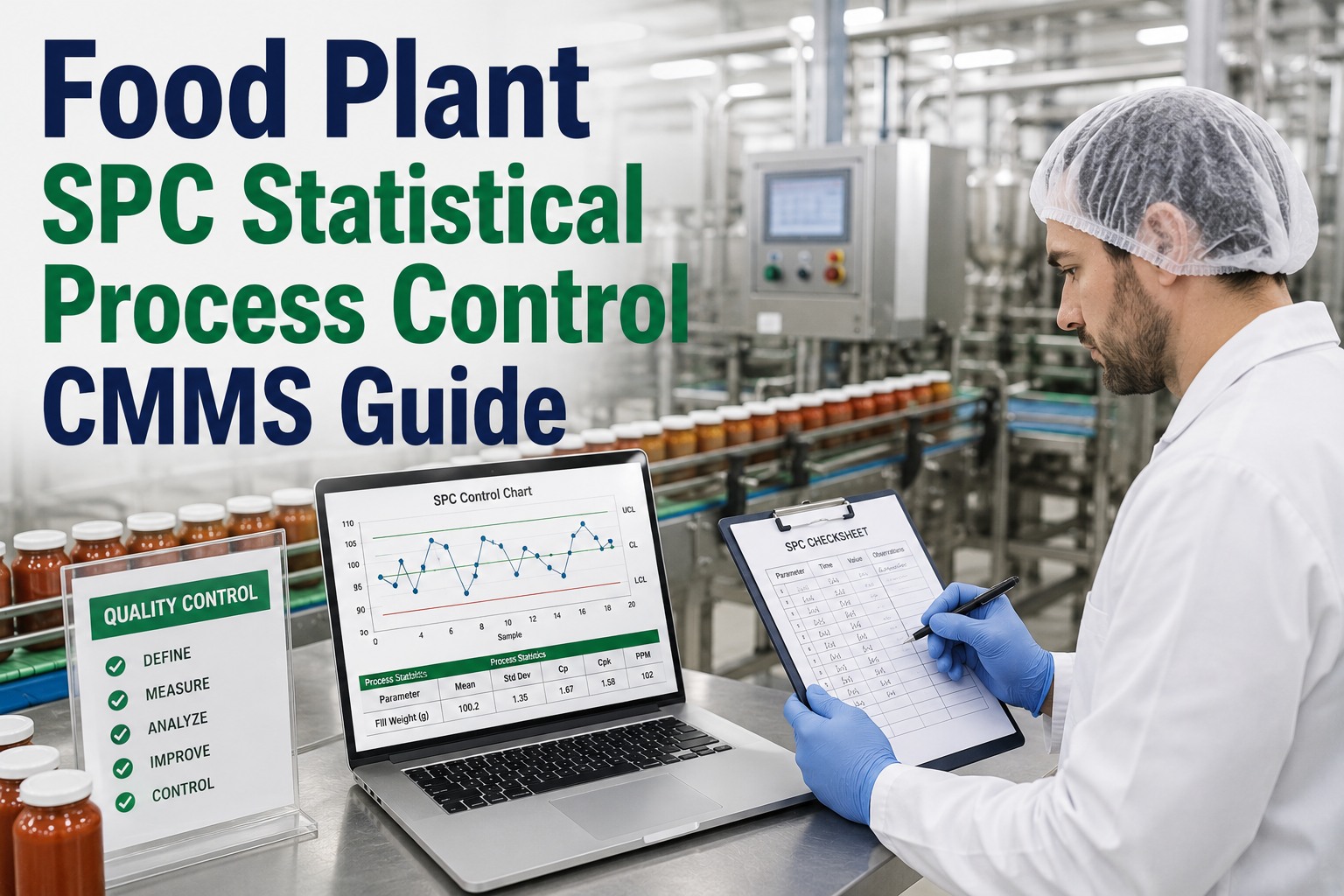
Statistical process control (SPC) in a food plant is most powerful when its signals trigger maintenance investigation — not just quality holds. When a CMMS integrates directly with control chart CCP (Critical Control Point) monitoring, process drift and deviation trends automatically generate preventive work orders, closing the gap between statistical process control and equipment reliability. By tying SPC triggers to maintenance action, food manufacturers can detect mechanical wear before it causes a batch failure, reducing unplanned downtime by up to 30% and saving tens of thousands of dollars in scrapped product. See how OxMaint bridges this gap when you Start Free Trial or explore the full SPC CMMS guide below.
Is Your SPC Data Triggering Maintenance — or Just Quality Holds?
Most food plants chart CCP parameters but never link statistical process control signals to asset reliability. When SPC detects process drift, your CMMS should automatically generate a maintenance work order before equipment failure causes a deviation.
Connecting food plant SPC to your CMMS turns statistical anomalies into predictive maintenance action — cutting unplanned downtime, reducing scrap, and ensuring audit readiness.
How Food Plant SPC Should Trigger Maintenance Work Orders
In a typical food manufacturing plant, 70% of CCP deviations trace back to mechanical wear — not recipe error. Yet most SPC systems flag the outlier and stop there.
SPC control chart detects statistical drift
Temperature, pressure, or flow rate CCP parameters breach the upper or lower control limit (UCL/LCL) on the control chart. The SPC software flags a statistically significant trend — not a random fluctuation.
CMMS receives the SPC trigger via API
The statistical process control system sends a trigger payload to the CMMS. OxMaint classifies the signal by asset ID, CCP type, and severity — routing it to the correct maintenance team in under 5 seconds.
Predictive work order auto-generates
Instead of waiting for a quality hold, the CMMS generates a predictive maintenance work order. The technician receives a job card pre-loaded with SPC context, asset history, and required spare parts.
Root cause resolved before batch failure
The technician inspects the asset — a fouled heat exchanger, a drifting actuator — and corrects the mechanical drift. SPC returns to centerline. The asset history logs the intervention for audit compliance.
CMMS Food Process Drift: A Real-World Scenario
A 180-asset dairy plant spending $42K annually on scrapped product linked their SPC system to OxMaint — here is what happened in 90 days.
The Problem
A pasteurization line's hold temperature drifted 1.2°F below the lower control limit over three shifts. The SPC chart flagged the trend, but quality only quarantined the product. No maintenance trigger fired. Root cause: a scaling heat exchanger plate that took 4 hours to emergency-clean, costing $8,500 in lost production and scrap.
The SPC-CMMS Solution
After integrating OxMaint, the same drift trigger auto-generated a work order with a 4-hour response SLA. The technician cleaned the exchanger during a planned CIP gap — zero product quarantined, zero unplanned downtime. Over 90 days, the plant cut CCP-related scrap by 64% and reduced emergency maintenance calls by 40%.
SPC and the Maintenance Triggers It Should Set Off
Not every SPC signal needs a mechanic. But three statistical patterns must generate automatic maintenance investigation in any food plant SPC CMMS setup.
1. Sustained Mean Shift
When the process mean shifts by 1.5 sigma or more and holds for 5+ consecutive data points on the control chart, trigger an investigation. This indicates sensor calibration loss, bearing wear, or heat exchanger fouling — not a random spike.
Trigger: 5 points above centerline2. Trend Rule Violation
Six consecutive points trending up or down signal progressive mechanical degradation — a slow seal leak, a drifting actuator, or filter loading. The CMMS should generate a priority-2 work order before the parameter breaches the critical LCL or UCL.
Trigger: 6-point trend rule3. Increased Variability
When the standard deviation of a CCP parameter increases by 25% over its historical baseline, the asset is losing mechanical stability. Trigger a predictive inspection — the equipment is approaching failure even if it has not yet breached a limit.
Trigger: 25% sigma expansionHow OxMaint Connects SPC to Maintenance Action
OxMaint is an AI-powered CMMS and EAM platform that turns statistical process control signals into automated maintenance workflows — closing the gap between quality and reliability.
Real-Time SPC Integration
OxMaint ingests control chart CCP data via API. When a statistical rule fires, the platform auto-generates a work order tagged with the exact deviation, asset ID, and SPC context — no manual entry, no missed signals.
Cuts signal-to-action time from hours to under 60 secondsPredictive Maintenance Scheduling
Instead of reacting to equipment failure, OxMaint schedules inspections and interventions based on SPC trend data. The AI engine ranks assets by statistical risk, so technicians handle the highest-impact drift first.
Reduces unplanned downtime 30–50%Audit-Ready Compliance Logs
Every SPC-triggered work order, asset intervention, and part replacement is automatically logged against the CCP record. OxMaint maintains a complete chain-of-custody for FDA, HACCP, and ISO 22000 audits.
Eliminates 12+ hours of manual audit prep per monthSpare Parts Auto-Reservation
When a SPC trigger generates a work order, OxMaint checks the BOM and auto-reserves required spare parts from inventory — gaskets, seals, filters — so the technician never waits for parts during a CCP response.
Cuts mean-time-to-repair by 40%See OxMaint Turn SPC Signals Into Maintenance Action
Book a 30-minute demo and watch a live CCP deviation trigger a predictive work order in real time.
CMMS Food SPC Statistical Integration: What to Connect
A successful SPC CMMS integration requires mapping quality parameters to asset identifiers and defining which statistical rules generate which maintenance responses.
| CCP Parameter | SPC Trigger Rule | Likely Asset Root Cause | CMMS Maintenance Response |
|---|---|---|---|
| Hold Temperature | 1.5-sigma mean shift, 5 points | Heat exchanger fouling / valve wear | Predictive CIP + actuator inspection |
| Line Pressure | 6-point downward trend | Seal degradation / filter loading | Priority-2 seal and filter replacement |
| Metal Detector Signal | 25% sigma expansion | Conveyor bearing failure / vibration | Emergency bearing inspection work order |
| Fill Weight | 2-of-3 points beyond 2-sigma | Filling valve drift / pneumatic loss | Calibration + pneumatic pressure check |
| pH Level | Single point beyond UCL | Dosing pump inaccuracy / sensor drift | Immediate dosing pump audit + recalibration |
Food Plant SPC and CMMS Integration FAQ
What is SPC in a food manufacturing plant?
Statistical process control (SPC) in a food plant uses control charts to monitor Critical Control Point (CCP) parameters — temperature, pressure, flow rate, fill weight — in real time. It detects statistically significant deviations from established process limits, distinguishing random variation from real process drift that requires investigation.
How does SPC connect to CMMS maintenance triggers?
When an SPC system detects a rule violation — such as a 1.5-sigma mean shift or a 6-point trend — it sends an API signal to the CMMS. The CMMS then auto-generates a work order tagged with the asset ID, deviation type, and severity. You can see this workflow live when you Book a Demo with OxMaint.
Which SPC trigger rules should generate maintenance work orders?
The three highest-value triggers are sustained mean shifts (5+ points off centerline), trend rule violations (6 consecutive points in one direction), and increased variability (25% or greater standard deviation expansion). These patterns indicate mechanical degradation — not recipe error — and should generate priority-2 or emergency work orders.
Can OxMaint integrate with our existing SPC software?
Yes. OxMaint ingests SPC data via REST API and supports webhook triggers from leading statistical process control platforms. If your SPC system can send an HTTP payload with asset ID and deviation data, OxMaint can convert it into an automated maintenance workflow in under 60 seconds. Start Free Trial to test the integration.
How much does SPC-CMMS integration reduce downtime?
Food plants that connect SPC triggers to their CMMS typically reduce unplanned downtime by 30–50% and cut CCP-related scrap by 60% or more within the first 90 days. The ROI comes from catching mechanical drift during planned maintenance windows instead of reacting to equipment failure during production runs.
Stop Charting Deviations. Start Preventing Them.
OxMaint turns your SPC data into predictive maintenance action — cut downtime 30%, eliminate CCP scrap, and pass every audit. Book your 30-minute demo today.
Free 14-day trial · No credit card