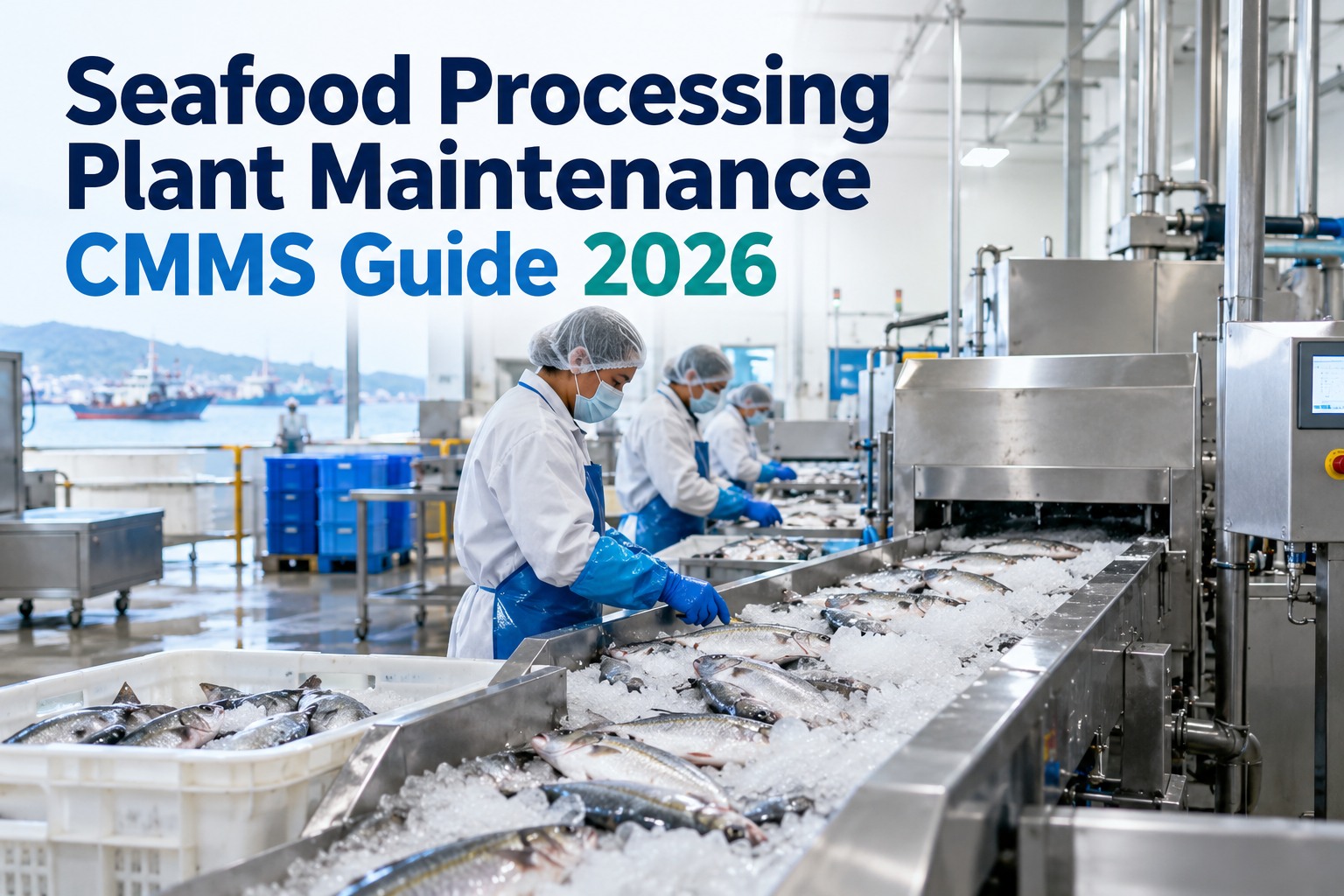
Seafood processing runs on two clocks at once: a fast-perishing product that punishes any lapse in the cold chain, and a harsh, wet, salt-laden wash-down environment that punishes the equipment keeping that chain intact. Add FDA seafood HACCP on top and maintenance stops being a back-office function — it becomes the thing standing between a profitable batch and a spoiled, non-compliant one. This guide covers what a real seafood maintenance program looks like: refrigeration and freezing reliability, sanitary PM in a corrosive plant, the maintenance that keeps HACCP defensible, and the CMMS that ties it together. Book a free seafood plant maintenance review.
Two Clocks: The Cold Chain and the Corrosion
Product spoils in hours, equipment corrodes in a wash-down world, and HACCP watches both. Maintenance is what holds the line.
HACCP
FDA seafood rule maintenance must support
Cold
Chain that fails the moment refrigeration does
Wash
Down & salt — the corrosion clock never stops
24/7
Reliability the perishable line demands
The Seafood Plant Is a Chain of Critical Systems
A seafood facility isn't one machine — it's a sequence where each stage depends on the one before it holding temperature and hygiene. Follow the product from dock to freezer and the maintenance-critical systems line up in order.
1
Intake & Ice
Ice machines and chilled receiving keep raw product cold from the moment it lands.
→
2
Filleting Line
Blades, conveyors, and graders — sanitary, fast-moving, and unforgiving of wear.
→
3
Blast Chill / Freeze
Blast chillers and freezers that lock in freshness — the reliability heart of the plant.
→
4
Cold Store & Dispatch
Refrigerated storage and loading holding temperature until the product ships.
The Three Maintenance Pressures — and What They Demand
Every seafood maintenance decision traces back to one of three pressures. Naming them makes the PM plan obvious: each pressure maps to a specific set of tasks you can't skip.
Cold-Chain Integrity
One refrigeration failure and a batch is lost. Demands condition monitoring, refrigerant checks, compressor PM, and instant alerting on temperature drift.
Wash-Down & Corrosion
Daily high-pressure, salt, and moisture attack bearings, seals, and electricals. Demands IP-rated PM, seal replacement schedules, and corrosion inspection.
HACCP Compliance
Sanitary equipment and monitored CCPs must stay validated. Demands documented PM, calibration records, and an audit trail that proves control.
The Critical-Equipment PM Map
Not every asset carries the same risk. This is where the program earns its keep — matching each critical system to the failure that hurts most and the PM cadence that prevents it.
| Equipment | Failure That Hurts | PM Focus | Cadence |
|---|
| Ice Machines | No ice at intake — raw product warms | Water quality, scale, condenser clean | Weekly / Monthly |
| Filleting & Conveyors | Line stops, contamination risk | Blade wear, belt tracking, bearing seals | Daily / Weekly |
| Blast Chillers | Slow pull-down — freshness lost | Refrigerant charge, coil, defrost cycle | Monthly / Quarterly |
| Freezers & Cold Store | Temperature excursion — batch spoiled | Compressor, door seals, sensor calibration | Monthly / Quarterly |
| Wash-Down Motors | Water ingress, seizure mid-shift | IP seal check, corrosion, lubrication | Weekly / Monthly |
Map Your Plant's Critical PMs in 30 Minutes
Bring your equipment list. We'll build the cold-chain, wash-down, and HACCP PM schedule onto one system — and show where a single failure could cost you a batch.
Where Maintenance Meets HACCP
HACCP isn't a separate binder — several of its critical control points live or die on maintenance. When the CMMS holds the record, the auditor's questions answer themselves.
Temperature CCPs
Chill and freeze holding temps are critical limits. Sensor calibration and refrigeration PM keep them defensible — with logged proof.
Sanitary Design
Worn seals and pitted surfaces harbor bacteria. Documented PM on food-contact equipment keeps sanitation validated.
Calibration Records
Every monitored instrument needs a traceable calibration history — the first thing an auditor asks to see.
Audit Trail
Who did what, when, on which asset. An automatic maintenance log turns audit prep from a scramble into a export.
How OxMaint Runs a Seafood Maintenance Program
OxMaint gives a seafood plant one system for the cold chain, the wash-down fleet, and the HACCP record — PM automation, mobile work orders for a wet floor, condition monitoring, and reporting an auditor can trust.
Cold Chain
Refrigeration PM & Alerts
Scheduled compressor and coil PM plus condition monitoring, so a temperature drift is caught before it becomes a lost batch.
Wash-Down
Corrosion-Aware Schedules
Seal, bearing, and IP-rated PM built for a salt-and-water plant — the failures wash-down environments cause, prevented on cadence.
HACCP
Compliance-Ready Records
Calibration logs, documented PM, and a full audit trail tied to each asset — HACCP evidence generated as you work.
Mobile
Work Orders on the Floor
Technicians raise and close work from any device on a wet production floor — no paper that can't survive the environment.
Priority
Criticality-Ranked Assets
Rank equipment by the batch it can spoil, so the most dangerous failures get PM attention first.
Overlay
SAP & Maximo Compatible
Works alongside existing enterprise systems, so adopting a dedicated CMMS doesn't mean ripping anything out.
Protect Every Batch — and Every Audit
Put the cold chain, the wash-down fleet, and the HACCP record on one system built for seafood reality. See how OxMaint holds the line. Free forever plan available.
Frequently Asked Questions
What makes seafood plant maintenance different?
Two pressures at once: a perishable cold chain where any refrigeration failure spoils product, and a wet, salty wash-down environment that corrodes equipment fast — all under FDA seafood HACCP oversight.
Which equipment is most critical to maintain?
Anything holding the cold chain — ice machines, blast chillers, freezers, and cold storage — plus the filleting line and wash-down motors that stop production or create contamination risk when they fail.
How does maintenance support HACCP compliance?
Many critical control points depend on it — temperature limits, sanitary equipment condition, and instrument calibration. Documented PM and a clean audit trail turn maintenance records into HACCP evidence.
How does OxMaint help a seafood processing facility?
One system for refrigeration PM and alerts, corrosion-aware wash-down schedules, HACCP-ready records, mobile work orders, and criticality ranking — with SAP and Maximo overlay. A free forever plan is available.