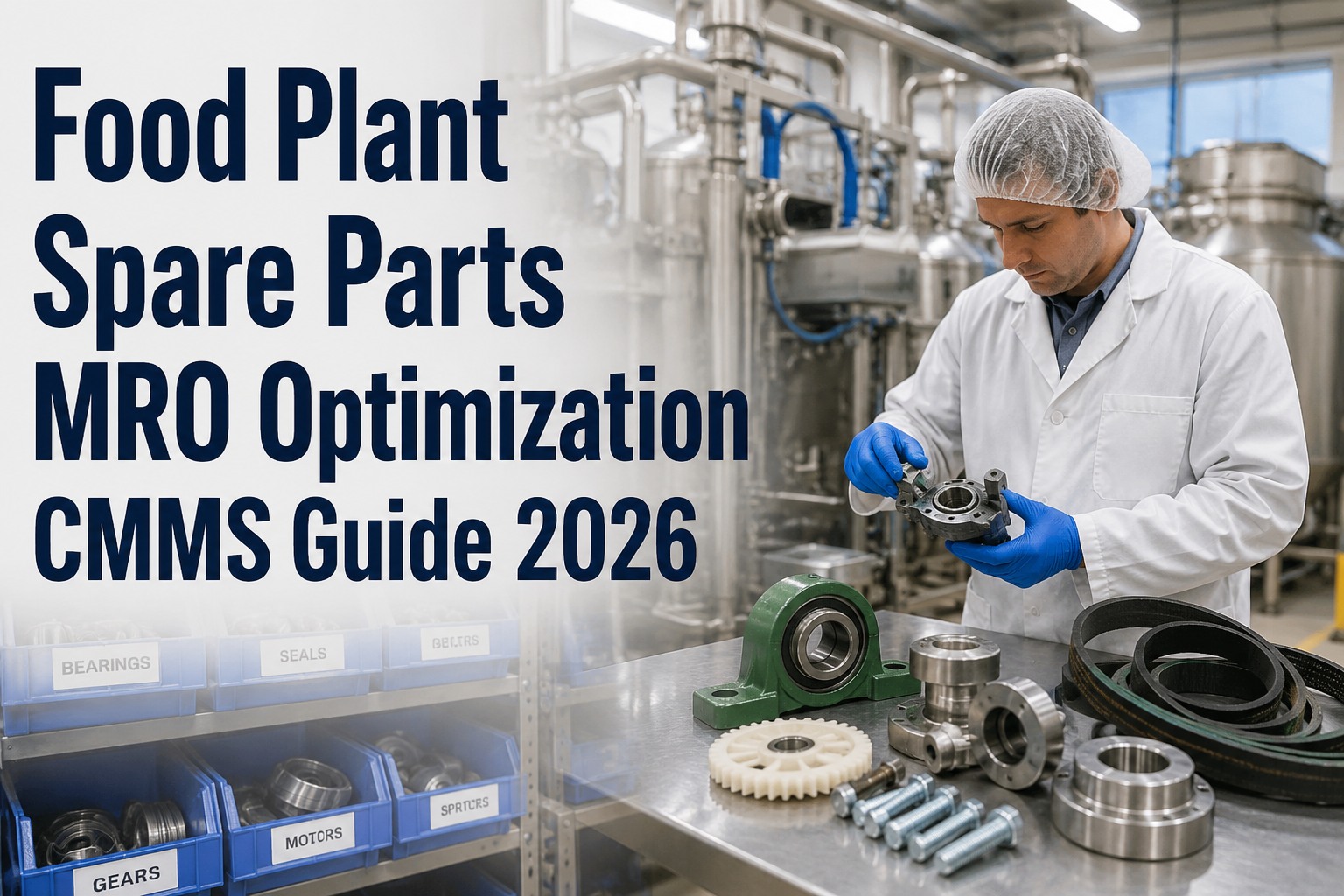
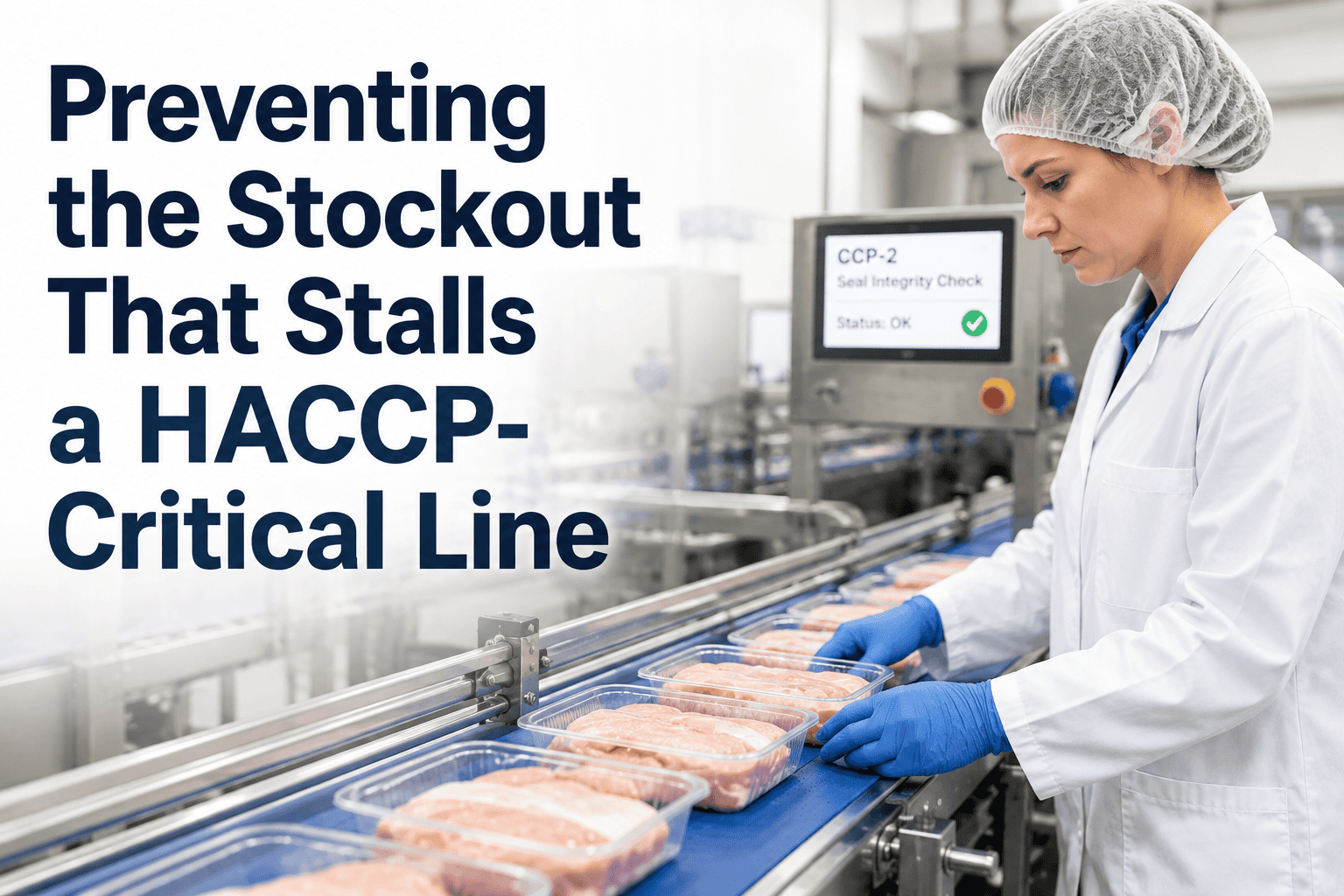
Food plant MRO optimization sits at an intersection most other manufacturing verticals never touch: every spare part is both an inventory-economics decision and a food-safety decision. An unrated bearing grease pulled from the general MRO shelf during a 2 AM breakdown looks like a saved production hour — until a lubricant sample from the finished product traces back to it and turns into a recall. The NSF White Book lists 12,000+ H1-registered lubricants and thousands of NSF 51 material-approved components for a reason: the rating is what defends the emergency repair, not the request-tracking form. This guide covers the food-plant-specific MRO discipline: the NSF rating tiers (H1 / H2 / 3H) and where each is allowed, the ABC classification that layers food-safety consequence on top of cost velocity, the substitution scenarios that generate recalls, and the CMMS structure that keeps every emergency repair defensible under FSMA, BRC, and internal food-safety audits. OxMaint is the maintenance management software food plants use to run all of it as a single system — NSF certification stored per SKU, expiry alerts on the White Book number, vendor approvals, and an audit-ready trail on every part issue. Start free on OxMaint to load the NSF-rated MRO templates, or book a demo to see certification tracking on your stockroom.
Food Plant Spare Parts & MRO · Optimized for Cost AND Compliance
NSF H1 / H2 / 3H · CCP-critical ABC · substitution risk · CMMS-live traceability.
H1 · H2 · 3H
Three NSF lubricant ratings — every stocked lubricant maps to one, and where each is allowed is the compliance frame
10 ppm
21 CFR 178.3570 incidental-contact limit for NSF H1 lubricants in finished food product
12,000+
H1 lubricants currently registered on the NSF White Book — 7% annual registration growth
3–5×
Typical cost premium of H1-rated over industrial equivalents — the trade against recall exposure is a straightforward line
NSF Rating Tiers · What Every Food-Plant Spare Must Be Classified Against
The NSF classification system is the shorthand every food-plant stockroom, purchasing team, and CMMS must speak. It defines where a lubricant or component is allowed to be used, and what happens if it drifts. Every stocked SKU maps to exactly one tier, and the CMMS enforces the tier match at the point of issue — not at the point of audit.
NSF H1Incidental Food Contact Allowed
Use whereAny lubrication point above or around a food-contact zone — pumps, conveyors, mixers, seamers, fillers, cappers, bottling stirrups.
Regulatory limit21 CFR 178.3570 · maximum 10 ppm incidental contact in finished food. USP White Mineral Oil is the field-standard base.
CertificationNSF White Book registration number required · ISO 21469 certification also accepted (mandatory in Brazil).
Substitution riskSubstitute an H2 or industrial-grade in this zone → recall exposure. The most common food-safety MRO failure documented.
NSF H2No Possibility of Food Contact
Use whereLubrication points with no credible path to food contact — motors below the line, hydraulic systems in non-food zones, compressors in utility rooms.
Regulatory limitNo FDA incidental-contact allowance — zero tolerance for food contact. Not permitted on any equipment above product flow.
CertificationNSF H2 registration verifies formulation excludes heavy metals, carcinogens, and other harmful substances.
Substitution riskUsing H2 where H1 is required is a compliance failure. Using H1 where H2 is spec'd is safe but wasteful (3–5× cost premium).
NSF 3HDirect Food Contact Permitted
Use whereRelease agents on grills, loaf pans, cutters, boning benches, chopping boards, hard surfaces in direct contact with food product.
Regulatory limitDesigned for direct contact; formulations restricted to USP mineral oil, vegetable oils, and specific GRAS ingredients.
CertificationProducts can be dual-rated H1 and 3H when both incidental and direct contact are in scope for the application.
Substitution riskThe smallest category by volume but the highest per-incident exposure — never substitute at this tier.
Beyond Lubricants · NSF 51 & NSF 61 for Materials in Contact
The H-series ratings govern lubricants specifically. For gaskets, hoses, valves, and every material that touches product or process water, two other NSF standards define the stocking spec. Miss the rating on a replacement gasket during a 3 AM rebuild and the finding runs to the same recall pathway as the H1 substitution above.
NSF 51
Food Equipment Materials
Certifies materials (elastomers, plastics, coatings, sealants) used in food-contact surfaces of equipment. Every food-contact gasket, O-ring, valve seal, and belt liner should carry an NSF 51 mark.
NSF 61
Drinking Water System Components
Certifies components (pipes, fittings, valves, tanks) in contact with potable water. Required across CIP water systems, ingredient water lines, and any process water contact point.
FDA 21 CFR 177
Polymers for Food Contact
FDA's list of polymer materials approved for repeated food contact. Vendor CoC (Certificate of Conformance) with 21 CFR 177 citation is the standard evidence artifact.
Food-Plant ABC Classification · Layering Food-Safety Consequence on Cost Velocity
Standard MRO ABC classification ranks parts by usage value: A items ~10–20% of SKUs and 70–80% of spend, C items the reverse. For a food plant that ranking is insufficient — a $12 O-ring on a filler CCP outranks a $12,000 motor spare on a non-critical utility fan on a food-safety consequence basis. The classification below layers food-safety consequence on top of cost velocity, and it's what drives stocking policy in a mature food-plant MRO program.
Class A
CCP-Critical & NSF-Rated · Stock on Shelf
Criteria On a CCP equipment path (cook, cool, pasteurize, metal detect) · OR carries an NSF food-contact rating · OR >4 week lead time. Any one qualifier is enough.
Examples H1 lubricants for filler/capper, NSF 51 food-contact gaskets, metal-detector belt splices, pasteurizer control valves, seamer replacement seals.
Stocking policy Min-max with safety stock; supplier certified in vendor system; NSF number tracked per SKU with White Book expiry alerts.
Class B
Production-Critical · Standard Stock
Criteria Impacts production availability but not food safety directly · 1–4 week lead time · high consumption volume across the plant.
Examples H2 lubricants for utility motors, standard bearings for non-food-contact conveyors, hydraulic filters, contactor consumables.
Stocking policy Reorder-point-triggered; central stores; two approved vendors; consumption tracking against production hours.
Class C
Commodity · Just-In-Time
Criteria Off-shelf commodity, <1 week lead time, multiple vendors, no food-safety or CCP consequence, replaceable across many assets.
Examples Fasteners, general shop supplies, standard electrical wire, standard cleaning-tool consumables.
Stocking policy JIT or vendor-managed; low or zero on-shelf; consumption tracked at issue.
The substitution scenario
The failure mode that drives the food-plant MRO discipline sounds like this. Filler bearing seizes at 2 AM. The stocked H1 grease cartridge is empty. The tech grabs the closest full cartridge from the general MRO shelf — H2 industrial grease. Filler restarts, production runs the shift. Three weeks later a customer complaint lab analysis picks up lubricant traces above the 10 ppm 21 CFR 178.3570 threshold. The recall clock starts. Every element of the failure — the empty min-max, the co-located H2, the un-checked-out issue — is a CMMS control problem, and every one is solvable at configuration time.
NSF-Rated Spare Part Categories & Where They Live in the Stockroom
The six categories below are where food-plant MRO discipline lives day to day. Each one carries a specific NSF or FDA rating expectation and a specific CMMS storage pattern — the stockroom, the record, and the point-of-issue check all speak the same certification language.
01
Food-Grade Lubricants
NSF H1 / 3H
USP mineral oil or PAO-base. White Book number stored per SKU, expiry alerts, physical segregation from H2 stock.
02
Gaskets, O-Rings, Seals
NSF 51 · FDA 21 CFR 177
Elastomers (EPDM, silicone, FKM/Viton) with CoC citing 21 CFR 177 sub-parts. Batch traceability at issue.
03
Food-Contact Hoses
NSF 51 · 3-A Sanitary
Sanitary-fitting hoses for CIP, ingredient transfer, wash-down. Rating on the hose label, log at issue.
04
Bearings with H1 Grease
Bearing + H1 pre-pack
Pre-lubricated food-grade bearings for food-contact conveyors, fillers, mixers. H1 grease part-of-package.
05
Valves & Fittings
NSF 51 / 61 · 3-A
Product-contact valves (NSF 51 + 3-A), water-system valves (NSF 61). Stainless spec and surface finish per zone.
06
Conveyor Belts & Splices
Food-grade urethane / PU
Belt material FDA / NSF 51 approved; metal-detectable splice compounds for post-detector zones.
Load the NSF-Rated MRO Templates in OxMaint — Free Forever
Sign up on OxMaint's free forever plan and load the NSF H1/H2/3H, NSF 51/61 SKU templates. Every stocked part carries its rating, White Book expiry, and vendor CoC on the record — point-of-issue enforces the tier match, and the substitution scenario stops being possible. No card, no time limit.
MRO KPIs a Food-Plant Reliability Team Should Actually Open
Inventory KPIs without a compliance overlay are half the story in a food plant. The dashboard below is the tight set that combines cost-side inventory metrics (turnover, stockout, carrying cost, dead stock) with compliance-side metrics (certification expiry alerts, vendor approval status) — the shape a mature food-plant CMMS produces on demand.
Inventory Turnover
Target: 3–6× annually for A/B items combined
Falls when Class A safety stock is over-scoped; rises when consumption tracking is disciplined. Excludes deliberately-held long-lead CCP-critical spares.
Stockout Rate on Class A
Target: < 2% on food-safety-critical SKUs
The single most-referenced KPI in a food-plant MRO program — a Class A stockout is what drives the substitution scenario.
MRO Carrying Cost %
Target: 18–25% of inventory value annually
Storage, insurance, obsolescence, capital cost combined. Class A items justify higher carrying cost against recall exposure.
Dead Stock %
Target: < 5% of SKU count with no issue in 24 months
Rises when NSF-rated inventory expires unused, or when superseded equipment leaves matched spares on the shelf.
NSF Certification Expiry Alerts
Target: zero expired White Book numbers on active SKUs
Expired-yesterday counts as expired. The CMMS fires lead alerts on a configurable cycle so no active SKU carries a stale registration.
Vendor-Approval Status
Target: 100% approved-vendor issue on Class A
Every Class A issue must trace to an approved vendor with current CoC on file — enforced at PO and at goods-in.
How OxMaint Runs the Full Food-Plant MRO Program
The NSF-rating enforcement, the ABC classification, the substitution-scenario prevention, and the compliance-KPI dashboard all run on one CMMS — SKU records that carry the White Book number and expiry, point-of-issue checks that enforce the tier match, and audit-ready traceability from every issue back to the vendor CoC.
Store
SKU Record with NSF Rating & White Book #
Every stocked SKU carries its NSF tier (H1/H2/3H, NSF 51/61), White Book registration number, expiry, vendor CoC, and 21 CFR reference on the record.
Classify
Food-Plant ABC Layer
Class A/B/C automated on the criteria set — CCP path + NSF rating + lead time — so stocking policy reflects both cost velocity and food-safety consequence.
Enforce
Point-of-Issue Tier Match
Every part issue checks the asset's food-zone tier against the SKU's NSF rating — the substitution scenario blocks at issue, not at audit.
Alert
White Book Expiry & Min-Max Reorder
Configurable lead alerts on NSF registration expiry and stocked-below-min on Class A — zero surprises on audit day and no empty shelf during a 2 AM breakdown.
Trace
Issue → Vendor CoC → 21 CFR Reference
Every issue trails back to the vendor, CoC, and regulatory reference. Recall exposure investigations produce evidence in minutes.
Report
MRO Dashboard with Compliance Overlay
Turnover, stockout, carrying cost, dead stock, expiry-alert count, and approved-vendor-issue % on one dashboard — the shape a food-safety auditor and a plant manager both open.
Turn Your MRO Stockroom Into a Food-Safety Control Point
Free forever plan — no card, no time limit. Load the NSF-tier SKU templates, wire the ABC classification with the food-safety consequence layer, and every part issue enforces the tier match at the point of use. Or book 30 minutes and we'll walk your Class A inventory end-to-end on the platform.
Frequently Asked Questions
What are the NSF H1, H2, and 3H ratings and where does each apply?
H1 lubricants are permitted for incidental food contact — used on any lubrication point above or around food-contact zones (fillers, cappers, conveyors, mixers, seamers). H2 lubricants are for locations with no possibility of food contact — motors below the line, hydraulic systems in non-food zones, utility compressors. 3H lubricants are permitted for direct food contact — release agents on grills, cutters, chopping boards, boning benches. Products can be dual-rated H1 and 3H. Every stocked SKU maps to exactly one tier, and the CMMS enforces the tier match at issue.
What is the 21 CFR 178.3570 incidental-contact limit?
21 CFR 178.3570 is the FDA regulation that permits incidental food contact from NSF H1 lubricants up to a maximum of 10 parts per million in the finished food product. Above that threshold the lubricant is treated as an unintended food ingredient — with the recall pathway that implies. USP White Mineral Oil is the field-standard base for most H1 formulations because it delivers the purity needed to hit the 10 ppm ceiling with margin.
How should a food plant apply ABC classification differently from a standard MRO shop?
Standard ABC classifies by usage value — A items are ~10–20% of SKUs and 70–80% of spend. In a food plant that ranking is insufficient because a $12 O-ring on a filler CCP outranks a $12,000 motor spare on a non-critical utility fan on a food-safety consequence basis. The food-plant Class A criteria layer three qualifiers: on a CCP equipment path, OR carries an NSF food-contact rating, OR greater than four-week lead time. Any one qualifier is enough to promote the SKU to Class A stocking policy.
Book a demo to see the classification automated in OxMaint.
What's the "substitution scenario" and how does a CMMS prevent it?
The substitution scenario is the failure pattern most food-plant recalls trace back to: an empty H1-rated stocked cartridge during a breakdown, a co-located H2 industrial-grade grease on the same shelf, a technician under production pressure. The H2 cartridge goes into the machine, production runs, and weeks later a lab result on customer complaint traces lubricant above the 10 ppm 21 CFR 178.3570 threshold. Every element is a CMMS control problem — physical segregation, min-max reorder on Class A, point-of-issue tier match, White Book expiry alerts. All four are configurable at deployment.
What certifications and standards should stocked spare parts carry, beyond lubricants?
Every food-contact gasket, O-ring, valve seal, and belt liner should carry an NSF 51 mark (food equipment materials). Every component contacting potable or process water — pipes, fittings, valves, tanks — should carry NSF 61 (drinking water system components). Polymer parts contacting food should have a vendor Certificate of Conformance citing FDA 21 CFR 177 (approved polymers for food contact). Sanitary hoses and fittings should carry 3-A Sanitary Standards marks in addition to NSF 51.
Sign up free to store every rating per SKU on your first shift.