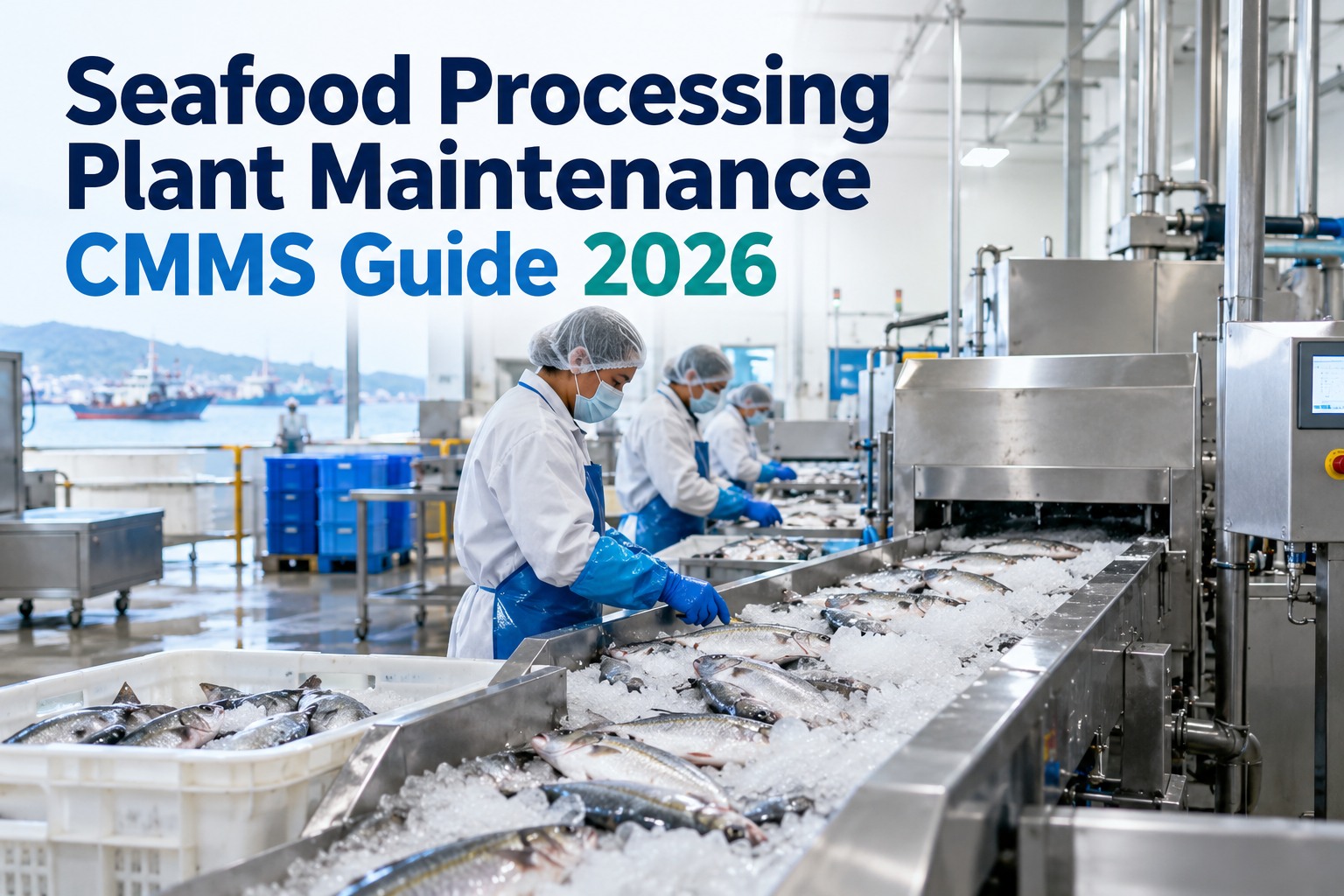
Choosing the right CMMS software for food and beverage manufacturing is one of the most consequential technology decisions a food plant maintenance manager will make in 2026. With FSMA enforcement intensifying, HACCP documentation requirements expanding, and sanitation scheduling complexity growing alongside product line diversification, generic maintenance platforms no longer meet the compliance and operational demands of modern F&B facilities. This guide compares the best food and beverage CMMS platforms available today — evaluating FSMA compliance workflows, HACCP audit trails, sanitation scheduling automation, and food-grade maintenance documentation against the real-world requirements of food processing and beverage manufacturing operations. Sign up for OxMaint free to experience a CMMS purpose-built for food manufacturing compliance from day one.
The CMMS Built for Food & Beverage Compliance in 2026
OxMaint delivers FSMA-ready PM scheduling, HACCP-integrated work orders, sanitation logs, and audit-ready documentation — all in one cloud CMMS platform designed specifically for food and beverage plant engineers.
Why Food and Beverage Plants Need a Specialized CMMS in 2026
The food and beverage manufacturing sector operates under a compliance burden that no other industry matches — FSMA preventive controls, HACCP critical control point monitoring, allergen sanitation verification, FDA 21 CFR Part 117 documentation, and multi-scheme food safety certifications including SQF, BRC Global Standards, FSSC 22000, and IFS Food. A general-purpose CMMS deployed in a food processing plant without food-safety-specific configuration creates dangerous documentation gaps: maintenance records that don't map to HACCP plans, sanitation schedules that aren't linked to allergen changeover protocols, and PM completion data that can't be exported in the format FDA or third-party auditors require.
The best CMMS for food manufacturing in 2026 must do more than schedule preventive maintenance work orders. It must integrate with HACCP prerequisite programs, enforce sanitation standard operating procedures (SSOPs) at the work order level, track food-contact surface maintenance separately from non-food-contact equipment, and maintain an immutable compliance audit trail that survives personnel turnover and system migrations. Sign up free for OxMaint to build your food plant PM program on a compliance-ready foundation from day one.
Key Features to Evaluate in F&B CMMS Software
Before comparing platforms, food plant maintenance managers must align on the non-negotiable feature requirements that separate a food-grade CMMS from a generic industrial maintenance platform. The evaluation criteria below reflect the operational and regulatory reality of food and beverage manufacturing in 2026.
FSMA Preventive Controls Integration
FSMA compliance requires that equipment maintenance activities tied to food safety preventive controls — temperature control systems, CCP monitoring equipment, allergen contact surface assets — be documented with corrective action records linked to the preventive control plan. A food manufacturing CMMS must allow maintenance records to be tagged to specific FSMA preventive controls with automatic escalation when PM tasks are overdue on food safety-critical assets.
HACCP Workflow and CCP Documentation
HACCP-integrated maintenance workflows ensure that calibration records for CCP monitoring instruments — temperature probes, pH meters, metal detectors, checkweighers — are automatically linked to the HACCP plan, with out-of-calibration alerts that trigger corrective action work orders before the affected CCP monitoring equipment is returned to service. HACCP CMMS software closes the loop between maintenance activity and food safety control.
Sanitation Scheduling and SSOP Management
Sanitation scheduling in food and beverage plants must manage allergen changeover cleaning, daily sanitation of food-contact surfaces, pre-operational equipment inspections, and periodic deep-cleaning cycles — all with digital sign-off records that satisfy FDA documentation requirements. The best food factory CMMS platforms support SSOP-linked sanitation work orders that capture chemical concentration, contact time, rinse verification, and employee sign-off in a single auditable record.
Audit-Ready Compliance Documentation
Food safety auditors conducting SQF, BRC, FSSC 22000, or regulatory inspections require instant access to maintenance history, calibration records, sanitation logs, and corrective action records organized by asset, date range, and compliance category. A food industry maintenance software platform must generate audit-ready compliance reports without requiring manual data compilation — reducing audit preparation time from days to hours.
Food-Contact vs. Non-Food-Contact Asset Classification
Regulatory and food safety certification requirements differentiate maintenance procedures, lubricant specifications, and inspection frequencies for food-contact and non-food-contact equipment. A food plant CMMS must support asset classification that automatically applies food-grade maintenance standards — including NSF H1 food-grade lubricant requirements and food-contact surface sanitation verification — to correctly classified assets throughout the PM program.
Mobile Work Order Execution on the Plant Floor
Food and beverage plant maintenance technicians performing PM tasks, sanitation checks, and equipment inspections in GMP-controlled areas require mobile-first CMMS interfaces that work reliably in environments with limited connectivity. Mobile work order execution with barcode/QR scanning for asset identification, photo capture for maintenance documentation, and offline mode with automatic sync when connectivity resumes is a baseline requirement for modern F&B CMMS deployment.
Best CMMS Platforms for Food and Beverage Manufacturing in 2026
The food and beverage CMMS market has consolidated around a set of platforms that offer meaningful food-safety-specific functionality beyond generic maintenance scheduling. The comparison below evaluates the leading options against the criteria that matter most to food plant engineers and maintenance managers responsible for FSMA compliance, HACCP documentation, and multi-scheme food safety certification maintenance.
| Platform | FSMA Compliance Tools | HACCP Integration | Sanitation Scheduling | Audit Documentation | Mobile Capability | F&B Specialization |
|---|---|---|---|---|---|---|
| OxMaint | Full preventive controls linking, overdue escalation | CCP calibration tracking, corrective action workflows | SSOP-linked, allergen changeover, digital sign-off | One-click audit export, multi-scheme report templates | Offline mobile, QR scan, photo capture | Purpose-built for food manufacturing |
| Limble CMMS | Custom fields for compliance tagging | Manual configuration required | Work order templates, limited SSOP integration | Report builder, manual compilation needed | Strong mobile app | General industrial with food configurations |
| UpKeep | Limited, requires custom setup | Not natively supported | Recurring work orders, no food-grade enforcement | Standard reporting, audit prep manual | Good mobile UX | General maintenance platform |
| Fiix by Rockwell | Compliance modules via configuration | Integration with third-party systems | Schedule-based, no SSOP native support | Strong reporting engine | Mobile app available | Industrial focus, food via add-ons |
| MaintainX | Procedure-based work orders, limited FSMA mapping | Checklist-based, manual CCP linking | Recurring checklists, no allergen workflow native | Digital records, export requires formatting | Excellent mobile UI | General SMB maintenance focus |
| IBM Maximo | Highly configurable compliance framework | ERP integration capable | Complex scheduling, high configuration cost | Enterprise audit trails | Mobile via add-on | Enterprise industrial, food via SI partners |
FSMA Compliance and Your Food Plant CMMS: What the Regulation Actually Requires
The FDA Food Safety Modernization Act (FSMA) Preventive Controls for Human Food rule under 21 CFR Part 117 establishes specific documentation requirements for maintenance activities that are part of a food facility's food safety preventive control plan. Understanding what FSMA actually requires from a maintenance documentation perspective is essential for evaluating whether a candidate CMMS platform will satisfy regulatory scrutiny during FDA inspections. Book a demo to see how OxMaint maps your maintenance program directly to FSMA preventive control documentation requirements.
Preventive Control Records for Equipment Maintenance
FSMA requires written records of preventive control monitoring, corrective actions, and verification activities for food safety preventive controls that include equipment maintenance as a control measure. Maintenance records for equipment involved in process controls — temperature-controlled cooking, pasteurization, metal detection — must demonstrate that the equipment was maintained in a condition that supports the food safety function it performs. A FSMA compliant CMMS automatically links PM completion records to the specific preventive controls they support.
Corrective Action Documentation
When maintenance activities reveal equipment conditions that could compromise food safety — a failed temperature probe on a pasteurizer, a damaged food-contact surface on a filling line, a metal detector that fails calibration — FSMA requires documented corrective action records that identify the problem, describe the corrective action taken, evaluate affected product for safety, and prevent recurrence. A food safety CMMS must generate corrective action work orders that capture all required data elements in a format that satisfies FDA records review.
Supplier and Contractor Maintenance Records
Food facilities that use contract maintenance service providers for specialized equipment maintenance must maintain records of contractor activity that are as complete and accessible as records from in-house maintenance staff. A food beverage CMMS software platform must support contractor work order management with the same documentation standards applied to internal maintenance — including sign-off, time stamps, parts used, and compliance verification — creating a unified maintenance record regardless of who performed the work.
Sanitation Scheduling Software for Food and Beverage Plants: Beyond the Checklist
Sanitation scheduling in food and beverage manufacturing is not a simple recurring task — it is a risk-managed program that must account for allergen changeover protocols, cleaning-in-place (CIP) validation, environmental monitoring integration, pre-operational inspection requirements, and the zoning complexity of facilities producing multiple product lines with different allergen and microbial risk profiles. The best food processing maintenance platforms treat sanitation as a first-class maintenance discipline — not an afterthought bolted onto a generic work order system. Try OxMaint free to see how sanitation scheduling integrates with your full F&B maintenance program in one platform.
Allergen Changeover Sanitation Workflows
Allergen changeover cleaning requires verification steps — visual inspection, ATP swabbing, allergen-specific swab testing — that must be documented and signed off before the production line can be released for the next allergen profile. A food-grade CMMS must enforce allergen changeover sanitation workflows with mandatory verification capture and block work order completion until all required verification steps are recorded, preventing inadvertent allergen cross-contact through incomplete sanitation.
CIP System Maintenance and Validation Records
Cleaning-in-place systems in food and beverage facilities require regular maintenance of spray devices, chemical dosing systems, heat exchangers, and flow controls — with validation records that demonstrate CIP cycles deliver the required time, temperature, chemical concentration, and flow velocity parameters at food-contact surfaces. Maintenance records for CIP components must be linked to CIP validation data in a CMMS that tracks both equipment condition and process performance.
Pre-Operational and Operational Sanitation Inspections
Pre-operational sanitation inspection records — the daily verification that food-contact equipment is clean and ready for production — are among the most frequently requested records during FDA inspections and third-party food safety certification audits. A sanitation scheduling software platform must generate pre-operational inspection work orders automatically at shift start, capture equipment-specific inspection findings with photo documentation capability, and record the qualified inspector sign-off required by food safety certification schemes.
Environmental Monitoring Program Integration
Environmental monitoring programs (EMPs) for pathogens like Listeria monocytogenes require scheduled swabbing activities in food processing zones that generate positive/negative results linked to corrective action escalation. A beverage manufacturing CMMS that integrates EMP scheduling with maintenance corrective action workflows enables root cause investigation — linking positive environmental test results to maintenance activities, sanitation frequencies, and equipment condition — closing the loop between monitoring and corrective maintenance.
Automate Sanitation Scheduling and HACCP Compliance with OxMaint
Food plant maintenance managers use OxMaint to manage allergen changeover workflows, CCP calibration records, pre-operational sanitation inspections, and FSMA documentation — all in one audit-ready cloud CMMS platform.
How to Implement a Food and Beverage CMMS: A Phased Approach
Implementing a CMMS in a food or beverage manufacturing facility requires a deployment sequence that prioritizes compliance-critical functionality — ensuring the platform delivers regulatory value from day one rather than phasing compliance features in after basic maintenance scheduling is established. The roadmap below reflects best practice F&B CMMS implementation sequencing validated across food processing and beverage manufacturing deployments.
Asset Register and Food Safety Classification
Build a complete food plant asset register in the CMMS with food-contact and non-food-contact classification, HACCP critical control point designation for CCP-adjacent equipment, and asset criticality ratings based on food safety risk and production impact. This foundational data structure determines the compliance value of every PM record and audit report generated by the system. Map existing PM procedures to asset records, prioritizing food-safety-critical equipment and CCP monitoring instruments in the first data load.
Preventive Maintenance and Calibration Program Launch
Configure and activate PM schedules for all food-safety-critical and production-critical assets, with FSMA-mapped preventive control linkages for maintenance tasks that support the facility's food safety plan. Launch the instrument calibration management program for all CCP monitoring equipment — temperature probes, pH meters, metal detectors, checkweighers — with calibration records that include as-found/as-left values, calibration standard traceability, and corrective action records for out-of-tolerance findings.
Sanitation Scheduling and SSOP Integration
Build sanitation work order templates linked to facility SSOPs, configure allergen changeover workflows with mandatory verification steps, and activate daily pre-operational inspection scheduling across all food processing lines. Connect environmental monitoring swabbing schedules to maintenance corrective action workflows so that positive EMP results automatically generate root cause investigation work orders linked to the relevant assets and processing zones where positive findings occurred.
Audit Readiness and Continuous Improvement
Configure compliance report templates for each active food safety certification scheme — SQF, BRC, FSSC 22000, IFS Food — so that audit preparation generates the required documentation from CMMS records without manual compilation. Establish KPI dashboards tracking PM compliance rate, overdue work orders on food-safety-critical assets, calibration compliance, and sanitation completion rates that enable maintenance leadership to demonstrate continuous improvement during certification scheme re-audits. Book a demo with OxMaint to see all four phases mapped to your facility's certification requirements.
Water Treatment and Utility Maintenance in Food and Beverage CMMS Programs
Food and beverage manufacturing facilities rely on complex utility systems — process water treatment, steam generation, compressed air, refrigeration — that are as critical to food safety and product quality as the processing equipment they serve. A food factory CMMS must manage utility asset maintenance with the same compliance rigor applied to direct food-contact processing equipment, because utility failures and out-of-specification utility quality events directly affect food safety and product compliance.
| Utility System | Food Safety Risk | Key CMMS Maintenance Records | Regulatory Reference |
|---|---|---|---|
| Process Water Treatment | Microbial contamination, chemical residues in food-contact water | Microbiological test results, chemical dosing records, filter change logs | FDA 21 CFR 117, CODEX CAC/RCP 1 |
| Food-Grade Steam | Chemical carryover contamination of direct steam injection products | Boiler treatment chemical records, steam purity conductivity logs, GRAS chemical verification | FDA 21 CFR 173.310, 3-A Sanitary Standards |
| Compressed Air | Oil contamination, microbial contamination of food-contact air | Filter element change records, oil content test results, dryer performance logs | ISO 8573-1 Food Grade, SQF Code |
| Ammonia Refrigeration | Refrigerant leak detection, temperature excursion in food storage | Leak inspection records, temperature monitoring calibration, PSM compliance documentation | OSHA PSM 29 CFR 1910.119, EPA RMP |
| Wastewater Treatment | Discharge compliance, cross-contamination risk from process drain backflow | Effluent quality test records, lift station PM logs, backflow preventer inspection records | CWA NPDES Permit, Local Pretreatment Standards |
Measuring CMMS ROI in Food and Beverage Manufacturing
Food plant maintenance managers justifying CMMS investment to financial leadership must quantify returns across three value dimensions: compliance risk reduction, operational efficiency improvement, and maintenance cost optimization. Each dimension delivers measurable value that compounds over the first 12-24 months of structured food industry maintenance software deployment. Get started free with OxMaint and begin capturing the data that demonstrates ROI to your leadership team from day one.
Recall and Regulatory Penalty Avoidance
FDA-initiated food recalls cost food manufacturers an average of $10 million in direct costs — recall execution, product destruction, legal exposure, regulatory settlement, and brand damage. Maintenance-related root causes — contaminated food-contact surfaces, failed CCP monitoring equipment, inadequate sanitation — contribute to a significant portion of microbial and allergen recalls. A CMMS that enforces FSMA-compliant maintenance documentation and closes the loop on food-safety-critical PM tasks measurably reduces the probability of maintenance-attributable recall events.
Unplanned Downtime Reduction
Food processing equipment downtime costs food manufacturers between $50,000 and $500,000 per hour depending on facility throughput, product value, and customer contract obligations. Structured preventive maintenance programs implemented through a food plant CMMS consistently achieve 30-50% reductions in unplanned maintenance events within 18 months of deployment — delivering downtime avoidance value that exceeds CMMS platform costs by multiples in high-throughput food manufacturing environments.
Labor and Parts Cost Optimization
Reactive maintenance in food plants is 3-5x more expensive per repair event than planned preventive maintenance — accounting for emergency parts procurement, overtime labor, production disruption costs, and accelerated equipment degradation from deferred maintenance. CMMS-managed PM programs shift maintenance spend from reactive emergency repairs to planned preventive activity, reducing total maintenance cost per unit of production output while simultaneously improving equipment reliability and food safety compliance.
Frequently Asked Questions: CMMS Software for Food and Beverage Manufacturing
What makes a CMMS "food-grade" or suitable for food manufacturing?
A food-grade CMMS goes beyond generic maintenance scheduling by incorporating food safety-specific features: FSMA preventive control documentation linkages, HACCP CCP calibration tracking, allergen changeover sanitation workflows, food-contact asset classification with NSF/food-grade lubricant enforcement, SSOP-linked sanitation work orders, and audit-ready report generation for SQF, BRC, FSSC 22000, and FDA inspection documentation requirements. A food beverage CMMS software platform must treat food safety documentation as a first-class function — not a configurable add-on to a general maintenance system.
How does CMMS software support FSMA compliance documentation?
FSMA compliance documentation in a CMMS is achieved by linking PM work orders and maintenance records to specific preventive controls in the facility's food safety plan — creating an auditable record that maintenance activities supporting food safety were completed on schedule, corrective actions were taken when anomalies were discovered, and verification activities confirm that food safety controls remain effective. A FSMA compliant CMMS generates the records required under 21 CFR Part 117.190 and 117.195 without manual compilation, making FDA inspection documentation instantly accessible.
Can a CMMS manage both maintenance and sanitation scheduling for food plants?
The best food manufacturing CMMS platforms manage both preventive maintenance and sanitation scheduling in a unified system — allowing food plant maintenance managers to see total asset care across both maintenance and sanitation dimensions from one dashboard. Unified management eliminates the gaps that occur when maintenance and sanitation are managed in separate systems: allergen changeover sanitation records that aren't linked to equipment maintenance history, or maintenance activities on food-contact equipment that aren't coordinated with pre-operational sanitation requirements.
What is the typical implementation timeline for a food plant CMMS?
A cloud-based food and beverage CMMS like OxMaint can be deployed with core PM scheduling and compliance documentation functionality active within 2-4 weeks for a typical food processing facility. Full deployment — including complete asset register, HACCP-linked calibration management, sanitation scheduling, and audit report configuration — typically requires 6-12 weeks depending on facility complexity and the volume of existing PM documentation to be migrated. The phased implementation approach described above delivers compliance value at each stage rather than requiring complete deployment before any regulatory benefit is realized.
How does a CMMS reduce food safety audit preparation time?
Food safety audit preparation time is reduced by a CMMS when maintenance records, calibration logs, sanitation records, and corrective action documentation are captured digitally in real time — eliminating the paper record compilation and manual data entry that makes audit preparation labor-intensive in facilities without a CMMS. With audit-ready report templates configured for specific certification schemes, food plant maintenance managers can generate complete audit documentation packages in hours rather than the days typically required for manual record compilation across paper-based and spreadsheet maintenance systems.